

Is Your AC Acting Up in Carlsbad, CA? Signs It Needs Repair Before It Gets Worse
The signs your AC needs repair before it gets worse are often easy to miss — until they turn into a full breakdown on the hottest day of the year. For homeowners in Carlsbad, CA, that’s not just uncomfortable. It can become a real problem fast.
Here’s a quick look at the most common warning signs to watch for:
- Weak or uneven airflow from vents
- Warm air blowing instead of cool air
- Unusual noises like grinding, squealing, or hissing
- Strange odors — musty, moldy, or burning smells
- Short cycling — the unit turns on and off too frequently
- High indoor humidity even with the AC running
- Water leaks or ice buildup around the unit
- Unexplained spikes in your energy bill
Most major AC failures don’t happen out of nowhere. Your system almost always gives you warning signals first. The problem is that many homeowners brush off those early signs, assuming the issue will resolve on its own. It usually doesn’t — and the longer you wait, the more damage builds up inside the system.
In a place like Carlsbad, where summer heat and humidity put real strain on cooling systems, catching a small problem early can mean the difference between a simple service call and a major repair.
The sections below break down each warning sign in plain terms — what causes it, why it matters, and what to do next.
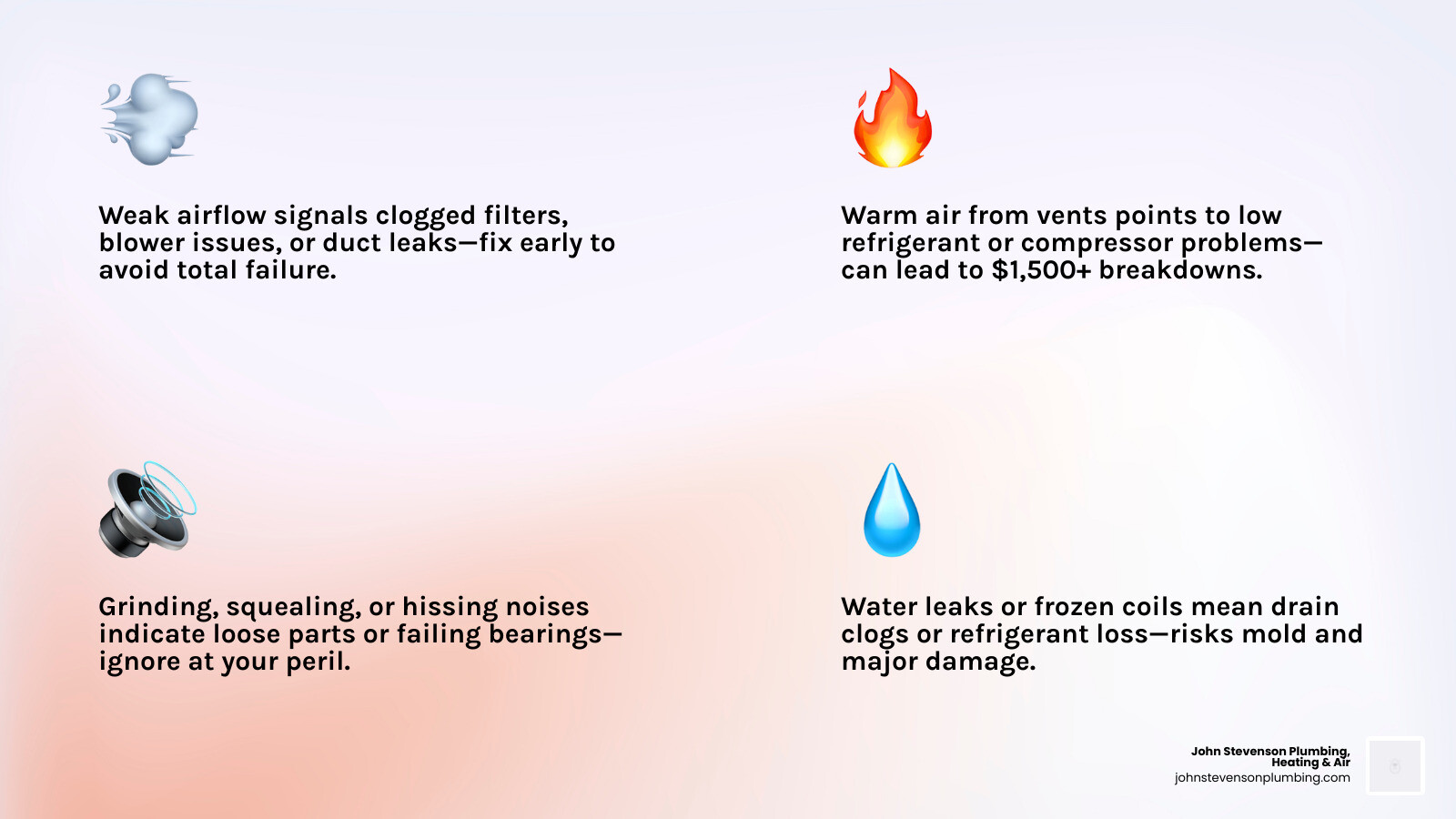
Common Signs Your AC Needs Repair Before It Gets Worse
When we talk about preventative care, we aren’t just talking about keeping the dust off the unit. We’re talking about maintaining the delicate balance of mechanical and electrical components that keep your home a sanctuary. In coastal areas like Encinitas or Del Mar, salt air and humidity can accelerate wear and tear, making it even more vital to catch the signs your AC needs repair before it gets worse.
Ignoring a small symptom is a gamble. A system struggling with a minor issue operates at lower efficiency, meaning it works harder and stays on longer to achieve the same temperature. This “overwork” leads to a domino effect where one failing part stresses another. If you notice any of the following indicators, scheduling a professional AC Repair is the smartest move you can make before the next heatwave rolls into San Diego County.
Weak Airflow: Early Signs Your AC Needs Repair Before It Gets Worse
Have you noticed that some rooms feel like a walk-in freezer while others feel like a sauna? Or perhaps you put your hand up to a vent and feel only a pathetic wisp of air? Weak airflow is often one of the very first signs your AC needs repair before it gets worse.
This issue usually stems from one of three places:
- The Blower Motor: This is the fan that pushes the air through your home. If it’s failing or sluggish, the air simply won’t move.
- Clogged Filters: A dirty filter acts like a wall. If air can’t get into the system, it can’t come back out.
- Ductwork Leaks: Did you know that up to 20-30% of conditioned air can escape through holes or poorly connected ducts? You’re essentially paying to cool your attic or crawlspace.
If your airflow feels “tired,” our Cooling Services can help pinpoint if it’s a simple filter fix or a more complex motor issue.
Blowing Warm Air
There is nothing quite as heart-sinking as feeling a blast of warm air from your vents when it’s 90 degrees outside in Escondido. If your thermostat is set to “cool” and the fan is set to “auto,” but the air is lukewarm, you have a problem.
This often indicates a failing compressor or low refrigerant levels. Refrigerant doesn’t just “run out” like gas in a car; it circulates in a closed loop. If it’s low, you have a leak. Continuing to run a system with low refrigerant can lead to total compressor failure—a very expensive headache. Our San Diego HVAC Services team can perform a performance test to see if your system is hitting the normal 15-20°F temperature differential required for a cool home.
Sensory Warnings: Unusual Noises and Foul Odors
Your AC should be a “silent partner” in your home comfort. While a gentle hum is normal, your ears and nose are often better diagnostic tools than your eyes. If your system starts “talking” to you or making its presence known through smell, it’s waving a red flag.
Unusual Noises and What They Mean
A healthy AC unit should operate relatively quietly. If you start hearing noises that keep you up at night, it’s time for an Orange County AC Repair specialist to take a look. Here is a quick translation of AC “noises”:
- Grinding: Usually indicates worn-out motor bearings.
- Squealing: Often a sign of a slipping or frayed belt.
- Hissing: This is the most serious sound, as it typically signals a refrigerant leak.
- Banging or Clanking: This suggests a loose part, like a connecting rod or crankshaft, is rattling around inside the compressor.
Strange Odors from Vents
If you’re asking, “What’s that smell?” every time the air kicks on, don’t just light a candle. Odors from your vents can range from annoying to dangerous.
- Musty/Moldy Smells: This is common in humid areas like Oceanside. It usually means mold or mildew is growing on the evaporator coils or inside the ductwork due to poor drainage.
- Burning/Electrical Smells: This is an emergency. It could indicate burned wiring or an overheating motor. Turn the system off immediately and call for HVAC Maintenance or repair.
- Rotten Egg Smell: This could indicate a pest has unfortunately passed away inside your ductwork, or in some cases, it could signal a gas leak if you have a packaged unit.
Operational Issues: Short Cycling and High Humidity
Sometimes the signs aren’t about how the air feels, but how often the machine is running. Your AC is designed to run in cycles long enough to both cool the air and remove moisture. When those cycles get interrupted, your comfort and your wallet both suffer.
Short Cycling: Critical Signs Your AC Needs Repair Before It Gets Worse
Short cycling is when your AC turns on, runs for a few minutes, shuts off, and then starts up again almost immediately. This is incredibly hard on your system. Think of it like stop-and-go traffic for your car; it wears out the “brakes” (the compressor and fan motor) much faster.
Short cycling can reduce your system’s lifespan by as much as 50%. It’s often caused by an oversized unit, a malfunctioning thermostat, or low refrigerant. If your AC is constantly “restarting,” Contact us before the compressor gives up entirely.
High Indoor Humidity
We live in a beautiful part of the country, but the “June Gloom” and coastal humidity can make a house feel sticky. Your air conditioner’s secondary job is to act as a dehumidifier. If your skin feels clammy or you notice fog on the windows while the AC is running, the system isn’t doing its job. This could be due to dirty evaporator coils or a system that is no longer powerful enough to pull moisture from the air. Our full range of Services includes humidity diagnostics to keep your indoor air crisp and dry.
Physical Indicators: Leaks and Frozen Coils
Visual cues around your indoor or outdoor unit are hard to ignore. If you see water where it shouldn’t be or ice on a hot day, your AC is crying for help.
Water Leaks and Moisture
While some condensation is normal (it should exit through the drain line), a puddle around your furnace or indoor air handler is a problem. This usually points to a clogged condensate drain line. In our humid climate, these lines can easily grow algae or “sludge,” causing water to back up and overflow. If ignored, this moisture can lead to mold growth and significant structural damage to your flooring or drywall. Regular AC Maintenance includes clearing these lines to prevent “indoor rain.”
Frozen Evaporator Coils
It might seem strange to see ice on a machine when it’s 85 degrees in San Marcos, but frozen coils are a common sign of trouble. This happens when the refrigerant can’t absorb enough heat, causing the coils to drop below freezing.
- The Cause: Usually restricted airflow (dirty filters) or low refrigerant.
- The Danger: If the ice reaches the compressor, it can cause “liquid slugging,” which destroys the motor. If you see ice, turn the system off to let it melt—but do not scrape it off! Call for professional AC Repair immediately.
When to Consider Replacement Over Repair
Sometimes, replacing an older system makes more sense than continuing to repair it.
Frequent Repairs and Aging Systems
The average lifespan of a central air conditioning unit is 10 to 15 years. If your system is getting older and has needed multiple repairs in recent summers, it may be time to consider an AC Replacement instead of continuing to patch recurring issues.
Newer systems often offer improved efficiency and more consistent cooling performance. They can also help reduce strain on your system during hotter months.
If your older unit uses R-22 refrigerant (Freon), repairs may become more difficult over time because that refrigerant has been phased out by the EPA. In those cases, a new AC Installation may be the better long-term solution for comfort and reliability.
Frequently Asked Questions
Why is my AC blowing air but not cooling the house?
This is usually a sign of a “split” problem. If the indoor fan is blowing but the air isn’t cold, the outdoor unit might not be running at all. This could be due to a tripped breaker, a failed capacitor, or a broken compressor. It could also be a simple thermostat calibration issue where the sensor isn’t telling the cooling components to kick in.
How can I tell if my AC compressor is failing?
Watch for “hard starting”—where the unit shakes or makes a loud stuttering sound when it tries to turn on. Other signs include the circuit breaker constantly tripping or the outdoor unit blowing cool air instead of hot air (the outdoor unit should blow hot air as it removes heat from your home).
Is it normal for an AC unit to make a loud clicking noise?
A single click when the unit turns on or off is normal electrical operation. However, constant rapid clicking usually points to a failing relay or an electrical issue with the thermostat or control board. It’s best to have this checked out before it leads to a total system “blackout.”
Conclusion
Don’t let a small hiccup turn into a mid-summer meltdown. Recognizing the signs your AC needs repair before it gets worse is the best way to ensure your family stays comfortable all season long. Whether you are in Carlsbad, Rancho Bernardo, or Irvine, the experts at John Stevenson Plumbing, Heating & Air Conditioning are here to help.
We stand by our 5-Star Service Guarantee, offering thorough diagnostics and upfront pricing so there are never any surprises. From a simple tune-up to a complex Orange County AC Repair, our certified technicians are dedicated to your 24-hour satisfaction. Give us a call today and let’s get your home heatwave-ready!