
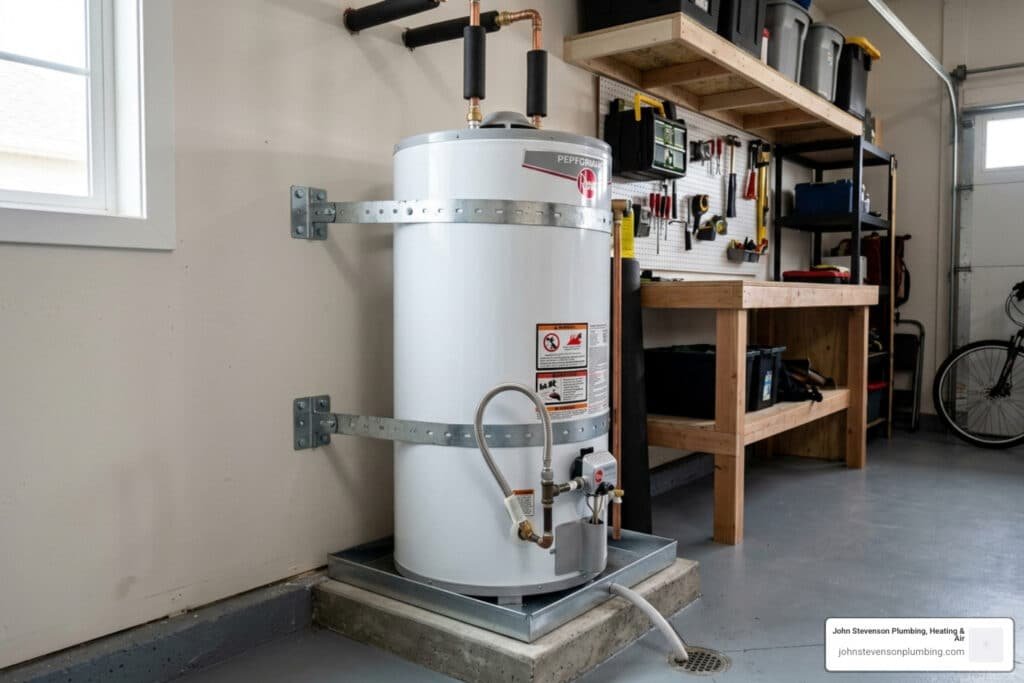
Why the Earthquake Straps Water Heater California Requirement Matters for Every Carlsbad Homeowner
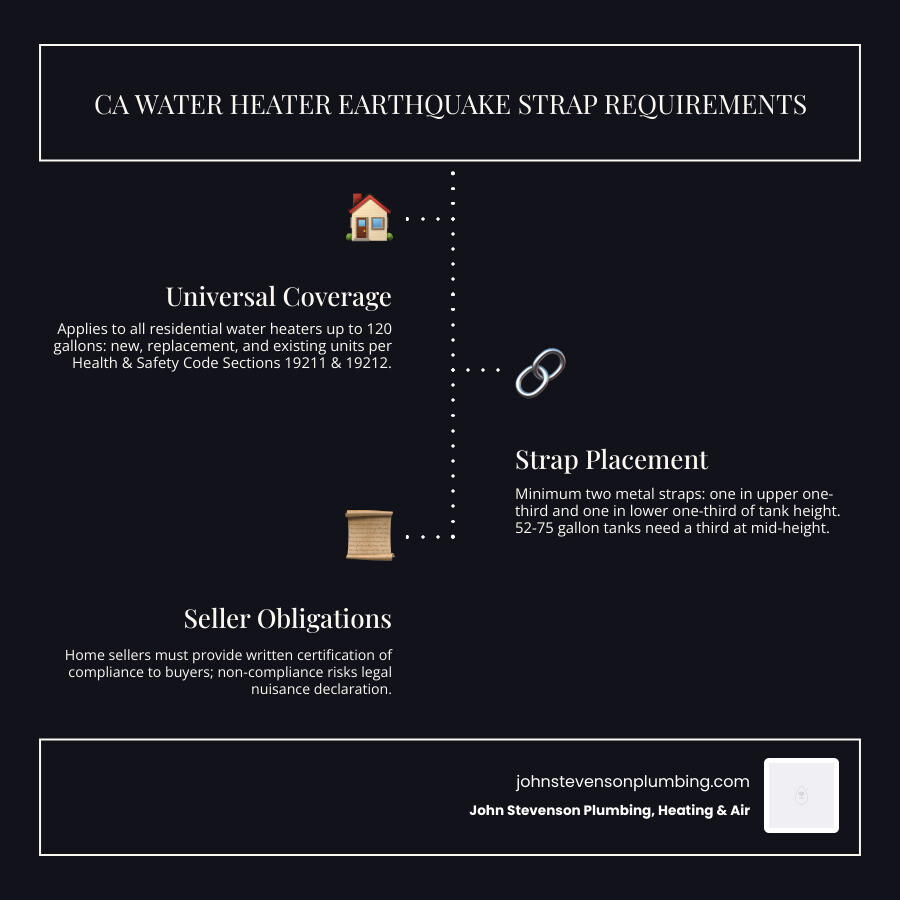
The earthquake straps water heater california requirement is a statewide law that applies to all residential water heaters — new, replacement, and existing — requiring them to be braced, anchored, or strapped to prevent tipping or shifting during an earthquake. Here’s what California law requires at a glance:
Quick Answer:
- All residential water heaters must be braced, anchored, or strapped per California Health & Safety Code Section 19211
- Applies to water heaters with a capacity of up to 120 gallons
- Required for new installations, replacements, and existing units
- A minimum of two sets of straps are required — one in the upper one-third and one in the lower one-third of the tank
- Water heaters between 52 and 75 gallons require a third strap at mid-height
- Home sellers must provide written certification of compliance to buyers
- Non-compliance can result in the property being declared a legal nuisance
This isn’t a suggestion — it’s California law, and for good reason. During past earthquakes, unanchored water heaters have tipped over, snapping gas lines, flooding homes, and starting fires. The California Legislature has acknowledged this as a serious public safety threat, noting the risk of “fire, explosion, or electrocution” from water heaters that overturn during seismic events.
If you live in Carlsbad, CA — a region that sits within California’s active seismic landscape — making sure your water heater is properly strapped protects your family, your home, and your legal standing if you ever sell.
I’m looking to secure my home’s appliances. What is the earthquake straps water heater california requirement?
When we talk about the earthquake straps water heater california requirement, we are referring to a set of laws designed to keep your home standing and your family safe when the ground starts to shake. These requirements are primarily found in the California Health & Safety Code, specifically Sections 19211 and 19212.
The law is very clear: all new and replacement water heaters, as well as all existing residential water heaters, must be braced, anchored, or strapped. This is intended to resist falling or horizontal displacement caused by earthquake motion. This isn’t just for the big industrial units; it applies to any standard water heater with a capacity of not more than 120 gallons for which a preengineered strapping kit is readily available.
Since July 1, 1991, manufacturers have been required to include bracing instructions with every water heater sold in California. However, many older homes still have units that were installed before these rules were strictly enforced, or the straps were installed incorrectly by a previous DIY owner. Whether your unit is brand new or has been in your garage for a decade, it must meet these seismic safety standards. For more information on keeping your system up to date, check out our Water Heater Services.
Step-by-Step Earthquake Straps Water Heater California Requirement for Homeowners
To ensure your installation is code-compliant, you can’t just throw a single bungee cord around the tank and call it a day. The California Plumbing Code (CPC) and the Division of the State Architect (DSA) provide specific instructions on how to properly secure these units.
- Number of Straps: You need a minimum of two sets of straps for standard tanks.
- Upper Strap Placement: This should be located in the upper one-third of the water heater tank.
- Lower Strap Placement: This should be in the lower one-third of the tank. Crucially, the lower strap must be at least 4 inches above the water heater’s control unit to avoid interfering with the thermostat or gas valves.
- Wall Anchoring: Straps must be anchored to the wall studs using 1/4-inch diameter lag screws. These screws must have at least 1.5 inches of thread penetration into the center of the stud. Using large flat washers between the screw head and the strap is also required to prevent the strap from tearing away under tension.
- Eliminate Slack: There should be no more than 1 inch of slack between the tank and the wall. If there is a large gap, a spacer (like a 2×4 block of wood) should be secured to the wall so the tank has a solid surface to rest against.
| Feature | 30-50 Gallon Tank | 52-75 Gallon Tank |
|---|---|---|
| Minimum Number of Straps | 2 Sets | 3 Sets |
| Upper Strap Location | Upper 1/3 of tank | Upper 1/3 of tank |
| Mid-Height Strap | Not required | Required |
| Lower Strap Location | Lower 1/3 (4″ above controls) | Lower 1/3 (4″ above controls) |
| Anchor Hardware | 1/4″ Lag Screws | 1/4″ Lag Screws |
Meeting the Earthquake Straps Water Heater California Requirement During a Home Sale
If you are planning to sell your home in Carlsbad or anywhere in San Diego or Orange County, the earthquake straps water heater california requirement becomes a legal hurdle in the escrow process. Under Health & Safety Code Section 19211(b), sellers of any real property containing a water heater must certify in writing to the prospective purchaser that the seismic bracing requirements have been met.
This certification is usually included in the standard Real Estate Transfer Disclosure Statement. If a buyer discovers the water heater isn’t strapped, they can demand it be fixed before closing. Furthermore, a water heater that isn’t properly braced can be declared a “nuisance” by local authorities. This gives the law teeth, ensuring that even if a homeowner isn’t worried about earthquakes, the legal requirements of a home sale will eventually force compliance to protect the next occupant.
Who in Carlsbad specializes in code-compliant water heater bracing?
At John Stevenson Plumbing, Heating & Air, we live and work in the same neighborhoods as you. We know that Carlsbad homeowners value safety and professionalism. While you can find “preengineered kits” at most hardware stores, installing them to meet the strict Division of the State Architect guidelines can be tricky.
Proper bracing is about more than just the straps; it’s about the entire system. When a water heater tips, it doesn’t just fall; it pulls on the gas lines and water pipes. That’s why we always recommend using code-compliant flexible connectors for water and gas lines. These “flex lines” allow the heater to move slightly during a tremor without snapping the rigid pipes, which is the primary cause of post-earthquake fires.
Required Materials for a Compliant Installation:
- Two (or three) heavy-duty steel straps (usually 22 to 20 gauge).
- 1/4″ x 3″ Lag screws for stud mounting.
- Fender washers.
- Flexible gas connector (CSA approved).
- Flexible water supply connectors.
- Internal bracing or spacers if the unit is away from the wall.
If you aren’t sure if your current setup is safe, we can help. Our certified technicians can perform a thorough diagnostic of your system. If your tank is older and showing signs of wear, we can also assist with Water Heater Repair to ensure it’s worth strapping in the first place.
My water heater is in the garage. Are there special requirements for Carlsbad homes?
In many Carlsbad and North County homes, the water heater is located in the garage. This introduces an additional layer of safety requirements beyond just the earthquake straps water heater california requirement.
Because garages often house cars, lawnmowers, and gasoline cans, there is a risk of flammable vapors pooling near the floor. Most plumbing codes require that the “ignition source” (the pilot light or electric heating element) be elevated at least 18 inches above the garage floor.
When we install or brace a water heater in a garage:
- Elevation: We ensure the unit sits on a structurally adequate platform or stand.
- Stability: The straps must be anchored to the wall studs behind the platform. If the water heater is on a stand in the middle of the garage, additional structural bracing may be required to prevent the entire stand from moving.
- Protection: In some cases, a bollard (a protective metal post) may be required to prevent a vehicle from accidentally striking the water heater.
If you’ve switched to a more modern system, you might be wondering about Tankless Water Heaters. These units are wall-mounted and don’t require the same heavy strapping as a 50-gallon tank, but they still must be securely anchored to the structure to prevent them from being shaken off the wall during a quake.
I’m selling my house in Carlsbad. What are the legal requirements for my water heater?
Selling a home involves a lot of paperwork, and earthquake safety is a major part of the California disclosure process. If your home was built before 1960, you are legally required to provide the “Homeowner’s Guide to Earthquake Safety” to the buyer. This booklet includes a section specifically on water heater bracing.
Even for newer homes, the “Transfer Disclosure Statement” will ask you to check a box confirming that the water heater is braced, anchored, or strapped. If you check that box and the buyer’s home inspector finds that you only have one strap, or that the straps are made of flimsy material, it can delay your closing.
We often get calls from frantic sellers in Carlsbad and Oceanside who need an emergency Water Heater Installation or a strapping upgrade because an inspector flagged their unit. Providing written proof of compliance—often in the form of a plumbing permit or a receipt from a licensed professional—gives the buyer peace of mind and keeps your sale on track.
Frequently Asked Questions about California Water Heater Strapping
We know this can be a confusing topic, especially with different rules for different cities. Here are some of the most common questions we hear from our customers in the San Diego and Orange County areas.
What materials are prohibited for strapping water heaters?
Not all “straps” are created equal. In fact, some common materials that people used in the past are now strictly prohibited because they failed during real-world earthquakes.
- Plumber’s Tape: Also known as light-gauge perforated iron strap. This is often too thin (24 gauge or higher) and can snap under the weight of a full water heater (which can weigh over 450 lbs).
- Single Strap Systems: California law requires a minimum of two straps. A single strap allows the bottom of the tank to “kick out,” which still leads to broken pipes.
- L-Brackets with Short Screws: These don’t provide enough “wrap” around the tank and the screws often pull right out of the drywall.
- Bungee Cords or Plastic Ties: These are obviously not code-compliant and provide zero seismic protection.
In some areas, like the City of Los Angeles, the rules are even stricter, prohibiting perforated tape on any unit over 40 gallons. For Carlsbad and the surrounding areas, we always use heavy-duty, 20-gauge (or thicker) galvanized steel banding.
Is a permit or professional installation required for bracing?
Technically, a homeowner can install a bracing kit themselves. However, if you are installing a new or replacement water heater, you are required to obtain a plumbing permit from your local building department (such as the City of Carlsbad).
When the city inspector comes out to sign off on your new water heater, the very first thing they check is the seismic strapping. If the straps are in the wrong place, use the wrong screws, or aren’t tight enough, they will fail the inspection. Many homeowners find that hiring a professional is worth it just to ensure the job is done right the first time and passes inspection without a headache.
What are the risks of not bracing a water heater during an earthquake?
The risks are significant and go far beyond just losing your hot water.
- Fire and Explosion: This is the biggest danger. If a gas water heater tips over, the rigid gas line can snap. Gas then fills the room, and the pilot light (or an electrical spark) can ignite it.
- Water Damage: A standard 50-gallon tank holds about 400 pounds of water. If the tank falls and the pipes break, that water will flood your garage or home instantly.
- Electrocution: For electric water heaters, a tipped unit can tear live wires from the wall, creating a massive electrocution hazard in a flooded room.
- Loss of Emergency Water: After a major earthquake, the water in your tank is actually a valuable source of clean drinking water. If the tank tips and leaks, you lose that emergency reserve.
Conclusion
Securing your home against the “Big One” starts with the small things—like making sure your water heater stays upright. The earthquake straps water heater california requirement is a vital part of home safety that protects your property, your legal interests during a sale, and most importantly, your family.
At John Stevenson Plumbing, Heating & Air, we are committed to helping our neighbors in Carlsbad, San Diego, and Orange County stay safe and compliant. Whether you need a simple strap inspection, a repair, or a brand-new Water Heater, our team is here to help. We offer a 5-Star Service Guarantee, which means you get thorough diagnostics, upfront pricing, and the peace of mind that comes with hiring certified technicians.
Don’t wait for the ground to start shaking to find out if your water heater is secure. Give us a call today, and let’s make sure your home is ready for whatever California’s geology throws our way!