
What California Water Heater Code Requirements for Homeowners Actually Mean for You
California water heater code requirements for homeowners cover a surprisingly wide range of rules — from how your tank is strapped to the wall to what type of water heater you’ll even be allowed to buy after 2030. If you’ve recently replaced a water heater, are planning to, or just bought a home in California, these regulations directly affect you.
Here’s a quick summary of the key requirements:
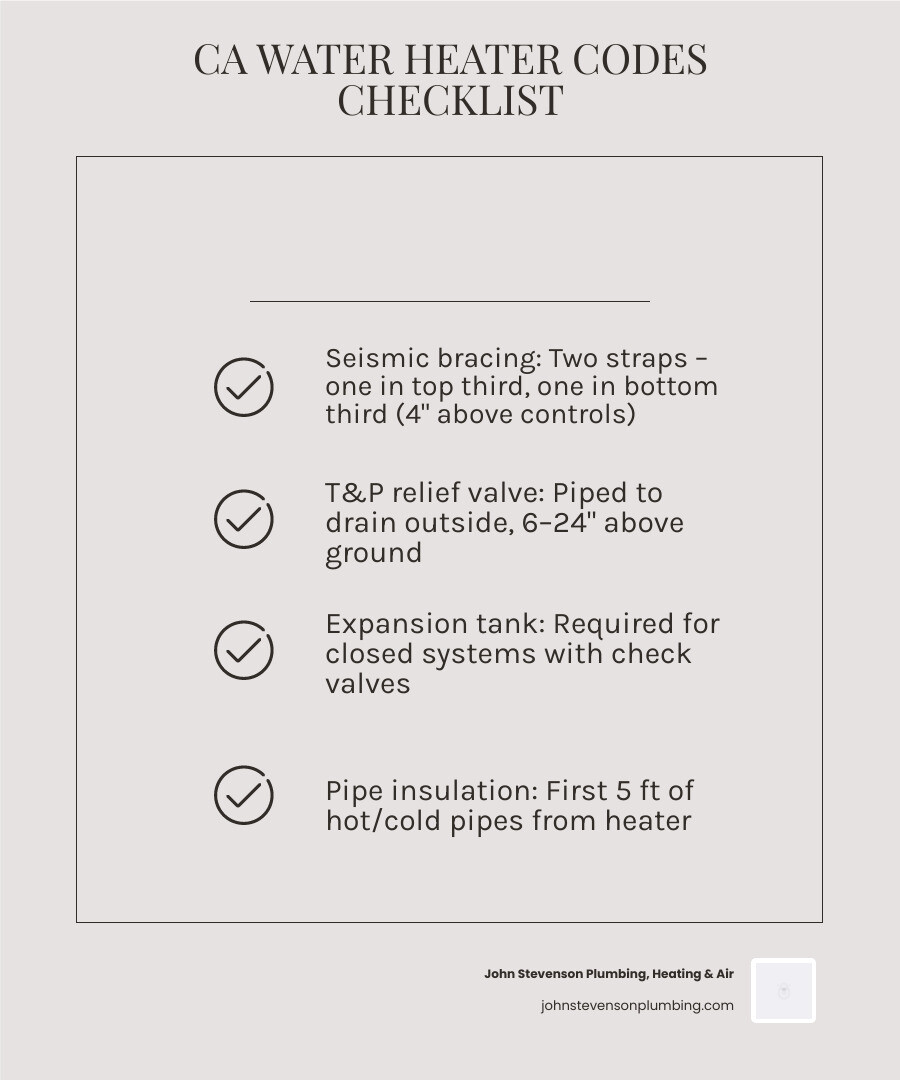
- Seismic bracing: Two earthquake straps required — one in the top third of the tank, one in the bottom third (at least 4 inches above the controls)
- Permits: A plumbing permit from your local building department is required before any installation or replacement
- T&P relief valve: A temperature and pressure relief valve must be installed and piped to drain outside, 6–24 inches above ground
- Expansion tank: Required on closed plumbing systems (any system with a check valve, backflow preventer, or pressure regulator)
- Water pressure regulator: Required if incoming water pressure exceeds 80 PSI
- Energy efficiency: All new water heaters must meet California Title 20 and Title 24 standards
- Gas phase-out: New gas water heaters will no longer be available for purchase after 2030
- Garage elevation: Gas water heater ignition sources must sit at least 18 inches above the garage floor (unless the unit is FVIR-certified)
- Pipe insulation: The first 5 feet of hot and cold water pipes from the heater must be insulated
- Electric-ready wiring: New gas water heater installations require a dedicated 125V, 20-amp electrical receptacle within 3 feet of the unit
California’s water heater rules are among the strictest in the country — and for good reason. The state’s seismic activity, aggressive energy goals, and diverse housing stock all shape a code that goes well beyond what most other states require. Missing even one requirement can mean a failed inspection, a voided warranty, or a real safety risk in your home.
Essential California Water Heater Code Requirements for Homeowners: Safety and Seismic Bracing
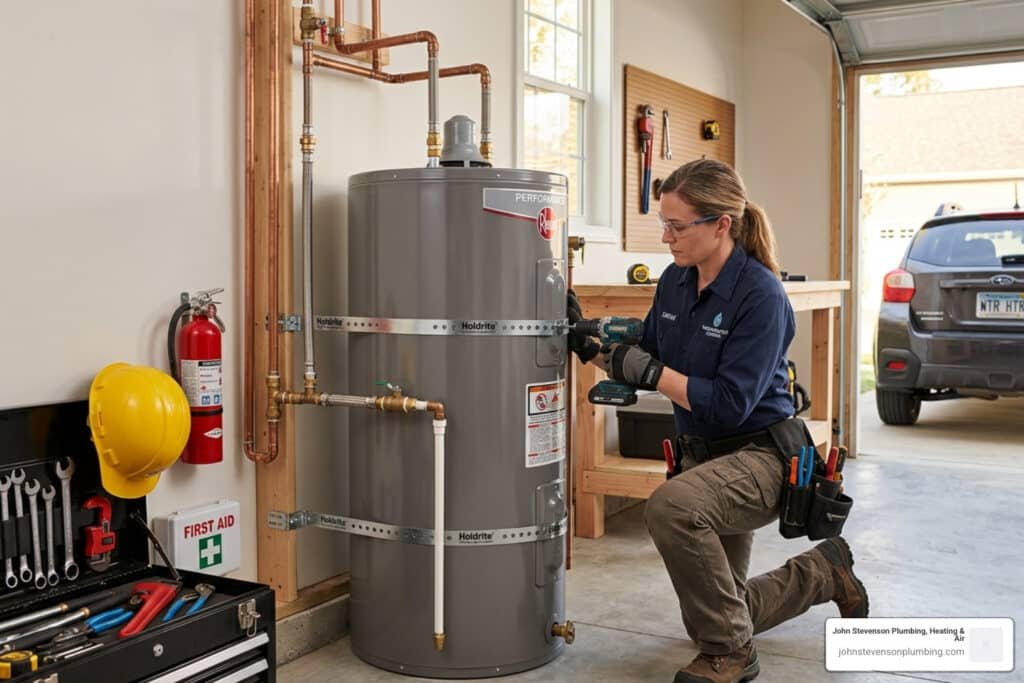
In California, we don’t just worry about leaks; we worry about the ground moving. Because of our unique geography, the California Plumbing Code (CPC) and Health and Safety Code Section 19211 mandate that all Water Heaters be braced, anchored, or strapped to resist falling or horizontal displacement during an earthquake.
The Two-Strap Rule
You cannot simply throw one strap around the middle and call it a day. The code requires at least two earthquake straps. These must be positioned specifically:
- Top Strap: Located within the upper one-third of the tank.
- Bottom Strap: Located within the lower one-third of the tank.
- The 4-Inch Rule: Crucially, the lower strap must be at least 4 inches above the water heater’s control valves to ensure they remain accessible and undamaged.
Temperature and Pressure (T&P) Relief Valves
Every storage water heater is essentially a pressurized vessel. To prevent it from becoming a rocket, a Temperature and Pressure (T&P) relief valve is mandatory. This valve is designed to “blow” if the internal temperature hits 210°F or the pressure reaches 150 PSI.
However, the valve itself is only half the requirement. The discharge piping must:
- Be made of approved materials (like copper or CPVC).
- Drain to the exterior of the building.
- Terminate between 6 and 24 inches above the ground or flood level.
- Point downward and have no threads at the end (to prevent anyone from accidentally capping it).
Managing Pressure with Expansion Tanks and Regulators
Many homeowners are surprised when we mention expansion tanks, but they are a critical part of california water heater code requirements for homeowners in “closed-loop” systems.
| Feature | Open Plumbing System | Closed Plumbing System |
|---|---|---|
| Pressure Relief | Excess pressure pushes back into the city main. | Pressure is trapped by a valve. |
| Components | No check valves or regulators. | Includes check valves, backflow preventers, or regulators. |
| Code Requirement | Expansion tank usually optional. | Expansion tank is mandatory. |
Why Thermal Expansion Matters
When water heats up, it expands. In an older “open” system, that extra volume just pushed back into the city water supply. Modern California homes, however, often have backflow preventers or pressure regulators that create a “closed” system. Without an expansion tank to act as a cushion, that rising pressure can cause Water Heater Repair issues like recurring leaks or even premature tank failure.
The 80 PSI Threshold
If your home’s incoming water pressure exceeds 80 PSI, the code requires a water pressure regulator. High pressure might feel great in the shower, but it’s a silent killer for your plumbing fixtures and water heater. In fact, most manufacturer warranties are voided if the unit is operated above 80 PSI without a regulator.
Venting Standards and Location Restrictions
Where you put your water heater matters just as much as how you install it. California has strict rules regarding the air the unit breathes and how it exhales exhaust.
Garage Installations
If you are installing a gas water heater in a garage, the ignition source (the pilot light or spark) must be elevated at least 18 inches above the floor. This is a fire safety rule designed to prevent the heater from igniting heavy gasoline vapors that might settle on the floor.
- Note: Many modern units are Flammable Vapor Ignition Resistant (FVIR) certified, which may allow for floor-level installation in some jurisdictions, but we always recommend checking local Carlsbad or San Diego county amendments first.
Attic and Indoor Locations
For units located in attics or furred spaces, the code requires:
- Access: A minimum 22×30 inch opening.
- Platform: A stable 30×30 inch working platform.
- Lighting: A permanent light fixture near the unit.
- Drip Pans: A watertight pan with a 3/4-inch drain line is required if a leak could cause damage to the structure.
Venting Types
Proper venting prevents carbon monoxide poisoning. Atmospheric units typically use Type B double-wall metal vents. High-efficiency Tankless Water Heaters often require Category III or IV stainless steel or specialized plastic venting to handle acidic condensate and pressurized exhaust.
Energy Efficiency Standards and the 2030 Gas Phase-Out
California is leading the charge in decarbonization, and our water heaters are on the front lines. Current standards under Title 24, Part 6 (the Energy Code) and Title 20 (Appliance Regulations) require units to meet strict Uniform Energy Factor (UEF) ratings.
The 2030 Gas Water Heater Ban
You may have heard the news: California plans to phase out the sale of new gas-fired water heaters by 2030. While you won’t be forced to rip out your working gas heater on New Year’s Day 2030, you won’t be able to buy a new gas replacement once yours fails after that date. This is part of the state’s goal to reduce greenhouse gas emissions.
The Shift to Heat Pumps
Because of these upcoming changes, many homeowners are already choosing Water Heater Installation for electric heat pump models. These units are incredibly efficient—often using half the electricity of a standard electric resistance heater—and they align with the state’s long-term environmental goals.
Modern Installation Standards: Electric-Ready and Pipe Insulation
Even if you choose to stick with a gas water heater today, the state wants to make sure your home is ready for an electric future. This is known as the “high-efficiency ready” requirement.
Electric-Ready Requirements
For new gas water heater installations in single-family homes, the code now requires:
- Dedicated Receptacle: A 125V, 20-amp electrical outlet within 3 feet of the water heater.
- Circuit Space: Reserved space in your electrical panel for a double-pole circuit breaker.
- Wiring: A 120/240V 10 AWG copper branch circuit must be pre-run or “spare” conductors must be labeled for future use.
Pipe Insulation and Gas Lines
To reduce energy loss—which can account for up to 30% of your water heating energy—the first 5 feet of both hot and cold water lines must be insulated.
Additionally, for those installing Tankless Water Heater Services, the gas supply line must have a capacity of at least 200,000 Btu/hr. This ensures that if you upgrade to a high-demand tankless unit, the infrastructure is already in place to support it.
Frequently Asked Questions
What are the california water heater code requirements for homeowners regarding drip pans?
Drip pans are mandatory whenever a water heater is installed in a location where a leak could cause damage (like an attic, a second floor, or certain indoor closets). The pan must be made of a corrosion-resistant material, be at least 1-1/2 inches deep, and have a 3/4-inch drain line that leads to an approved location (usually the outdoors). Our Water Heater Services always include an assessment of whether your specific location requires a pan to protect your home from water damage.
Are there specific california water heater code requirements for homeowners regarding permits?
Yes. It is a common myth that you only need a permit for “new” work. In California, a plumbing permit is required for the replacement of an existing water heater. This permit ensures that a city inspector will visit to verify the seismic strapping, venting, and safety valves are all up to current code. Skipping a permit can lead to issues when you try to sell your home, as unpermitted work often comes up during the discovery phase of a real estate transaction. If you need help with a replacement, our team provides expert Water Heater Repair and replacement services that include handling the paperwork.
How do requirements differ for single-family versus multifamily buildings?
Multifamily buildings (like apartments or condos) often have more complex “central” water heating systems. These systems are subject to different Title 24 requirements, such as mandatory demand-controlled recirculation loops. These loops use sensors to ensure hot water is only pumped through the building when someone actually needs it, preventing the massive energy waste associated with 24/7 circulation. For residents in these buildings, our Water Heater Services ensure that even complex central systems remain compliant with California’s rigorous energy tables.
Conclusion
Navigating california water heater code requirements for homeowners can feel like a full-time job. From seismic safety to the 2030 gas phase-out, the rules are designed to keep you safe and help California meet its energy goals. However, for a homeowner, the most important thing is knowing that your hot water will be there when you need it—and that your installation won’t cause a headache during a home inspection or a natural disaster.
At John Stevenson Plumbing, Heating & Air, we’ve spent decades serving the Carlsbad, San Diego, and Orange County areas. We understand the local nuances of the California Plumbing Code and Title 24. Our certified technicians provide thorough diagnostics and upfront pricing, backed by our 5-Star Service Guarantee and 24-hour satisfaction check-ins. We take the guesswork out of compliance so you can just enjoy the hot water.
Schedule your professional California code-compliant water heater service today