
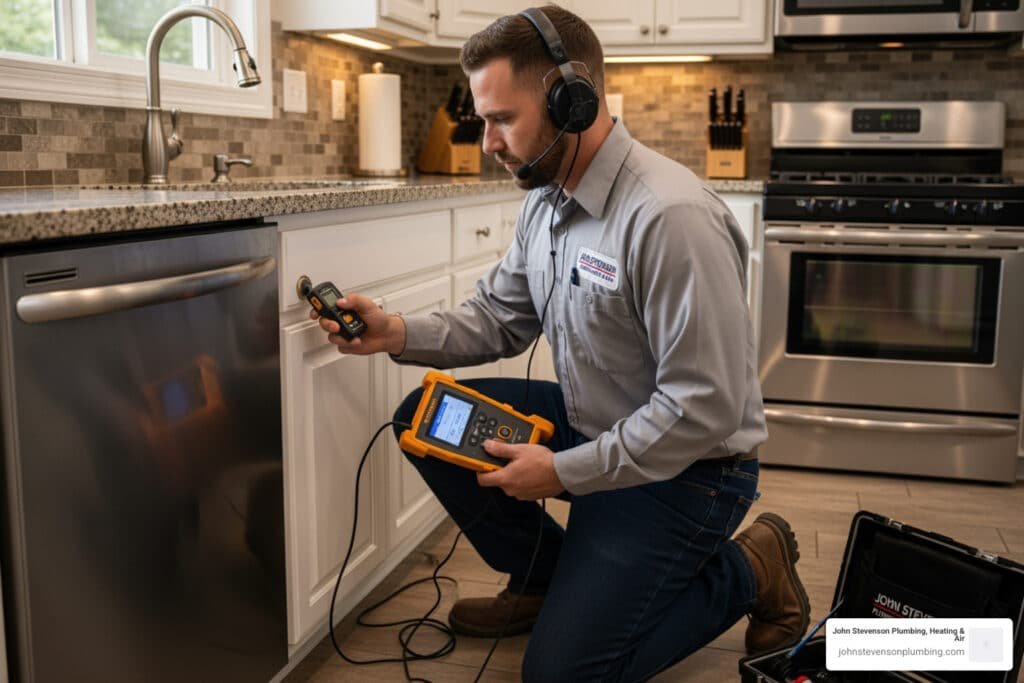
Why Understanding How Leak Detection Technology Works Could Save Your Home
How leak detection technology works is simpler than most homeowners expect — and knowing the basics could save you thousands of dollars in water damage repairs.
Here’s a quick overview:
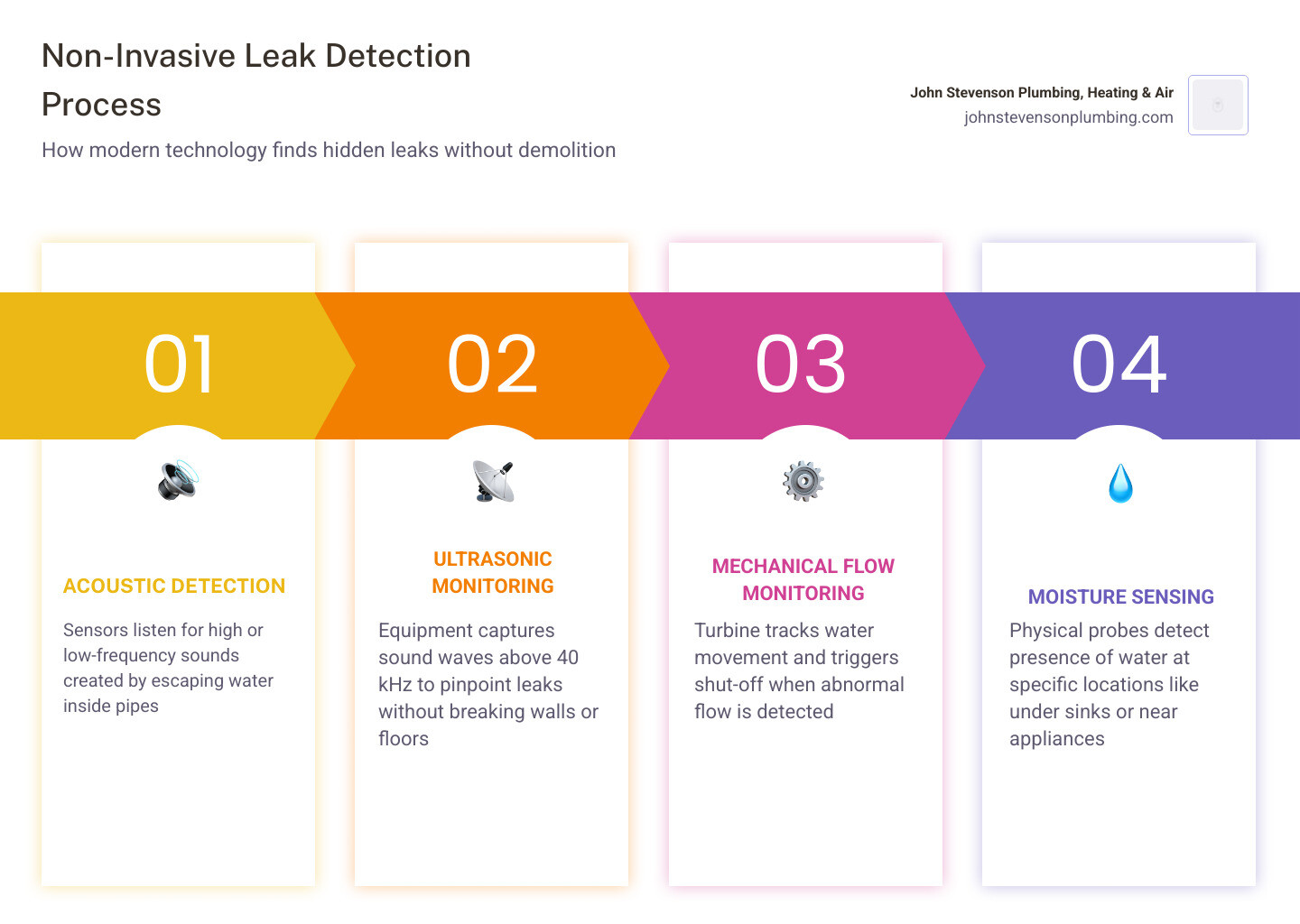
- Acoustic detection – Sensors listen for the distinctive high- or low-frequency sounds that escaping water creates inside pipes
- Ultrasonic monitoring – Equipment captures sound waves above 40 kHz, invisible to human ears, to pinpoint leaks without breaking walls or floors
- Mechanical flow monitoring – A turbine inside the detector tracks water movement and triggers a shut-off when abnormal flow is detected
- Moisture-sensing probes – Physical sensors detect the presence of water at specific locations, like under sinks or near appliances
- Smart IoT systems – Connected devices analyze flow patterns continuously and send real-time alerts to your phone when something is wrong
The stakes are real. The United States loses 2 trillion gallons of treated drinking water every year from undetected leaks. The average water damage insurance claim runs $10,234, and roughly 8.1% of homes deal with a plumbing leak in any given year. The average household also wastes around 10,000 gallons annually just from slow, unnoticed drips.
The good news is that modern leak detection technology can catch problems early — often before you ever see a drop of water on your floor.
Understanding How Leak Detection Technology Works in Residential Plumbing
In homes across Carlsbad, San Diego County, and Orange County, leak detection usually comes down to one big goal: find the problem fast without turning your house into a demolition project.
Residential systems generally fall into four groups:
- Mechanical flow-based devices
- Ultrasonic flow-based devices
- Moisture-sensing alarms
- Smart whole-house monitoring and shut-off systems
A whole-house system is usually installed near the main water entry point so it can monitor the entire home. That matters because a leak behind a wall does not politely announce itself. It just runs up the water bill and starts redecorating your drywall from the inside.
Mechanical systems use a small internal turbine or similar moving part to track water flow. If the system sees water running for too long or notices a pattern that does not match normal household use, it can trigger an alert or close an automatic shut-off valve.
Ultrasonic whole-house systems do something similar, but without moving parts. They send ultrasonic signals through flowing water and measure changes in those signals to calculate flow. Because there is no turbine in the stream, these systems can be very sensitive and avoid some of the wear issues associated with mechanical components.
Moisture-sensing devices work differently. Instead of watching total water flow, they wait for actual water to appear where it should not. Common locations include under sinks, behind toilets, near washing machines, by water heaters, and beneath refrigerators with ice makers. When water bridges two contacts or wets a sensing strip, the device sounds an alarm or communicates with a shut-off valve.
For homeowners, the best setup often combines these methods: a point-of-entry monitor for overall protection plus spot sensors in high-risk areas. If you need help with leak detection and repair, that layered approach gives broader coverage than relying on one tool alone.
How ultrasonic leak detection technology works for hidden pipes
Ultrasonic leak detection is one of the most useful non-invasive methods for finding concealed leaks in walls, ceilings, floors, and slabs.
Here is the basic principle: when pressurized water escapes through a crack, pinhole, loose fitting, or damaged joint, it creates turbulence. That turbulence produces sound. Some of that sound is in the ultrasonic range, typically above 20 kHz and often discussed around 40 kHz or higher, which humans cannot hear unaided.
Technicians use specialized sensors and receivers to capture those frequencies. The equipment filters out normal background noise and amplifies leak-related sound signatures. As we scan different sections of the plumbing system, the signal gets stronger near the leak source. That helps narrow the location without cutting open large sections of wall or flooring.
Why this works so well:
- Small leaks often create higher-frequency sounds
- Larger leaks tend to produce lower-frequency sounds
- Ultrasonic tools can identify subtle turbulence before damage becomes obvious
- The method works on hidden piping where visual inspection is impossible
This is especially helpful for slab leaks, where the pipe is buried beneath concrete. Instead of guessing and jackhammering first, we can use non-invasive testing to localize the issue more accurately.
Ultrasonic detection is not the only step in a professional diagnosis, though. We often pair it with pressure testing, thermal clues, moisture readings, and experience with how homes are piped. Good leak detection is part science, part signal interpretation, and part knowing that the weird wet spot in the hallway is never there for a good reason.
Smart monitoring and real-time alerts
Smart leak detection systems add another layer: they do not just find leaks, they watch for them all the time.
These systems usually include:
- A flow sensor on the main line
- An automatic shut-off valve
- Wi-Fi or hub-based communication
- App alerts
- Sometimes temperature sensors for freeze-risk monitoring
The system learns normal water-use patterns, such as showers in the morning, dishwasher cycles at night, and irrigation schedules. If it sees continuous flow at 2 a.m. or a sudden surge that looks like a burst line, it can send an alert and in some cases shut the water off automatically.
The biggest benefits are:
- Faster response to hidden leaks
- Protection when you are away from home
- Water-use history and trend tracking
- Early warning before visible damage spreads
- Less chance of a small issue becoming a major insurance claim
There are trade-offs too. Smart systems can require professional installation, app setup, battery checks for accessory sensors, and periodic testing of internet or hub connectivity. Wi-Fi is usually needed for remote notifications, but many units still provide local alarms or basic shut-off functions even if the internet goes down.
If you have already noticed musty smells, warped flooring, bubbling paint, or unexplained water spots, our guide on hidden water damage warning signs is a good next read.
Acoustic Methods for Municipal and Large-Scale Pipelines
Large pipeline systems use many of the same scientific principles as home leak detection, but on a much bigger scale.
Acoustic leak detection for water mains and distribution systems works by listening for the sound of water escaping under pressure. Sensors may be attached to hydrants, valves, or other access points. In some cases, hydrophones are used inside the water column to pick up leak noise more directly.
The core idea is straightforward:
- A leak creates a distinctive sound
- That sound travels through the pipe wall and water
- Sensors at different points record the signal
- Software compares timing, frequency, and intensity
- The leak location is estimated based on how the sound arrives at each sensor
This non-invasive approach is especially valuable because crews can investigate long pipeline sections without excavation first. Some acoustic tools also help evaluate pipe condition by measuring how sound waves travel through the pipe, which can reveal information related to wall thickness or deterioration.
For small-to-medium systems, utilities often use portable tools such as listening devices, noise loggers, and correlators. For larger distribution networks, they may deploy permanent sensors, broader monitoring zones, and analytics platforms that prioritize the highest-risk locations. In short, smaller systems tend to use targeted field investigations, while larger systems rely more on continuous monitoring and network-wide data.
That same practical, diagnostic mindset matters in residential work too. Our broader plumbing services are built around finding the source of the problem before recommending repairs.
Comparing internal and external detection systems
At the pipeline level, leak detection systems are usually grouped into two categories: internal and external.
Internal systems use operating data from inside the pipeline process, such as:
- Pressure
- Flow rate
- Temperature
- Inventory balance
- Hydraulic models
Examples include pressure and flow monitoring, statistical analysis, and real-time transient modeling, often called RTTM. Enhanced versions use more advanced modeling and pattern analysis to reduce false alarms during start-ups, shutdowns, and other unstable conditions.
External systems use independent sensors or field devices outside the process calculations, such as:
- Acoustic sensors
- Fiber-optic cables
- Infrared or thermal imaging
- Vapor-sensing tubes
- Digital sensing cables
So which is better? Usually neither by itself.
Internal systems are useful for continuous oversight across long distances, but they can struggle with very small leaks or unusual operating conditions. External systems can provide more direct evidence and often better location accuracy, but they may require more field hardware and installation planning.
That is why larger operations often combine multiple methods. One system watches the math. Another listens to the pipe. Another checks for heat, moisture, or chemical presence. Leak detection works best when no single method has to do all the heavy lifting.
Performance metrics for how leak detection technology works at scale
For any serious leak detection setup, four performance requirements matter most:
- Sensitivity
- Reliability
- Accuracy
- Robustness
Sensitivity means the smallest leak the system can detect. Reliability means how consistently it detects real leaks without missing them. Accuracy refers to how close the reported location or leak size is to reality. Robustness means the system still performs during changing operating conditions, electrical noise, background sound, or pressure swings.
These factors matter because simple monitoring alone is not always enough. Reported field data has shown that basic SCADA systems identified only a limited share of leaks, and computational pipeline monitoring systems also had relatively low reported detection rates in some studies. That is one reason utilities increasingly layer technologies instead of depending on one dashboard and hoping for the best.
| System type | Reported leak detection rate |
|---|---|
| SCADA-only monitoring | 19% |
| Computational pipeline monitoring | 10% |
For advanced systems, performance can be much stronger. Some modern internal pipeline platforms report detection in seconds with very tight location accuracy under controlled conditions. The key takeaway for homeowners is simple: better sensing and better analysis lead to earlier intervention.
Advanced Industrial and Non-Invasive Solutions
Beyond home plumbing and city water mains, leak detection technology also includes thermal imaging, sensing cables, and AI-enhanced monitoring.
Thermal imaging looks for temperature differences on surfaces. A hidden water leak may cool or warm surrounding materials enough to create a visible pattern on an infrared camera. This can be useful behind walls, below floors, or around radiant and hot-water systems. It is non-destructive, but it works best as part of a broader inspection because not every leak creates a clear thermal signature.
Digital sensing cables and spot probes are common in commercial buildings, equipment rooms, and critical spaces. These systems detect water when it touches the cable or probe, then send an alarm to a panel or building management system. Some distance-read systems can estimate where along the cable the leak occurred, which saves a lot of time in large spaces.
AI-enhanced modeling is mainly used in industrial pipeline settings. These systems combine physics-based models, historical trends, and pattern recognition to distinguish actual leak behavior from normal operational noise. In plain English: the software gets better at telling the difference between “the pipeline is behaving weirdly” and “the pipeline is leaking.”
For homeowners, the takeaway is that non-invasive leak detection is no longer one gadget or one trick. It is a toolkit. Depending on the property and symptoms, we may use acoustics, thermal clues, moisture sensors, pressure testing, or direct flow analysis as part of a complete plumbing repair diagnosis.
Testing and commissioning protocols
A leak detection system is only useful if it actually works when needed. That is where testing and commissioning come in.
For residential systems, good commissioning typically includes:
- Verifying the sensor powers on and communicates properly
- Confirming the shut-off valve opens and closes correctly
- Testing app notifications and local alarms
- Simulating leak conditions at selected sensor points
- Confirming alerts clear after the condition is resolved
For commercial and monitored environments, testing can go much further. Panels may be checked for voltage and current, zone maps verified, sensing cable routes tagged, and alarms confirmed at both the local panel and the building management system. Distance-read systems may also be tested for location tolerance so teams know the displayed leak point is trustworthy.
The same idea applies in a home: if a smart detector has batteries, they should be checked regularly. If it relies on Wi-Fi, confirm the connection is active. If it uses spot sensors, test them with a controlled moisture check according to the manufacturer instructions. Leak detectors should not be treated like decorative smoke alarms. They need occasional attention.
Frequently Asked Questions about Leak Detection
What is non-invasive leak detection and how does it work?
Non-invasive leak detection means finding a leak without opening walls, digging up floors, or excavating first. It usually works by analyzing indirect signs of water loss, such as sound, flow changes, temperature differences, or moisture patterns.
Common non-invasive methods include:
- Acoustic listening for leak noise
- Ultrasonic sensing for high-frequency turbulence
- Thermal imaging for hidden temperature changes
- Flow monitoring for unexplained continuous water use
- Moisture meters for damp building materials
In larger pipes, acoustic methods can also help assess pipe condition by studying how sound waves travel through the system.
Can leak detection systems find small leaks behind walls?
Yes, often they can. Small hidden leaks may be identified through ultrasonic sound, moisture mapping, abnormal flow patterns, or a combination of methods.
Ultrasonic tools are especially useful because tiny openings can create distinctive high-frequency signals even when there is no visible damage yet. Whole-house monitors can also flag hidden leaks when they notice low but continuous flow during times the house should be idle.
That said, no single method is perfect for every leak. The most accurate results usually come from combining technology with a thorough onsite diagnosis.
Do I need Wi-Fi for a smart leak detector to function?
Not always.
Many smart systems need Wi-Fi for mobile alerts, app control, and remote monitoring. But some devices still offer local alarms, onboard shut-off functions, or hub-based communication without depending entirely on your home internet.
If remote protection matters to you, especially for a second home, rental, or long workdays away, Wi-Fi-enabled monitoring is a strong advantage. If you just want a local siren under the sink, a basic non-connected moisture alarm may be enough.
Conclusion
Understanding how leak detection technology works helps you make better decisions before a small plumbing issue becomes major damage. From ultrasonic listening and acoustic tracing to moisture sensors and smart shut-off systems, today’s tools can find problems faster and with far less disruption than old-school guesswork.
At John Stevenson Plumbing, Heating & Air Conditioning, we bring that same practical, homeowner-focused approach to every visit. Our licensed technicians provide thorough diagnostics, upfront pricing, and the support behind our 5-Star Service Guarantee, including 24-hour satisfaction check-ins after service.
If you need help tracking down a hidden leak in Carlsbad or nearby Southern California communities, schedule your professional leak detection and repair in Carlsbad today.