
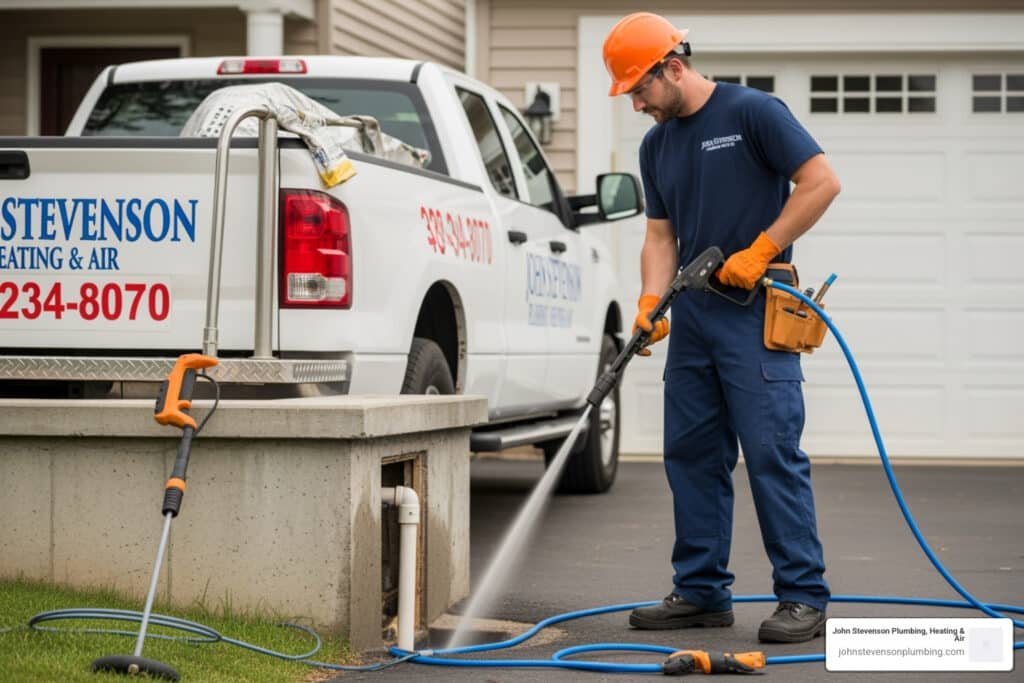
The Real Hydro Jetting vs Snaking Cost Comparison Carlsbad Homeowners Need
When it comes to the hydro jetting vs snaking cost comparison, here is a quick breakdown of what you need to know:
| Factor | Snaking | Hydro Jetting |
|---|---|---|
| Upfront cost | Lower | Higher |
| How long results last | Weeks to a few months | 2–3 years typically |
| Best for | Simple, isolated clogs | Recurring clogs, buildup, roots |
| Pipe cleaning depth | Punches a path through the clog | Scours the full pipe wall |
| Risk of repeat service calls | Higher | Lower |
| Camera inspection needed | Usually not required | Recommended before service |
You have a slow drain — or a full backup. A plumber gives you two options: snake the line or hydrojet it. One costs less right now. The other costs more upfront but might save you money down the road. How do you know which one actually makes sense for your home?
That decision is not always straightforward. The right answer depends on what is causing your clog, how old your pipes are, and whether this is the first time you have had this problem or the third time this year.
This guide breaks down the real costs of both methods — not just the service call price, but the long-term value — so you can make a smart decision for your Carlsbad home.
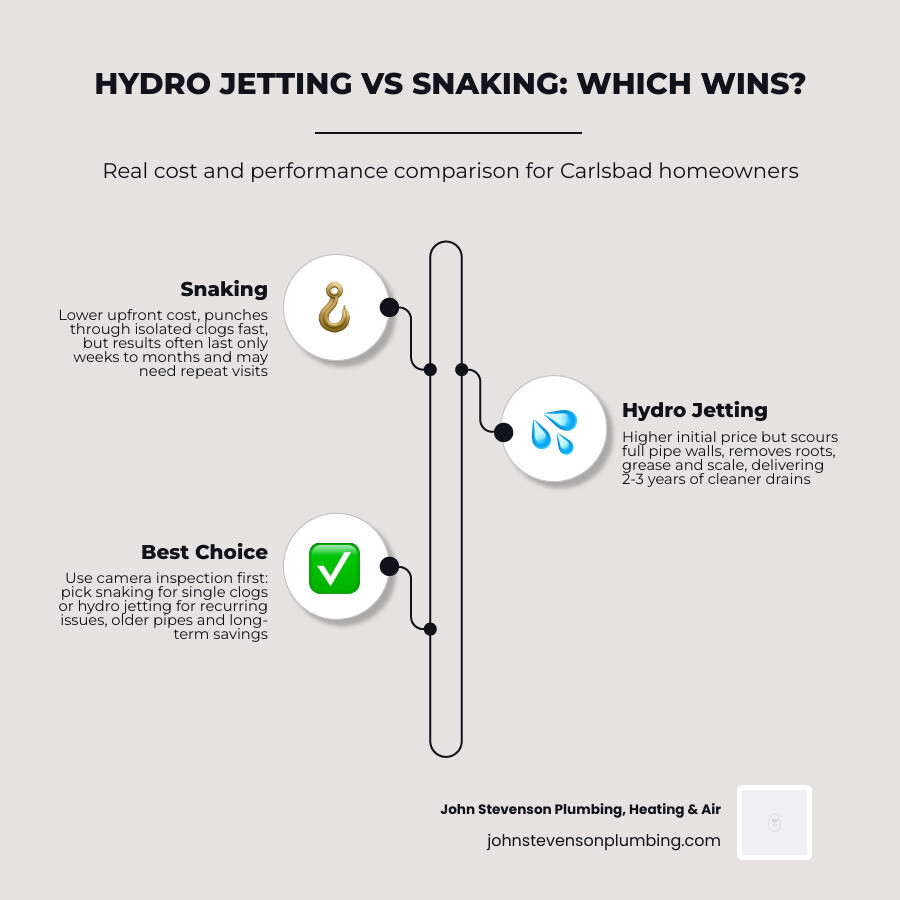
Hydro Jetting vs Snaking Cost Comparison: What Homeowners Are Really Comparing
Most homeowners start with the same question: which option is cheaper? But in a real hydro jetting vs snaking cost comparison, that is only part of the picture.
What you are actually comparing is:
- Immediate relief vs longer-lasting cleaning
- A localized clog vs buildup throughout the line
- A branch drain vs the main sewer line
- One service call vs repeat service calls
- Short-term savings vs long-term value
Snaking and hydro jetting both clear drains, but they do it very differently. Snaking uses a flexible cable to break through or pull out a blockage. Hydro jetting uses high-pressure water, often in the 1,500 to 4,000 PSI range, to clean the inside walls of the pipe.
That difference matters. A snake can restore flow fast, but it often leaves residue on the pipe walls. Hydro jetting is designed to wash away grease, sludge, soap scum, mineral scale, and some root intrusion across the full diameter of the line.
Here is the practical version: if you have one clog caused by hair or a dropped object, snaking may be exactly what you need. If your drains keep slowing down every few months, the issue is usually not one clog anymore. It is buildup.
| Comparison Point | Snaking | Hydro Jetting |
|---|---|---|
| How it clears a clog | Opens a path through blockage | Cleans the full interior of the pipe |
| Typical use | Isolated fixture clog | Recurring or widespread drain issues |
| Common materials removed | Hair, paper, small obstructions | Grease, sludge, scale, roots, heavy buildup |
| Likelihood of clog returning soon | Higher | Lower |
| Best value scenario | One-time blockage | Repeat clogs or buildup problems |
What snaking does well for isolated clogs
Snaking is often the most sensible first move when the problem is simple and specific.
It tends to work best for:
- Hair clogs in tubs and showers
- A single slow sink drain
- A toilet blockage caused by paper or a foreign object
- A localized branch line clog close to the fixture
- A first-time blockage in newer piping
In these cases, snaking offers fast relief without being more aggressive than the problem requires. Think of it as the plumbing version of using the right size screwdriver instead of bringing out a jackhammer.
If you are dealing with a basic drain issue in one part of the home, our drain cleaning services may be the right place to start.
Why hydro jetting often changes the long-term equation
Hydro jetting often makes more financial sense when the line is coated with material rather than blocked by one item.
That includes:
- Grease buildup in kitchen lines
- Sludge and soap buildup
- Hard water mineral scale
- Repeated main line slowdowns
- Tree root intrusion
- Multiple drains acting sluggish at the same time
Because hydro jetting cleans the full pipe wall, it usually lasts much longer than snaking. Research consistently shows snaking may only hold for weeks to a few months in buildup-heavy lines, while hydro jetting often lasts 2 to 3 years in residential settings.
That longer interval is why many homeowners eventually realize they spent more on repeat clearing than they would have on one thorough cleaning in the first place.
If recurring drain issues are wearing out your patience, and your weekend plans, our hydro jetting service may be the better long-term solution.
Typical Service Pricing and What Changes the Quote
Even though we are not listing service-specific prices here, it helps to understand what usually affects the quote for either method.
Drain cleaning is not priced by magic, mood, or moon phase. It usually comes down to scope and difficulty.
Common factors include:
- Whether the problem is in a single fixture or the main sewer line
- How far into the line the blockage is located
- Whether access is through a cleanout, drain opening, or roof vent
- How severe the clog or buildup is
- Whether multiple drains are affected
- Whether a sewer camera inspection is needed
- Whether the service is requested during an emergency or after hours

Typical residential ranges in a hydro jetting vs snaking cost comparison
Across residential service discussions, snaking is generally the lower-upfront option, while hydro jetting is the more involved service. That is especially true when hydro jetting includes camera inspection before cleaning and verification after cleaning.
In Southern California homes, the quote can also shift based on whether we are addressing:
- A standard sink, shower, or tub drain
- A toilet line
- A kitchen branch line with grease buildup
- A whole main sewer line
- A severe backup that requires more time and setup
Hydro jetting also typically takes longer than snaking because proper service may include inspection, pressure selection, cleaning, and confirmation that the line is truly clear.
Factors that make one method cost more than the other
Some drain problems are straightforward. Others are the plumbing equivalent of opening a closet and having everything fall on you at once.
Here are the biggest cost drivers:
- Pipe diameter: Larger lines take more time and equipment.
- Clog location: A blockage near the fixture is simpler than one deep in the sewer line.
- Access method: Cleanout access is usually easier than roof vent access.
- Root intrusion: Roots are tougher than hair and soap scum.
- Grease and scale: Wall buildup often calls for more thorough cleaning.
- Multiple slow drains: This often points to a main line issue, not a single fixture problem.
- Old pipe condition: Fragile or corroded lines may require inspection and extra care.
- Severe backups: Heavy standing water and repeated overflows increase labor and cleanup concerns.
If you are comparing methods for a bigger drain issue, our full drain services page explains the types of solutions that may apply.
How Long Results Last and Why That Affects Total Cost
This is where the math changes.
A lot of homeowners compare one visit to one visit. The better question is: how often will you need that visit again?
Research on residential drain cleaning consistently points to this pattern:
- Snaking often provides short-term relief, especially in buildup-heavy lines
- Hydro jetting typically delivers longer intervals before the same problem returns
- Recurring clogs can turn a lower upfront option into the more expensive choice over time
Hydro jetting vs snaking cost comparison over time
If a line is clogging because of grease, scale, or roots, snaking may only open a narrow path through the blockage. Water flows again, which feels like victory, but the residue remains. That leftover material catches new debris and the cycle starts over.
That is why repeated snaking every few months can add up quickly over a two- or three-year period.
By contrast, hydro jetting cleans the full inside of the pipe, which usually extends the time between service visits. In many homes, that means one more thorough cleaning can outperform multiple shorter-lived fixes.
A simple way to estimate your own break-even point is to review:
- How many times the same line has been cleared in the past two years
- Whether the clogs returned within 3 to 6 months
- Whether the problem affects one fixture or multiple fixtures
- Whether the line has known grease, roots, or mineral buildup
If the same drain has needed repeated attention, hydro jetting often provides better value.
Hidden and recurring costs homeowners often miss
The service itself is only part of the total cost of a recurring clog.
Hidden costs can include:
- Emergency scheduling premiums
- Water damage from backups or overflows
- Cabinet or flooring cleanup
- Lost time waiting for repeated appointments
- Damage to belongings near backed-up fixtures
- Ongoing stress from unpredictable drain behavior
- Extra wear on pipes from repeated clog cycles
- Temporary DIY products that do not solve the cause
A recurring sewer backup is never just a drain problem. It can become a schedule problem, a cleanup problem, and a home damage problem.
That is why a lower initial bill is not always the lower overall cost.
Which Option Makes More Sense for Your Pipes and Your Clog
The best method depends on three things:
- What is causing the blockage
- What condition the pipes are in
- Whether the issue is isolated or recurring
Pipe age and material matter too. Newer PVC lines usually have smoother interiors, which means isolated clogs may respond well to snaking. Older cast iron lines tend to collect more internal scale and corrosion, which makes hydro jetting more useful when the pipe is still structurally sound.
Clay lines can be more delicate, especially if they have cracks or shifting joints. In those cases, inspection comes first.
When hydro jetting provides better value
Hydro jetting usually delivers better value when the problem is ongoing or the pipe walls are heavily coated.
That often includes:
- Recurring clogs in the same drain
- Slow drains across multiple fixtures
- Kitchen lines with grease buildup
- Hard water scale inside pipes
- Main sewer line blockages
- Root intrusion
- Older homes with buildup inside drain lines
In many Orange County and San Diego County homes, buildup is the real issue, not a one-time obstruction. If your drains work for a bit after cleaning and then slow down again, that is a strong sign the pipe walls need more than a basic opening.
Learn more about options for recurring drain issues with our Orange County drain cleaning services.
When snaking is the more cost-effective choice
Snaking is often the smarter and more economical choice when the blockage is clearly isolated.
That usually means:
- One fixture is clogged, but the rest of the house drains normally
- You know what caused the blockage
- The clog is close to the opening
- The home has newer pipes in good shape
- The line is too fragile for high-pressure cleaning
- You need a targeted fix instead of full-line cleaning
This is especially true for hair clogs, paper blockages, and minor foreign-object issues.
For local fixture and branch drain problems, our Lake Forest drain cleaning page shows how targeted clearing can help.
Why camera inspections matter before deciding
A camera inspection can prevent a bad decision.
Before hydro jetting, a camera helps us check for:
- Cracks
- Misaligned joints
- Collapsed sections
- Severe corrosion
- Heavy root intrusion
- The exact location and nature of the blockage
This matters because hydro jetting is powerful. In the right pipe, it is excellent. In a damaged pipe, it may not be the right first step.
A camera inspection also helps avoid guessing. If the issue is a toy, a wad of wipes, or a partial collapse, that changes the recommendation completely.
And after cleaning, video confirmation helps show whether the line is actually clear or just temporarily flowing.
Professional Recommendations for Recurring Clogs vs One-Time Blockages
In general, plumbers do not recommend the same tool for every problem, and they should not.
A good recommendation starts with diagnosis, not habit.
What pros usually recommend for recurring clogs
For recurring clogs, professionals usually lean toward:
- Camera inspection first
- Hydro jetting if the pipe is structurally sound
- Removal of grease, sludge, scale, or roots
- Preventive cleaning on a sensible schedule for homes with chronic issues
Recurring clogs within 6 to 12 months usually suggest buildup rather than a one-time blockage. That is especially true if you notice:
- Gurgling drains
- Sewage odors
- Multiple slow fixtures
- Backups after laundry or dishwasher use
- Repeat kitchen sink clogs
If you are dealing with those patterns, our Lake Forest hydro jetting service explains how full-line cleaning can help.
What pros usually recommend for one-time blockages
For a one-time blockage, professionals often recommend the least aggressive method that solves the problem.
That may be:
- Snaking a sink, tub, shower, or toilet
- Removing a physical obstruction
- Clearing a branch drain close to the fixture
- Restoring flow without full-line cleaning if there is no sign of buildup
That approach keeps the repair focused and avoids doing more than the situation calls for.
For straightforward drain clearing needs, our Mission Viejo drain cleaning service is a helpful example of targeted service.
Questions to ask before approving drain cleaning
Before you approve either method, ask a few smart questions:
- Is an inspection included?
- Where do you think the clog is located?
- Is this a fixture issue or a main line issue?
- Will you access the line through a cleanout, drain opening, or roof vent?
- If snaking restores flow, how will we know whether heavy buildup is still present?
- If the pipe condition is uncertain, should we do a camera inspection first?
- What is the follow-up plan if the clog returns?
Good drain cleaning should come with good diagnostics. At John Stevenson Plumbing, Heating & Air Conditioning, we believe homeowners deserve clear explanations, upfront pricing, and recommendations based on what the line actually needs.
Frequently Asked Questions about Hydro Jetting vs Snaking Cost Comparison
Is hydro jetting worth it if my drain was already snaked once?
Often, yes. If the drain was snaked and the problem came back, that suggests the original service may have opened a path without removing the buildup along the pipe wall.
Hydro jetting is often worth considering when:
- The same line clogged again within months
- More than one fixture is slowing down
- The issue involves grease, scale, or roots
- Snaking restored flow but did not restore normal performance for long
One repeat clog does not automatically mean you need hydro jetting, but it is a strong sign that a better diagnosis is needed.
Can hydro jetting damage older pipes?
It can if the pipes are already cracked, collapsed, severely corroded, or otherwise compromised. That is why camera inspection matters.
When performed by trained professionals after inspection, hydro jetting is generally safe for sound plumbing systems. Pressure should be matched to the pipe material and condition. For older or fragile lines, snaking or a different repair strategy may be more appropriate.
In short: hydro jetting is powerful, but it should never be used blindly.
How do I know whether my clog is simple or a sign of a bigger sewer problem?
A simple clog usually affects one fixture. A bigger sewer issue often shows up across the home.
Signs of a likely isolated clog:
- One sink, tub, or toilet is slow or blocked
- Other drains work normally
- You know what probably caused it
Signs of a bigger sewer or main line problem:
- Multiple fixtures are draining slowly
- Toilets gurgle when another fixture runs
- You smell sewer odors
- Water backs up in a tub or shower when the washer drains
- The problem keeps returning
If multiple drains are involved, do not assume you just have bad luck. That pattern usually points to a larger issue in the system.
Conclusion
When homeowners compare hydro jetting and snaking, the real question is not just which one costs less today. It is which one makes the most sense for the type of clog, the condition of the pipe, and the likelihood of the problem coming back.
Snaking is often the better fit for a simple, one-time blockage. Hydro jetting usually brings better long-term value for recurring clogs, grease, scale, and root-related problems.
At John Stevenson Plumbing, Heating & Air Conditioning, we take a diagnostic-first approach so you are not paying for the wrong solution. Our 5-Star Service Guarantee means thorough diagnostics, upfront pricing, certified techs, and 24-hour satisfaction check-ins, so you know exactly what to expect.
If you need help with a recurring drain issue, a slow main line, or a stubborn clog that keeps making encore appearances, explore our full drain services to take the next step.