
Why the Best Thermostat Settings for Energy Savings Matter More Than You Think
The best thermostat settings for energy savings are simpler than most homeowners expect — and the payoff is real. Heating and cooling account for roughly half of the average American household’s energy bill, totaling around $900 a year. A few small, consistent adjustments to your thermostat can cut that number significantly without sacrificing comfort.
Here’s a quick-reference guide to the recommended settings:
| Situation | Winter Setting | Summer Setting |
|---|---|---|
| Home and awake | 68°F | 78°F |
| Sleeping | 62-66°F | 82°F |
| Away (4+ hours) | 58-62°F | 85°F |
| Vacation / Extended away | 55°F (minimum) | 85-88°F |
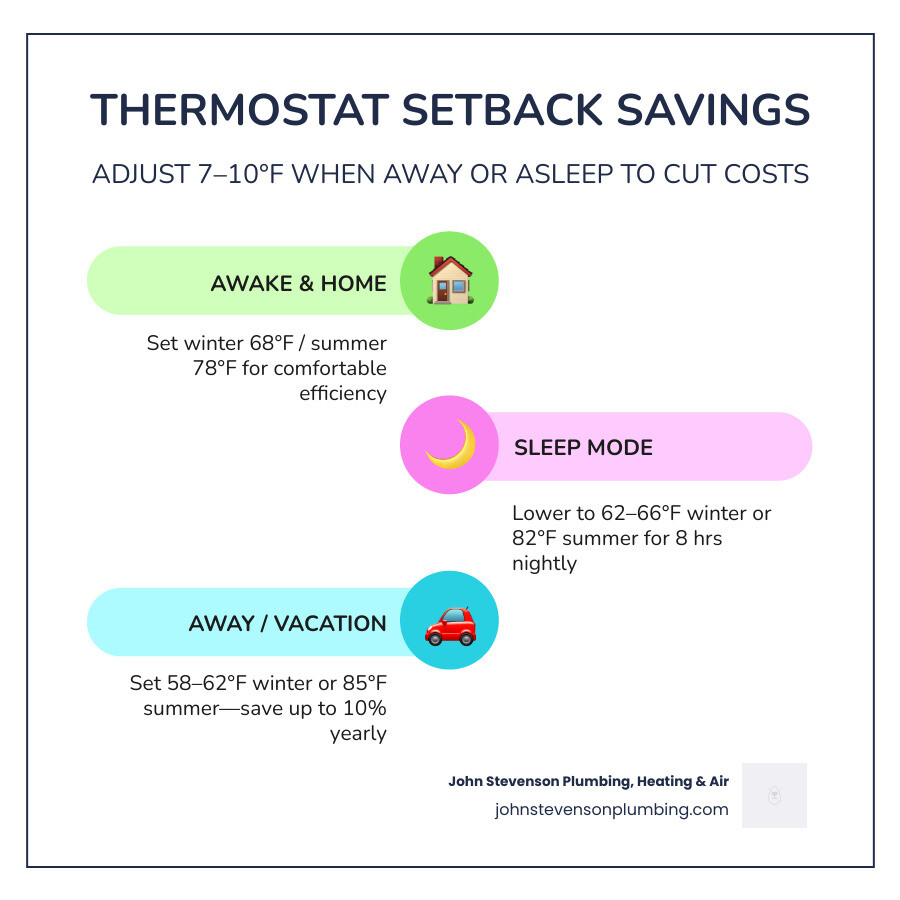
The single most impactful move: Adjusting your thermostat 7-10°F for at least 8 hours a day — while you sleep or are away — can save up to 10% annually on your heating and cooling bills, according to the U.S. Department of Energy.
Most people set it and forget it. Or they crank the AC down hoping the house cools faster (it doesn’t). Or they leave the heat running all day for an empty home. These habits quietly drain hundreds of dollars every year.
Whether you have a basic manual dial or a Wi-Fi smart thermostat, the strategy is the same: match your indoor temperature to what’s actually happening in your home — who’s there, what time it is, and what the season demands. The rest of this guide breaks down exactly how to do that, season by season, room by room, and system by system.
Best Thermostat Settings for Energy Savings by Season
Finding the sweet spot between comfort and a lower utility bill can feel like a guessing game. However, the U.S. Department of Energy (DOE) has provided a clear roadmap. The core philosophy is simple: the closer your indoor temperature is to the outdoor temperature, the lower your bill will be. By keeping your HVAC system from working overtime when it isn’t strictly necessary, you protect both your wallet and the lifespan of your equipment.
Best thermostat settings for energy savings in winter
When the Southern California “winter” chill hits places like Carlsbad or San Marcos, the temptation is to crank the heater to 72°F or higher. However, the DOE recommends setting your thermostat to 68°F while you are home and awake. This temperature is generally considered the “sweet spot” for alertness and efficiency.
When you go to bed, try lowering the setting to between 62°F and 66°F. Not only does this save energy, but the National Sleep Foundation suggests that cooler rooms actually promote better sleep quality. If you’re leaving the house for work or errands (at least 8 hours), a setting of 58-62°F is ideal.
To stay comfortable at 68°F, we recommend:
- Layering up: A cozy sweater or a pair of warm socks goes a long way.
- Harnessing the sun: Open your curtains on south-facing windows during the day to let natural sunlight heat your home for free. Close them at night to add an extra layer of insulation.
- Safety first: Never set your thermostat below 55°F in the winter. Even in our milder climate, a sudden cold snap could risk frozen pipes in uninsulated areas.
Best thermostat settings for energy savings in summer
In the sweltering heat of July or August in Irvine or Temecula, your air conditioner is the MVP of your home. To maximize savings, the DOE suggests a home-and-awake setting of 78°F. While this might sound high to some, using ceiling fans can make 78°F feel like 74°F due to the wind-chill effect.
When you are away from home for more than four hours, raise the thermostat to 85°F. This prevents the house from becoming an oven while ensuring the AC doesn’t run needlessly for an empty room.
To manage the heat effectively:
- Block the sun: Keep blinds and curtains closed on the west and south sides of your home during the afternoon.
- Avoid heat-sync chores: Try to avoid using the oven or clothes dryer during the hottest parts of the day, as these appliances add significant heat to your living space.
How much a 7-10°F thermostat setback can save
The math is compelling: you can save as much as 10% a year on heating and cooling by simply turning your thermostat back 7°-10°F from its normal setting for 8 hours a day. In the average American household, where heating and cooling account for 52% of energy costs, this is the most significant “passive income” you can generate for your household budget.
This works because of the physics of heat loss. As soon as your house drops below its normal temperature in winter, it loses energy to the surrounding environment more slowly. The longer your house remains at the lower temperature, the more energy you save. The same principle applies to heat gain in the summer.

How to Set Your Thermostat When You’re Home, Asleep, or Away
Achieving the best thermostat settings for energy savings requires a strategy that matches your lifestyle. If your home is empty from 8:00 AM to 5:00 PM, there is no reason to pay for a “comfort” temperature during those hours.
A simple weekday and weekend thermostat schedule
A standard four-phase schedule is the most effective way to automate your savings. Here is a sample schedule for a typical workday:
- Wake (6:00 AM – 8:00 AM): 68°F (Winter) / 78°F (Summer).
- Leave (8:00 AM – 4:30 PM): 60°F (Winter) / 85°F (Summer).
- Return (4:30 PM – 10:00 PM): 68°F (Winter) / 78°F (Summer).
- Sleep (10:00 PM – 6:00 AM): 64°F (Winter) / 82°F (Summer).
On the weekends, you might keep the “Return” temperature active throughout the day if you are home. Many modern thermostats feature “Adaptive Recovery,” which learns how long it takes your home to reach a target temperature and starts the system early so it’s comfortable exactly when you walk through the door.
Should you leave the thermostat at one temperature?
There is a common myth that it takes “more energy” to reheat or recool a home than it does to maintain a constant temperature. This is thermodynamically false. Your HVAC system runs at a constant speed; it doesn’t “work harder” to bridge a 10-degree gap—it just runs longer. However, the total runtime required to recover from a setback is significantly less than the runtime required to fight heat loss or gain all day long.
Pro Tip: Never set your AC to 65°F to “cool the house faster.” It won’t. It will simply run until it hits that temperature, likely overshooting your comfort zone and wasting energy in the process.
Safe away settings for vacations, freezes, and hot spells
If you’re heading out of town, don’t turn the system off entirely.
- In Winter: Set it to 55-60°F. This is high enough to prevent pipes from freezing but low enough to save a fortune.
- In Summer: Set it to 85°F. This protects your electronics, prevents indoor humidity from spiking (which can lead to mold), and keeps your houseplants from wilting.
If you have pets staying at home, keep the range between 64°F and 78°F to ensure their safety and comfort.
Manual vs Programmable vs Smart Thermostats
The tool you use to control your climate matters just as much as the numbers you choose.
| Feature | Manual | Programmable | Smart |
|---|---|---|---|
| Ease of Use | Low (Must remember) | Medium (Set once) | High (App controlled) |
| Automation | None | Time-based | Learning & Geofencing |
| Energy Savings | Variable | ~10% | 12-15% |
| Remote Access | No | No | Yes |
Which thermostat type saves the most energy?
While a manual thermostat can save money, it relies entirely on human memory. Most of us forget to turn the heat down before leaving for work. ENERGY STAR certified smart thermostats are the gold standard, saving approximately 8% on heating and 10% on cooling bills annually. Because they automate the process, the savings happen even when you’re busy.
Smart thermostat features that maximize savings
Modern smart thermostats offer high-tech ways to shave dollars off your bill:
- Geofencing: Uses your phone’s GPS to detect when you leave the house and automatically switches to “Eco Mode.”
- Learning Algorithms: Some models learn your habits over a week and build a schedule for you.
- Energy Reports: You can see exactly how many hours your system ran and get tips on how to improve.
- Remote Sensors: These allow the thermostat to prioritize the temperature in the room you are actually using (like the bedroom at night) rather than a drafty hallway.
When thermostat upgrades make the biggest difference
If you are still using a “slider” or a basic digital screen that doesn’t allow for scheduling, an upgrade will likely pay for itself within two years. This is especially true for homeowners in our service area, from Carlsbad to Yorba Linda, where seasonal shifts can be unpredictable. You can learn more about our WiFi thermostats and home automation services or explore energy-efficient thermostat installation to see how we can help you modernize your home.
Special HVAC System Rules Homeowners Shouldn’t Ignore
Not all heating and cooling systems respond to thermostat changes in the same way. If you have a specialized system, the standard “7-10 degree” rule might need tweaking.
Heat pumps need smaller setbacks
Heat pumps are incredibly efficient, but they work differently than a traditional furnace. In the winter, if you drop the temperature too low (more than 2-3 degrees), the heat pump might struggle to recover quickly and trigger “auxiliary heat” or “emergency heat” strips. These electric strips are much more expensive to run. For heat pump owners, we recommend smaller, more gradual setbacks of about 2-4°F.
Electric resistance and line-voltage thermostat considerations
If you have baseboard heaters or wall heaters, you likely have “line-voltage” thermostats (120V or 240V). These require specific thermostats designed for high voltage. The same energy-saving temperatures apply, but you must ensure your hardware is compatible to avoid a fire hazard.
Radiant floor and steam systems respond slowly
Radiant floor heating and steam radiators have a “thermal lag.” It can take several hours for a radiant floor to warm up. For these systems, you should program your “Return” or “Wake” cycles to begin at least two hours before you actually need the warmth.
Thermostat Placement, Climate Differences, and Common Mistakes
Where you put your thermostat is just as important as what you set it to. A poorly placed thermostat will give “ghost readings,” causing your system to cycle on and off unnecessarily.
Where to install a thermostat for the most accurate reading
To get the most out of the best thermostat settings for energy savings, your thermostat should be installed:
- On an interior wall near the center of the house.
- In a frequently used room.
- Away from direct sunlight (which tricks the sensor into thinking it’s hotter than it is).
- Away from kitchen heat, drafty doorways, and windows.
- At a height of about 5 feet from the floor.
If your thermostat is currently in a hallway or near a window, it might be time for a professional thermostat installation in Lake Forest or your local neighborhood to ensure accuracy.
How regional climates change the ideal settings
In our coastal California regions like Del Mar or Oceanside, humidity plays a huge role in comfort. High humidity makes 78°F feel much hotter. In these cases, using the “Circulate” mode on your fan for 15-20 minutes every hour can help move air and manage moisture without running the full AC compressor.
Costly thermostat mistakes to avoid
- The “Crank It” Mistake: Setting the temp to 60°F in summer to cool faster.
- Closing Vents: Many homeowners think closing vents in unused rooms saves money. In reality, it increases pressure in the ducts, which can cause leaks and damage your blower motor.
- Leaving the Fan “On”: Always use the “Auto” setting. Leaving the fan to “On” runs the blower 24/7, which uses significant electricity and can actually pull humidity back into your home.
- Ignoring Filters: A dirty filter makes your system work 20% harder to move the same amount of air.
Frequently Asked Questions About Best Thermostat Settings for Energy Savings
What’s the best thermostat setting for sleeping, infants, pets, and houseplants?
- Sleeping: 60-67°F is the gold standard for adults.
- Infants: The American Academy of Pediatrics recommends a slightly warmer range of 68-72°F to ensure babies don’t get too cold, as they cannot regulate their body temperature as well as adults.
- Pets: Most cats and dogs are comfortable between 64°F and 78°F.
- Houseplants: Most tropical houseplants thrive between 60°F and 75°F.
Does turning the thermostat lower make the house cool faster?
No. Your air conditioner delivers a steady stream of cold air. Setting it to 65°F instead of 78°F doesn’t make that air colder; it just makes the system run longer, which wastes energy and increases wear and tear.
Is a smart thermostat worth it for long-term energy savings?
Absolutely. With average savings of $50-$140 per year, most smart thermostats pay for themselves in under two years. Beyond the money, the convenience of adjusting your home temperature from your phone while sitting at a restaurant in Carlsbad is hard to beat.
Conclusion: Build a Smarter Thermostat Strategy for Year-Round Savings
Mastering the best thermostat settings for energy savings is one of the easiest ways to take control of your home’s operating costs. By following the 68°F winter / 78°F summer rule and utilizing smart setbacks, you can keep your hard-earned money in your pocket rather than sending it to the utility company.
At John Stevenson Plumbing, Heating & Air, we are dedicated to helping Southern California homeowners achieve peak efficiency. From Carlsbad to San Diego and throughout Orange County, our certified technicians are ready to help you find the perfect HVAC solutions.
Don’t forget to take advantage of current incentives! You can learn how the IRA makes your California home efficiency upgrade much cheaper or check out these California HVAC and water heater rebates. If you’re ready to upgrade, we can even help you navigate the California energy rebate application process like a pro.
Ready to start saving? Contact us today for a professional energy-efficient thermostat installation and experience our 5-Star Service Guarantee for yourself.