
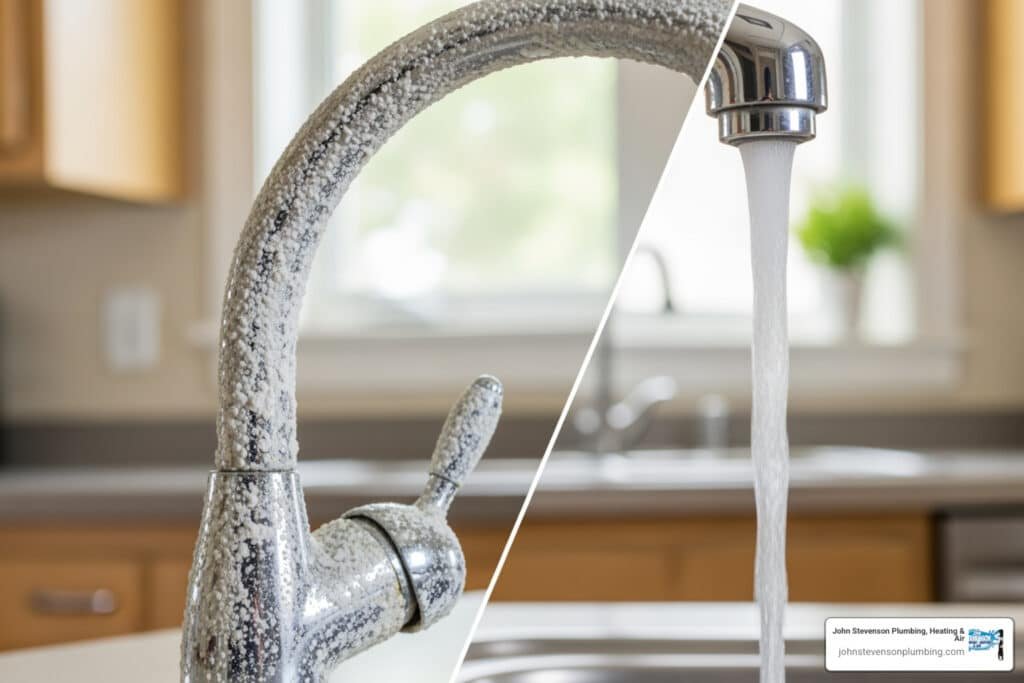
Why the Difference Between Hard Water and Soft Water Matters for Your Home
Understanding what is the difference between hard water and soft water comes down to one thing: mineral content. Here’s a quick breakdown:
| Hard Water | Soft Water | |
|---|---|---|
| Mineral content | High calcium and magnesium | Very low calcium and magnesium |
| Hardness level | 120–180+ ppm | Less than 17 ppm |
| Feel on skin | Can leave a residue | Feels smooth or slightly slippery |
| Effect on pipes | Causes limescale buildup | Minimal scale deposits |
| Soap lather | Poor, leaves soap scum | Rich, rinses cleanly |
| Taste | Often mineral-forward | Flatter, sometimes slightly salty if softened |
If you’re a homeowner in Carlsbad, CA, this distinction isn’t just trivia — it directly affects your plumbing, your appliances, your water bills, and even your skin. About 85% of homes across the US deal with hard water, and Southern California is no exception.
Water that falls from the sky starts out naturally soft. It only becomes hard after it soaks into the ground and picks up minerals like calcium and magnesium from rock and soil. By the time it reaches your tap, that mineral load can vary widely — and the effects inside your home can range from mildly annoying to genuinely costly.
In this guide, we’ll walk you through exactly how hard and soft water differ, how to tell which one you have, and what you can do about it.
What Is the Difference Between Hard Water and Soft Water?
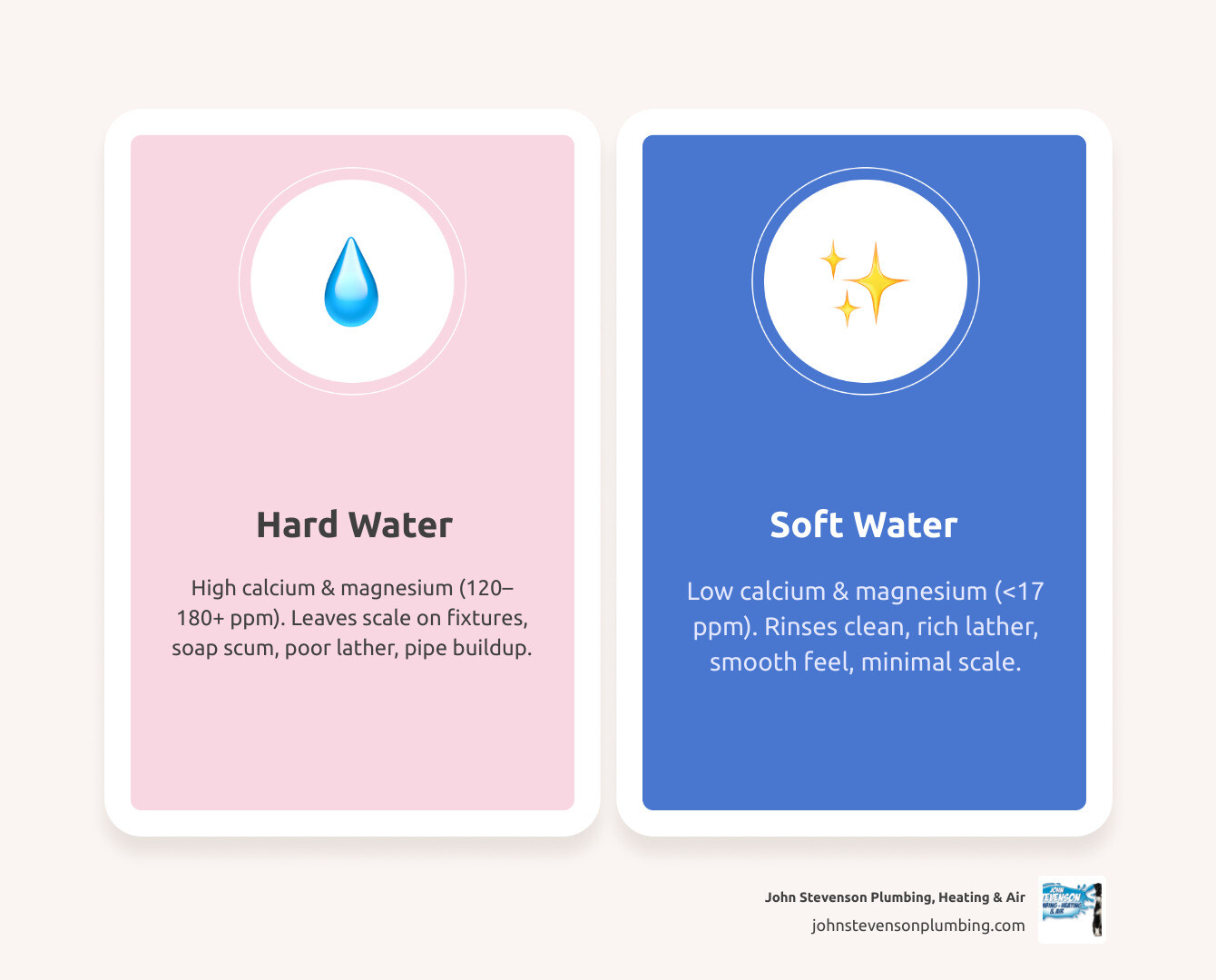
The main difference is simple: hard water contains more dissolved calcium and magnesium, while soft water contains very little of those minerals.
That mineral difference changes how water behaves around your home. Hard water is more likely to leave white scale on fixtures, create soap scum in showers, reduce lather, and build deposits inside pipes and appliances. Soft water, by contrast, rinses cleaner, lathers more easily, and is much gentler on plumbing equipment.
Hard water and soft water can also taste different. Hard water often has a more noticeable mineral taste. Softened water may taste flatter, and in some homes it can have a faint salty note because of the softening process.
What is the difference between hard water and soft water in simple terms?
In plain English, hard water is “mineral-heavy” water. Soft water is “mineral-light” water.
A few easy ways homeowners describe the difference:
- Hard water leaves spots on dishes
- Hard water makes soap work harder
- Hard water can make skin and hair feel dry
- Soft water makes soap lather faster
- Soft water makes laundry feel softer
- Soft water can feel slippery on skin, even when you are actually rinsed clean
That slippery feeling surprises a lot of people. It is not usually a residue problem. It is often just the absence of the mineral drag you feel with hard water.
What causes water to be hard or soft?
Water hardness is mostly caused by geology.
As water moves through soil, aquifers, and rock layers, it dissolves natural minerals. When groundwater passes through limestone, chalk, or other mineral-rich formations, it picks up calcium and magnesium. That is what makes it hard.
Softer water usually has less contact with those minerals. Rainwater starts out naturally soft because the evaporation-condensation cycle leaves minerals behind. Once rainwater reaches the ground, though, it can become harder depending on the local soil and rock conditions.
So if we had to sum it up:
- Rain starts soft
- Ground contact adds minerals
- More calcium and magnesium means harder water
- Less calcium and magnesium means softer water
How Water Hardness Is Measured and Classified
Water hardness is usually measured in parts per million (ppm) or milligrams per liter (mg/L). For practical home use, ppm and mg/L are treated the same.
Here is the standard hardness scale:
| Hardness classification | ppm or mg/L |
|---|---|
| Soft | Less than 17 |
| Slightly hard | 17-60 |
| Moderately hard | 60-120 |
| Hard | 120-180 |
| Very hard | Greater than 180 |
What is the difference between hard water and soft water on the hardness scale?
On the hardness scale, soft water sits at the very low end, under 17 ppm. Hard water starts at 120 ppm and goes up from there. Once you get above 180 ppm, you are in very hard water territory, where scale problems tend to become much more obvious.
That means there is a meaningful difference between “a little hard” and “very hard.” A home with slightly hard water may notice some spotting. A home with very hard water may deal with crusty showerheads, water heater scale, and stubborn soap scum that seems to respawn overnight like a bathroom villain.
How to read your home water test results
If you test your water, you may see results reported in:
- ppm
- mg/L
- grains per gallon (gpg)
If your results come in gpg, that is another common hardness measurement. In general, the higher the number, the harder the water.
When reading a home test or lab report:
- Under 17 ppm means soft
- 17-60 ppm means slightly hard
- 60-120 ppm means moderately hard
- 120-180 ppm means hard
- Over 180 ppm means very hard
Municipal water reports can also be helpful, but they may show average system-wide data rather than the exact conditions inside your home. Plumbing materials, local distribution, and any treatment equipment in the house can affect what you actually experience at the tap.
Signs You Have Hard Water at Home
Most homeowners do not discover hard water by reading a lab report. They discover it when the faucet starts wearing a white collar.
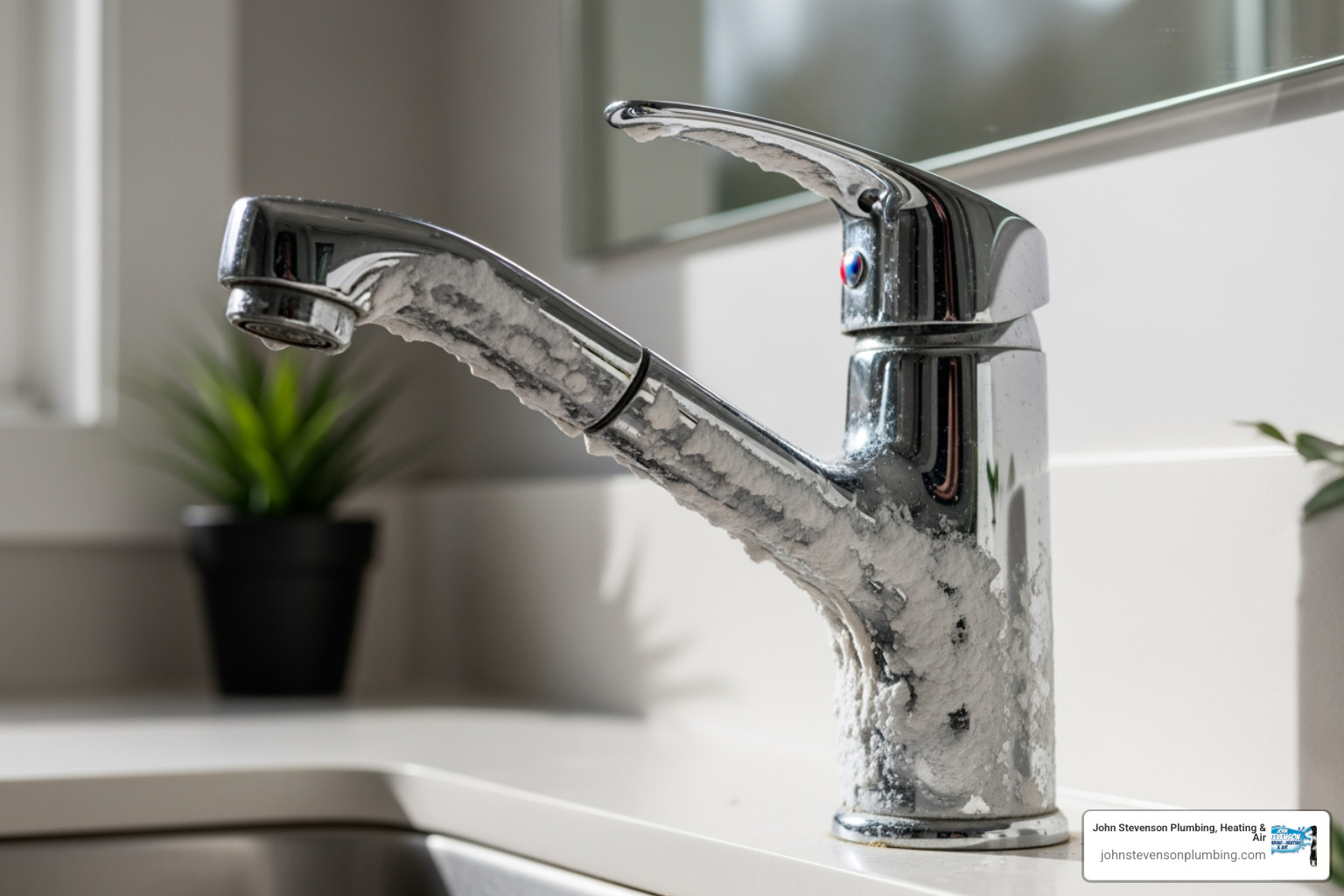
Common signs of hard water include:
- White chalky buildup on faucets and showerheads
- Soap scum on shower walls and doors
- Cloudy spots on glasses and silverware
- Dry or itchy skin after bathing
- Dull-looking hair
- Towels and laundry that feel stiff
- Reduced water flow from scale-clogged fixtures
- Water heater inefficiency due to mineral buildup
Common signs on plumbing, fixtures, and appliances
Hard water leaves behind limescale as water evaporates or heats up. Over time, that scale can collect in places like:
- Faucet aerators
- Showerheads
- Dishwasher interiors
- Water heater tanks and heating elements
- Washing machine components
- Interior pipe walls
This matters because scale is not just cosmetic. It can restrict flow, reduce heat transfer, and force appliances to work harder. Research commonly notes that scale buildup in water heaters can drive energy use up significantly, with some estimates putting utility impacts around 28% when efficiency drops from limescale insulation.
If you are noticing buildup around fixtures or suspect scale inside your plumbing system, our water descaling services can help address the problem more directly.
Effects on skin, hair, dishes, and laundry
Hard water does not just affect pipes. It shows up in daily routines too.
On skin and hair:
- Soap and shampoo may not rinse as easily
- Mineral residue can leave skin feeling dry
- Some people with sensitive skin or eczema notice more irritation
- Hair can feel dull, rough, or harder to manage
On dishes:
- Glassware may come out cloudy
- Water spots can remain even after drying
- Detergent may not perform as well
On laundry:
- Fabrics can feel stiff or scratchy
- Whites may look dingier over time
- Detergent and soap often need to work harder
Hard Water vs Soft Water: Pros, Cons, and Health Questions
There is no universal “best” water for every purpose. Hard and soft water each have pros and cons.
Hard water brings mineral content that some people prefer for taste. Soft water is generally easier on plumbing, appliances, cleaning, and laundry. The better choice depends on what matters most in your home: taste, maintenance, personal comfort, or appliance protection.
Is hard water safe to drink, and does it provide essential minerals?
In general, yes, hard water is safe to drink. Hardness is about minerals, not contamination.
That distinction matters. Calcium and magnesium are naturally occurring minerals, not the same thing as harmful bacteria, viruses, or chemical pollutants. Hard water can contribute small amounts of essential minerals to the diet, and many people prefer its taste because those minerals give water more character.
That said, hard water is not a major nutrition strategy by itself. It can contribute minerals, but it should not be treated as a substitute for a balanced diet.
A few health notes:
- Hard water is typically safe for most people
- It may provide modest calcium and magnesium intake
- Very high magnesium levels can have a laxative effect in some cases
- People on sodium-restricted diets may want to ask about softened water, depending on their setup
- Households with kidney or renal concerns may want to review mineral intake with a healthcare professional
If your concern is water safety rather than hardness alone, that is where broader water quality testing becomes important.
What are the benefits of soft water, and what are the drawbacks?
Soft water has plenty of household advantages.
Benefits of soft water:
- Better soap lather
- Less soap scum
- Softer-feeling laundry
- Cleaner dishes with fewer spots
- Less scale in plumbing and appliances
- Better long-term performance for water heaters, dishwashers, and washing machines
- Smoother feel on skin and hair for many people
Potential drawbacks of soft water:
- It may feel slippery at first
- Some people do not like the taste
- Salt-based softening can add a small amount of sodium
- Water softeners need routine maintenance
- Softening does not remove all contaminants, because a softener is not the same thing as a filter
That last point is a big one. A water softener changes hardness minerals. It does not automatically remove sediment, chlorine, microbes, or other water quality issues. Softening and filtration are related, but they are not the same service.
Can hard water affect plumbing and energy use?
Absolutely.
When hard water is heated, minerals are more likely to come out of solution and form scale. That scale acts like insulation inside water heaters, making it harder for the system to transfer heat efficiently. The result can be:
- Longer heating cycles
- More wear on components
- Reduced appliance lifespan
- Higher gas or electric use
- More maintenance needs
Inside plumbing, scale can also narrow the interior diameter of pipes over time, especially in older systems. That may contribute to lower flow and recurring fixture issues.
If you are seeing repeated signs of buildup, spotting, or reduced performance, it may be time to look at your home’s water quality solutions.
How to Test and Treat Hard Water Effectively
The good news is that hard water is very testable and very treatable.
How can you test your home’s water to determine if it’s hard or soft?
Here are several easy ways to find out:
Use water hardness test strips
These are simple, quick, and widely available. You dip the strip, compare the color, and get a rough hardness reading.Try a soap lather test
Fill a clear bottle with water, add a few drops of liquid soap, and shake. If the water lathers poorly and looks cloudy, hard water may be the reason. This is not a precise test, but it is a classic clue.Check your local water quality report
A municipal report may list hardness levels for your area. Just remember that neighborhood conditions and in-home plumbing can still affect your actual results.Schedule professional testing
This is the best option if you want a more complete picture of hardness plus other water quality concerns.
For homeowners comparing treatment options, our water filtration services can be part of a broader water improvement plan when hardness is not the only issue.
How do water softeners work, and what maintenance do they require?
The most common whole-house softeners use ion exchange.
Here is the basic process:
- Hard water flows through a tank filled with resin beads
- Those beads attract and hold calcium and magnesium ions
- In exchange, the system releases sodium or potassium ions
- The water leaving the tank is softened
Over time, the resin becomes full of hardness minerals. The system then regenerates by flushing the beads with a brine solution, which recharges them so they can keep working.
Common maintenance needs include:
- Adding salt or potassium to the brine tank
- Checking for salt bridging or clumping
- Cleaning the brine tank when needed
- Watching regeneration settings
- Periodic inspection to make sure valves and controls are working properly
Regular maintenance matters because neglected softeners can become less efficient and, in some cases, develop sanitation or performance issues.
Which treatment option fits your home?
The right treatment depends on your goals.
Whole-house ion exchange softener:
- Best for true hardness removal
- Good when scale protection is the main goal
- Helpful for very hard water and whole-home appliance protection
Salt-free conditioner:
- Often used to reduce scale formation rather than remove minerals entirely
- Lower-maintenance for some homeowners
- May be a fit when you want conditioning without traditional salt-based softening
Descaling system:
- Useful when scale control is the main issue
- Can be part of protecting pipes and appliances
Point-of-use filter:
- Best for improving water at one faucet or appliance
- Helpful when taste or specific contaminants are a concern
- Not usually a full solution for whole-home hardness
If you are in Orange County or nearby communities and want to compare options for your house, visit our water quality page and water filtration page for more information.
When to Consider a Water Softener for Your Home
You do not always need a softener the moment you spot one crusty faucet. But there are clear signs that treatment is worth considering.
Best times to install a softening or conditioning system
Consider a system when:
- Your water tests as hard or very hard
- You keep cleaning white spots off fixtures and glass
- Soap scum is a constant battle
- Your skin or hair feels dry after showers
- Laundry feels rough
- Your water heater seems less efficient
- You are installing new appliances and want to protect them
- You are remodeling and want to address water issues at the same time
- You live in an older home where mineral buildup can compound existing plumbing wear
Factors that influence the right choice
The best solution depends on a few household-specific factors:
- Your actual hardness level
- Whether you want mineral removal or just scale control
- Household size and water usage
- Sensitivity to sodium
- Maintenance preferences
- Existing plumbing condition
- Whether you also need filtration for taste, sediment, or other issues
For many homes in Carlsbad and surrounding Southern California communities, the right answer is not just “buy a softener.” It is “match the treatment to the water.” That is why testing and a proper evaluation come first.
Frequently Asked Questions About What Is the Difference Between Hard Water and Soft Water
Is hard water contaminated?
Not necessarily. Hard water contains minerals, mainly calcium and magnesium. That is different from contamination. Contaminants are things like harmful microbes, chemicals, or pollutants. Water can be hard and still be safe, or soft and still need filtration for other issues.
Why does soft water feel slippery on skin?
Soft water does not leave the same mineral residue that hard water does. Without those minerals, soap rinses differently and skin feels smoother. Many people describe this as slippery, especially if they are used to hard water. It is usually just a difference in feel, not a sign that soap is still stuck on you.
Are water softeners the same as water filters?
No. A water softener reduces hardness minerals. A water filter is designed to reduce other substances such as sediment, chlorine, taste and odor issues, or certain contaminants. Some homes need one, some need the other, and some benefit from both.
Conclusion
When homeowners ask us what is the difference between hard water and soft water, the short answer is mineral content. The practical answer is bigger: that mineral content affects how your water tastes, how your soap works, how your skin feels, and how long your plumbing and appliances hold up.
Hard water is usually safe to drink, and it can contain beneficial minerals. But it can also leave scale, reduce appliance efficiency, and create daily frustrations around cleaning and comfort. Soft water is easier on plumbing and household chores, though it comes with its own considerations, especially if you are choosing a salt-based system.
If you are seeing spots, buildup, dry skin, or signs of scale in your home, it may be time to take a closer look at your water. At John Stevenson Plumbing, Heating & Air Conditioning, we help homeowners in Carlsbad and surrounding service areas understand their options and choose practical solutions for better water performance. Learn more about our water quality services.