
Should You Get a Sewer Inspection Before Buying a Home in Carlsbad, CA?
Should you get a sewer inspection before buying a home? Yes — and it’s one of the smartest moves you can make before closing. Here’s the short answer:
- Yes, always get one if the home is older than 25–30 years
- Yes, especially if there are mature trees near the property
- Yes, even for newer homes — construction debris and poor installation can cause problems from day one
- Standard home inspections do not cover the buried sewer line — that underground pipe is entirely invisible without a camera
- A sewer scope can reveal root intrusion, cracked pipes, collapsed sections, or bellies (low spots) before they become your problem
- Findings give you real leverage to negotiate repairs, request seller credits, or walk away with confidence
The sewer lateral — the pipe running from the house to the city main — is one of the only major systems a standard home inspection skips entirely. You can tour every room, check every outlet, and still have zero idea what’s happening 30 to 100 feet underground beneath the yard.
As one master plumber put it, a sewer scope is essentially “a colonoscopy for your pipes.” It’s a brief, non-invasive camera inspection that can be the difference between a smart purchase and inheriting a repair bill that runs well into the tens of thousands of dollars. Plumbers regularly get calls from devastated new homeowners whose sewer lines backed up just weeks after moving in — all because no one looked at the line during escrow.
If you’re under contract on a home in Carlsbad or anywhere in San Diego County, this guide covers everything you need to know before closing day.
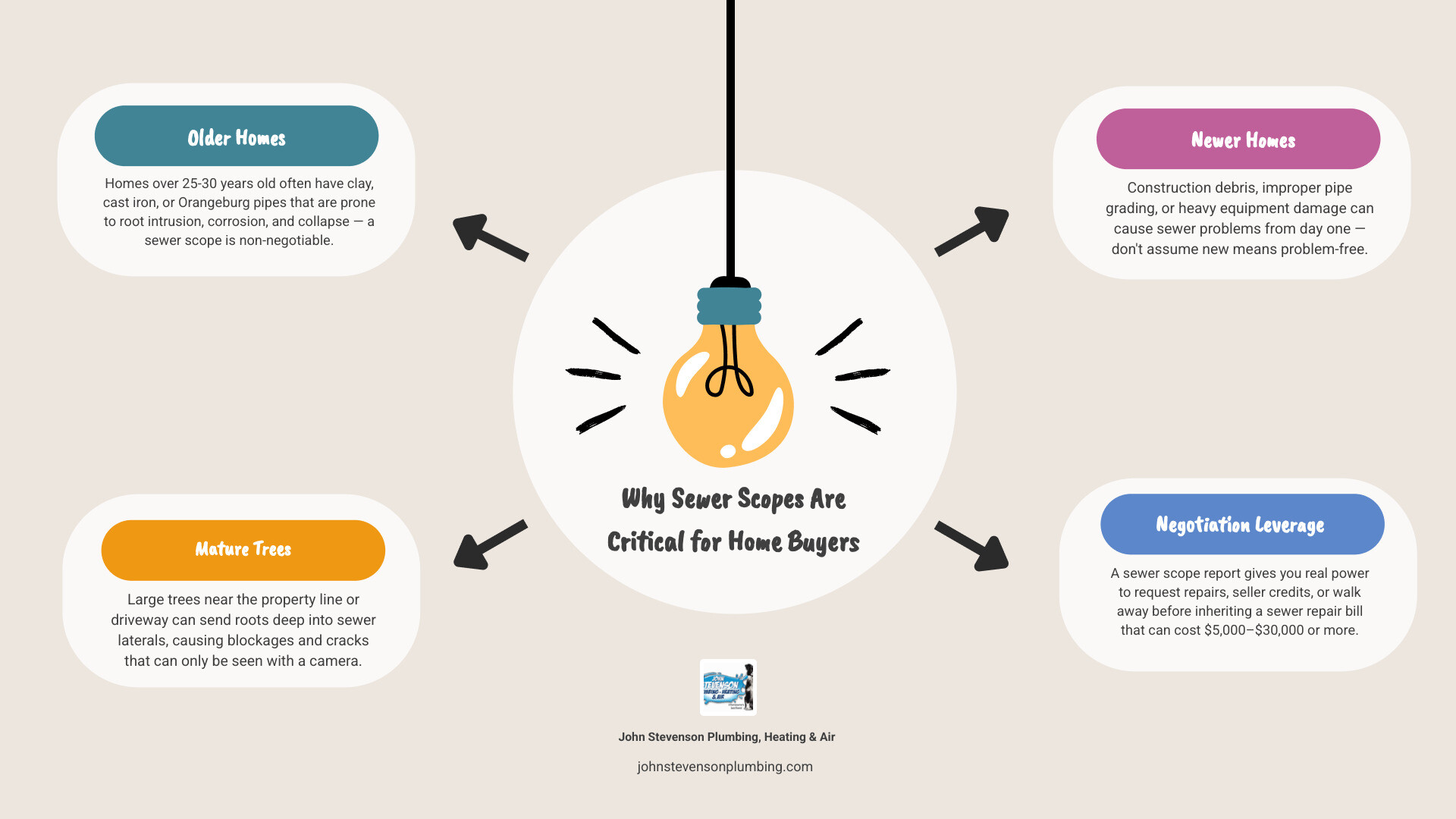
Under Contract? Why Should I Get a Sewer Inspection Before Buying a Home
When you enter escrow on a Southern California property, your to-do list feels endless. You are coordinating with lenders, signing stacks of paperwork, and scheduling various inspectors. It is easy to assume that your standard general home inspection has you covered. Unfortunately, relying solely on a general inspector to check your waste lines is a recipe for post-closing heartbreak.
The reality of property ownership is that you are legally responsible for the sewer lateral—the underground pipe that transports wastewater from your home’s foundation to the municipal main sewer line under the street (or to your private septic tank). If this underground pipe is cracked, sagging, or crushed, the municipality will not step in to fix it. The entire burden of repairing or replacing this lateral falls squarely on your shoulders.
Standard Home Inspection vs. Sewer Scope Inspection
To understand why a specialized sewer scope is non-negotiable, let us look at how it differs from what a general home inspector does:
| Feature/Capability | Standard Home Inspection | Specialized Sewer Scope Inspection |
|---|---|---|
| Primary Method | Visual check of accessible fixtures, running water down drains | Inserting a high-definition, self-leveling fiber-optic camera into the pipe |
| Underground Visibility | None (cannot see past the drain opening) | Complete visibility from the cleanout to the city main connection |
| Detection of Structural Defects | Only if a backup actively occurs during the walkthrough | Identifies cracks, offset joints, collapses, and sags before backups happen |
| Root Intrusion Identification | Cannot detect | Pinpoints exact locations of root intrusion and joint separation |
| Pipe Material Analysis | Limited to visible pipes in crawlspaces or under sinks | Evaluates the health and material of the entire underground run |
| Negotiation Leverage | General plumbing issues only | Hard video evidence of subsurface structural failures |
Skipping this specialized check leaves you blind to the actual state of your waste system. If you want to prepare your future home’s plumbing for the long haul, reviewing Stop The Drip With These Spring Plumbing Inspection Tips is an excellent way to understand how proactive maintenance keeps major systems running smoothly.
What Is a Sewer Scope and Why Is It Excluded From Standard Home Inspections?
A sewer scope is a highly focused diagnostic procedure. A certified technician inserts a flexible, waterproof, high-resolution camera attached to a long fiberglass cable into the home’s main sewer cleanout. As the camera travels down the line, it transmits real-time video footage to a monitor, documenting the interior condition of the pipe, measuring distance, and assessing the slope.
Why doesn’t your general home inspector do this?
General home inspectors are generalists. Their job is to evaluate visible, readily accessible home systems. They look at the roof, test the electrical outlets, run the HVAC system, and turn on the faucets to make sure water flows and drains. However, they do not carry specialized heavy diagnostic equipment like high-definition pipe cameras, nor are they licensed plumbers trained to interpret subterranean pipe failures.
Because the sewer lateral is buried deep underground beneath concrete driveways, manicured lawns, or public streets, it is physically impossible to inspect visually without specialized tools. Therefore, standard home inspection agreements explicitly exclude the main sewer lateral from their scope of work, leaving buyers completely vulnerable if they do not schedule a separate sewer camera test.
High-Risk Properties: Who Needs a Sewer Scope the Most?
While we recommend a sewer scope for every single home purchase in Carlsbad, Encinitas, and the surrounding areas, certain properties present a much higher risk for underground plumbing failures.
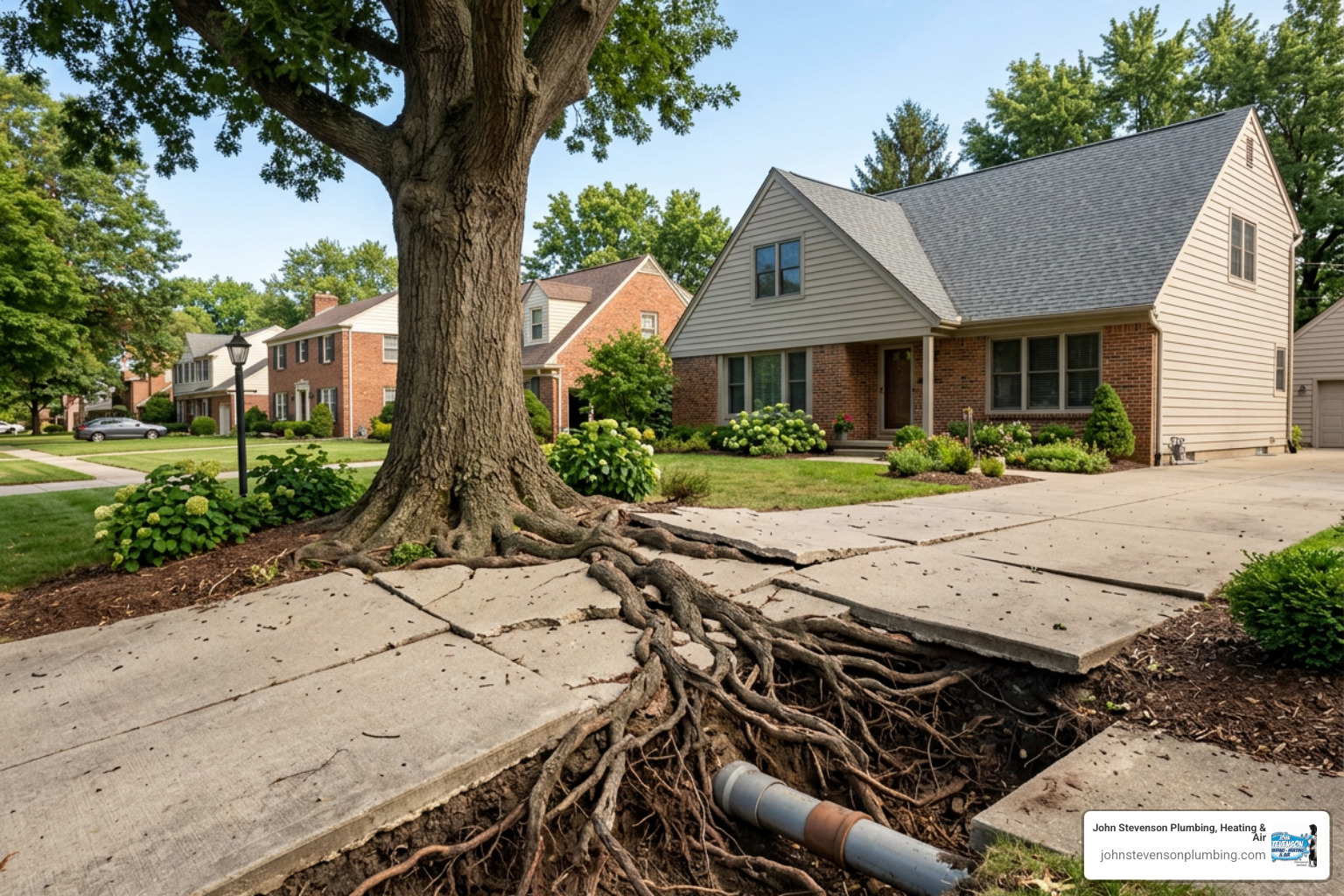
Several environmental and structural factors make a sewer camera inspection absolutely mandatory:
- Older Housing Stock: Homes built before the mid-1980s frequently utilize outdated, fragile pipe materials that are highly susceptible to decay.
- Mature Landscaping: Large, established trees—such as eucalyptus, ficus, or oaks common in older San Diego County neighborhoods—have aggressive root systems that actively seek out moisture in sewer lines.
- Geological and Terrain Factors: Hilly coastal terrains, seismic activity, and shifting clay soils can put immense pressure on buried lines, pulling joints apart or cracking rigid materials.
To safeguard your investment, it helps to understand how to spot other subterranean water issues. You can read more about identifying hidden water issues in our guide on How To Find Hidden Water Leaks The Right Way.
I am buying an older property in San Diego County, should i get a sewer inspection before buying a home?
If you are eyeing a charming mid-century home in La Jolla, a historic property in Point Loma, or an older bungalow in Oceanside, the answer is a resounding yes. Properties constructed prior to 1980 often harbor ticking time bombs in their waste systems due to the materials used during those eras:
- Clay Pipes: Highly popular in older construction, clay is a rigid, brittle material. Over decades, shifting soils crack clay pipes, and the joints between sections frequently separate, creating perfect entry points for tree roots.
- Cast Iron Pipes: Widely used for decades, cast iron has an expected lifespan of 50 to 75 years. As it ages, it corrodes from the inside out. This causes a rough, bumpy texture (known as scaling) that catches debris and leads to chronic clogs, or it can cause the bottom of the pipe to completely rot away, leaking raw sewage directly into the soil beneath your home.
- Orangeburg Pipes: Made of wood pulp fibers bound with coal tar, Orangeburg was used as a cheap alternative mid-century. It is notorious for absorbing moisture, losing its structural integrity, flattening under the weight of the soil, and completely collapsing. If a home has Orangeburg pipe, it is not a matter of if it will fail, but when.
When buying older properties, plumbing issues can manifest in multiple ways. To protect yourself from inheriting a home with existing structural concerns, check out our resource on Dont Ignore These Warning Signs Hidden Water Damage 101.
I am purchasing a newly constructed home, should i get a sewer inspection before buying a home?
It is a common misconception that newly built homes in communities like Irvine, Mission Viejo, or Carlsbad are immune to sewer line issues. Many buyers assume that because the plumbing is brand new, a sewer scope is a waste of money.
In our years of serving Southern California homeowners, we have seen some of the worst sewer line damage in newly constructed properties. Here is why:
- Construction Debris: During the building process, tradespeople sometimes flush drywall mud, mortar, paint, gravel, or even construction trash down the drains. This debris can settle in the main lateral, harden, and create severe blockages before you even move in.
- Heavy Equipment Damage: Heavy excavators, concrete trucks, and supply vehicles constantly drive over the unpaved soil of a construction site. If the sewer lateral was buried shallowly or not backfilled properly, the immense weight of these vehicles can easily crush or crack PVC pipes underground.
- Improper Pipe Grading: If the plumbing crew did not properly grade the trench before laying the pipe, the sewer line may lack the necessary slope (or “fall”) required for gravity to carry waste to the main. This results in sags or “bellies” where standing water and solid waste pool, leading to immediate, chronic clogs.
- Soil Settling: Newly backfilled soil around a new build can shift and settle rapidly, putting uneven pressure on joint connections and pulling newly glued PVC fittings apart.
Common Sewer Line Problems Revealed by a Camera Scope
When our certified technicians run a high-definition camera through an underground sewer line, we are looking for very specific structural and functional defects.
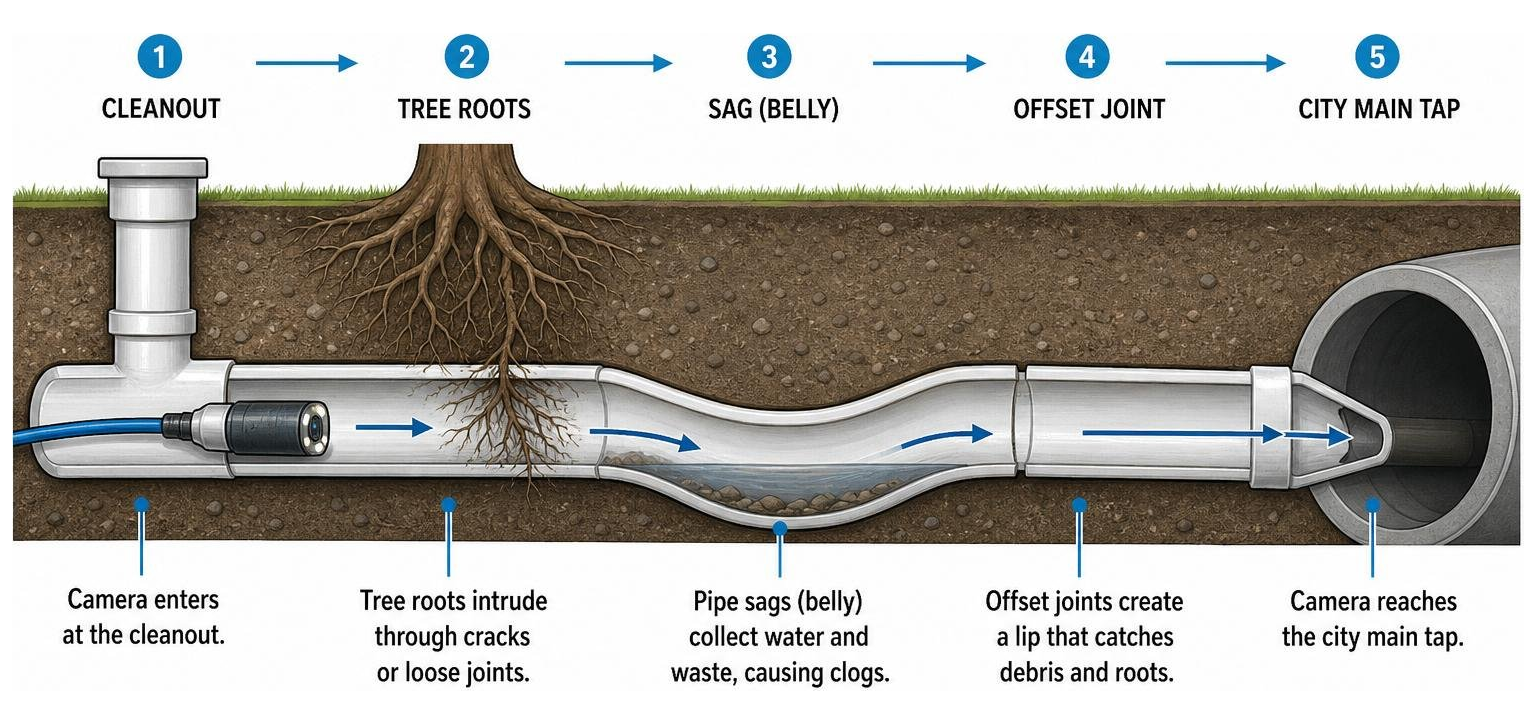
Here are the most common issues a camera scope reveals:
- Tree Root Intrusion: Tree roots are highly sensitive to moisture and nutrients. Even the tiniest hairline crack or loose joint in a sewer line releases warm, nutrient-rich water vapor into the surrounding soil. Tree roots grow directly toward this vapor, penetrate the pipe joint, and begin growing inside the line. What starts as a small cluster of hair-like roots quickly grows into a thick, solid mass that acts as a net, catching toilet paper and waste until the pipe is completely blocked.
- Pipe Bellies (Sags): A “belly” is a low spot in the sewer line where the pipe sags downward. This is usually caused by soil settling, poor installation compaction, or seismic shifting. Because sewer lines rely on gravity to move waste, water pools in these low spots. Solid waste and grease settle in the belly, eventually leading to recurring clogs and backups.
- Offset Joints: An offset occurs when two sections of pipe misalign at the joint. This is common in older clay and concrete lines due to soil movement. When a joint is offset by more than a quarter of an inch, it creates a sharp lip that catches solid waste and provides an easy entry point for surrounding soil and roots.
- Collapsed or Cracked Lines: Over time, extreme pressure from shifting soils, heavy vehicle traffic, or simple material degradation can cause pipes to crack or completely collapse. A collapsed line blocks all flow and requires immediate excavation or advanced trenchless repair to restore service.
- Excessive Grease and Scale Buildup: Over years of use, grease, soap scum, and minerals bind to the interior walls of cast iron or clay pipes. This narrows the functional diameter of the pipe and creates a rough surface that slows down water flow.
Understanding how we pinpoint these issues underground is incredibly valuable. If you want to dive deeper into the science behind subsurface diagnostics, check out A Comprehensive Guide To How Leak Detection Technology Works.
How to Use Sewer Inspection Findings to Negotiate with the Seller
A sewer camera inspection is not just a diagnostic tool; it is one of the most powerful financial instruments you have during a real estate transaction. You are not simply buying a video of a pipe—you are buying leverage.
If the sewer scope reveals structural defects like root intrusion, an offset joint, or a pipe belly, you have several strategic options before your contingency period ends:
- Request a Seller Credit: This is often the preferred route for buyers. Rather than letting the seller hire the cheapest contractor they can find to perform a quick fix, you negotiate a financial credit at closing. This allows you to retain complete control over the quality of the repair, choosing a trusted, licensed local plumber to do the job correctly after you take ownership.
- Require Repairs Prior to Closing: You can request that the seller hire a licensed plumbing professional to repair or replace the damaged section before the close of escrow. If you choose this route, always require a post-repair camera re-scope to verify that the work was completed properly and that no new issues were created during the process.
- Renegotiate the Purchase Price: If the repairs are extensive, you can use the documented findings and written repair estimates to negotiate a direct reduction in the home’s purchase price.
- Walk Away from the Deal: If the sewer line is completely collapsed, runs beneath expensive hardscaping or neighboring properties, and the seller refuses to cooperate, your contract’s inspection contingency allows you to walk away from the purchase with your earnest money deposit fully intact.
To ensure you are working with professionals who put your interests first during this critical window, read our guide on What To Look For In A Local Plumber Before Your Basement Becomes A Pool.
Frequently Asked Questions about Sewer Inspections
What are the warning signs of a failing sewer line?
While a camera inspection is the only way to confirm the exact state of a buried pipe, several red flags indicate that a sewer line is actively struggling or failing:
- Slow Drains Throughout the House: If only one sink drains slowly, it is likely a localized clog. However, if multiple sinks, tubs, and showers are slow to drain, the blockage is deep in the main sewer lateral.
- Gurgling Toilets: If your toilets make a bubbling or gurgling sound when you run the washing machine or drain a bathtub, it means air is trapped in the line due to an obstruction.
- Lush, Unusually Green Patches of Grass: If you notice a specific strip of your lawn that is significantly greener, taller, and healthier than the surrounding grass, it often indicates a sewer leak. The escaping wastewater acts as a natural fertilizer.
- Foul Odors: Persistent sewer gas smells inside your home, crawlspace, or yard indicate a crack or break in the plumbing ventilation or waste lines.
- Indentations in the Yard: Shifting soil or unexplained sinkholes in the lawn can occur when a broken sewer pipe washes away the surrounding dirt.
If you want to protect your property from unexpected water damage after a major Southern California weather event, keep our Dont Get Flooded By Repairs With This Post Storm Checklist handy.
When during the home-buying process should I schedule the inspection?
You should schedule your sewer scope as early as possible within your home inspection contingency or due diligence window. Ideally, coordinate the sewer scope to happen on the same day as your general home inspection.
Scheduling early is critical because if the camera reveals a significant defect, you will need time to:
- Obtain written repair estimates from a licensed specialist.
- Draft formal negotiation requests with your real estate agent.
- Allow the seller time to respond or obtain their own secondary opinions before your contingency period expires.
Waiting until the final days of escrow to book your scope puts immense pressure on the transaction and can force you to waive important rights just to meet closing deadlines.
What are the limitations of a sewer camera inspection?
While incredibly advanced, a sewer camera inspection has a few practical limitations:
- Cleanout Access Constraints: The camera must enter the system through an accessible sewer cleanout. If the property lacks a cleanout, the technician may have to remove a toilet or access the system through a roof vent, which can limit how far the camera can travel.
- Standing Water and Blockages: If the sewer line is completely backed up with standing water or thick grease, the camera lens will be obscured, making it impossible to see the pipe’s structural condition. In these cases, the line must be cleared or hydro-jetted before an accurate scope can be performed.
- Same-Day Visual Record: A sewer scope is a visual snapshot of the pipe’s interior on that specific day. It cannot guarantee that a pipe joint won’t shift next year or that a new root won’t penetrate a joint in the future. It is a powerful diagnostic tool, not a crystal ball.
Conclusion
Buying a home is one of the largest financial investments you will ever make. Protecting that investment means looking beneath the surface—literally. Skipping a sewer scope to save a small amount of time during escrow is a gamble that simply isn’t worth the risk of inheriting an expensive, underground plumbing disaster.
At John Stevenson Plumbing, Heating & Air, we have spent decades helping homebuyers throughout Carlsbad, San Diego County, and Orange County make informed, confident decisions. Our certified, highly trained technicians use state-of-the-art diagnostic cameras to provide clear, high-definition footage and honest, straightforward written reports.
We stand behind our work with our signature 5-Star Service Guarantee—featuring thorough diagnostics, upfront pricing, certified technicians, and a 24-hour satisfaction check-in to ensure your complete peace of mind.
If you are under contract on a home in our service area, do not leave your underground plumbing to chance. Contact us today to schedule your professional camera scope, or visit our Sewer Line Services page to learn more about how we keep your home’s vital systems flowing smoothly.