
Water Quality Issues in Southern California Explained: Legal vs. Health Standards
When we talk about water safety, we are usually talking about Maximum Contaminant Levels (MCLs). These are the legal limits set by the EPA and the state of California. If a city’s water stays under these limits, it is considered “safe” for public consumption. However, there is a second set of numbers you should know about: Public Health Goals (PHGs).
PHGs are set by environmental scientists based strictly on health risks, without considering the financial cost of treatment. In many cases, the legal limit (MCL) is much higher than the health goal (PHG). This is because municipal water systems have to balance safety with the massive expense of filtering millions of gallons of water for an entire city.
As of May 2026, the EPA has moved to tighten standards, particularly for “forever chemicals,” but the lag between scientific discovery and infrastructure upgrades means that your home might still be receiving water that falls into this “safety gap.” Understanding Water Quality means recognizing that “legal” does not always mean “optimal” for your family’s long-term health.
Understanding the Safety Gap: Water Quality Issues in Southern California Explained
The “safety gap” refers to the space between what the law allows and what health experts recommend. For example, California’s health goal for Arsenic is incredibly low (0.004 ppb), yet the legal limit is significantly higher to allow for practical municipal treatment.
| Contaminant | CA Public Health Goal (PHG) | EPA/CA Legal Limit (MCL) | Typical SoCal Detection |
|---|---|---|---|
| PFAS (PFOA/PFOS) | 0.007 ppt | 4.0 ppt | Detectable in many areas |
| Chromium-6 | 20 ppt | 10,000 ppt (Proposed) | 63 ppt (Long Beach avg) |
| Arsenic | 0.004 ppb | 10 ppb | Trace levels in Norwalk/Fullerton |
| Lead | 0.2 ppb | 15 ppb (Action Level) | Varies by home plumbing |
When you read your city’s Consumer Confidence Report (CCR), you’ll likely see that your water is in “compliance.” This is true. However, organizations like the Environmental Working Group (EWG) often point out that these legal standards are outdated. By the time a chemical is officially regulated, it may have been present in the groundwater for decades.
The “Forever Chemical” Threat and Emerging Contaminants
One of the most pressing water quality issues in southern california explained today involves PFAS (per- and polyfluoroalkyl substances). These are known as “forever chemicals” because they do not break down in the environment or the human body.
In early 2026, the EPA finalized strict notification levels at 4 parts per trillion (ppt) for PFOA and PFOS. Despite these regulations, PFAS remain detectable in the groundwater of the Orange County Basin and San Diego County. In Fullerton, legacy industrial plumes have required the closure of several wells, while in Norwalk, trace levels of arsenic and industrial solvents continue to be a point of monitoring.
Chromium-6 (Hexavalent Chromium) is another major concern. While it gained fame through the movie Erin Brockovich, it remains a reality in our local pipes. In Long Beach, detections have averaged around 63 ppt. While this is technically legal, it is more than triple the California Public Health Goal of 20 ppt.
Microplastics and PFAS: Water Quality Issues in Southern California Explained
As of 2025, California became the first state to mandate microplastics testing in drinking water. Recent studies have linked these microscopic plastic fibers to increased risks of heart disease and Alzheimer’s. These particles enter our water system through urban runoff and the breakdown of plastic waste in our reservoirs.
We also have to contend with disinfection byproducts (DBPs). When cities use chlorine to kill biological threats like bacteria, the chlorine reacts with organic matter in the water to create chemicals like Trihalomethanes. These are necessary for preventing immediate illness (like cholera), but long-term exposure at trace levels is a factor many homeowners choose to address with Water Filtration at the point of use.
Regional Environmental Crises: Tijuana River and Salton Sea
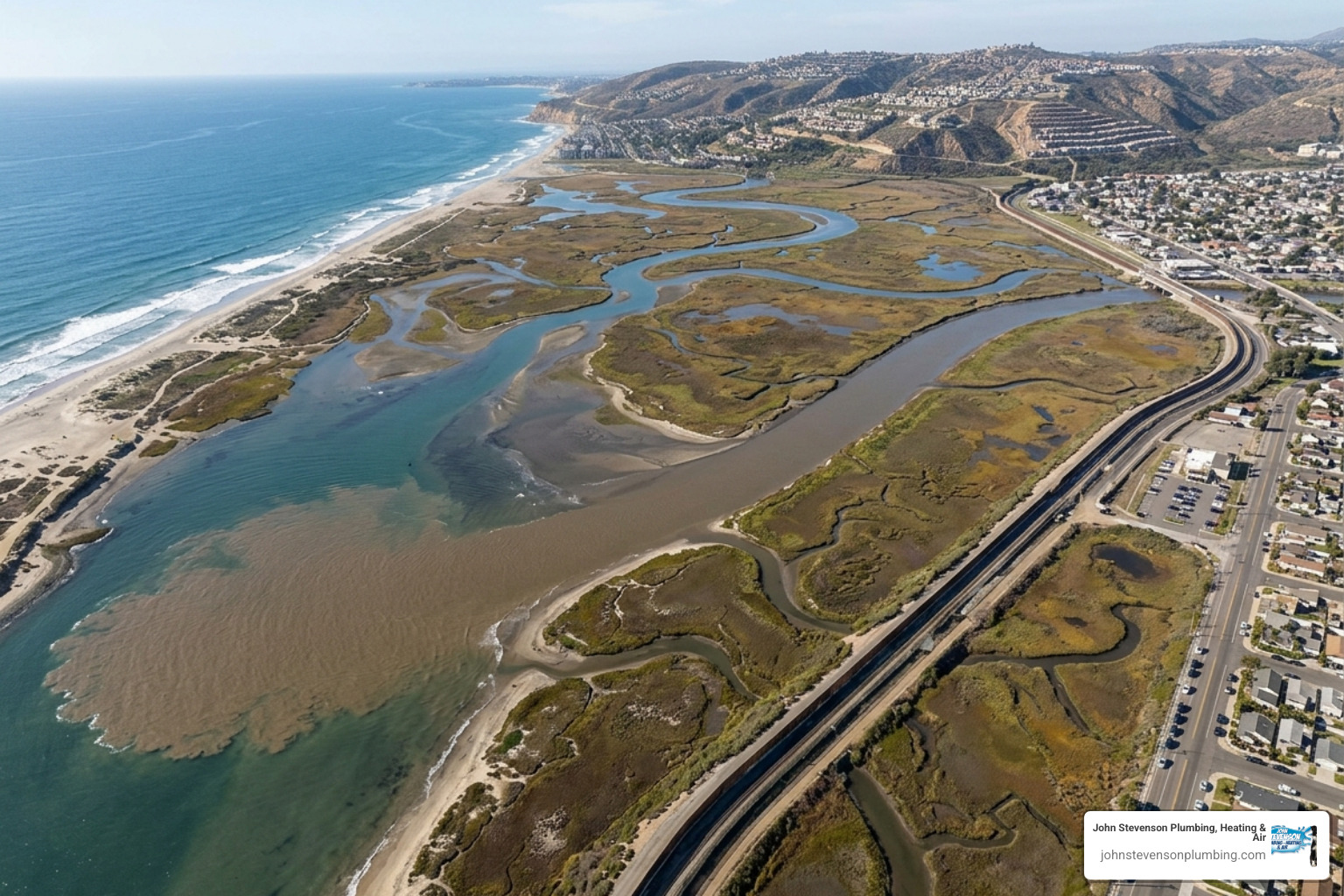
Southern California faces unique geographic challenges that directly impact our environmental health. To the south, the Tijuana River sewage crisis has reached catastrophic levels. Since 2018, over 100 billion gallons of raw sewage, industrial waste, and trash have flowed across the border.
In the first few months of 2025 alone, 10 billion gallons crossed into San Diego County. This isn’t just a water issue; it’s an air quality crisis. Hydrogen sulfide levels near the river have been measured at 4,500 times typical urban levels. Residents in nearby communities report high rates of respiratory illness, headaches, and nausea.
Further inland, the Salton Sea is receding due to drought and water diversion agreements. As the water evaporates, it exposes a lake bed filled with decades of concentrated agricultural runoff, including pesticides and heavy metals. This “toxic dust” becomes airborne, contributing to some of the highest childhood asthma rates in the state. While this primarily affects the air, the underlying cause is a century of poor water management and nutrient loading that has left the sea hyper-saline and ecologically collapsed.
How Climate Change and Hard Water Affect Your Plumbing
Climate change acts as a “threat multiplier” for our water. Frequent wildfires strip the hillsides of vegetation; when the rains finally come, they wash ash and heavy metals into our reservoirs. This increases the cost and difficulty of water treatment for municipal plants.
Additionally, drought conditions lead to saltwater intrusion in coastal aquifers. As we pump groundwater to meet the needs of cities like Carlsbad and Oceanside, the lack of freshwater recharge allows saltier water from the Pacific to seep in.
Then there is the issue of “hard water.” Southern California is notorious for high mineral content—specifically calcium and magnesium. While not a health risk, these minerals are a nightmare for your home’s infrastructure.
- Scale Buildup: Minerals solidify inside your pipes, reducing water pressure.
- Appliance Death: Your dishwasher, laundry machine, and water heater have to work harder, leading to early failure.
- Skin and Hair: Hard water prevents soap from lathering and leaves a film on your skin.
To combat this, many residents utilize Water Descaling technology to protect their investment and improve their quality of life.
Physical, Chemical, and Biological Factors
When we evaluate water, we look at four main categories:
- Physical: This is the “aesthetic” side—how the water looks, smells, and tastes. If your water is cloudy or smells like a swimming pool (chlorine), it’s a physical quality issue.
- Chemical: This includes the pH balance and the presence of minerals, metals, and synthetic chemicals like PFAS.
- Biological: These are the living threats—bacteria, viruses, and parasites. While municipal treatment is excellent at killing these, a break in a local water main can introduce them into your home.
- Radiological: Radioactive elements like uranium can occur naturally in the earth’s crust. While rare, they are monitored by the EPA.
The Water Quality in your specific neighborhood can also be affected by the age of the distribution system. Old iron pipes can add a metallic taste or reddish tint to your water.
Practical Solutions for Clean, Safe Water at Home
The good news is that you don’t have to wait for federal or state agencies to upgrade their infrastructure. You can take control of your home’s water quality today. The most effective solution for the modern contaminants we’ve discussed is Reverse Osmosis (RO).
A 5-stage RO system acts as a “final barrier.” It uses a semi-permeable membrane to strip away up to 99% of PFAS, microplastics, Chromium-6, and arsenic. These are often installed as point-of-use systems under the kitchen sink, providing high-purity water for drinking and cooking.
For those looking for a whole-home solution, Water Filtration systems can address chlorine taste and sediment before the water even enters your pipes. This ensures that every shower you take and every load of laundry you wash is done with cleaner water.
Why Homeowners Need Water Quality Issues in Southern California Explained
Even if the city’s water is perfect, your home’s plumbing might not be. If your house was built several decades ago, you could have lead solder in your copper pipes or even legacy lead service lines. As water sits in these pipes, metals can leach into your supply.
This is why we recommend a professional water analysis. Our certified technicians can perform thorough diagnostics to see exactly what is coming out of your tap. We don’t just look at the city report; we look at the water in your kitchen.
Frequently Asked Questions about SoCal Water Quality
Is Southern California tap water safe to drink in 2026?
Yes, it meets the legal EPA and California state standards for safety. However, “legal” does not mean “contaminant-free.” Many residents choose to filter their water because it contains detectable levels of PFAS, microplastics, and Chromium-6 that exceed non-binding health goals (PHGs).
What are the most common contaminants in San Diego and Orange County?
The most frequent issues we see are high mineral content (hard water), disinfection byproducts (from chlorine treatment), Chromium-6, and trace amounts of industrial chemicals like PFAS. In specific areas like Long Beach or Fullerton, groundwater plumes from historical manufacturing remain a concern.
How can I remove PFAS and microplastics from my water?
Standard pitcher filters often aren’t enough to tackle these microscopic threats. The most reliable method is a multi-stage Reverse Osmosis system. These systems are designed to catch the tiny particles and chemical bonds that standard carbon filters might miss, offering up to a 99% removal rate.
Conclusion
Navigating the water quality issues in southern california explained in this guide can feel overwhelming, but you don’t have to do it alone. At John Stevenson Plumbing, Heating & Air Conditioning, we live and work in the same communities you do—from Carlsbad to Irvine and down to San Diego.
We believe that every family deserves water that isn’t just “legally compliant,” but truly clean and refreshing. Whether you are dealing with the frustrations of hard water scale or are concerned about the long-term health impacts of “forever chemicals,” we have the expertise to help.
Our 5-Star Service Guarantee ensures that you get thorough diagnostics and upfront pricing. We provide professional installation of high-quality Water Quality solutions, including reverse osmosis and whole-home filtration, tailored to the specific needs of Southern California homes.
Don’t let complex water issues drain your peace of mind. Give us a call today, and let’s make sure the water in your home is the best it can be.