
What Every California Homeowner Needs to Know About Sewer Line Regulations
California sewer line regulations for homeowners are more complex — and more consequential — than most people realize. Whether you’re buying a home, planning a major remodel, or simply trying to stay on the right side of your local sanitation district, the rules around sewer lines touch almost every property owner in the state.
Here’s a quick overview of what the regulations require:
Key California Sewer Line Rules at a Glance:
- Who owns what: You are responsible for the sewer lateral (the pipe connecting your home to the public main) — at minimum from your foundation to the property line, and in many cities, all the way to the main.
- Mandatory connection: If a public sewer main is available within a certain distance of your property, California law and local health codes typically require you to connect to it rather than rely on a septic system.
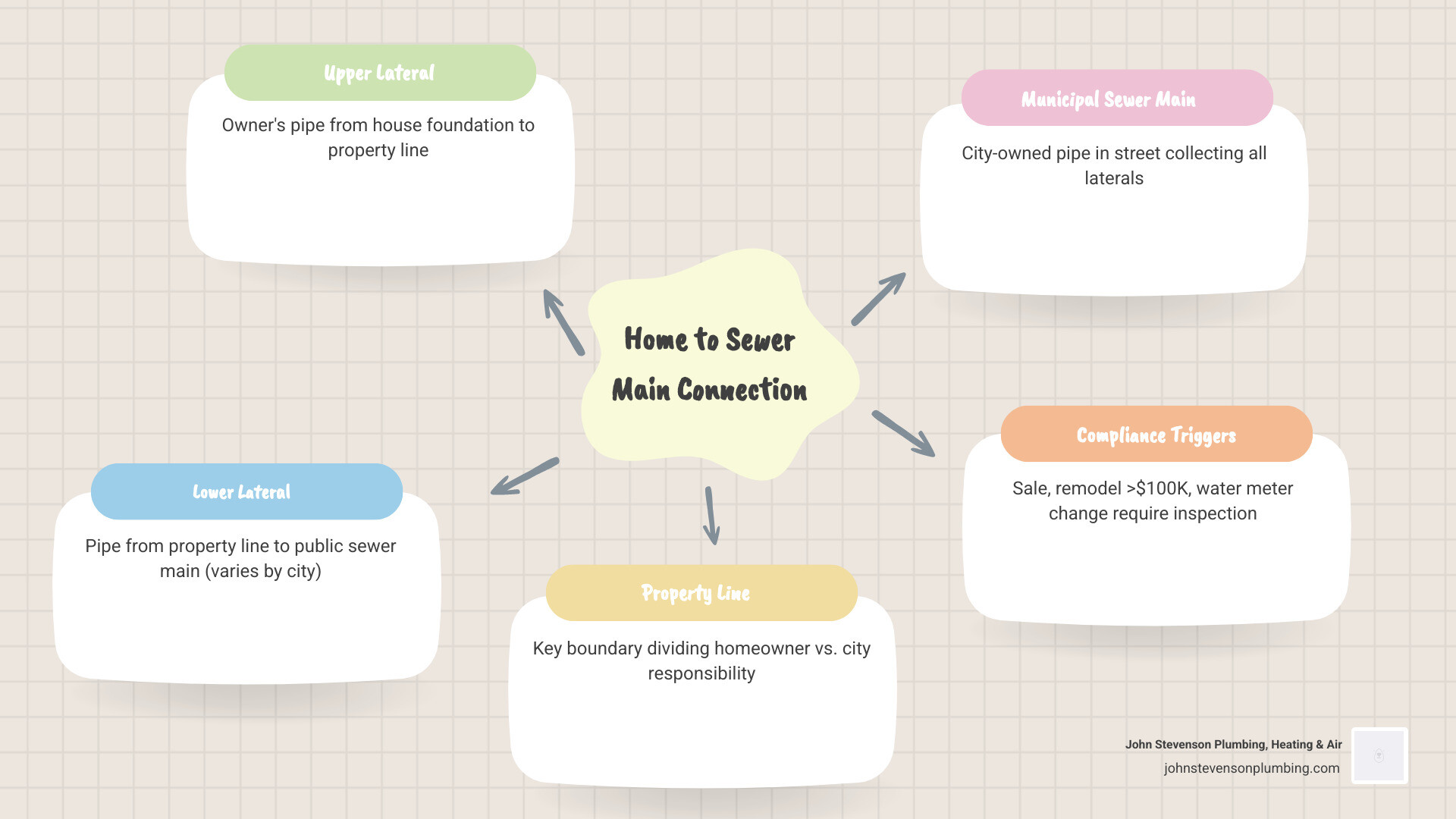
- Inspection triggers: Selling your home, completing a remodel over $100,000, or changing your water meter size can all require a mandatory sewer lateral inspection and compliance certificate.
- Compliance certificates: A full lateral replacement earns a certificate valid for up to 20 years; a repair or passed test typically earns 7 years of coverage.
- HOA properties: Responsibility can shift between the HOA and individual owners depending on your CC&Rs and California’s Davis-Stirling Act — and the stakes can be high (one condo owner was billed $15,000 for a 50-foot lateral repair).
- Regional rules vary: East Bay, Sonoma Valley, South Placer, and other regions each layer on their own specific ordinances, deadlines, and fee structures on top of state baseline requirements.
- Consequences of non-compliance: Ignoring sewer regulations can mean fines, failed property transfers, environmental liability, or even termination of sewer service.
Most homeowners don’t think about their sewer lines until something goes wrong — a backup, a failed inspection, or a surprise bill at closing. But California’s sewer regulations are designed to prevent a real problem: aging, cracked, or leaky pipes can allow groundwater to flood the sewer system during storms, increasing treatment plant flows by as much as 2,000% and risking untreated wastewater spills into local waterways. The EPA’s enforcement of the Clean Water Act is a major reason local districts across the state have adopted strict inspection and compliance programs.
Understanding your obligations before a problem forces your hand is the smartest — and often the least expensive — approach.
Understanding California Sewer Line Regulations for Homeowners
At the state level, sewer rules start with a simple public-health principle: wastewater has to go somewhere safe. If public sewer service is available to your property, local health departments and sanitation agencies often require connection rather than continued use of a private septic system. If no public sewer is available, a properly permitted septic system may still be legal.
So, is it mandatory for houses in California to connect to the public sewer system? Often yes, when sewer access is reasonably available. But this is not a one-size-fits-all statewide rule applied the same way everywhere. In practice, homeowners need to check city, county, and sanitation district requirements.
For homes in our Southern California service areas, that means looking at local municipal code, public works standards, and sanitation district rules before assuming a septic system is allowed, grandfathered, or replaceable. A home outside sewer service may still rely on septic, but once a public main becomes available, connection requirements can change.
This is also why proper sewer line installation matters. New connections usually require permits, approved materials, inspections, and compliance with the California Plumbing Code plus local amendments.
A few baseline concepts homeowners should know:
| Topic | Public Sewer | Private Septic |
|---|---|---|
| Where wastewater goes | Municipal sewer main and treatment system | On-site treatment and leach field |
| Who regulates it | City, county, sanitation or utility district | County environmental health department |
| When it is typically required | When sewer service is available and connection is mandated locally | When no public sewer is reasonably available |
| Ongoing owner duty | Maintain your private lateral | Maintain the entire septic system |
| Common permit triggers | New connection, repair, replacement, remodel | New system, replacement, major repair |
Some districts also use design assumptions when sizing or reviewing systems. One utility district standard, for example, uses 100 gallons per person per day and assumes four people per residential unit. That is more of an engineering benchmark than a homeowner behavior rule, but it shows how closely local agencies regulate sewer capacity.
Key triggers for California sewer line regulations for homeowners
Most homeowners do not have to think about sewer compliance every year. The rules usually kick in when something changes.
The most common triggers include:
- Selling or transferring a property
- Major remodeling projects
- Water meter size changes
- Sewer backups or suspected defects
- New construction, additions, or ADUs
- Repair or replacement of the existing lateral
In some California programs, remodeling over $100,000 triggers mandatory lateral inspection and certification. In others, point-of-sale rules mean you need proof that the lateral passed inspection before closing. Where those local ordinances apply, a damaged line may need sewer line replacement or approved repair before the transaction can move forward.
Certificate validity also matters. In programs cited in the research, a full lateral replacement can earn a compliance certificate valid for up to 20 years, while a repair or a passed test without full replacement may only be valid for 7 years. In plain English: replacing the line can buy a lot more peace and paperwork relief than patching one problem area.
If you are buying or selling a home, the practical checklist is:
- Ask whether the property is on public sewer or septic.
- Confirm whether the city or district has a point-of-sale sewer lateral ordinance.
- Request any prior compliance certificate, inspection video, and permit history.
- Verify whether the certificate is still valid.
- If needed, schedule a camera inspection before closing gets too close for comfort.
Regional variations in sewer compliance
This is where sewer law gets sneaky. California has broad health and plumbing rules, but local agencies often add stricter requirements. That means a rule that applies in one part of the state may not apply in Mission Viejo, Lake Forest, Carlsbad, or San Diego.
The research highlights examples from the East Bay, Sonoma Valley, and South Placer. Those are useful for understanding how sewer programs work, but they are not automatically the rule in Southern California. For our service area, the main takeaway is this: always verify local requirements before repair, sale, or remodel.
Examples of how local programs can vary include:
- Point-of-sale inspection mandates
- Remodel thresholds that trigger certification
- Different responsibility lines for the lower lateral
- Different extension or hardship rules
- Different certificate lengths and testing standards
For example, some programs outside our area allow 180-day extensions tied to a compliance deposit. Some require inspection when a remodel exceeds $100,000. Others impose age-based rules on older laterals. Those examples show the range of possible regulation, but homeowners in our area need local confirmation rather than assumptions based on another county’s ordinance.
If you are dealing with a home in South Orange County, our Mission Viejo sewer line services page is a good starting point for understanding local sewer needs and repair options.
Private Sewer Laterals (PSL): Ownership and Maintenance Duties

A private sewer lateral, often called a PSL, is the buried pipe that carries wastewater from your home’s plumbing to the public sewer main. Usually, that line is about 4 inches in diameter for a single-family home.
The most important ownership rule is this: homeowners are generally responsible for the private lateral, while the city or district is responsible for the sewer main.
But there is a catch. The exact dividing line varies by jurisdiction.
In many places, the homeowner is responsible from the foundation all the way to the main in the street. In other places, responsibility is split into:
- Upper lateral: from the building to the property line
- Lower lateral: from the property line to the sewer main
Some agencies assign both segments to the owner. Others take responsibility for the lower lateral. That distinction matters because repairs in the street may involve pavement cuts, traffic control, and encroachment permits.
This is why we encourage homeowners to think of the sewer lateral as part of the home, not just “the city’s pipe somewhere underground.” If the line cracks, sags, gets invaded by roots, or leaks groundwater in, the owner is often on the hook for maintenance, cleaning, repair, and reconstruction.
A few common lateral issues include:
- Tree root intrusion
- Grease buildup
- Offset joints
- Cracks and fractures
- Pipe belly or sag
- Corrosion or deterioration in older clay lines
- Missing or damaged cleanouts
When we diagnose these issues, services like sewer line repair can often address isolated defects before they become full-scale failures.
Many local programs also want inspections to meet recognized industry standards, including NASSCO-based video reporting. That means the camera inspection is not just “we looked around a bit.” It should document the full run of pipe and identify defects clearly enough for compliance review.
Compliance with California sewer line regulations for homeowners in HOAs
If you live in an HOA, condo, townhome, or other common interest development, sewer responsibility gets more complicated.
The short answer to “Who is responsible for maintaining and repairing sewer lines in an HOA or condominium?” is: it depends on the Davis-Stirling Act and the governing documents.
Under California Civil Code Section 4775, maintenance responsibility often turns on whether the line serves:
- A separate interest only
- Common area
- Exclusive use common area
That sounds legalistic because it is. But the practical meaning is important:
- If a sewer line serves only one unit, the owner may be responsible.
- If it serves multiple units or runs through common area, the HOA may be responsible.
- If it runs through exclusive use common area, responsibility may depend on the CC&Rs.
The governing documents matter a lot. CC&Rs, bylaws, maintenance matrices, and rules can shift or clarify duties beyond the default statutory framework. That is why two similar-looking condo communities can have different answers to the same sewer repair question.
One well-known California dispute involved a condo owner being billed $15,000 for repair of a 50-foot sewer lateral serving his unit. The lesson for homeowners is not just “read the law.” It is “read your HOA documents before there is sewage involved.” Nobody wants to learn pipe responsibility the hard way.
If you own in an HOA, take these steps:
- Review the CC&Rs and any maintenance responsibility chart.
- Confirm whether the line serves one unit or multiple units.
- Identify whether the pipe is in common area or exclusive use common area.
- Ask whether prior board decisions or policies address sewer laterals.
- Get legal clarification if the documents are vague.
For homeowners in South Orange County, our Lake Forest sewer line services page can help you understand the practical side of inspection, repair, and replacement when community property issues are part of the picture.
Technical Standards and Preventing Sewer Overflows
Even though homeowners do not need to memorize engineering manuals, a few technical standards show up again and again in sewer work.
Common baseline standards include:
- Typical residential lateral diameter: 4 inches
- Minimum slope for gravity flow: 1/4 inch per foot, or about 2%
- Proper cleanout access
- Watertight joints
- No sags, major offsets, or structural breaks
If a line is too flat, solids can settle and cause repeated blockages. If it is too steep, liquids may outrun solids. If joints separate or roots get in, you may end up with backups inside the house or groundwater infiltration from outside the pipe.
For larger public sewer design, one district standard cited in the research requires a minimum velocity of 2.0 feet per second when the pipe is half full or full, a maximum public sewer depth of 25 feet, at least 10 feet of horizontal clearance between parallel water and sewer lines, and 1 foot of vertical separation at crossings. Public sewers also should not be placed near water wells without strict separation standards. Those are mainly design rules for agencies and contractors, but they help explain why permits and inspections are not optional paperwork.
For homeowners, the takeaway is simple: sewer lines must be installed and repaired correctly, not just quickly.
Backwater protection is another overlooked issue. Where plumbing fixtures are lower than the upstream manhole cover elevation, a backwater valve may be required to prevent sewage from flowing backward into the home during surcharging events. It is one of those devices homeowners never brag about at a barbecue, but they are very happy it exists when the system backs up.
If you are dealing with recurring backups, slow drains throughout the home, or a line that keeps failing root cleaning, it may be time for a camera inspection and a more permanent fix. Our Scripps Ranch sewer line repair service covers the kind of diagnostic work needed to see what is actually happening underground.
Proactive maintenance to avoid environmental penalties
Most sewer regulations exist for one big reason: leaking private laterals do not just affect one house. They can overload the public system.
This is the inflow and infiltration problem, often shortened to I&I. During storms, groundwater and rain-related water can enter cracked laterals and old mains. Research cited in this brief notes that flows can spike by as much as 2,000% during wet weather. That extra flow strains treatment plants and raises the risk of sanitary sewer overflows into streets, storm drains, creeks, and coastal waters.
That is why proactive maintenance matters. It is not just about avoiding a backup in your shower. It is also about preventing pollution and avoiding enforcement consequences.
Best practices for homeowners include:
- Schedule periodic camera inspections for older sewer lines
- Clean lines that are vulnerable to roots or grease buildup
- Address repeated clogs instead of treating them like bad luck
- Avoid flushing grease, wipes, hygiene products, and other pipe enemies
- Repair defects promptly after inspection
- Keep records of inspections, permits, and completed work
Maintenance tools may include:
- CCTV video inspection
- Hydro-jetting
- Root cutting
- Smoke testing in some compliance investigations
- Trenchless repair or lining where allowed
- Full replacement where the line is structurally failed
Older clay laterals are especially vulnerable to root intrusion and joint separation. That is one reason so many local ordinances focus on aging homes and older underground infrastructure.
Neglect can lead to:
- Sewage backups in the home
- Failed real estate closings
- Mandatory repairs after district notice
- Fines or code enforcement action
- Environmental damage
- In extreme cases, sewer service interruption or termination
Some jurisdictions do offer hardship deferrals or limited extensions, but those are exceptions, not a maintenance plan. Waiting until a deadline letter shows up is rarely the smooth path.
If your line has recurring issues, our sewer line repair team can help identify whether cleaning, spot repair, trenchless rehabilitation, or replacement makes the most sense.
Frequently Asked Questions about California Sewer Rules
Is it mandatory to connect to the public sewer in California?
Usually, if public sewer service is available to your property and local code requires connection, yes. Septic systems are still used in areas without sewer access, but once a public main becomes available, local health or sanitation rules may require hookup. The exact trigger depends on local ordinance, not just state law alone.
Who is responsible for the sewer line between my house and the street?
In most cases, the homeowner is responsible for the private lateral from the home to at least the property line, and often all the way to the public main. The city or sanitation district usually maintains the main sewer. In HOA communities, responsibility may shift depending on Civil Code Section 4775 and your governing documents.
What happens if I sell my house without a sewer compliance certificate?
If your city or district requires a compliance certificate for transfer, the sale may be delayed, escrow may be held up, or the parties may need to negotiate repairs, extensions, or responsibility before closing. In some ordinances, limited extensions exist, but they usually come with strict deadlines and documentation requirements. The safest move is to verify sewer compliance early, not the week you want the keys handed over.
Conclusion
California sewer rules are not exactly dinner-table conversation, but they matter. A lot. For homeowners, the biggest lessons are straightforward:
- Know whether your property is on public sewer or septic
- Understand where your responsibility begins and ends
- Check local rules before selling, remodeling, or replacing a line
- Do not assume your HOA is automatically responsible
- Inspect and maintain older laterals before they fail at the worst possible moment
At John Stevenson Plumbing, Heating & Air, we help homeowners make sense of complicated sewer issues with thorough diagnostics, clear communication, and our 5-Star Service Guarantee. If you need help evaluating a sewer lateral, planning a repair, or figuring out the next step for your Southern California home, we are here to help.
To learn more about protecting your property with professional sewer services, visit Protect your home and the environment with professional sewer lines services in Mission Viejo.