
How Long Does a Central AC System Last — And What It Means for Your Home
How long does a central ac system last is one of the most common questions homeowners ask — and the short answer is: most central AC systems last between 15 and 20 years with proper maintenance, though many factors can shorten or extend that range.
Here’s a quick breakdown:
| Condition | Expected Lifespan |
|---|---|
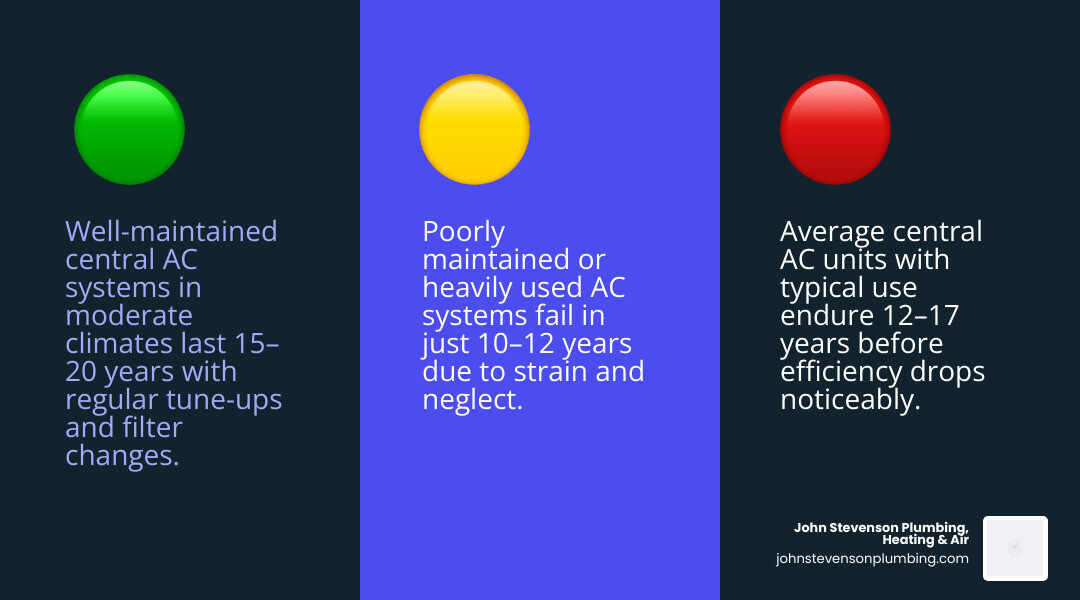
| Well-maintained, moderate climate | 15–20 years |
| Average maintenance, typical use | 12–17 years |
| Poorly maintained or heavy-use climate | 10–12 years |
| Older unit (pre-2000s) | 10–12 years |
| Modern high-efficiency unit, excellent care | Up to 20+ years |
If your system is pushing 12–15 years old and you’re noticing more repairs, higher energy bills, or uneven cooling, it may be approaching the end of its useful life. That doesn’t always mean immediate replacement — but it does mean it’s time to pay close attention.
For homeowners in Carlsbad, CA, where summers are warm and systems often run well into fall, understanding your AC’s lifespan isn’t just useful — it helps you plan ahead and avoid a breakdown on the hottest day of the year.
How Long Does a Central AC System Last on Average?
When we look at the data across the HVAC industry, the consensus is that a central air conditioning system typically serves a home for 15 to 20 years. However, “average” can be a tricky word. In the cooling world, the median lifespan is often cited right at the 15-year mark.
It is important to distinguish between different types of cooling technology, as they don’t all age at the same rate. For example, a dedicated central AC unit (a split system) often outlasts a heat pump. Why? Because a heat pump works double duty, providing both heating and cooling year-round, whereas a central AC unit typically rests during our cooler Southern California winters.
| System Type | Typical Lifespan (Years) | Median Lifespan (Years) |
|---|---|---|
| Central AC (Split System) | 15–20 | 15 |
| Ductless Mini-Split | 15–20 | 17 |
| Heat Pump | 10–16 | 12 |
| Window/Room Unit | 5–10 | 8 |
Modern units generally have a longer life expectancy than those manufactured 20 or 30 years ago, thanks to improvements in materials and sensors. However, a high-quality AC installation is the foundation of that longevity. A poorly installed unit—one that is the wrong size for the home or has restricted airflow from the start—will struggle and likely fail years before a correctly installed counterpart.
I’m Looking for Ways to Protect My Investment. What Factors Influence Longevity?
If you want to ensure your system reaches that 20-year milestone, you have to look at the environment it lives in. In places like Carlsbad, Oceanside, and Newport Beach, we face unique challenges that homeowners in the Midwest don’t have to worry about.
Climate and Usage Patterns
The more a system runs, the faster it wears out. It’s simple mechanical math. In Southern California, our cooling season is longer than in many other parts of the country. If you keep your thermostat set to a chilly 68°F while it’s 90°F outside, your compressor is working much harder than a neighbor who keeps theirs at 78°F. This constant high-pressure operation gradually wears down the internal seals and motor windings.
Coastal Air Corrosion
For our friends in Leucadia, Del Mar, and Solana Beach, the “salt air” isn’t just a refreshing breeze—it’s a silent AC killer. Salt is highly corrosive to the delicate aluminum fins on your outdoor condenser. Without protection, these fins can “white rust” and crumble, which prevents the unit from releasing heat effectively. This forces the system to run longer and hotter, significantly shortening how long does a central ac system last in coastal zones.
Sizing and Installation Quality
One of the biggest mistakes we see is “over-sizing.” A system that is too large for the home will “short-cycle,” meaning it turns on and off rapidly. The most stressful part of an AC’s life is the startup. Frequent starting and stopping causes electrical strain and prevents the system from properly dehumidifying the air. Professional AC installation includes a “Manual J” load calculation to ensure the unit is the perfect fit for your home’s square footage and insulation levels.
The Role of Maintenance in Extending How Long a Central AC System Lasts
We cannot stress this enough: AC maintenance is the single most important factor within your control. Think of it like a car; you wouldn’t expect a vehicle to last 200,000 miles without an oil change.
Standard HVAC maintenance should include:
- Filter Changes: Clogged filters restrict airflow, making the blower motor work overtime and potentially causing the evaporator coil to freeze.
- Coil Cleaning: Dirty coils can’t transfer heat. Cleaning them annually keeps efficiency high.
- Drain Line Clearing: Algae and debris can clog the condensate drain, leading to water damage and system shutdowns.
- Professional Inspections: A technician can spot a failing capacitor or a small refrigerant leak before it destroys the expensive compressor.
Studies suggest that regular annual tune-ups can extend a system’s life by 3 to 5 years. That is a massive return on a small annual investment.
Is It Time to Replace My Unit in Carlsbad? Recognizing the Signs of Failure
Even with the best HVAC maintenance, every system eventually reaches a point where it’s no longer cost-effective to keep it running. Knowing the signs of a “dying” unit can save you from an emergency replacement during a heatwave.
Common Indicators for Replacement:
- The “50% Rule”: If the cost of an AC repair is more than 50% of the value of a new system, it’s time to upgrade.
- Frequent Breakdowns: If you’ve had our team out for AC repair three or more times in the last two years, the system is telling you it’s finished.
- Rising Energy Bills: As components wear out, they draw more electricity to produce the same amount of cooling. If your bills are climbing but your usage hasn’t changed, efficiency is tanking.
- Humidity Issues: An aging evaporator coil loses its ability to pull moisture from the air, leaving your home feeling “clammy” even if it’s cool.
- Strange Noises: Grinding, squealing, or heavy rattling often points to a failing compressor or blower motor.
- R-22 Refrigerant: If your unit was built before 2010, it likely uses R-22 (Freon). This refrigerant was phased out in 2020. Repairs involving refrigerant leaks on these units are now prohibitively expensive because the gas is no longer produced.
If you are seeing these signs, it is often better to schedule an AC replacement during the “shoulder seasons” (spring or fall) when you can take your time choosing the right model and avoiding the summer rush.
Determining the Age and How Long a Central AC System Lasts in Your Home
Not sure how old your unit is? You can usually find the manufacture date on the “data plate” on the side of the outdoor condenser. Look for a metal sticker with a serial number. Most manufacturers (like Trane, Lennox, or Carrier) hide the date within the serial number—for example, the first four digits might represent the week and year.
If the plate is faded, you can search the brand and serial number online or have a professional check it during your next AC repair visit. Knowing the age helps you apply the “$5,000 Rule”: Multiply the age of the unit by the repair cost. If the result is more than $5,000, replacement is usually the smarter financial move.
Frequently Asked Questions about AC Longevity
Can a central AC unit last 30 years?
While it is technically possible, it is extremely rare. A unit that lasts 30 years has likely had several major components (like the compressor or fan motor) replaced along the way, essentially making it a “Ship of Theseus.” Furthermore, a 30-year-old unit would be incredibly inefficient compared to modern SEER2 standards, likely costing you double or triple in monthly electricity what a new unit would. For most, 20 years is the realistic “gold medal” for cooling services longevity.
Does salt air affect AC lifespan in coastal areas?
Absolutely. Salt air acts as an accelerant for corrosion. Homeowners in coastal cities like Carlsbad and Encinitas should consider units with “coastal coatings” or “Blygold” treatments on the coils. We also recommend rinsing the outdoor unit with a gentle stream of fresh water from a garden hose once a month to remove salt buildup. This simple DIY AC maintenance step can add years to a coastal unit’s life.
How often should I change my filters to maximize life?
In Southern California, we recommend checking your filters every month. If you have pets or live in a dusty area (like Fallbrook or Pauma Valley), you’ll likely need to replace them every 30 to 60 days. A dirty filter is the #1 cause of “suffocating” an AC system. When airflow is restricted, the system has to work harder and run longer, which directly impacts how long does a central ac system last.
Conclusion
Your central air conditioner is one of the most significant investments you’ll make in your home’s comfort. While the average lifespan is 15 to 20 years, your mileage will vary based on how well you treat the system. By staying on top of AC repair needs and committing to annual HVAC maintenance, you can push your system toward that two-decade mark and keep your energy bills in check.
At John Stevenson Plumbing, Heating & Air, we are dedicated to helping our neighbors in Carlsbad, San Diego, and Orange County stay cool and comfortable. Whether you need a thorough diagnostic on an aging unit or a professional AC installation for a new, high-efficiency system, our certified technicians are here to help.
We stand behind our work with our 5-Star Service Guarantee, ensuring you get upfront pricing and a 24-hour satisfaction check-in. Don’t wait for your AC to fail on a 90-degree day—contact us today to see how we can help extend the life of your cooling system with our expert HVAC services.