
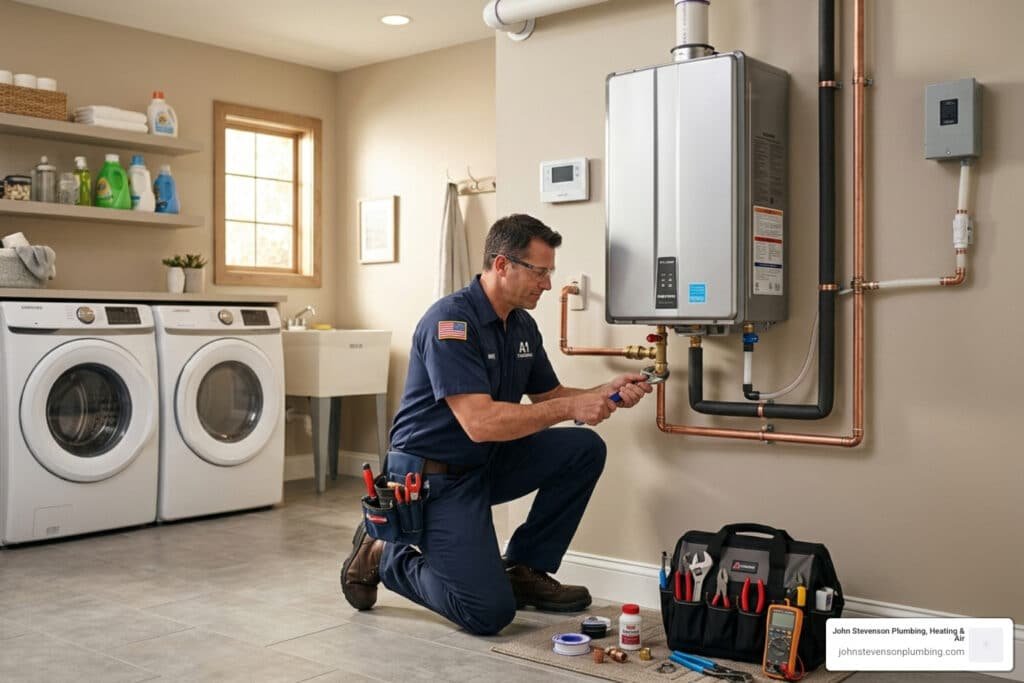
Are Tankless Water Heaters Worth It? Pros, Cons, and What Carlsbad Homeowners Need to Know
The tankless water heater pros and cons come up every time a Carlsbad homeowner starts thinking about replacing an aging, inefficient storage tank — and for good reason. Hot water accounts for roughly one-third of the average home’s energy costs, and the decision between going tankless or sticking with a traditional tank model can have a real impact on your utility bills, your comfort, and your home’s long-term value.
Here’s a quick breakdown to answer the core question right away:
Tankless Water Heater Pros:
- Heats water on demand — no standby energy waste
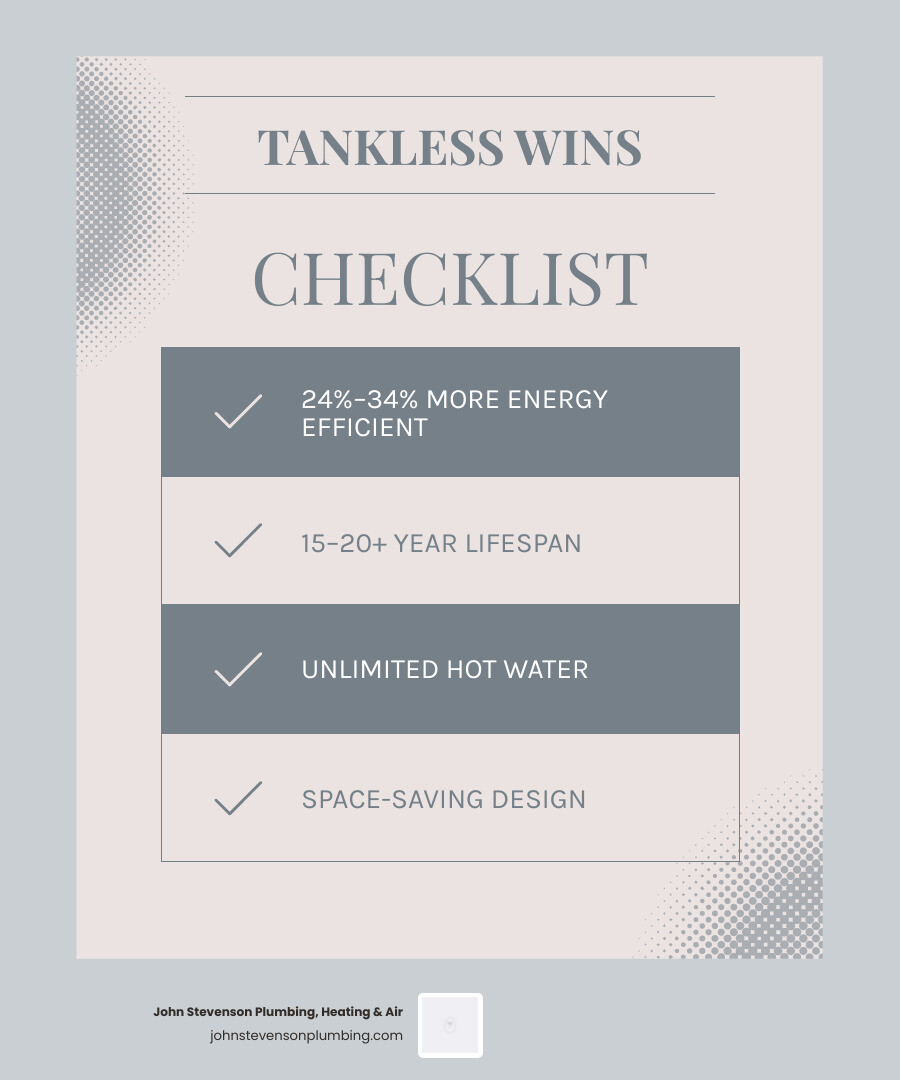
- Can be 24%–34% more energy efficient for average-use households
- Lifespan of 15–20+ years (nearly double a traditional tank)
- Compact, wall-mounted design saves space
- Unlimited hot water supply
- Eligible for a 30% federal tax credit (up to $600 for qualifying models)
Tankless Water Heater Cons:
- Higher upfront and installation costs than tank models
- Limited flow rate (2–5 GPM for electric; 5–10 GPM for gas) can be stretched by simultaneous use
- May require gas line, electrical, or venting upgrades
- Won’t function during a power outage (even gas models)
- Requires annual maintenance to prevent mineral buildup
The right choice depends on your household size, hot water habits, and budget. For many Carlsbad homeowners — especially those in smaller households or with high energy costs — the long-term savings and convenience make tankless systems a smart upgrade. But it’s not a one-size-fits-all decision, and understanding the full picture before you buy is essential.
How On-Demand Water Heating Works in 2026
In 2026, the technology behind water heating has become more sophisticated, yet the core principle remains beautifully simple. Unlike a traditional unit that keeps 40 to 80 gallons of water hot all day (even while you’re at work or sleeping), a tankless system only springs into action when you turn on a faucet.
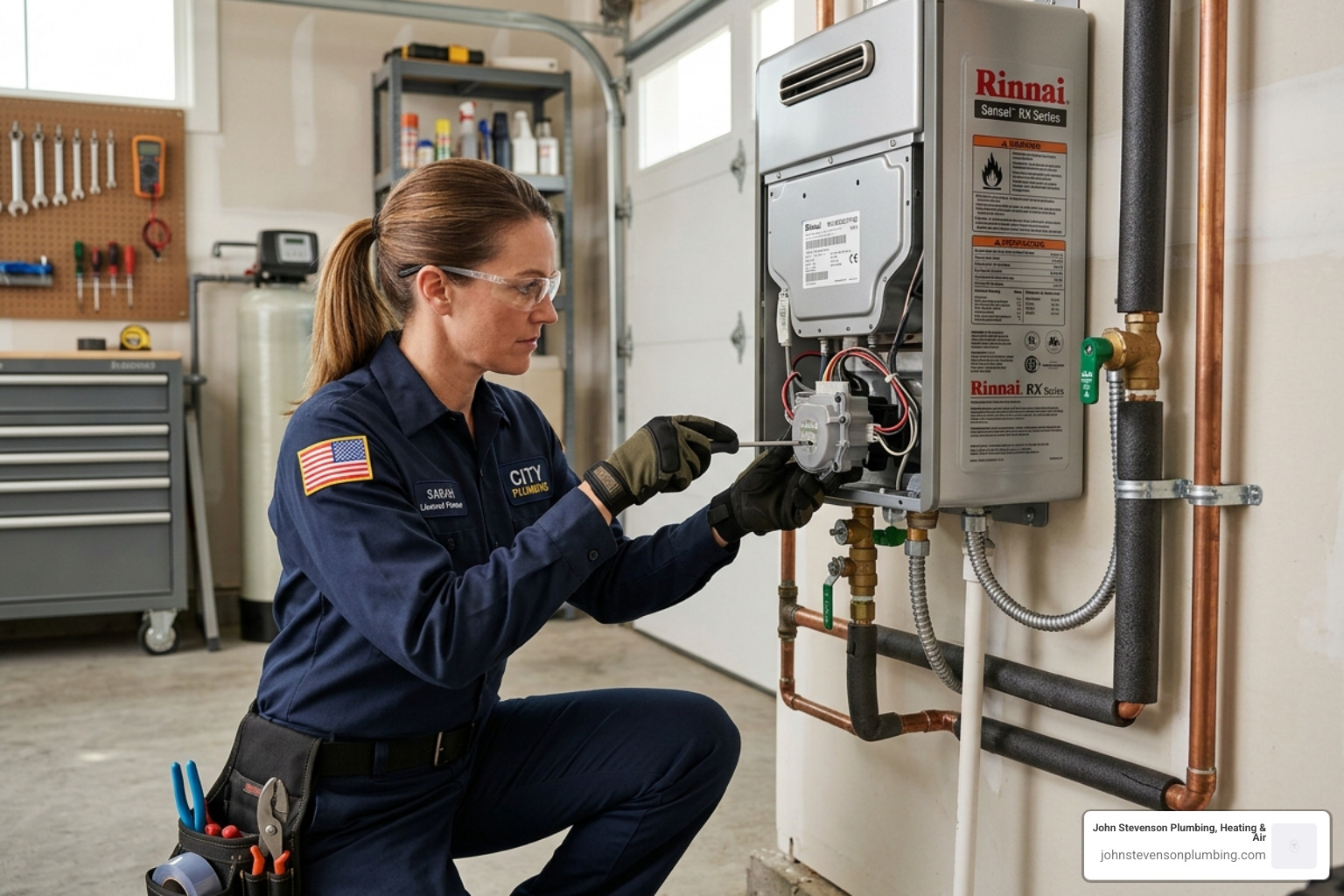
When you open a hot water tap, a flow sensor detects the movement of water entering the unit. This triggers the “on-demand” heating process. In a gas-fired model, a powerful burner ignites, and the cold water travels through a heat exchanger—a series of coils that absorb the heat and transfer it directly to the water. In electric models, high-powered electric coils do the heavy lifting.
This instantaneous process eliminates “standby loss,” which is the energy wasted by traditional tanks to keep water hot 24/7. Because there is no tank to deplete, you don’t run out of hot water in the middle of a shower. However, the water that was already sitting in your pipes will still be cool, so you’ll experience a brief wait for the hot water to travel from the unit to your fixture. If you’re interested in how these systems integrate with your current setup, our Tankless Water Heater Services can provide a clear picture of the installation process.
The Top Benefits of Switching to a Tankless System
When we talk to homeowners in San Diego and Orange County, the excitement usually centers around one thing: never having to take a cold shower again. But the benefits go far beyond just comfort.
- Endless Hot Water: Since the water is heated as it flows, you aren’t limited by the size of a tank. If you have back-to-back guests or a large family, everyone gets a hot shower.
- Space-Saving Design: Traditional tanks are bulky and often take up a large footprint in a garage or utility closet. Tankless units are roughly the size of a small suitcase and are wall-mounted, freeing up valuable floor space for storage.
- Double the Lifespan: While a standard tank might last 8 to 12 years before it starts to rust or leak, a well-maintained tankless unit can easily last 20 years or more. Many models are built with replaceable parts, meaning we can often repair them rather than replacing the whole system.
- Superior Energy Efficiency: According to the U.S. Department of Energy, these units can be 24%–34% more energy efficient for homes using 41 gallons or less of hot water daily. Even for high-use homes (around 86 gallons a day), they remain 8%–14% more efficient.
- Reduced Risk of Water Damage: Without a 50-gallon tank of water sitting in your home, the risk of a catastrophic tank failure flooding your house is virtually eliminated.
For those in areas like Mission Viejo or San Marcos, choosing Tankless Water Heaters is often seen as a long-term investment in the home’s infrastructure.
Understanding the Tankless Water Heater Pros and Cons Before You Buy
While the benefits are impressive, we believe in giving our neighbors a balanced view. Weighing the tankless water heater pros and cons means looking at the logistical hurdles alongside the perks.
One of the primary “cons” is the initial investment. Because these units require high-powered burners or electric elements, the equipment itself is more complex. Additionally, the installation can be more involved. If you’re switching from a tank to a tankless model, we may need to upgrade your gas line to handle the higher BTU requirement or install a new venting system. For electric models, your home’s electrical panel might need an upgrade to support the high-amperage circuit.
Another consideration is the “flow rate.” Every unit has a maximum number of gallons per minute (GPM) it can heat. If you try to run the dishwasher, the washing machine, and two showers simultaneously, the unit might struggle to keep up, leading to a drop in water temperature. This is why proper sizing is the most critical step in the process. You can learn more about how we handle these complexities by visiting our page on Tankless Water Heaters.
Comparing Tankless vs. Traditional Storage Tank Models
To help you visualize the differences, we’ve put together this comparison based on typical performance in Southern California homes.
| Feature | Tankless Water Heater | Traditional Tank Heater |
|---|---|---|
| Average Lifespan | 20+ Years | 8–12 Years |
| Energy Efficiency | High (No standby loss) | Lower (Standby loss occurs) |
| Hot Water Supply | Continuous/Endless | Limited to tank size |
| Space Required | Minimal (Wall-mounted) | Large (Floor-standing) |
| Maintenance | Annual flushing required | Minimal (Anode rod checks) |
| Installation | Complex (Venting/Gas/Electric) | Simple (Plug and play) |
| Power Outage | No hot water (needs electricity) | Hot water remains in tank |
Many modern tankless systems carry the Energy Star certification, making them eligible for federal tax credits. As of 2026, Energy Star gas tankless heaters can qualify for a 30% federal tax credit, often capping at $600. This helps offset the initial investment and speeds up the “payback period,” which typically ranges from 3 to 7 years depending on your usage.
Maintenance and Sizing for Southern California Homes
In coastal cities like Oceanside and Del Mar, water quality plays a huge role in how your appliances perform. Southern California is known for “hard water,” which contains high levels of minerals like calcium and magnesium.
When hard water is heated, these minerals can crystallize and form “scale” inside the heat exchanger. If left unaddressed, this buildup acts as an insulator, forcing the unit to work harder and eventually causing it to fail. To protect your investment, annual flushing and descaling are mandatory. This involves circulating a food-grade vinegar solution through the unit to dissolve mineral deposits.
Sizing is equally important. We calculate the right size based on your “peak demand.”
- 1–2 Fixtures: Usually requires a 3.5 GPM unit.
- 2–3 Fixtures: Typically needs a 5 GPM unit.
- 3–4 Fixtures: Requires 7+ GPM, often found in larger gas-fired models.
We also have to choose between condensing and non-condensing models. Condensing units are more efficient because they use a second heat exchanger to capture heat from the exhaust gases. This also allows them to be vented with cheaper PVC pipe rather than expensive stainless steel, which is often a better fit for homes in Rancho Santa Fe or Newport Beach.
Frequently Asked Questions
How long do tankless water heaters last compared to tank models?
Tankless water heaters are built for the long haul. Most high-quality models have a life expectancy of more than 20 years. In contrast, traditional storage water heaters usually last between 8 and 12 years. Because tankless units don’t store water, they aren’t subject to the same internal rust and corrosion that eventually kills tank models. Furthermore, almost every part of a tankless unit is replaceable, whereas a leaking tank usually means the entire heater is headed for the scrap yard.
What are the tankless water heater pros and cons for large families?
For a large family, the biggest “pro” is the endless supply of hot water. No more fighting for the first shower in the morning! However, the “con” is the limit on simultaneous use. If you have a household of five or more, we may recommend a high-output gas model or even two units installed in parallel to ensure that multiple showers and appliances can run at the same time without anyone getting a “cold water sandwich” (a brief burst of cold water between hot streams).
Are there specific tankless water heater pros and cons regarding maintenance?
Yes. The main “con” is that maintenance is not optional. While you might ignore a tank heater for a decade, a tankless unit in a hard-water area like Carlsbad will lose efficiency quickly without an annual flush. The “pro” is that this maintenance allows the unit to maintain its high efficiency for its entire 20-year lifespan, ensuring your utility bills stay low and your warranty remains valid. Many manufacturers actually require proof of maintenance for warranty claims related to scale buildup.
Conclusion
Deciding between a tank and a tankless system is a big step toward a more efficient home. While the tankless water heater pros and cons show that these systems require a bit more care and a higher initial commitment, the rewards of lower bills, extra space, and never-ending hot water are hard to beat.
At John Stevenson Plumbing, Heating & Air Conditioning, we specialize in helping homeowners across San Diego and Orange Counties find the perfect fit for their needs. Whether you’re in Carlsbad, Irvine, or Vista, our certified technicians provide thorough diagnostics and upfront pricing to ensure you get the best performance out of your new system. With our 5-Star Service Guarantee and 24-hour satisfaction check-ins, you can rest easy knowing your home’s comfort is in expert hands.
Ready to make the switch? Schedule your tankless water heater service today and experience the convenience of on-demand hot water.