
The Water Heater Decision Every Carlsbad Homeowner Eventually Faces
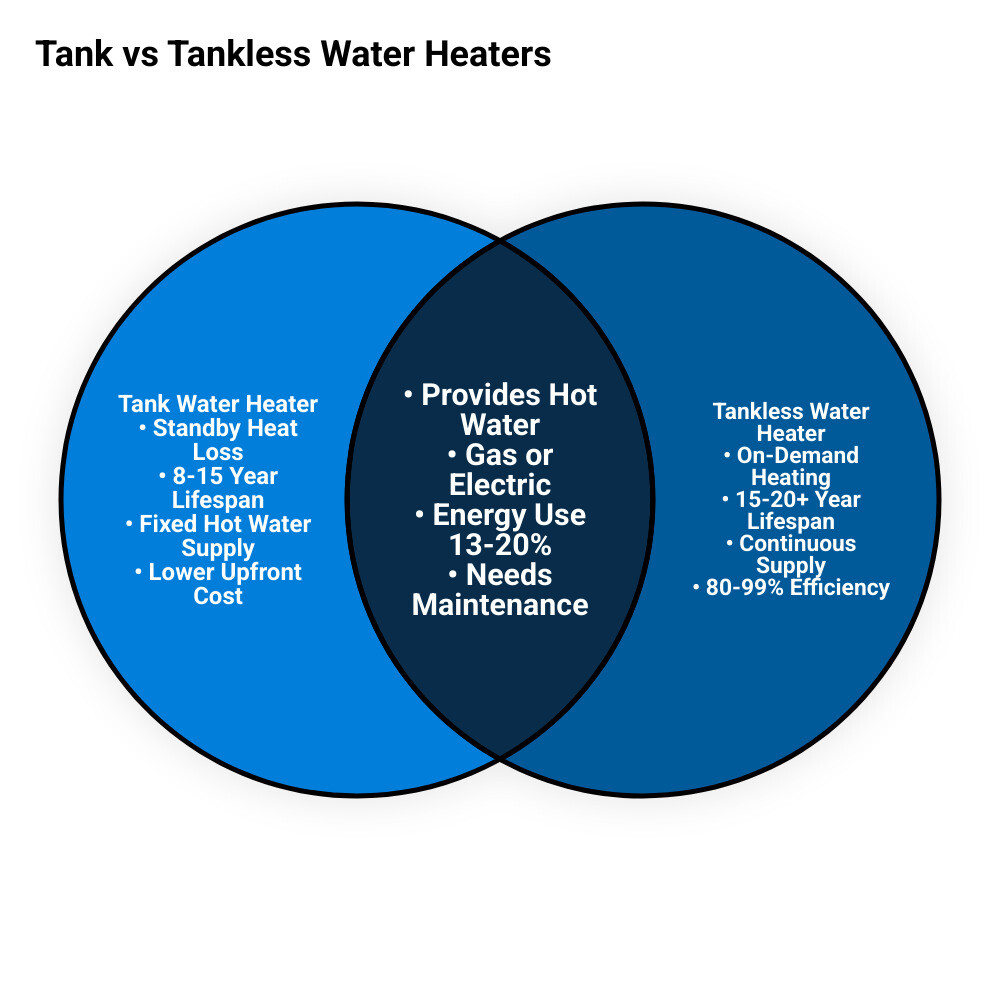
A tankless vs tank water heater comparison comes down to a few key factors: upfront cost, energy efficiency, hot water capacity, and how long you plan to stay in your home. Here’s a quick breakdown to help you decide:
| Factor | Tank Water Heater | Tankless Water Heater |
|---|---|---|
| How it works | Stores and reheats water continuously | Heats water on demand only |
| Energy efficiency | 40–65% | 80–99% |
| Lifespan | 8–15 years | 15–20+ years |
| Hot water supply | Limited by tank size | Continuous (flow-rate dependent) |
| Best for | Larger households, tight budgets | Smaller homes, long-term savings |
| Key drawback | Standby heat loss raises bills | Higher upfront cost, complex install |
Water heating accounts for roughly 13–20% of your home’s total energy use — making this one of the most financially significant appliance decisions you’ll make. Yet about 90% of water heater replacements happen during emergencies, leaving homeowners little time to compare options carefully.
If you’re a homeowner in Carlsbad, CA, that kind of rushed decision can cost you — either in higher monthly energy bills or in a system that doesn’t fit your household’s actual hot water needs.
The good news? You don’t have to figure this out alone. The sections below walk you through everything you need to know to make a confident, informed choice.
How Storage and On-Demand Systems Work
To make a smart tankless vs tank water heater comparison, we first need to look under the hood. While both systems aim to give you a comfortable shower, they take very different paths to get there.
The Traditional Storage Tank
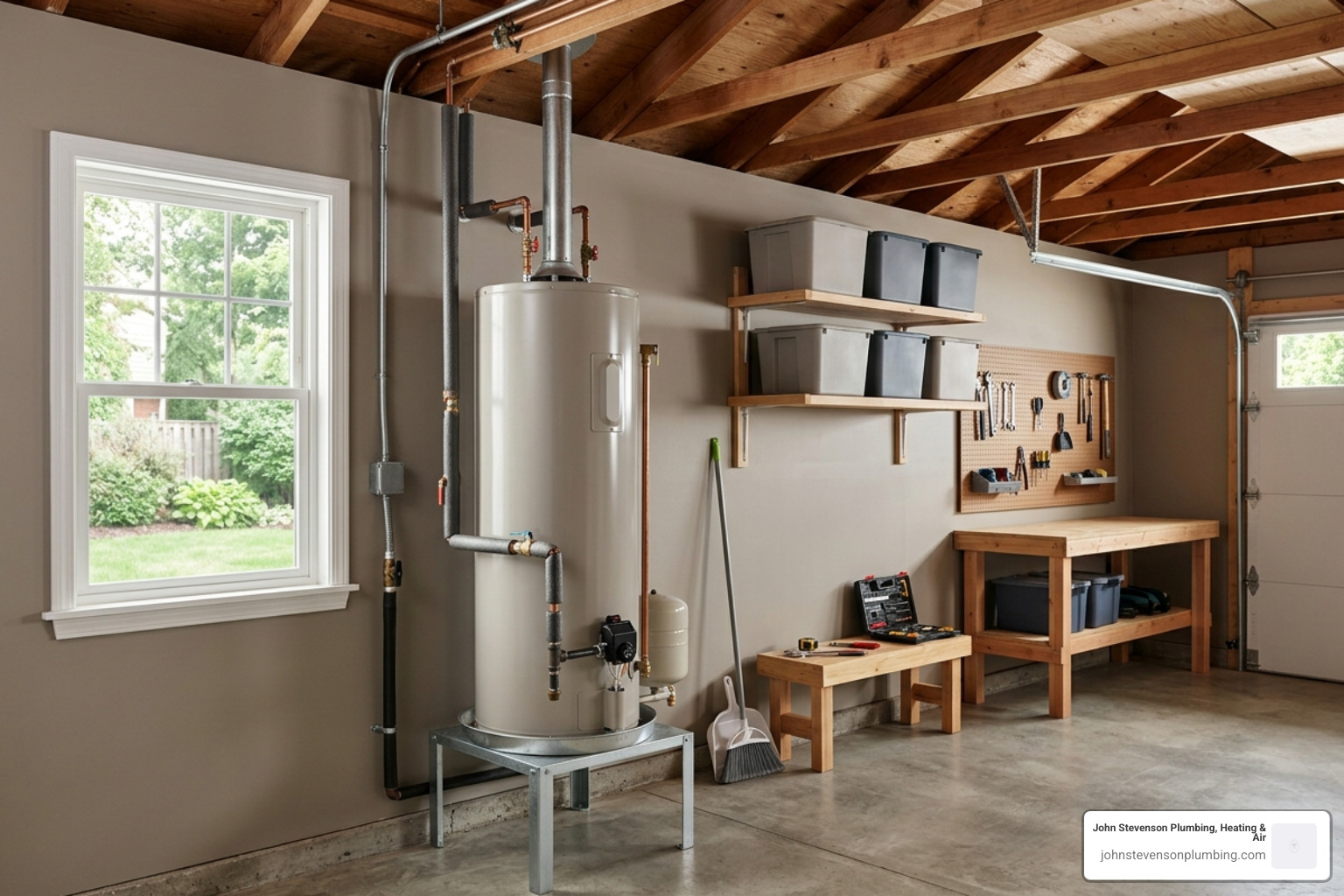
Think of a traditional Water Heater as a large, insulated thermos. Whether it uses gas or electricity, its job is to keep a specific volume of water—usually between 40 and 80 gallons—at a set temperature (typically 120°F to 140°F) 24 hours a day.
When you turn on the tap, hot water is drawn from the top of the tank, and cold water enters the bottom to be heated. The biggest downside here is “standby heat loss.” Even when you’re sleeping or at work, the unit is burning energy to keep that water hot. It’s like keeping your car idling in the driveway just in case you decide to go for a drive later.
The On-Demand Tankless System
Tankless units, often called “demand-type” heaters, ditch the big tank entirely. Instead, they use a high-powered heat exchanger. When you flip the hot water handle on your faucet, a flow sensor detects the movement and triggers the heating elements (electric) or the gas burner.
The water travels through a series of heated coils, reaching your desired temperature almost instantly. Because there is no storage tank, there is no standby heat loss. You only pay to heat the water you actually use. This “just-in-time” delivery system is why tankless units are roughly the size of a carry-on suitcase and can be mounted on a wall, saving significant floor space in your garage or utility closet.
Tankless vs Tank Water Heater Comparison: Performance and Efficiency
When we look at the data for April 2026, the efficiency gap between these two technologies is wider than ever.
| Performance Metric | Traditional Tank | Tankless System |
|---|---|---|
| Energy Efficiency (UEF) | 0.50 – 0.70 | 0.80 – 0.99 |
| Annual Energy Savings | Base Level | $100 – $124 avg. |
| Typical Lifespan | 10 – 15 Years | 20 – 30 Years |
| Space Required | ~9–12 sq. ft. floor space | Wall-mounted, compact |
Efficiency is measured by the Uniform Energy Factor (UEF). The higher the number, the more efficient the unit. Tankless Water Heaters consistently outperform tanks because they don’t have to fight the constant cooling of stored water. For homes in San Diego County that use 41 gallons or less of hot water daily, tankless models can be 24% to 34% more energy-efficient than traditional tanks.
Tankless vs tank water heater comparison: Flow rates and simultaneous use
Performance isn’t just about efficiency; it’s about how the water feels when you’re actually using it. This is where the “flow rate” becomes critical.
- Tank Performance: A tank provides a high initial “burst” of hot water. You can often run two showers and the dishwasher at once because the hot water is already sitting there waiting. However, once that 50-gallon tank is empty, you face a “recovery time.” It can take 30 to 60 minutes for a gas tank to reheat, and even longer for electric models.
- Tankless Performance: A tankless unit provides an endless supply. You could theoretically shower for five hours and never run out of hot water. The trade-off is the flow rate, measured in Gallons Per Minute (GPM). Most residential units provide 2 to 5 GPM. If you try to run multiple showers and the laundry at the same time, the unit might struggle to keep up, leading to a drop in temperature or water pressure.
One common quirk of tankless systems is the “cold water sandwich.” This happens when you turn the water off and back on quickly. A small “slug” of cold water that was in the pipes before the heater re-ignited can make its way to your showerhead. Modern, high-end units have largely solved this with small internal buffer tanks, but it’s a factor to consider in your tankless vs tank water heater comparison.
Tankless vs tank water heater comparison: Energy efficiency and standby loss
Standby loss is the silent budget-killer of the plumbing world. Traditional tanks lose heat through the walls of the tank and through the pipes. In contrast, Tankless Water Heater Services eliminate this entirely.
For gas-powered units, look for “condensing” technology. These models use a second heat exchanger to capture heat from the exhaust gases that would otherwise be wasted. This can push efficiency levels up to 98%. Additionally, modern tankless units use electronic ignition rather than a standing pilot light, ensuring that no gas is wasted when the heater isn’t in use.
Maintenance and Lifespan: Protecting Your Investment
Whether you choose a tank or tankless, your system is only as good as the maintenance it receives. In Southern California, our water can be “hard,” meaning it contains high levels of minerals like calcium and magnesium.
- Tank Maintenance: To prevent sediment from settling at the bottom and insulating the heating element, you should flush your tank every 6 to 12 months. You also need to check the “anode rod”—a sacrificial metal rod that attracts corrosion so the tank doesn’t rust. Replacing this rod every 3 to 5 years can significantly extend the life of your Water Heater Installation.
- Tankless Maintenance: These units are sensitive to scale. When water is flash-heated, minerals can bake onto the heat exchanger. We recommend a professional “vinegar flush” or descaling procedure once a year. This involves pumping a food-grade acid through the unit for about 45 minutes to clear out mineral deposits. Ignoring this can lead to the heat exchanger overheating and eventually cracking.
Long-term durability and reliability
If you are planning on staying in your Carlsbad home for the long haul, the lifespan of the unit is a major factor.
- Traditional Tanks: Usually last 8 to 12 years. Because they are constantly holding water, corrosion is an inevitable enemy. When a tank fails, it often leaks or bursts, which can lead to significant water damage.
- Tankless Units: Designed to last 20 to 30 years. Most components are modular and can be replaced individually. This means if a single part breaks, you don’t necessarily have to replace the whole unit. This makes Water Heater Repair more viable for tankless systems over the decades.
Choosing the Right System for Your Carlsbad Home
Selecting the right system involves more than just picking the most efficient model. You have to look at your home’s infrastructure. If you’re looking for Water Heater Repair in Lake Forest, you might find that your current setup is better suited for one type over the other.
Decision factors for Southern California residents
Here in Carlsbad and surrounding areas like Oceanside or Encinitas, we have a few unique advantages and challenges:
- Groundwater Temperature: Our groundwater is relatively warm compared to the Midwest. This means a tankless unit doesn’t have to work as hard to raise the water to 120°F, allowing for higher GPM flow rates even in the winter.
- Space Constraints: Many Southern California homes have water heaters located in tight laundry closets or crowded garages. The space-saving nature of a tankless unit can be a game-changer for organization.
- Gas Line Capacity: This is a big one. A traditional tank uses about 40,000 BTUs. A tankless unit can require up to 199,000 BTUs to heat water on demand. This often means we need to upgrade your gas line from a 1/2-inch to a 3/4-inch pipe to ensure the unit gets enough fuel.
- Venting: Tankless units produce hotter exhaust and require specialized stainless steel or PVC venting. You can’t always use the same vent pipe that your old tank used.
- Local Incentives: As of 2026, many local utility companies in San Diego and Orange County offer rebates for high-efficiency Water Heater Installation in Lake Forest and surrounding cities. These can help offset the initial investment.
Frequently Asked Questions
Is a tankless system better for a large family?
It depends on how you use water. If your family takes back-to-back showers, a tankless unit is a lifesaver because it never runs out of hot water. However, if everyone tries to shower at the exact same time while the dishwasher is running, a single tankless unit might hit its flow limit. For very large households, we sometimes install two tankless units in parallel or use a high-capacity model to ensure everyone stays comfortable.
How does hard water affect my water heater choice?
Hard water is the “kryptonite” of tankless heaters. If your home has hard water, the mineral scale will build up quickly on the heat exchanger, reducing efficiency and potentially voiding your warranty. If you choose tankless, we strongly recommend a water softener or a scale-prevention system to protect your investment. Traditional tanks also suffer from hard water, but they are slightly more “forgiving” of sediment buildup in the short term.
Can I replace my existing tank with a tankless unit?
Yes, but it is rarely a simple “swap.” Retrofitting requires modifications to your gas lines, venting, and sometimes your electrical panel (to power the unit’s computer and fans). This is why professional installation is non-negotiable. Our team at John Stevenson Plumbing, Heating & Air Conditioning handles these complexities every day, ensuring your new system meets all local Carlsbad building codes and safety standards.
Conclusion: Expert Guidance for Your Home
Choosing between a tank and a tankless system doesn’t have to be a headache. At John Stevenson Plumbing, Heating & Air Conditioning, we’ve spent decades helping homeowners across Carlsbad, San Diego, and Orange County find the perfect fit for their lifestyles.
Whether you need a quick repair on an aging tank or are ready to upgrade to a high-efficiency on-demand system, our 5-Star Service Guarantee ensures you get thorough diagnostics and upfront pricing. Our certified technicians will walk you through a personalized tankless vs tank water heater comparison based on your home’s unique layout and your family’s needs.
Don’t wait for a leak to force your hand. Contact us today for expert Water Heater Services and experience the peace of mind that comes with professional, local expertise.