
How Long Does a Water Heater Last? What Carlsbad Homeowners Need to Know First
How long does a water heater last depends on the type of unit you have, but here’s a quick answer before we dive deeper:
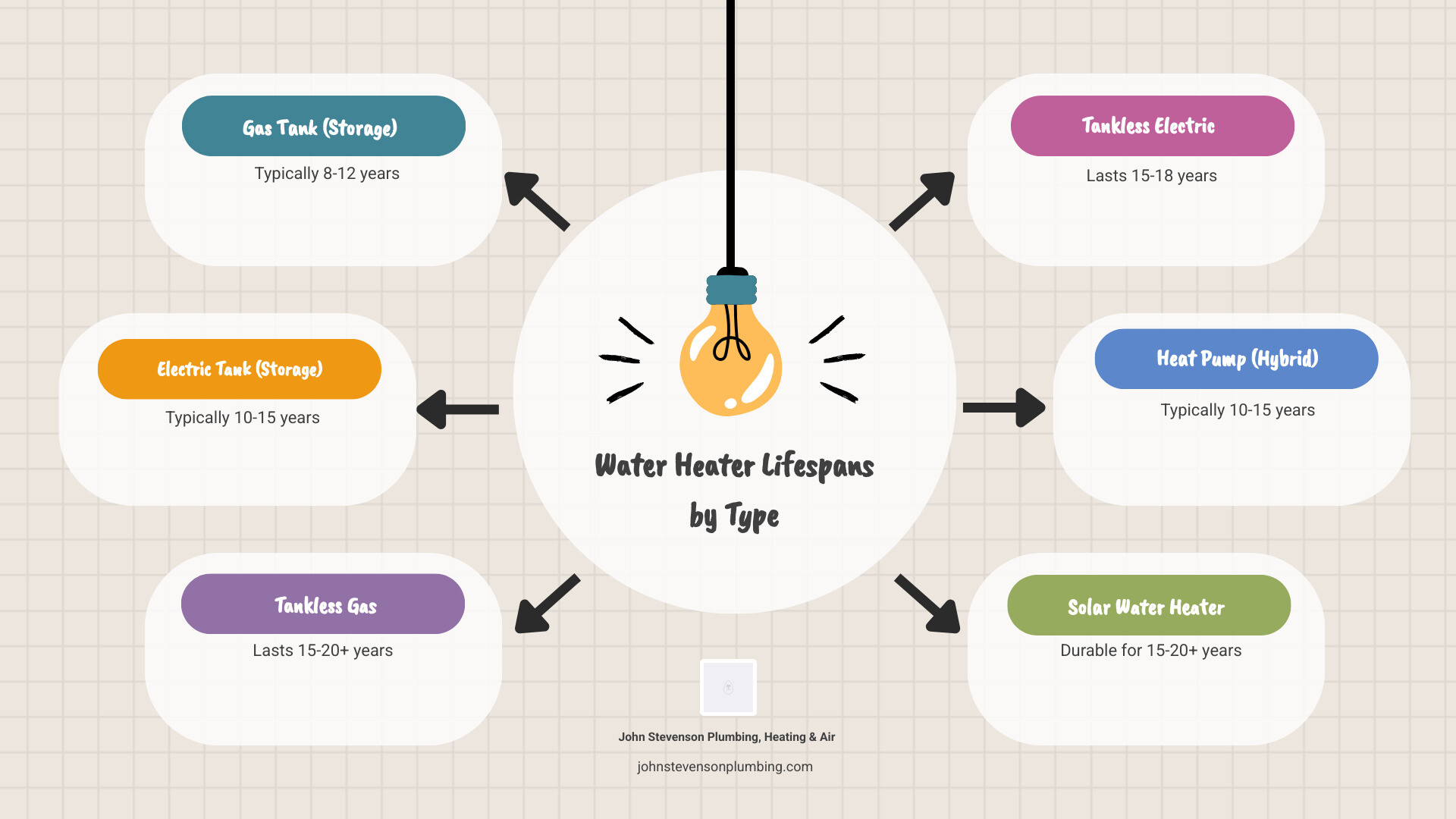
| Water Heater Type | Typical Lifespan |
|---|---|
| Gas tank (storage) | 8–12 years |
| Electric tank (storage) | 10–15 years |
| Tankless gas | 15–20+ years |
| Tankless electric | 15–18 years |
| Heat pump (hybrid) | 10–15 years |
| Solar water heater | 15–20+ years |
Most homeowners in Carlsbad, CA are running a conventional tank-style unit — and most of those last somewhere between 8 and 12 years. After that window, performance drops, energy bills climb, and the risk of a leak or full breakdown goes up fast.
That’s the short version. But if your unit is aging, making strange noises, or you’re not sure how old it even is, the details below can help you figure out exactly where you stand — and what to do about it.
There is nothing quite like stepping into a cold shower on a weekday morning to remind you how much you depend on your water heater. It runs quietly in the background every day, heating water for showers, dishwashing, and laundry — until it doesn’t. For most households, the water heater only gets attention when something goes wrong. By then, the options are often limited and the timing is never convenient.
Understanding how long your water heater should last — and what can cut that lifespan short — puts you back in control. Whether your unit is brand new or pushing 10 years old, knowing what to expect helps you plan ahead instead of reacting to a crisis.
How Long Does a Water Heater Last on Average?
When we talk about the average Water Heaters, we are generally looking at a window of 8 to 12 years for traditional tank systems. This is the industry standard cited by the U.S. Department of Energy and most major manufacturers like A.O. Smith. However, “average” is a tricky word in plumbing.
In April 2026, modern standards for home efficiency are higher than ever, but the physics of heating water remains the same. Several factors dictate whether your unit hits the 8-year mark or sails past 12 years. These include the manufacturing quality of the unit, the precision of the initial installation, and the environment where the heater lives. For instance, a unit tucked away in a humid crawl space or a cold garage in Fallbrook might work harder and corrode faster than one in a conditioned utility closet.
Regional water conditions also play a massive role. In Southern California, we often deal with mineral-heavy water that can act like sandpaper on the internal components of a heater, potentially shortening its life by up to 30%.
Lifespan of Gas vs. Electric Tank Models
There is a slight but notable difference between gas and electric storage units. Gas-fired units typically have a lifespan of 8 to 12 years. The primary reason they sometimes fail earlier than electric models is the burner assembly. The constant cycle of heating and cooling the bottom of the tank can lead to metal fatigue and accelerated corrosion in the burner chamber.
Electric resistance heaters, on the other hand, often last between 10 and 15 years. Because they use internal heating elements rather than an open flame at the base, the tank itself isn’t subjected to the same level of direct thermal stress. However, electric models are highly susceptible to scale buildup on the heating elements. When minerals encrust the elements, they have to run longer and hotter to heat the water, which can eventually lead to a burnout. If you are noticing a drop in performance, our Water Heater Services can help diagnose whether it’s a simple element swap or a sign of a failing tank.
How Long Does a Water Heater Last if it’s Tankless?
If you are looking for longevity, Tankless Water Heaters are the clear winners. Because these systems heat water on demand rather than maintaining a large standing pool of hot water, they avoid the constant corrosive environment that plagues tank models.
A well-maintained tankless unit can easily last 15 to 20 years, and some even push past the 25-year mark. They typically feature high-quality copper heat exchangers and modular components that can be replaced individually. This means if a single part fails, you don’t necessarily have to scrap the whole system. For homeowners in Mission Viejo or Irvine looking for a long-term investment, our Tankless Water Heater Services offer a path to nearly double the lifespan of a traditional heater.
Longevity of Hybrid and Solar Systems
As we move toward greener technology in 2026, hybrid and solar options have become more popular in San Diego County. Hybrid or heat pump water heaters typically last 10 to 15 years. These units are essentially “plumbing meets HVAC,” using a compressor assembly to pull heat from the air. While they are incredibly efficient, the added mechanical complexity means they require regular filter cleaning and professional check-ups to reach that 15-year goal.
Solar water heaters are the marathon runners of the industry. The solar collector arrays on your roof are built to withstand the elements and can last 20 years or more. However, the backup storage tank that sits inside your home still follows the rules of conventional tanks, usually needing a Water Heater Installation for the tank portion every 10 to 15 years.
Key Factors That Influence Your Unit’s Lifespan
Why does one neighbor’s heater last 15 years while yours gives up at 7? It usually comes down to what’s happening inside the pipes. The biggest enemy of water heater longevity in Southern California is water hardness. Our local water is often rich in calcium and magnesium. When this water is heated, these minerals solidify and settle at the bottom of the tank.
This sediment acts as an insulator, forcing the burner or element to work much harder to heat the water through the layer of “rock” at the bottom. This leads to overheating, metal fatigue, and eventually, the tank cracking. If you live in an area with particularly hard water, such as Oceanside, you might find that Water Heater Repair in Oceanside becomes a frequent necessity if maintenance is ignored.
Other factors include:
- Thermostat Settings: Many units ship with a default setting of 140°F, but we recommend 120°F. Not only does this prevent scalding, but it also slows down mineral accumulation and reduces the internal pressure on the tank.
- Thermal Expansion: As water heats, it expands. If your plumbing system is “closed,” this expansion can create immense pressure that stretches the tank.
- Usage Frequency: A household of six taking back-to-back showers puts significantly more stress on a unit than a single-occupant home.
The Role of the Sacrificial Anode Rod
If your water heater were a person, the anode rod would be its immune system. This long metal rod, usually made of magnesium or aluminum, hangs inside the tank. Through a scientific process called electrolysis, the rod “sacrifices” itself by attracting corrosive particles in the water. The water attacks the rod instead of the steel lining of your tank.
Most anode rods last about 3 to 5 years. Once the rod is completely dissolved, the water begins to eat the tank itself. This is why we emphasize Water Heater Repair that includes a rod inspection. Replacing a $50 rod every few years can easily add 3 to 5 years to the life of a multi-thousand-dollar heater.
Warning Signs Your Water Heater is Failing
Your water heater will usually try to tell you it’s struggling before it finally quits. Learning to listen (and look) can save you from a flooded garage.
- Rusty-Colored Water: If your hot water looks like tea but the cold water is clear, it’s a sign that the inside of your tank is rusting away.
- Rumbling or Popping Noises: This is the sound of sediment. As water gets trapped under the layer of mineral scale and boils, it creates “mini-explosions” that sound like popcorn or banging.
- Inconsistent Temperatures: If your shower goes from hot to lukewarm in five minutes, your heating elements or burner may be failing. For residents in Rancho Bernardo, Water Heater Repair in Rancho Bernardo can often address these issues before they lead to a total shutdown.
- Metallic Taste or Smell: If your water smells like rotten eggs or tastes like pennies, it’s likely a reaction between the bacteria in the water and a failing anode rod or a corroding tank lining. This is a common complaint we hear when performing Water Heater Repair in Ramona.
How Long Does a Water Heater Last Before Leaking?
Most water heaters will reach a “replacement advisory threshold” between year 10 and 12. While a tank might not burst dramatically, it often develops hairline fractures due to years of thermal expansion and contraction.
If you notice moisture accumulation around the base of the unit, don’t ignore it. It could be a simple valve failure, or it could be the “slow weep” of a dying tank. In coastal areas like Torrey Pines, salt air can also accelerate external corrosion. If you’re seeing puddles, it’s time to look into Water Heater Installation in Torrey Pines to prevent a catastrophic failure that could ruin your floors.
Maintenance Strategies to Extend Service Life
The secret to making a water heater last 15 years instead of 8 is remarkably simple: maintenance. We recommend an annual “tune-up” for all storage tank units.
- Annual Tank Flushing: This involves draining the tank to wash out the accumulated sediment. In places like Mission Viejo, where mineral content can be high, our Water Heater Services in Mission Viejo focus heavily on this step to keep units running efficiently.
- T&P Valve Testing: The Temperature and Pressure relief valve is a safety device. If the tank over-pressurizes, this valve opens to prevent an explosion. We test this annually to ensure it hasn’t seized shut.
- Anode Rod Checks: As mentioned, we check this every 2 to 3 years and replace it if it’s more than half-dissolved.
- Scale Descaling: For tankless units, we perform a chemical flush to remove scale from the heat exchanger coils. This is vital for maintaining the “on-demand” speed you expect.
If your unit is already showing its age, a professional Water Heater Installation from a certified technician ensures that everything from the venting to the gas lines is up to current 2026 safety codes.
Frequently Asked Questions About Water Heater Longevity
How do I tell how old my water heater is?
You don’t need a time machine to find your unit’s age; you just need the serial number. Most manufacturers encode the date in the first few characters of the serial number on the nameplate. For example, a serial number starting with “A22” might mean January (A) of 2022 (22). If you can’t decode it, just snap a photo of the label and show it to one of our techs during a service call—we can look it up in seconds.
Should I repair or replace my 10-year-old heater?
We generally suggest the “50% Rule.” If the cost of a Water Heater Repair is more than 50% of the cost of a new unit, and the heater is over 8-10 years old, replacement is usually the smarter financial move. Newer units are 20-30% more efficient than those built a decade ago, meaning a new installation often pays for itself in energy savings over time. Plus, units over 55 gallons now have to meet stricter NAECA standards, which might require a different setup than your old “direct swap” unit.
What do water heater warranties actually cover?
Most tank warranties last for 6, 9, or 12 years. These typically cover the tank itself if it leaks due to a manufacturing defect, and sometimes include smaller components like the gas valve or heating elements for a shorter period. It is important to note that most manufacturer warranties do not cover labor costs or damage caused by a leak. Also, many warranties are non-transferable if you buy a home with an existing unit.
Conclusion
At John Stevenson Plumbing, Heating & Air Conditioning, we’ve seen thousands of water heaters throughout Carlsbad, San Diego, and Orange County. We know that how long does a water heater last is often a question of how much care it receives.
Don’t wait for a cold shower or a flooded garage to think about your water heater. Whether you need a quick flush to clear out sediment, a new anode rod to fight off rust, or a full upgrade to a high-efficiency tankless system, our team is here to help. We provide thorough diagnostics and upfront pricing, backed by our 5-Star Service Guarantee.
Ready to ensure your home stays in hot water (the good kind)? Contact us today for our expert Water Heater Services and let our certified technicians give you the peace of mind you deserve.