
Why Hidden Water Leaks Are a Bigger Problem Than Most Homeowners Realize
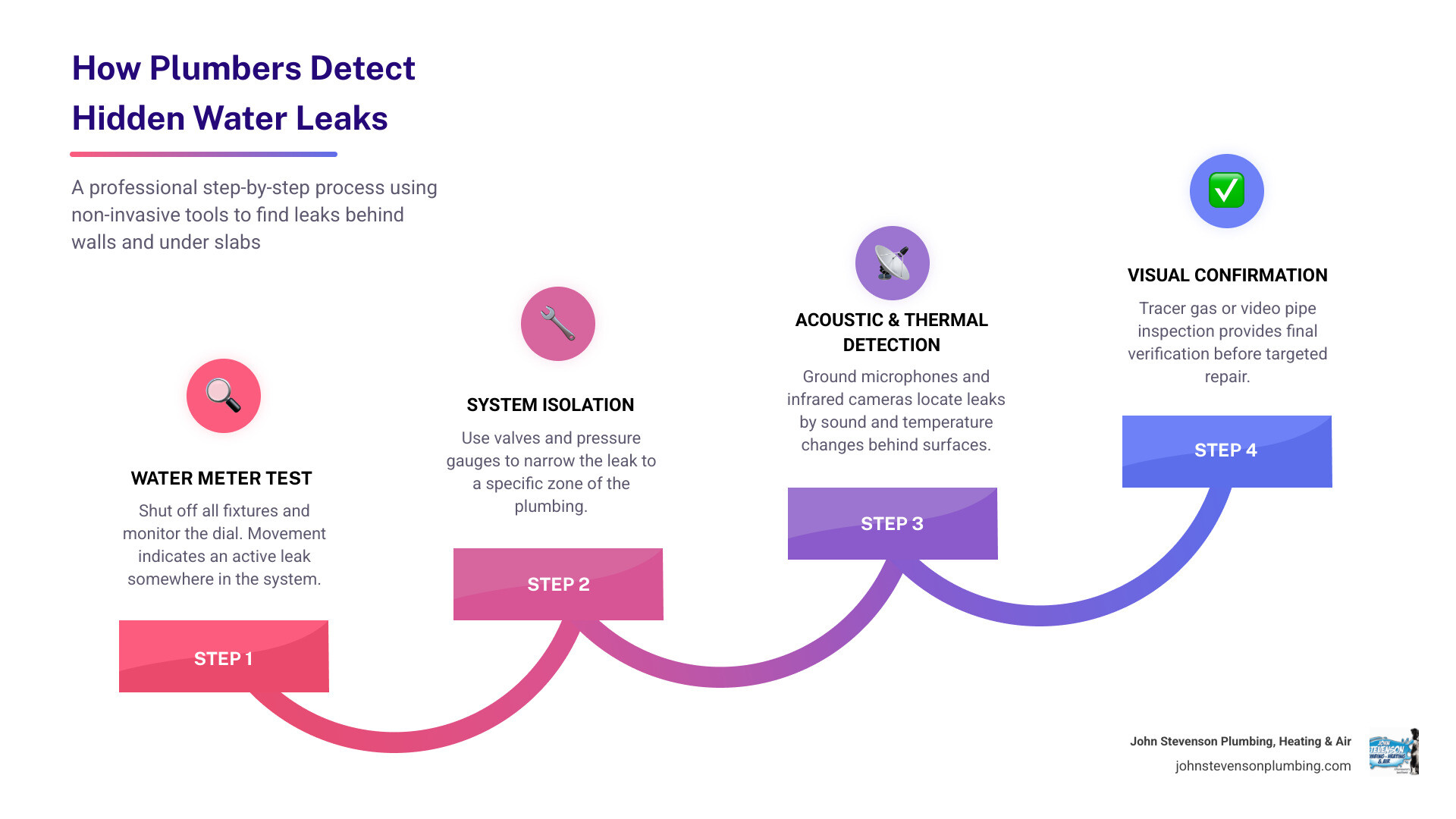
How plumbers find hidden water leaks comes down to a systematic process using specialized tools — here’s a quick overview:
- Water meter test — Shut off all fixtures and watch the meter dial. If it still moves, there’s an active leak.
- System isolation — Plumbers use isolation valves and pressure gauges to narrow the leak to a specific zone.
- Acoustic detection — Ground microphones and listening rods pick up the sound of escaping water through walls, slabs, and soil.
- Thermal imaging — Infrared cameras reveal temperature differences caused by hidden moisture behind walls or under floors.
- Tracer gas detection — A harmless gas mixture is pumped into pipes; a surface probe detects where it rises through the ground.
- Video pipe inspection — A fiber-optic camera travels through pipes to visually confirm cracks or damage in sewer and drain lines.
Water leaks are sneaky. A pinhole crack in a pipe behind your drywall or under your concrete slab can run for months without a single visible drop — and the damage quietly adds up. According to the EPA, household leaks waste nearly 10,000 gallons of water every year on average. Meanwhile, at least one in four building and contents insurance claims is tied to leaking or burst pipes.
For homeowners in Carlsbad, CA, that means a hidden leak isn’t just a plumbing problem — it’s a structural risk, a mold risk, and a financial one. The good news is that modern leak detection methods are precise, largely non-invasive, and far less disruptive than the old approach of tearing open walls and digging up floors to find the source.
This guide walks you through exactly how professionals locate hidden leaks — and what you can do right now to get ahead of the damage.
How plumbers find hidden water leaks definitions:
The Warning Signs of a Hidden Water Leak in Your Home
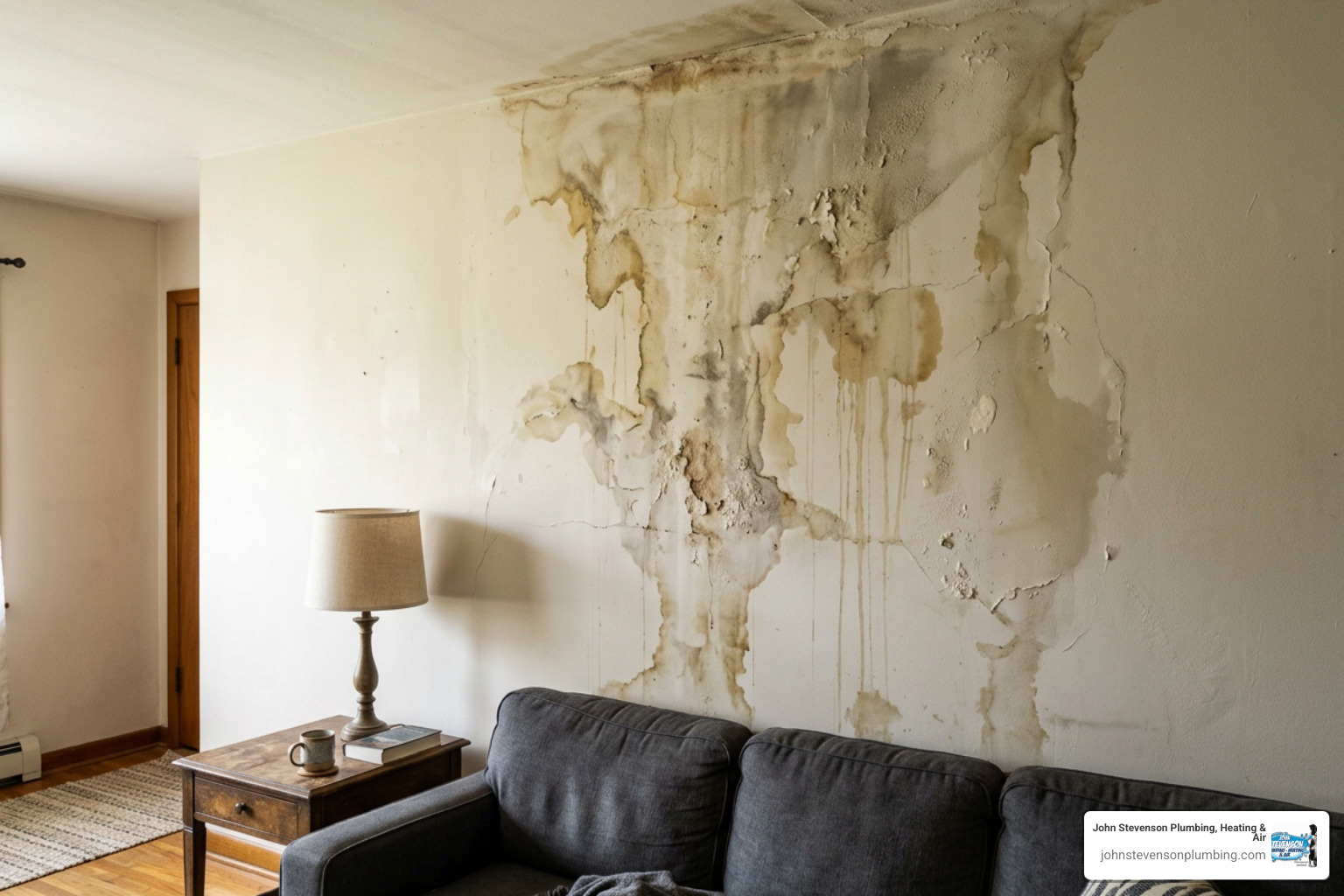
Because water follows the path of least resistance, a leak in your Southern California home might not show up directly where the pipe is broken. Gravity and capillary action can carry water along floor joists, behind drywall, or under concrete slabs, making the actual source a mystery. However, your home will almost always drop clues that something is wrong.
Paying attention to these early warning signs can save you from catastrophic damage:
- Unexplained Water Bill Spikes: If your household water habits haven’t changed but your monthly utility bill is climbing, water is escaping somewhere. A small, silent leak can waste hundreds of gallons of water over time.
- Musty Odors and Mold Growth: Mold thrives in dark, damp environments. If you notice a persistent musty smell in a bathroom, kitchen cabinet, or hallway — even after a thorough cleaning — there is likely moisture trapped behind the wall or under the floor.
- Stained, Bubbling, or Bulging Drywall: When drywall absorbs water, the paint begins to peel, bubble, or discolor. You might see light brown or yellowish rings on your ceiling or walls.
- Warm Spots on the Floor: If you walk barefoot across your tile or concrete slab floor and notice a localized “hot spot,” it is a classic sign of a broken hot water line running beneath the slab.
- Running Water Sounds: When your house is completely quiet, listen closely. If you hear a faint hissing, dripping, or splashing sound when all faucets and appliances are turned off, water is actively moving through your pipes.
- Silent Toilet Leaks: Did you know that more than 20 percent of gravity-flush toilets leak? They often leak silently around a worn-out flapper valve. A simple way to check is by dropping a few drops of food coloring or a dye tablet into the toilet tank. If the color seeps into the bowl within 15 minutes without flushing, you have a leak.
For a deeper dive into protecting your property, read our guide on how to Don’t Ignore These Warning Signs Hidden Water Damage 101.
To catch these issues before they escalate, many homeowners are now installing smart home water sensors and automatic shutoff valves. These devices continuously monitor your plumbing system’s flow rate, pressure, and temperature. If they detect an unusual trend, they can send an instant alert to your smartphone or even shut off your main water valve automatically to prevent a flood.
How Plumbers Find Hidden Water Leaks: The Step-by-Step Isolation Process
When we arrive at a home in Carlsbad or the surrounding San Diego County area, we don’t start by tearing down drywall. Instead, we follow a highly systematic “confirm, isolate, and pinpoint” framework. This ensures we only make a targeted opening where the repair actually needs to happen.
Before we pull out our high-tech equipment, we consider the most common culprits of plumbing leaks:
- Pipe Corrosion: Older homes with copper, galvanized steel, or polybutylene pipes are highly susceptible to corrosion over time, especially in hard water areas.
- High Water Pressure: Pressure exceeding 80 PSI puts immense stress on pipe joints, valves, and appliance connections, leading to sudden ruptures or slow pinhole leaks.
- Faulty Installations: Poorly soldered copper joints or improperly glued PVC fittings can slowly fail years after installation.
- Seasonal Temperature Changes: Even in Southern California’s mild climate, shifting soils and minor thermal expansion can stress underground supply lines.
To keep your system in top shape, check out our Stop the Drip with These Spring Plumbing Inspection Tips.
DIY First Steps: The Homeowner Water Meter Test
Before calling in the pros, you can perform a simple water meter test to confirm whether you have an active leak. This test is highly effective and takes only a few minutes of your time.
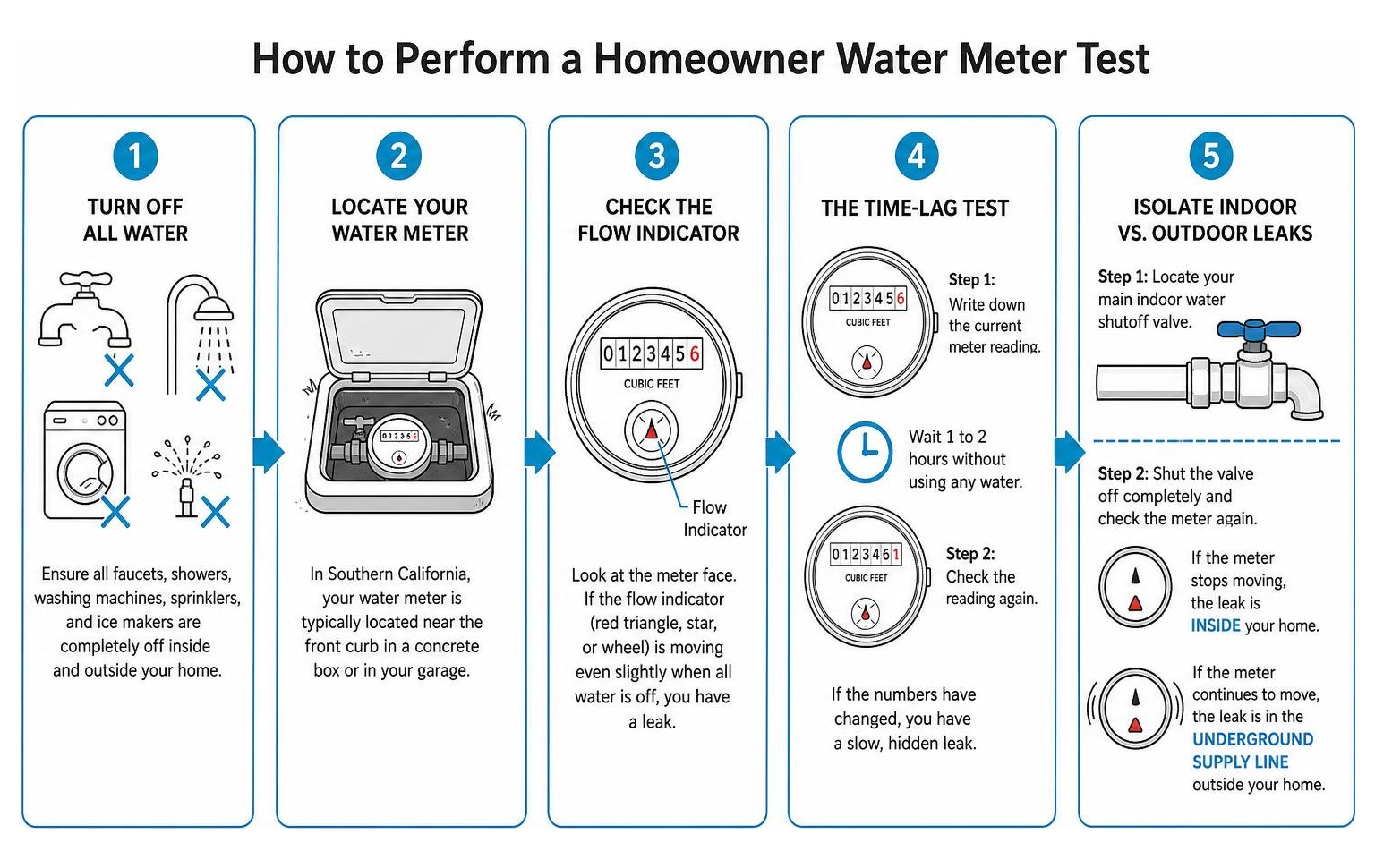
- Turn Off All Water: Ensure all faucets, showers, washing machines, sprinklers, and ice makers are completely off inside and outside your home.
- Locate Your Water Meter: In Southern California, your water meter is typically located near the front curb in a concrete box or in your garage.
- Check the Flow Indicator: Look at the meter face. Many meters have a small, sensitive “flow indicator” — usually a red or white triangle, a small star, or a spinning wheel. If this wheel is spinning even slightly when all water is shut off, you have a leak.
- The Time-Lag Test: If there is no obvious movement, write down the exact meter reading. Wait 1 to 2 hours without using any water, then check the reading again. If the numbers have changed, you have a slow, hidden leak.
- Isolate Indoor vs. Outdoor Leaks: To determine if the leak is inside your home or buried in your yard, locate your main indoor water shutoff valve (usually found near the garage or where the main line enters the house). Shut this valve off completely and check the meter again. If the meter stops moving, the leak is inside your home. If it continues to spin, the leak is in the underground supply line between the meter and your house.
If you have recently experienced heavy weather, you can also cross-reference your findings with our Don’t Get Flooded by Repairs with This Post-Storm Checklist.
System Isolation: How Plumbers Narrow Down the Leak Location
Once we confirm a leak exists, we must isolate the specific zone of the plumbing system. We do this by systematically closing isolation valves to separate different segments of your plumbing.
To narrow down the search, we use specialized test plugs and blocking plugs to seal off specific sections of the pipe network. We then attach a highly sensitive pressure gauge to the isolated system and pressurize it with water or air. If the gauge shows a pressure drop over a short period, we know the leak is located within that specific isolated run of pipe.
Water, Gas, and Air: How Detection Methods Differ by System Type
Plumbing systems carry more than just fresh water. They also handle natural gas, drainage, and ventilation. How plumbers find hidden water leaks differs significantly from how we locate gas or air leaks:
- Water Leaks (Pressurized): Because water is under constant pressure, it creates distinct acoustic vibrations and thermal changes as it escapes. We rely heavily on acoustic listening devices, thermal imaging, and moisture mapping to trace it.
- Gas Leaks: Gas leaks pose immediate fire and safety hazards. We use electronic gas leak detectors (commonly called “sniffers”) that can identify trace amounts of natural gas or carbon monoxide. For exposed joints, we apply a specialized bubble soap leak detector; if gas is escaping, it immediately forms highly visible bubbles. We also perform a manometer pressure check to verify the integrity of the gas line.
- Air and Vent Leaks: For drainage vents or HVAC ductwork, we often use air pressure drop testing or smoke testing to find cracks that allow sewer gases or conditioned air to escape.
To understand the science behind these professional methods, read A Comprehensive Guide to How Leak Detection Technology Works.
Non-Invasive Technology: How Plumbers Find Hidden Water Leaks Without Demolition
The days of tearing down entire walls or jackhammering concrete floors just to find a suspected leak are over. Modern plumbing relies on non-invasive diagnostic tools that allow us to “see” and “hear” through solid surfaces. This approach, often referred to as “trace and access,” is highly favored by insurance companies because it minimizes property damage and keeps repair bills manageable.
Acoustic Listening Devices: Pinpointing Sound Waves Under Concrete Slabs
When pressurized water escapes through a crack or pinhole in a pipe, it generates distinct vibrations and sound waves. These sounds travel through the pipe wall and the surrounding soil or concrete.
To find these leaks, we use advanced acoustic listening equipment, including:
- Listening Rods: Simple mechanical or electronic rods placed in direct contact with valves and fixtures to detect faint leak vibrations.
- Ground Microphones and Deck Plates: Highly sensitive microphones placed on concrete slabs, tile floors, or soil in a grid pattern.
- Acoustic Correlators: Advanced digital systems that place two sensors at different access points on a pipe. By measuring the exact time-lag of the sound wave reaching each sensor, the system mathematically calculates the location of the leak, often pinpointing it to within 15 to 30 centimeters.
Because different materials conduct sound differently — metal pipes conduct high-frequency sounds incredibly well, while PVC and plastic pipes muffle sound — our technicians use electronic filters to isolate the leak’s specific frequency from background noises like traffic, wind, or household appliances.
Thermal Imaging and Tracer Gas: How Plumbers Find Hidden Water Leaks Behind Walls
For leaks hidden behind drywall, plaster, or under wood flooring, we turn to thermal imaging and tracer gas.
- Thermal Imaging (Infrared Cameras): Water absorbs and releases heat differently than dry building materials. When a pipe leaks behind a wall, it creates a temperature signature. An infrared camera displays these subtle temperature variations as a visual map. A cool spot on a warm wall or a hot trail on a cold tile floor quickly guides us to the moisture source, showing us the full extent of the water spread without removing a single piece of drywall.
- Tracer Gas Detection: For incredibly small pinhole leaks or leaks in non-metallic PVC pipes that do not produce strong sound vibrations, we use tracer gas. First, we isolate and completely drain the suspect water line. Then, we pressurize the line with a safe, non-toxic, and lighter-than-air mixture of nitrogen and hydrogen gas. Because hydrogen molecules are incredibly small, they escape through the leak and rise vertically through soil, concrete, and flooring. We sweep a sensitive gas sniffer probe across the floor or ground surface; where the gas concentration spikes, the leak is located.
Video Pipe Inspection and Smoke Testing: How Plumbers Find Hidden Water Leaks in Sewer Lines
Sewer and drain lines are gravity-fed and not under constant pressure, which means they do not make noise or produce thermal patterns like pressurized water lines. To inspect drains and sewer pipes, we use visual and physical testing:
- Video Pipe Inspection: We insert a high-resolution, waterproof fiber-optic camera (an endoscopic camera) directly into your drain lines. As we push the camera through the pipe, it transmits real-time, high-definition video to a monitor. This allows us to visually confirm structural issues like tree root intrusion, cracks, offset joints, or pipe collapses.
- Smoke Testing: If you are dealing with a persistent sewer gas smell but cannot find the source, we use smoke testing. We seal off the sewer line and use a specialized blower to fill the drainage system with a thick, non-toxic, and odorless artificial smoke. If there is a crack in your sewer pipe or a dried-out vent seal behind your wall, the smoke will billow out of the opening, showing us exactly where the repair is needed.
Frequently Asked Questions About Professional Leak Detection
How accurate is acoustic leak detection?
Under the right conditions, acoustic leak detection is highly accurate and can locate a leak to within 15 to 30 centimeters of the actual breach point. Our technicians use advanced digital filtering and statistical analysis to block out environmental background noise, ensuring we only open the floor or wall at the exact spot of the pipe failure.
Will a plumber need to tear down my walls or dig up my floors to find a leak?
No. The diagnostic phase of our service is entirely non-invasive. We use thermal imaging, acoustic sensors, and tracer gases to find the leak without causing any damage. Once the leak is precisely located, we will only make a small, targeted opening in your wall or floor to perform the physical repair, saving you from extensive and costly restoration work.
Does homeowners insurance cover the cost of leak detection?
Many homeowners’ insurance policies in Southern California include “trace and access” coverage. This typically pays for the professional service to locate the hidden leak, as well as the cost of tearing out and replacing drywall or concrete to access the pipe. While the insurance company usually covers the water damage restoration and access costs, the actual repair of the pipe itself is often the homeowner’s responsibility. We recommend checking your specific policy details or speaking with your insurance agent.
Conclusion
Finding a hidden water leak doesn’t have to turn your home into a construction zone. By using non-invasive technologies like acoustic listening, thermal imaging, and tracer gases, professional plumbers can locate the exact point of a leak with surgical precision — protecting your home’s structural integrity and saving you from costly water damage.
At John Stevenson Plumbing, Heating & Air Conditioning, we serve Carlsbad, CA, and surrounding Southern California communities with expert leak detection and plumbing solutions. Backed by our 5-Star Service Guarantee, our certified, licensed technicians provide thorough diagnostics, upfront pricing, and a 24-hour satisfaction check-in to ensure your peace of mind.
If you suspect a hidden leak in your home, don’t wait for the damage to spread. Schedule professional leak detection and repair services today with the trusted local team at John Stevenson Plumbing, Heating & Air Conditioning.