
Water Heater Temperature Too High Risks: What Every Carlsbad Homeowner Needs to Know
Water heater temperature too high risks are more serious than most homeowners realize — and they can affect your family’s safety, your energy bills, and your home’s plumbing system all at once. Here’s a quick summary of what’s at stake:
Key risks of a water heater set too high:
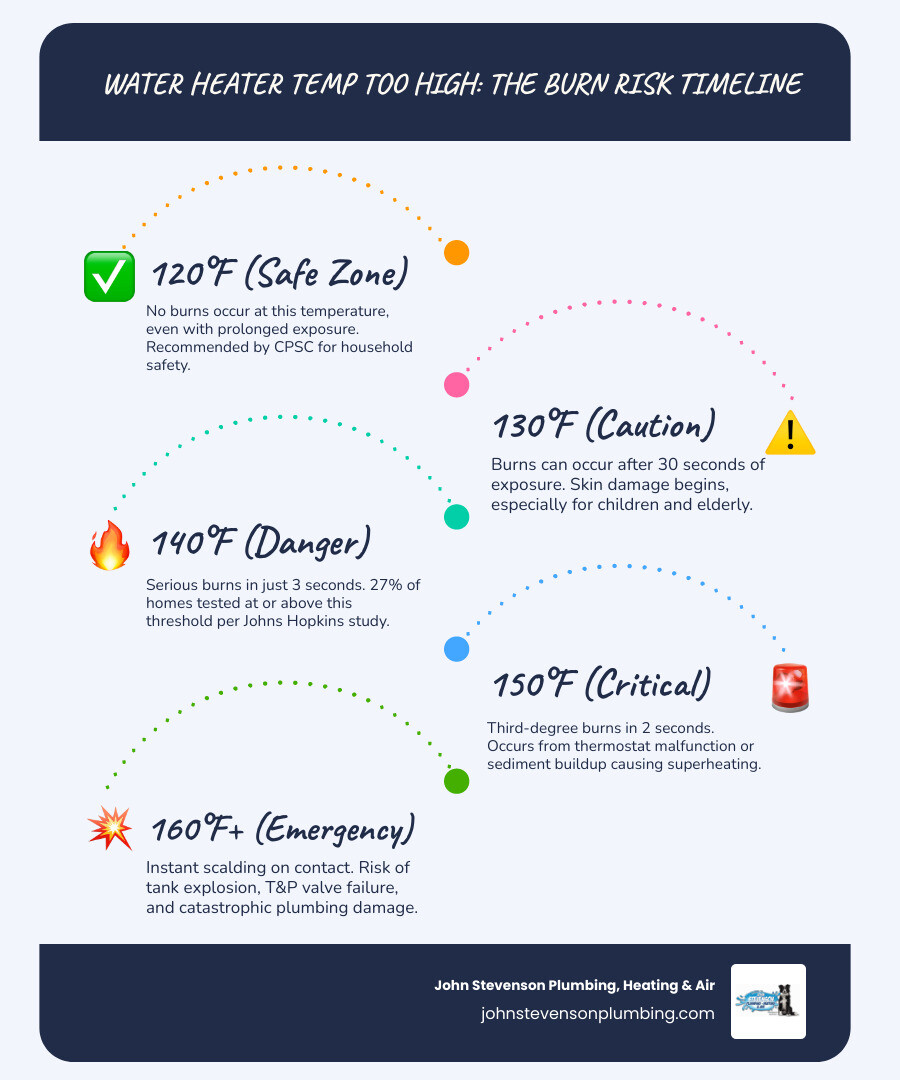
- Scalding and severe burns — At 140°F, serious burns can occur in as little as 3 seconds. At 150°F, it takes just 2 seconds for third-degree burns to develop.
- Increased danger for children and the elderly — Thinner skin and slower reflexes make these groups far more vulnerable to tap water burns.
- Higher energy bills — The Department of Energy estimates that lowering your water heater’s set point can save 4–22% on utility costs.
- Thermal expansion hazards — Overheated water expands, building dangerous pressure inside a closed plumbing system that can stress pipes and safety valves.
- Legionella bacteria risk from overcorrection — Setting the temperature too low to compensate actually encourages bacterial growth, creating a different health threat.
- Sudden scalding in the shower — Pressure imbalances from a toilet flush or appliance use can cause an instant temperature spike at the showerhead.
These risks are not rare edge cases. A Johns Hopkins Bloomberg School of Public Health study found that 41% of surveyed homes had hot water temperatures above the recommended 120°F safety threshold — and 27% were at or above 130°F. In the U.S., tap water burns send an estimated 1,500 people to the hospital and claim around 100 lives every year.
Most homeowners only think about their water heater when the hot water runs out — or when something goes wrong. But by then, the damage may already be done.
I’m John Stevenson, and my team at John Stevenson Plumbing, Heating & Air Conditioning has helped Carlsbad homeowners navigate exactly these kinds of water heater safety concerns for years — let’s walk through everything you need to know.
Understanding Water Heater Temperature Too High Risks: Scalding and Burns
When your water heater is set to an excessively high temperature, the most immediate and devastating hazard is physical injury. Many homeowners believe that hot tap water is inherently safe because it comes from a domestic utility. However, residential hot water can easily reach temperatures that mimic commercial sanitizing systems, causing severe thermal injuries in the blink of an eye.
To understand the physical dangers of high water temperatures, it helps to look at how quickly human skin suffers damage when exposed to different heat levels.
| Water Temperature | Time Required for a Serious Burn / Scald | Time Required for a Full Third-Degree Burn |
|---|---|---|
| 120°F (49°C) | Approximately 10 minutes | Approximately 10 minutes |
| 130°F (54°C) | Approximately 30 seconds | Approximately 30 seconds |
| 140°F (60°C) | 3 seconds | 5 to 6 seconds |
| 150°F (66°C) | 1.5 seconds | 2 seconds |
| 154°F (68°C) | Instantaneous | Instantaneous |
As this data shows, the margin of safety shrinks dramatically with every few degrees of temperature increase. At 120°F, a person has ample time to react and step away from the water stream before a serious burn occurs. But raise that temperature to 140°F, and a severe scald happens in the time it takes to gasp.
A third-degree burn is not a minor injury; it destroys the outer layer of skin (epidermis) and damages the deeper layers (dermis), often requiring emergency medical treatment, skin grafts, and leaving permanent scars. If your water heater is malfunctioning or set to its maximum capacity, you are living with a constant hazard. If you notice your water is suddenly scalding, you should learn How to Diagnose a Failing Water Heater to pinpoint the mechanical root of the problem before someone gets hurt.
How Water Heater Temperature Too High Risks Affect Children and the Elderly
While scalding hot water is dangerous for anyone, it poses a disproportionate threat to infants, young children, and older adults. This increased vulnerability is due to two primary biological factors: skin sensitivity and physical reflexes.
- Thin Skin: Children and the elderly have significantly thinner skin than younger adults. Because their skin barrier is delicate, heat penetrates deeper and faster, causing severe burns at lower temperatures and in less time than it would for an average adult.
- Slower Reflexes: An adult can quickly pull their hand away or jump out of a hot shower stream. However, infants and toddlers in a bathtub cannot escape the water on their own. Similarly, seniors with mobility challenges, arthritis, or cognitive conditions may not be able to react quickly enough to shut off a faucet or exit a tub before severe damage occurs.
For these reasons, pediatric and geriatric safety advocates emphasize that home tap water burns are entirely preventable. If you live in Southern California, keeping your household safe means understanding the local plumbing guidelines. You can read more about how to protect your family in our guide: Don’t Get Burned by California Plumbing Code Water Heater Rules.
Energy Waste and Utility Impacts of Overheating
Beyond the physical danger, keeping your water heater cranked up to an unnecessarily high setting is a massive drain on your wallet. Your water heater is constantly working to maintain the temperature of the water stored inside its tank. This process leads to what is known as standby heat loss.
Standby heat loss occurs when heat escapes through the walls of the water heater tank into the surrounding air. The higher the temperature of the water inside the tank, the faster this heat escapes, forcing the system to turn on and reheat the water more frequently.
According to the Department of Energy, lowering your water heater’s set point can save you between 4% and 22% on your utility bills. By keeping the temperature at a balanced level, you reduce standby heat loss, conserve natural gas or electricity, and lower your carbon footprint. Plus, reducing the constant heating cycles prevents premature wear and tear on your tank, helping you get the most out of your system. To learn more about maximizing your system’s efficiency, check out our practical tips on How to Extend the Life of Your Water Heater.
The Legionella Paradox: Storage vs. Point-of-Use Temperature
When addressing water heater temperature too high risks, we run directly into a classic plumbing dilemma known as the “Legionella Paradox.”
On one hand, we want to lower the water heater temperature to 120°F to prevent accidental scalding. On the other hand, setting the storage tank’s temperature that low turns your water heater into a literal breeding ground for Legionella pneumophila — the dangerous bacterium responsible for Legionnaires’ disease (a severe and potentially fatal form of pneumonia).
Why Experts Recommend 135-140°F Storage
Legionella bacteria thrive and multiply rapidly in warm water environments, specifically between 68°F and 122°F. They are particularly fond of temperatures between 95°F and 115°F.
If you set your water heater thermostat to 120°F, the water at the bottom of the tank (which is naturally cooler due to stratification) can easily sit within the ideal bacterial growth zone. When someone inhales fine water droplets or mist from a showerhead or faucet connected to a contaminated tank, they can contract Legionnaires’ disease. Out of the hundreds of thousands of pneumonia cases diagnosed in the U.S. every year, experts estimate that a significant portion may actually be misdiagnosed Legionnaires’ disease.
To ensure complete pathogen control and tank sanitation, the American Society of Plumbing Engineers (ASPE) and other leading health organizations recommend storing hot water at 135°F to 140°F. At 140°F, Legionella bacteria are neutralized within 32 minutes, and at temperatures above 150°F, they die in under two minutes.
To help you decide what’s best for your home’s setup, it is highly beneficial to read our guide: Stop Getting Into Hot Water Over Your Choice of Water Heater. Additionally, keeping your tank clean and hot prevents sediment from acting as a breeding ground, which is essential to understand when evaluating Don’t Get Into Hot Water Over Your Heater’s Lifespan.
Downstream Safety Devices and Mixing Valves
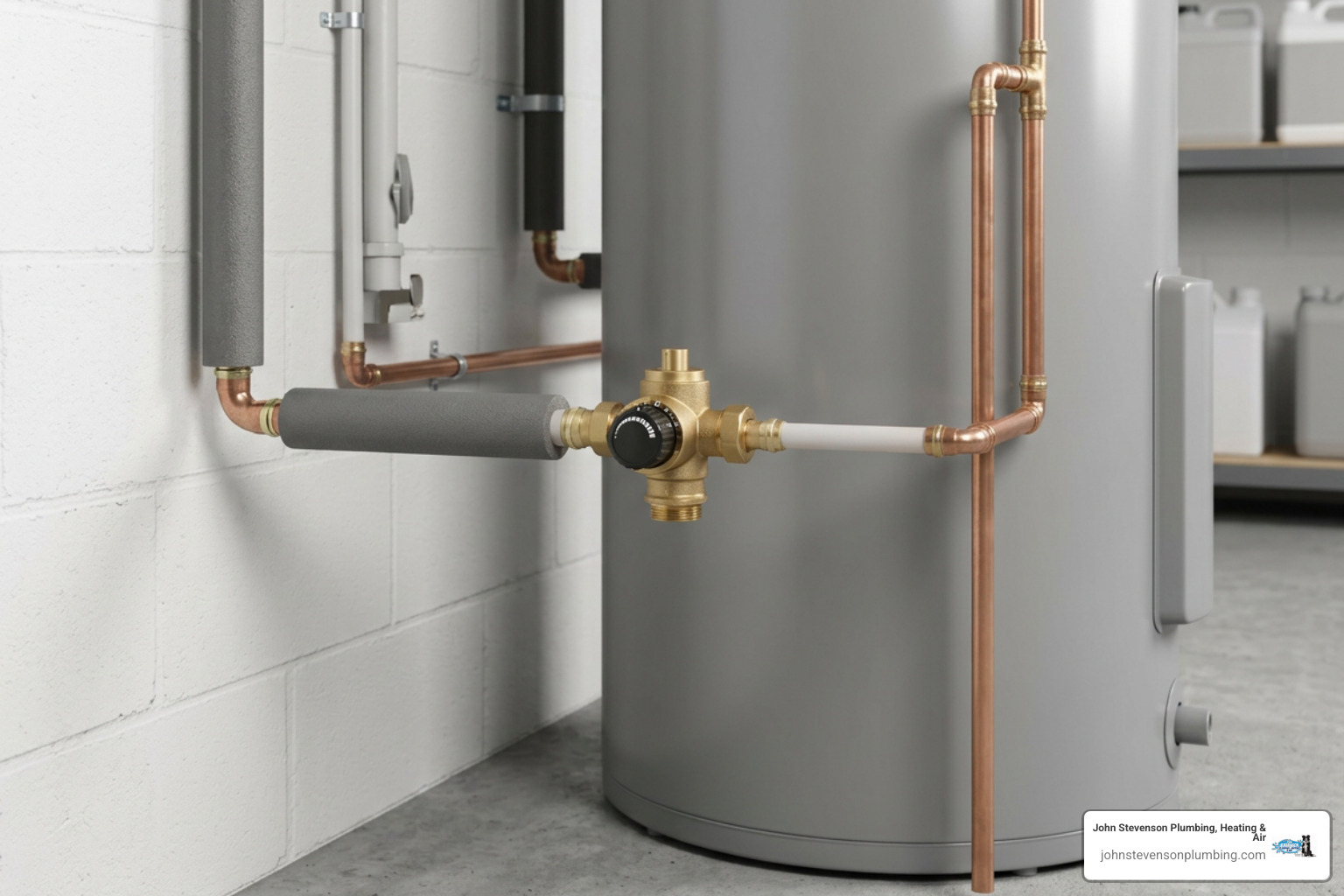
So, how do we store water at a bacteria-killing 140°F while delivering a safe, non-scalding 120°F to your faucets and showers? The answer lies in downstream safety devices called thermostatic mixing valves (TMVs).
A thermostatic mixing valve is installed directly at the outlet of your water heater or at individual fixtures. It works by automatically blending cold water with the super-heated water coming out of the tank before it reaches your taps.
- ASSE 1017 Valves: These are master mixing valves installed at the water heater. They temper the water for the entire house, ensuring that no water leaving the utility closet exceeds a safe limit (typically 120°F).
- ASSE 1016 Valves: These are automatic compensating valves installed at individual showers and tub fixtures to prevent sudden thermal shocks.
- ASSE 1070 Valves: These are temperature-limiting devices installed under handwashing sinks and lavatories to cap the maximum temperature.
By using these engineering solutions, you can keep your storage tank hot enough to eliminate biological threats while keeping your family perfectly safe from physical burns.
Thermal Expansion, Pressure Imbalances, and System Hazards
When water is heated, it expands in volume. In the old days, plumbing systems were “open,” meaning that as water expanded inside a home’s water heater, the excess volume and pressure could simply push back out into the municipal water main.
However, modern plumbing codes require “closed” systems to prevent backflow and protect public drinking water. Closed systems use backflow preventers, check valves, or pressure-reducing valves on the main water line.
While closed systems protect the public water supply, they create a major hazard inside your home: thermal expansion. When the water inside your closed system is overheated, the expanding water has nowhere to go. This causes rapid, intense pressure spikes that put immense stress on your pipes, joint connections, and the water heater tank itself. To understand how California plumbing codes address this issue, take a look at our breakdown: The Pressure Is On: Understanding California Expansion Tank Codes.
Technical Failures That Trigger Water Heater Temperature Too High Risks
Several mechanical failures can cause your water heater to overheat, building dangerous pressure:
- Thermostat Malfunction: If a thermostat is miscalibrated, stuck, or shorted, it will fail to signal the heating elements or gas burner to shut off. The water will continue to heat indefinitely, eventually boiling and turning into super-heated steam.
- Sediment Buildup: Over time, minerals like calcium precipitate out of your water and settle at the bottom of the tank. This sediment layer acts as an insulator over the heating elements or burner. The system has to work twice as hard to heat the water, causing localized superheating at the bottom of the tank and throwing off the thermostat’s readings.
- T&P Valve Failure: The Temperature and Pressure (T&P) Relief Valve is your water heater’s ultimate safety net. It is designed to open and safely discharge water if the tank’s temperature reaches 210°F or if the pressure exceeds 150 psi. If this valve is corroded, stuck, or blocked by sediment, the pressure inside the tank can build until the metal ruptures, resulting in a catastrophic tank explosion.
To prevent these dangerous scenarios, regular maintenance is vital. If you suspect your system is reaching the end of its reliable lifespan, read our advice on How to Know When to Replace Your Water Heater.
Pressure Imbalances and Sudden Shower Scalding
Have you ever been enjoying a comfortable shower only to scream in shock when someone flushes a toilet or turns on the washing machine? This is a classic pressure imbalance issue.
When a toilet flushes, it suddenly diverts cold water away from the shower’s mixing valve. If your shower is equipped with an older, non-compensating valve, the sudden drop in cold water pressure allows an unrestricted flow of hot water to blast through the showerhead. This rapid temperature spike can cause immediate thermal shock, leading to slip-and-fall injuries as you try to escape, or direct scald burns.
Installing modern pressure-balancing or thermostatic shower valves (complying with ASSE 1016) resolves this by instantly adjusting the hot water flow to match any sudden drops in cold water pressure, keeping the shower temperature safe and stable.
Frequently Asked Questions About Water Heater Safety
How can I accurately test my water heater’s temperature?
You cannot rely solely on the dial on your water heater tank, as these dials are notoriously imprecise and often only feature vague settings like “Hot,” “A, B, C,” or “Very Hot.” To accurately test your water temperature:
- Go to the faucet closest to your water heater (usually a kitchen or utility sink).
- Turn on the hot water fully and let it run for 60 to 90 seconds to ensure the water is coming directly from the tank.
- Hold an instant-read digital thermometer or a clean candy thermometer under the running stream of water.
- Note the temperature once the reading stabilizes. If it is above 120°F and you do not have mixing valves installed, your system’s temperature is set too high.
What are the code requirements for hot water temperatures in commercial settings?
Commercial facilities face strict regulatory guidelines regarding hot water. Under California plumbing codes and FDA restaurant standards:
- Public Handwashing Sinks: Must deliver hot water at a minimum of 110°F to ensure proper hygiene, but must not exceed 120°F to prevent public scalding.
- Commercial Dishwashers: Must maintain a minimum temperature of 160°F to 180°F to achieve proper sanitization without chemical sanitizers.
- California Title 22 (Hotels/Public Taps): Any public tap delivering water exceeding 125°F must have a prominent warning sign mounted at least 5 feet high to alert guests of the scalding hazard.
When should I repair or replace an overheating water heater?
If your water heater is consistently delivering scalding water despite you turning down the thermostat, you have a mechanical issue.
- Repair: If the water heater is relatively new (under 6–8 years old), replacing a faulty thermostat, replacing a shorted heating element, or performing a professional sediment flush is usually the best course of action.
- Replace: If your tank is over 10 years old, has heavy internal rust, or is showing signs of structural weakness, investing in repairs is often a temporary fix.
To help you make the right choice for your budget and home safety, read our comprehensive decision guide: How to Decide If Your Water Heater Is a Keeper or a Goner.
Conclusion
Managing your home’s hot water is a delicate balancing act. Set the temperature too low, and you risk exposing your family to harmful pathogens like Legionella. Set it too high, and you invite severe scalding hazards, sky-high utility bills, and dangerous thermal expansion pressures that can ruin your plumbing system.
At John Stevenson Plumbing, Heating & Air Conditioning, we believe you shouldn’t have to choose between safety from burns and safety from bacteria. Our certified, highly trained technicians serve Carlsbad, CA, and surrounding Southern California communities with our signature 5-Star Service Guarantee. This means you get a thorough diagnostic assessment, upfront pricing, and a 24-hour satisfaction check-in to ensure your system is running safely and efficiently.
Don’t leave your family’s safety and comfort to chance. Whether you need a professional sediment flush, a thermostat calibration, or the installation of a high-quality thermostatic mixing valve, we are here to help.
Schedule Professional Water Heater Services in Carlsbad with our friendly team today and enjoy true peace of mind!