

Ceiling Fans vs. AC: How to Lower Your San Diego Cooling Bill
Ceiling fans use far less power than AC, but they cool people, not rooms. On mild days in San Diego, CA, run a fan where you’re sitting and turn it off when you leave. On hotter days, use a fan with AC and raise the thermostat a few degrees if you stay comfortable. If your system runs too long or cools poorly, AC maintenance may address wasted energy that a fan cannot. Coastal and inland homes face different heat, so the right choice depends on your comfort and how well your AC works.
Explore our heating and cooling services or schedule AC maintenance.
I’m John Stevenson, and I’ll help you decide when a fan is enough and when your AC needs attention.
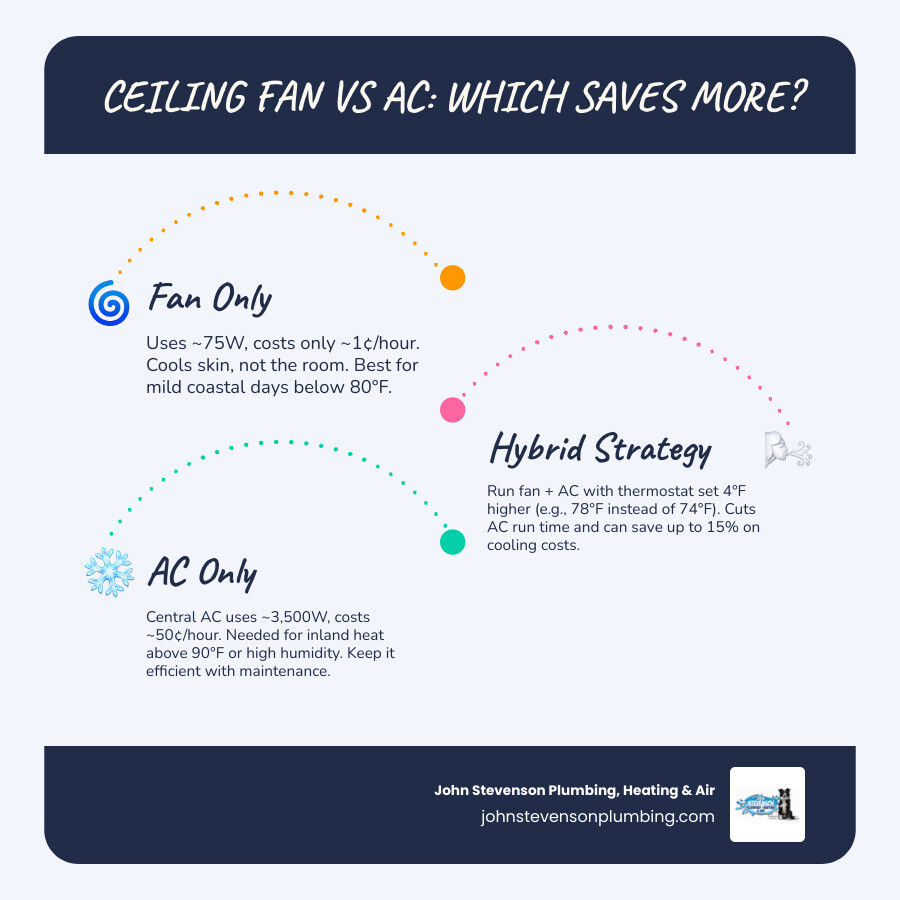
Ceiling fans vs ac which saves more money terms to know:
Ceiling Fans vs AC: Which Saves More Money on Energy Consumption?
When comparing basic operating draw, ceiling fans require only a tiny fraction of the electricity demanded by whole-home air conditioning systems. A central air conditioner relies on a heavy-duty compressor, blower motor, and outdoor condenser fan working together to extract heat and moisture from your home. By contrast, a ceiling fan simply spins a set of aerodynamic blades to circulate ambient air. For San Diego homeowners weighing ceiling fans vs AC, which saves more money depends on how each system is used and maintained.
| Feature | Ceiling Fan | Central Air Conditioner |
|---|---|---|
| Typical Power Draw | 15 to 75 Watts (DC models: 10–35 W) | 2,500 to 5,000 Watts |
| Primary Mechanism | Evaporative convective cooling on skin | Refrigeration cycle heat and humidity extraction |
| Impact on Room Temp | None (Zero sensible heat change) | Actively lowers sensible and latent indoor heat |
| Usage Strategy | Occupied rooms only | Whole-home or zoned temperature regulation |
| Relative Hourly Draw | Less than 2% of central AC power draw | Baseline standard for whole-home refrigeration |
In Southern California communities, electricity rates fluctuate across different usage tiers and peak hours. Because an air conditioner draws massive electrical wattage during mid-afternoon peak periods, relying purely on compressor-based cooling without proper air movement can send utility bills climbing rapidly.

Energy Consumption Breakdown: Ceiling Fans vs AC Which Saves More Money by the Numbers
Breaking down the equipment wattage illustrates why ceiling fans consume so little power. A standard alternating current (AC) motor ceiling fan consumes approximately 50 to 75 watts on high speed. Modern brushless direct current (BLDC) ceiling fans operate even more efficiently, drawing between 10 and 35 watts while moving substantial cubic feet of air per minute (CFM).
A central AC compressor and blower assembly typically draws 3,000 to 4,000 watts while actively running. To put that in perspective, running a single central air conditioning system for an hour consumes roughly the same electrical power as operating 50 to 100 ceiling fans simultaneously.
Understanding this power gap helps you make practical choices. Learning how to save energy with best thermostat settings for summer allows you to capture the mechanical efficiency of fans without asking your air conditioner to carry the entire cooling load alone.
The Real Efficiency Impact: Ceiling Fans vs AC Which Saves More Money During Peak San Diego Summers
During peak Southern California summer afternoons, cooling systems must work against significant heat loads. A central air conditioner must cycle its compressor repeatedly to manage heat transferring through roofs, unshaded windows, and exterior walls. When a system operates with dirty coils or restricted airflow, those compressor cycles stretch out, drawing continuous power during the most demanding hours of the day.
A ceiling fan operates on a steady, low wattage regardless of outdoor heat spikes. However, running a ceiling fan inside an empty room does not cool the structure or reduce indoor heat loads. Because fans cool human skin through evaporation rather than lowering air temperatures, leaving fans running in unoccupied spaces simply wastes electricity and adds minor motor heat back into your home. The true efficiency benefit occurs when you pair fans with smart temperature management.
How the Hybrid Strategy Maximizes Your Energy Savings
The single most effective way to lower summer utility expenses is not choosing between fans or air conditioning, but integrating them into a hybrid cooling strategy.
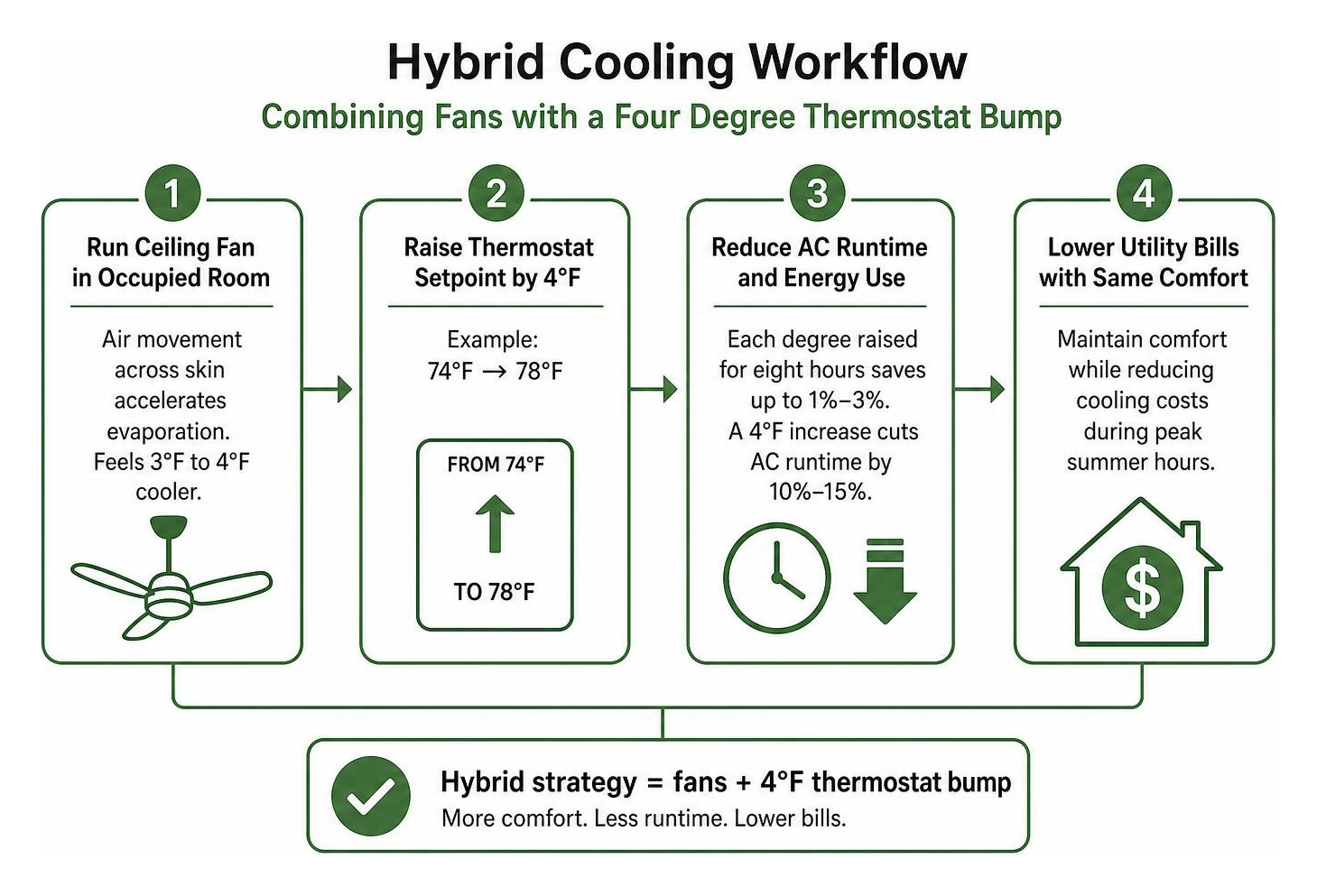
When air moves across exposed skin at a moderate speed, it accelerates natural moisture evaporation. This creates a perceived wind-chill effect that makes the ambient air feel 3°F to 4°F cooler than the actual room temperature.
By running a ceiling fan in the room you occupy, you can comfortably raise your thermostat setpoint by 4°F (for instance, bumping your setting from 74°F up to 78°F) without feeling any loss of comfort. According to the U.S. Department of Energy, every degree you raise your thermostat setpoint over an eight-hour period reduces cooling energy consumption by up to 1% to 3%. A consistent 4°F setback can cut overall air conditioner runtime by 10% to 15%, delivering noticeable reductions on monthly summer utility bills while keeping comfort levels steady.
Pairing multi-speed fans with a modern energy efficient thermostat installation automates this process, ensuring your home stays efficient throughout shifting daytime temperatures.
When Ceiling Fans Alone Are Not Enough for Indoor Comfort
While fans provide exceptional efficiency, they have clear physical limits. Ceiling fans do not remove humidity from the air, nor do they extract heat from enclosed spaces.
When outdoor conditions reach high temperatures with elevated humidity, fans lose their cooling efficacy:
- Elevated Indoor Humidity: High humidity prevents sweat from evaporating efficiently. When relative humidity climbs, air movement provides diminishing comfort returns because the moisture on your skin cannot evaporate quickly.
- Extreme Heat Waves: If indoor temperatures climb toward high thresholds (especially above 95°F), circulating hot air acts like a convection oven rather than a cooling breeze. During extreme heat advisories, fans alone cannot prevent heat-related stress for seniors, young children, or pets.
- Microclimate Variations: Coastal neighborhoods often enjoy refreshing evening marine layers where open windows and ceiling fans provide ample comfort. However, inland valleys experience intense radiant heat and lingering night warmth that demand active mechanical refrigeration and dehumidification.
How Right-Sized Cooling Equipment Prevents Wasted Energy
If your air conditioning unit is oversized or undersized, pairing it with ceiling fans will not fully solve your high utility bills. An oversized air conditioner cools a home too rapidly, shutting off before it can properly remove indoor humidity. This leaves indoor air feeling damp, cool, and clammy—prompting homeowners to lower the thermostat even further. An undersized system runs constantly without reaching the desired temperature.
Professional HVAC sizing uses Manual J load calculations, evaluating home square footage, insulation levels, window exposure, and local climate trends. Reviewing how to calculate required AC size in 4 easy steps demonstrates how proper equipment capacity protects long-term efficiency.
For targeted room-by-room comfort and flexible zoning, many Southern California homeowners also choose high-efficiency ductless mini splits to cool active living spaces without wasting energy on empty rooms.
Why AC Maintenance Delivers the Long-Term Savings Fans Can’t Provide
While ceiling fans trim energy usage by allowing higher thermostat setpoints, they cannot fix an inefficient air conditioning system. If your air conditioner suffers from neglected components, its energy efficiency ratio drops significantly, causing the compressor to draw far more electricity than designed.
Investing in regular AC maintenance delivers system improvements that ceiling fans cannot achieve:
- Restoring Heat Transfer: Outdoor condenser coils accumulate dust, salt air, dirt, and foliage over time. Dirty coils prevent the refrigerant from releasing trapped indoor heat, forcing the compressor to work harder and run longer.
- Optimizing Refrigerant Charge: Even a minor refrigerant undercharge can decrease system efficiency by 10% to 20% while placing heavy mechanical stress on the compressor.
- Balancing Airflow: Blower wheel cleaning and static pressure adjustments ensure that cooled air reaches every supply register efficiently.
- Preventing Premature Failures: Spotting worn electrical contactors, failing run capacitors, or motor drag prevents sudden system breakdowns during peak summer heat waves.
As we often remind homeowners, the secret to a stress-free summer is a spring HVAC tune-up, ensuring optimal performance before hot weather arrives.
Signs Your AC Inefficiency Is Driving Up Utility Bills
If you notice your electric bills climbing even though you run ceiling fans and maintain moderate thermostat setpoints, your cooling equipment may be signaling a performance problem.
Common indicators of air conditioning inefficiency include:
- Continuous Compressor Operation: The outdoor unit runs non-stop without reaching your set temperature.
- Weak or Lukewarm Register Airflow: Supply vents blow faint or warm air despite the system actively cycling.
- Elevated Indoor Humidity: Rooms feel sticky or stuffy even when the temperature reads normal.
- Short Cycling: The system starts, runs for two minutes, and abruptly turns off, causing electrical spikes.
- Unusual Mechanical Noises: Grinding, buzzing, or squealing from the outdoor condenser or indoor air handler.
Addressing these issues early with prompt AC repair and practicing routine upkeep like changing air filters helps you understand how to extend the life of your AC unit while protecting your summer budget.
When Maintenance Signals It Is Time for a System Replacement
Regular maintenance keeps systems operating at peak performance, but older units eventually reach the end of their functional lifespan. Air conditioners that have operated for over 10 to 15 years often run on outdated seasonal energy efficiency ratings and suffer from chronic component degradation.
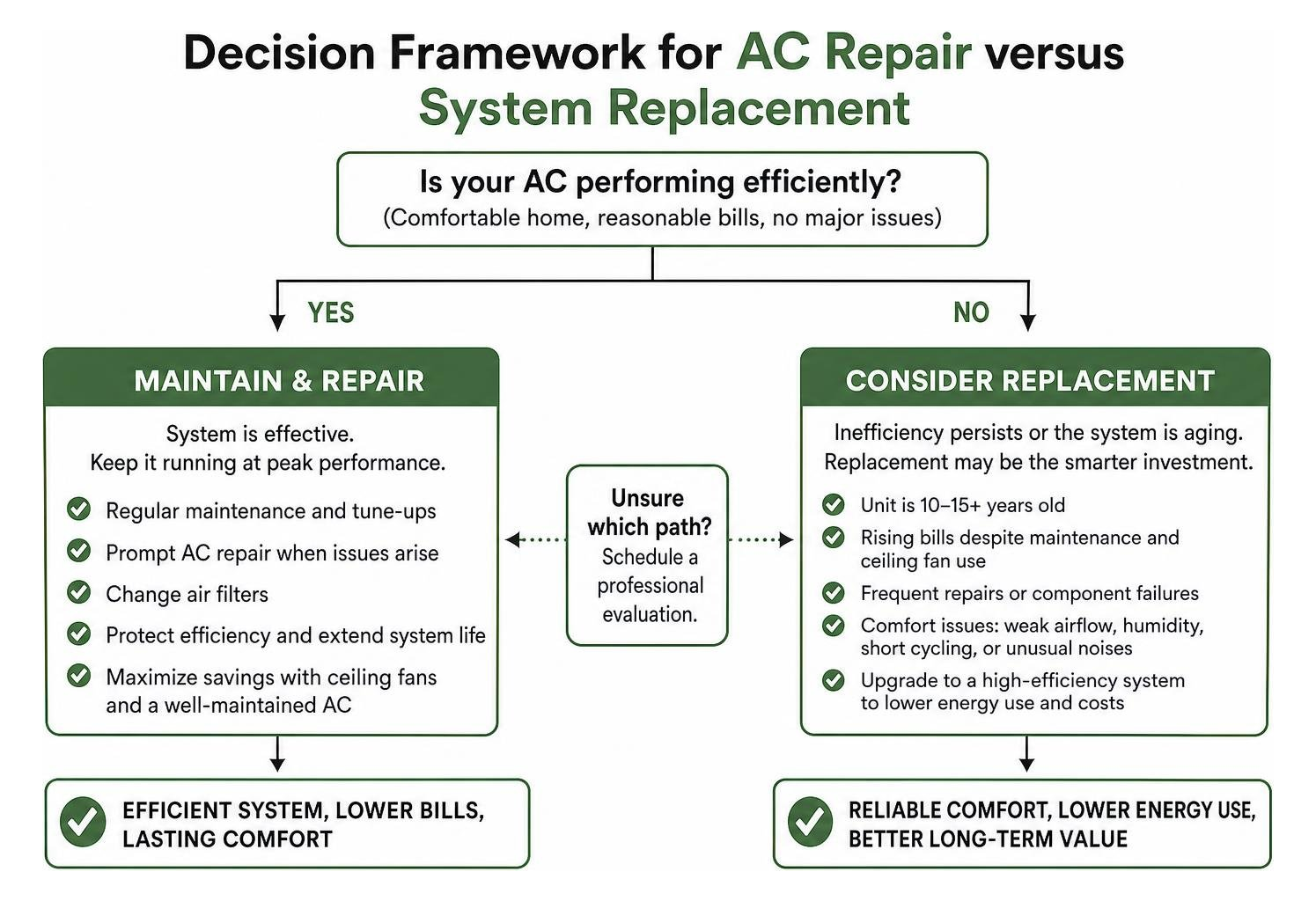
Learning how to know when to replace your central air conditioner helps homeowners avoid throwing money at failing equipment. Upgrading to a modern, high-efficiency system through professional AC installation cuts base electrical consumption dramatically, maximizing the combined benefit of your ceiling fans.
Frequently Asked Questions About Energy Efficiency and Cooling
Can running a ceiling fan lower the actual temperature in a room?
No. Ceiling fans circulate air across your skin to enhance evaporative cooling, creating a perceived temperature drop of roughly 4°F. However, they do not extract heat or alter sensible room temperatures. Because fan motors generate a small amount of operating heat, leaving a fan running in an empty room actually adds warmth over time without providing any cooling benefit. Always turn fans off when leaving the space.
How much money does raising the thermostat 4 degrees with fans save?
Raising your thermostat setpoint by 4°F (for instance, adjusting from 74°F to 78°F) while running ceiling fans can cut your air conditioner’s runtime by approximately 10% to 15%. This strategy yields direct utility savings because the minor electricity used by a low-wattage fan is offset by reducing compressor runtime.
When should I choose AC maintenance over just running ceiling fans?
You should schedule professional AC maintenance whenever your air conditioner struggles to maintain comfort, runs continuously during moderate weather, fails to manage indoor humidity, or causes unusual utility bill spikes. While ceiling fans help manage perceived comfort, they cannot correct dirty coils, restricted airflow, failing capacitors, or low refrigerant levels within your primary cooling system.
Conclusion: Balancing Fans and Professional AC Care for Maximum Comfort
Lowering your home cooling energy use does not require sacrificing comfort or choosing between fans and air conditioning. The most effective approach combines both solutions: operate low-wattage ceiling fans in occupied rooms to create refreshing airflow, bump your thermostat setting up by 4°F, and keep your central air conditioner properly maintained.
Our team at John Stevenson Plumbing, Heating & Air Conditioning is dedicated to helping homeowners across Carlsbad, San Diego County, and Orange County enjoy dependable, energy-efficient indoor comfort. Under our 5-Star Service Guarantee, our licensed technicians provide thorough system diagnostics, dedicated care, and prompt, reliable workmanship.
If your cooling bills are rising or your air conditioner is struggling to keep up with summer heat, explore our dependable HVAC services in Southern California and schedule your comprehensive cooling tune-up today.