
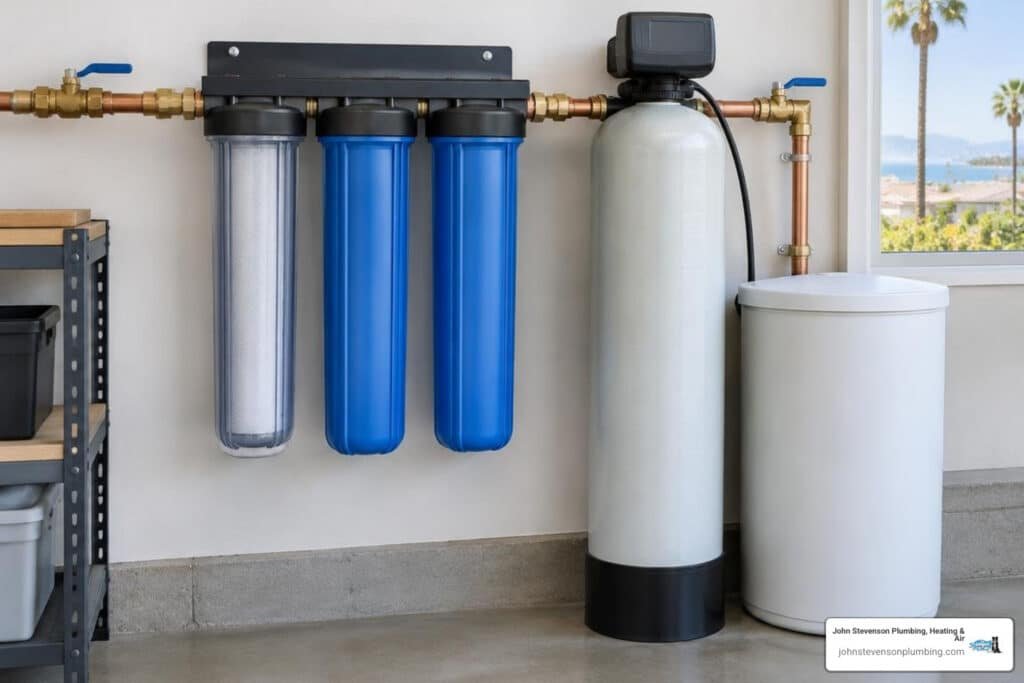
How Whole House Water Filtration Works in Carlsbad
A whole house water filtration system treats water where the main line enters your home, before it reaches your taps, showers, and appliances. Water typically passes through a sediment filter that catches grit and rust, then a carbon filter that reduces chlorine and some chemicals. Other stages depend on your water test. If you want cleaner water throughout your Carlsbad, CA, home, start by checking what is in your water. Then choose filters that target those concerns and can handle your household’s busiest water use.
Explore our plumbing services or get help with whole house water filtration.
I’m John Stevenson, and I’ll walk you through what each stage does and how to choose the right setup for your home.
Ask us about water filtration for your home.
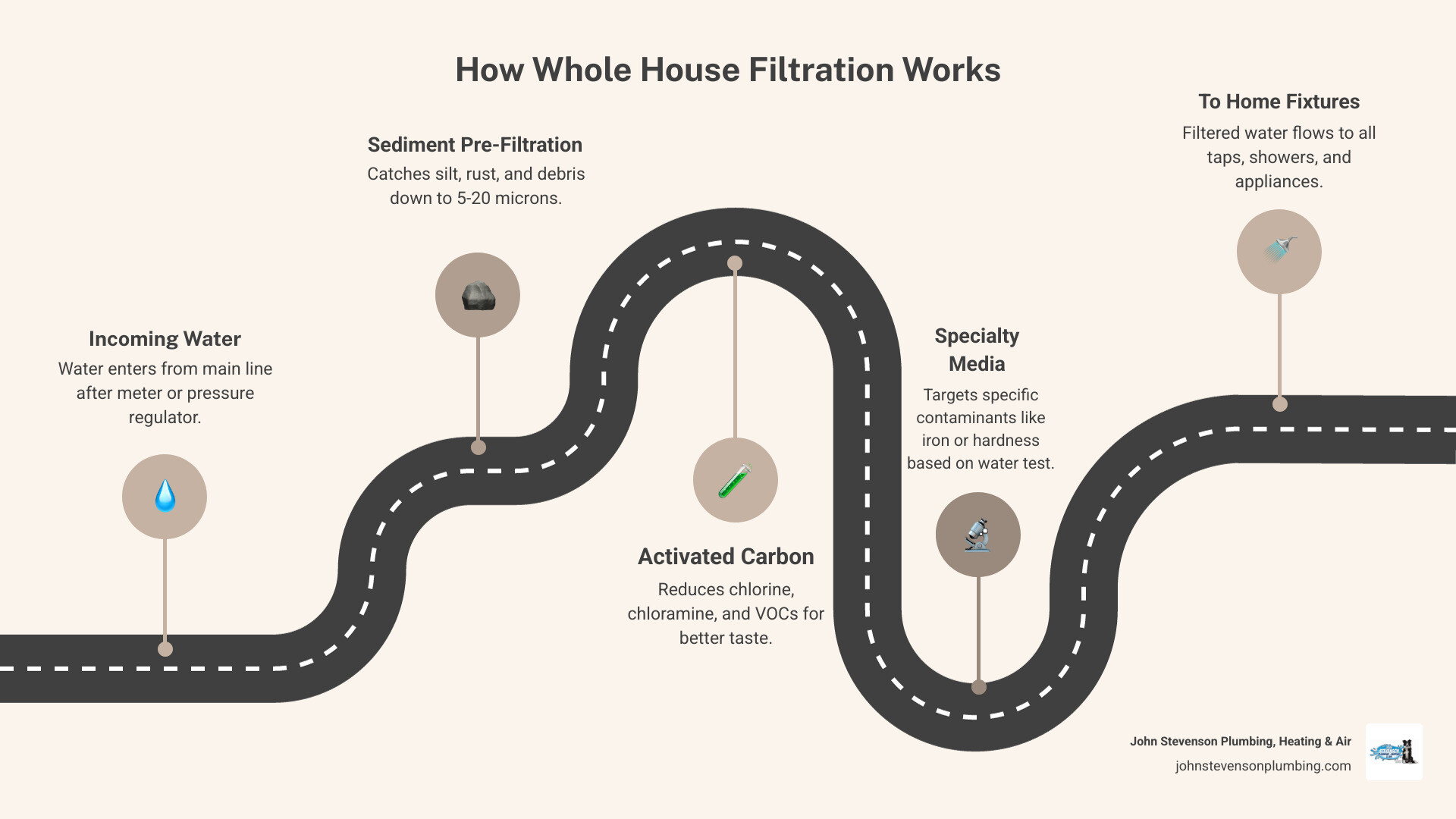
Point-of-Entry Filtration: How Whole-Home Coverage Works
When homeowners think about filtering their tap water, they often picture a pitcher sitting in the fridge or an under-sink unit mounted beneath the kitchen faucet. While point-of-use filters work well for cleaning up a single drinking tap, they leave the rest of your home completely exposed. Every time you run a load of laundry, start the dishwasher, or take a hot shower, you are still interacting with unfiltered municipal or well water.
A whole house setup operates on a completely different philosophy known as point-of-entry (POE) filtration. Instead of treating water right before it spills into a glass, a POE system connects directly to your main supply line right after the water meter or pressure regulator. Think of it as a bouncer stationed at the front door of your plumbing: nothing enters your pipes without getting thoroughly checked first.
By filtering water at the point of entry, you ensure comprehensive, whole-home fixture protection. Filtered water flows to your master bathroom, guest bath, outdoor hose bibs (if plumbed downstream), kitchen sink, ice maker, and water heater. This whole-home perimeter shields delicate plumbing infrastructure—such as cartridge valves, shower wands, and toilet fill seals—from abrasive particulate damage.
Furthermore, evaluating local tap quality with water quality in Carlsbad reveals that aesthetic factors like residual disinfectants and suspended sediment can take a toll over time. Extending appliance longevity is one of the biggest reasons to treat water at the main line. Unfiltered water leaves sediment resting inside the bottom of tank water heaters and clogs the micro-screens inside modern dishwashers and high-efficiency washing machines. When every gallon entering the building is filtered, your entire mechanical system operates more smoothly and reliably.
How a Whole House Water Filtration System Works Step-by-Step
Understanding how a whole house water filtration system works comes down to looking at the sequence of treatment stages. No single filter medium can catch every contaminant, so engineers arrange multiple specialized media in a coordinated “treatment train.” Water travels through each stage in a strict mechanical and chemical order, with each filter preparing the water for the next.
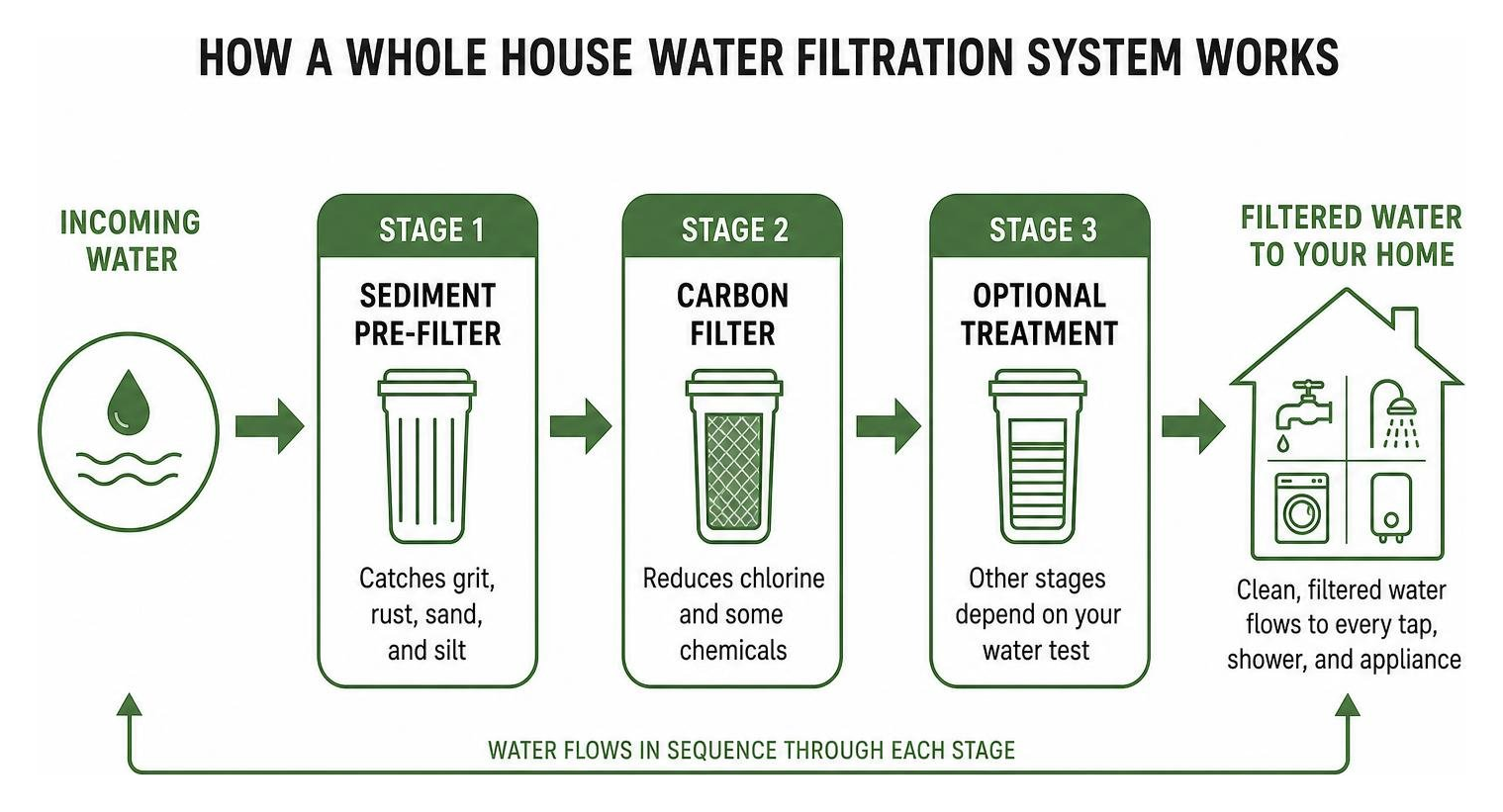
Navigating regional water supplies requires understanding Southern California’s complex water quality issues, which often involve a mix of imported surface water, local groundwater, and residual disinfectants. A multi-stage setup balances mechanical filtration, chemical adsorption, and steady pressure regulation so your home enjoys clean water without a noticeable drop in shower pressure.
Stage 1: Sediment Pre-Filtration and Particle Trapping
The first line of defense in any whole-home setup is the sediment pre-filter. Incoming water carries invisible, gritty hitchhikers: sand, silt, pipe scale, and loose flakes of rust knocked loose from aging distribution mains.
Sediment cartridges are typically constructed from spun or pleated polypropylene and carry ratings between 5 and 20 microns (for perspective, a human hair is about 70 microns wide). This stage acts purely as a physical barrier. Water is forced through the dense, micro-porous membrane, trapping coarse debris on the outer layers while clean water passes into the core.
Placing a sediment filter at the start of the system is essential for two key reasons:
- Protecting downstream carbon media: Activated carbon blocks contain microscopic pores designed to capture dissolved chemicals. If silt and sand coat the outside of a carbon block, those pores clog instantly, rendering the expensive carbon useless within weeks.
- Preventing plumbing and appliance damage: A cheap sediment cartridge prevents grit from scouring pipe walls and settling into water heaters, where it creates insulating sludge that causes premature tank failure.
Catching these abrasive particles early keeps water flowing freely and stops premature pressure drops throughout your house.
Stage 2: Activated Carbon Adsorption for Chlorine and Chemicals
Once water is stripped of physical grit, it enters the primary treatment stage: activated carbon. This is where chemical filtration happens through a scientific process called adsorption (not to be confused with absorption). During adsorption, dissolved chemical compounds physically bind to the surface of the carbon matrix as water flows through.
Activated carbon is manufactured by heating carbon-rich materials—such as coconut shells or coal—to extreme temperatures in the presence of steam. This creates an intricate labyrinth of microscopic internal pores. To put its density into perspective, a single gram of high-grade activated carbon possesses an internal surface area roughly equivalent to the playing surface of a football field.
As municipal water moves through this dense carbon bed, dissolved chlorine reacts with the carbon surface and is converted into harmless, odorless chloride ions. Catalytic carbon blocks go a step further, breaking down tougher chloramines (a chlorine-ammonia bond commonly used by utilities) and volatile organic compounds (VOCs), industrial solvents, and agricultural pesticides. The immediate result is crisp-tasting drinking water and shower steam that no longer smells like a municipal swimming pool.
Stage 3: Specialty Media for Targeted Water Concerns
Because every neighborhood’s water profile is slightly different, the third stage of a whole-home system is customizable. Based on a comprehensive water test, specialty media can be added to neutralize specific local problems:
- KDF-55 and KDF-85 (Kinetic Degradation Fluxion): High-purity copper-zinc granules that use an electrochemical oxidation-reduction (redox) process. KDF-55 targets water-soluble heavy metals (like lead and nickel) and chlorine, while KDF-85 targets dissolved iron and hydrogen sulfide gas (the source of rotten-egg odors). KDF media also creates a bacteriostatic environment, preventing algae and mold from colonizing the filter housings.
- Iron and Manganese Media: Specialized oxidizing media (such as Birm or manganese dioxide) convert dissolved ferrous iron into insoluble particles that can be filtered out, preventing orange-red stains on bathroom porcelain.
- Calcite / Acid Neutralizers: If water testing indicates an acidic pH below 7.0, a bed of crushed calcium carbonate safely raises the pH to protect copper pipes from pinhole leaks.
Matching these specialized stages to your actual laboratory results ensures you treat what is genuinely present without buying media you don’t need.
What a Whole House Water Filter Treats
To help you visualize how these technologies fit together, the table below breaks down the primary filtration mechanisms, what they target, their operating characteristics, and typical upkeep needs:
| Filtration Stage / Media | Operating Mechanism | Target Contaminants | Typical Peak Flow Impact | Maintenance Interval |
|---|---|---|---|---|
| Sediment Pre-Filter | Mechanical screening (5–20 microns) | Sand, silt, rust flakes, pipe scale, turbidity | <1 PSI drop when fresh; rises if neglected | Inspect / replace every 3–6 months |
| Activated / Catalytic Carbon | Chemical adsorption & catalytic reduction | Chlorine, chloramines, VOCs, foul tastes, chemical odors | 1–2 PSI drop across fresh block | Replace cartridge or re-bed every 6–12 months (or 3–5 years for large tanks) |
| KDF Process Media | Oxidation-reduction (redox reaction) | Free chlorine, soluble heavy metals, hydrogen sulfide | Minimal flow restriction | Lasts 3–5 years depending on throughput |
| Oxidizing Iron Media | Catalytic oxidation & physical straining | Dissolved iron, manganese, sulfur gas | Sized for 8–15+ GPM backwash flow | Periodic automatic backwashing; media lasts 5–10 years |
| Ultraviolet (UV) Chamber | 254 nm UV-C germicidal light exposure | Bacteria, viruses, coliform, protozoan cysts (Giardia, Cryptosporidium) | Zero pressure drop; requires clean water upstream | Clean quartz sleeve & replace UV lamp annually |
When evaluating your overall treatment plan, filtration removes impurities, while preventing hard water effects on plumbing and appliances requires dealing with dissolved calcium and magnesium. Pairing a whole house filter with a dedicated softener or descaling system provides complete protection against both chemical contaminants and crusty mineral scale.
Sizing, Maintenance, and Water Source Considerations
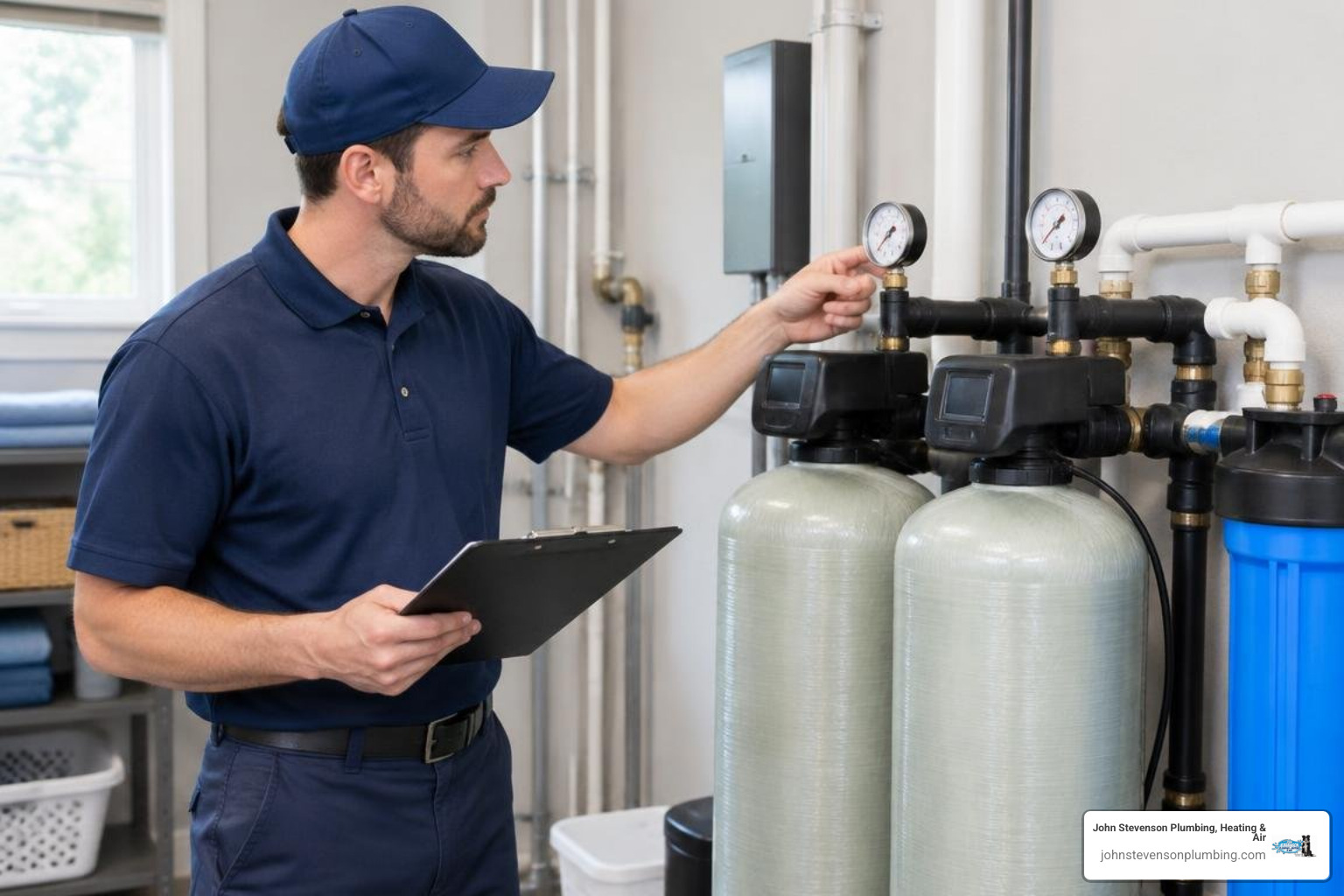
A whole house filtration system is only as good as its sizing and installation. If you choose an undersized unit, turning on a shower while the dishwasher is running will cause water pressure to plummet.
System sizing is determined by calculating your home’s peak simultaneous flow demand in Gallons Per Minute (GPM). Rather than looking at square footage, plumbing professionals size systems based on fixture counts:
- 1 to 3 Bathrooms: Requires an absolute minimum peak flow rating of 9 to 12 GPM.
- 4 to 6 Bathrooms: Demands a system rated for 12 to 15+ GPM to prevent pressure drops during morning peak hours.
A properly configured system introduces a barely perceptible pressure drop of just 2 to 5 PSI across the housings when cartridges are fresh. To keep that flow steady, ongoing maintenance requires swapping sediment cartridges every 3 to 6 months and carbon media every 6 to 12 months.
Understanding How a Whole House Water Filtration System Works at the Point of Entry
Proper physical integration into your plumbing determines how easy the system is to live with and service. A professional installation includes several key components:
- Main Shutoff Access: The system sits directly downstream of your main water shutoff and pressure-reducing valve (PRV), ensuring incoming pressure stays within safe operating parameters.
- Three-Valve Bypass Loop: This series of ball valves allows you to route water around the filter rack during cartridge replacements or emergency maintenance, so your home is never left without running water while you change a filter.
- Matched Port Diameters: If your main supply line uses 1-inch copper or PEX, the filter ports must also be 1-inch (not necked down to 3/4-inch), preventing narrow plumbing bottlenecks that choke water volume.
- Dual Pressure Gauges: Installing pressure gauges directly before and after the filter bank allows you to monitor the differential pressure drop. When the downstream gauge reads 10 to 15 PSI lower than the upstream gauge, you know a cartridge is loaded and ready for replacement.
How a Whole House Water Filtration System Works for City vs. Well Water
Your water source completely changes the design of your filtration train:
- Municipal (City) Water: City water utilities are governed by the federal Safe Drinking Water Act. While utility-treated water is generally safe from biological pathogens, it carries heavy loads of chlorine or chloramines, disinfection byproducts (like trihalomethanes), and pipe scale from aging municipal mains. City water systems prioritize high-volume catalytic carbon blocks and sediment traps.
- Private Well Water: Roughly 43 million Americans rely on private wells, which are not regulated by federal standards. Well water can carry high concentrations of dissolved iron, manganese, hydrogen sulfide, and agricultural nitrates. It is also vulnerable to seasonal bacteria and coliform contamination. A typical well water system requires a multi-stage approach: coarse spin-down sediment trapping, an oxidizing iron filter, fine sediment polishing, and a certified UV disinfection chamber.
Frequently Asked Questions About Whole House Water Filtration
What contaminants will a whole house water filter not remove?
Standard whole house filters are excellent at removing sediment, chlorine, VOCs, and sulfur, but they have distinct physical boundaries:
- Total Dissolved Solids (TDS): Harmless dissolved minerals like sodium, calcium, and potassium pass straight through sediment and carbon filters. Removing TDS requires a dense semi-permeable membrane, such as an under-sink reverse osmosis system.
- Microbial Pathogens (Without UV): Carbon and sediment cartridges do not kill or trap microscopic bacteria, viruses, or coliform. Biological disinfection requires an optional UV purification chamber delivering a germicidal dose of 40 mJ/cm² at 254 nanometers.
- Downstream Lead Leaching: An estimated 9.2 million lead service lines remain in use across the United States, along with pre-1986 plumbing fixtures containing lead solder. While specialty POE media can extract incoming lead, any lead that leaches from pipes inside your walls downstream of the filter can only be caught by a point-of-use filter at the faucet.
Conducting a laboratory water test will clarify whether your household requires POE filtration, point-of-use purification, or a combination of both.
Will installing a whole house water filtration system reduce my water pressure?
When properly sized, a whole house filtration system will not cause a noticeable drop in water pressure. A correctly engineered system creates a minor restriction of only 2 to 5 PSI, which is undetectable at the showerhead or faucet.
Noticeable pressure drops almost always point to one of three common issues:
- An Undersized Housing: Installing a 10-inch filter cartridge rated for only 5 to 7 GPM in a home that demands 12 GPM will restrict flow whenever two fixtures run simultaneously.
- A Clogged Sediment Filter: As the sediment pre-filter catches dirt, its pores gradually fill up. If you notice your showers feeling weak, checking and replacing a loaded pre-filter usually restores full pressure immediately.
- Improper Port Sizing: Installing housings with smaller internal ports than your incoming supply line creates an artificial bottleneck.
How often do whole house filtration cartridges need to be replaced?
Replacement schedules depend on your home’s water usage, incoming sediment levels, and the volume of water filtered:
- Sediment Pre-Filters: Generally replaced every 3 to 6 months. In areas with sandy well water or frequent municipal main flushing, they may need attention every 60 to 90 days.
- Carbon Block Cartridges: Typically replaced every 6 to 12 months. Over time, the internal pores become saturated with organic chemicals and chlorine, reducing their adsorption capacity.
- Large-Tank Media Beds: Heavy-duty, backwashing carbon or iron media tanks often last 3 to 5 years (and up to 10 years for specific iron media) before requiring a media re-bed.
- UV Lamps: Germicidal UV-C bulbs must be replaced once every 12 months, as their light output degrades over time even if the bulb still appears to be glowing.
Installing pressure gauges on your system makes tracking cartridge life simple and predictable.
Conclusion
Cleaner, fresher water throughout your home isn’t about guessing—it’s about understanding how each stage of filtration works and tailoring the setup to your specific water profile. By combining proper sediment pre-filtration, high-capacity activated carbon adsorption, and targeted specialty media, you can protect your plumbing infrastructure, safeguard your home appliances, and enjoy clear, odor-free water from every tap.
Because water chemistry varies from neighborhood to neighborhood, the best place to start is with custom water testing and professional system sizing. The team at John Stevenson Plumbing, Heating & Air Conditioning is ready to help you evaluate your water quality and configure a point-of-entry system tailored to your household’s peak demands. Our licensed technicians provide dependable workmanship backed by our 5-Star Service Guarantee and 24-hour satisfaction check-ins.
Ready to improve the water quality across your entire home? Contact us today to schedule professional home water filtration installation and enjoy cleaner water from every faucet.