
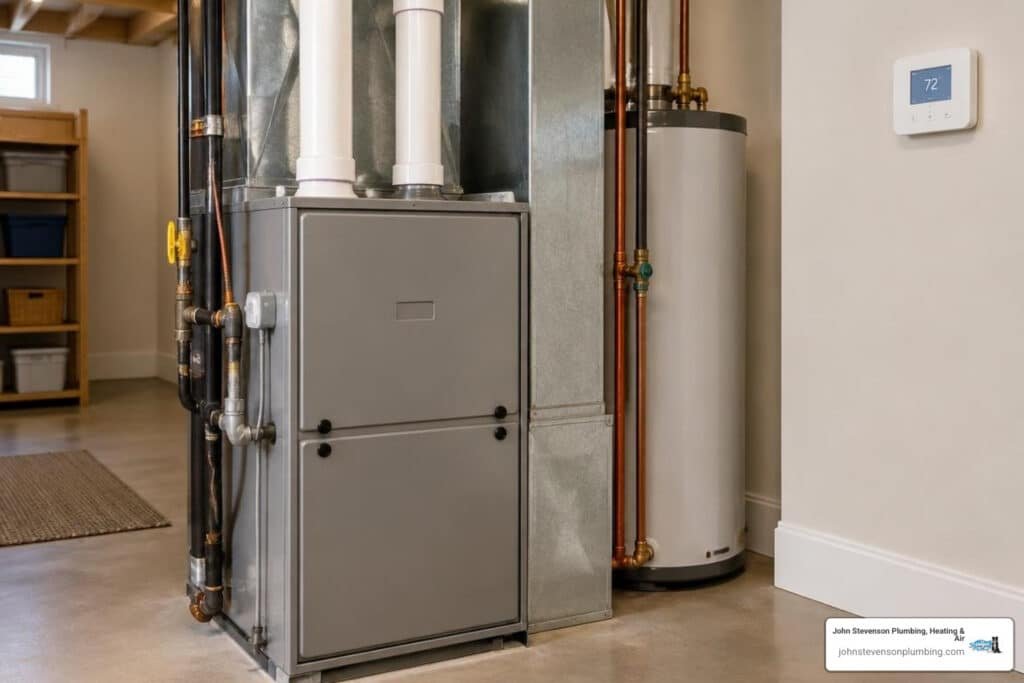
What to Do When Your Heater Bangs at Startup
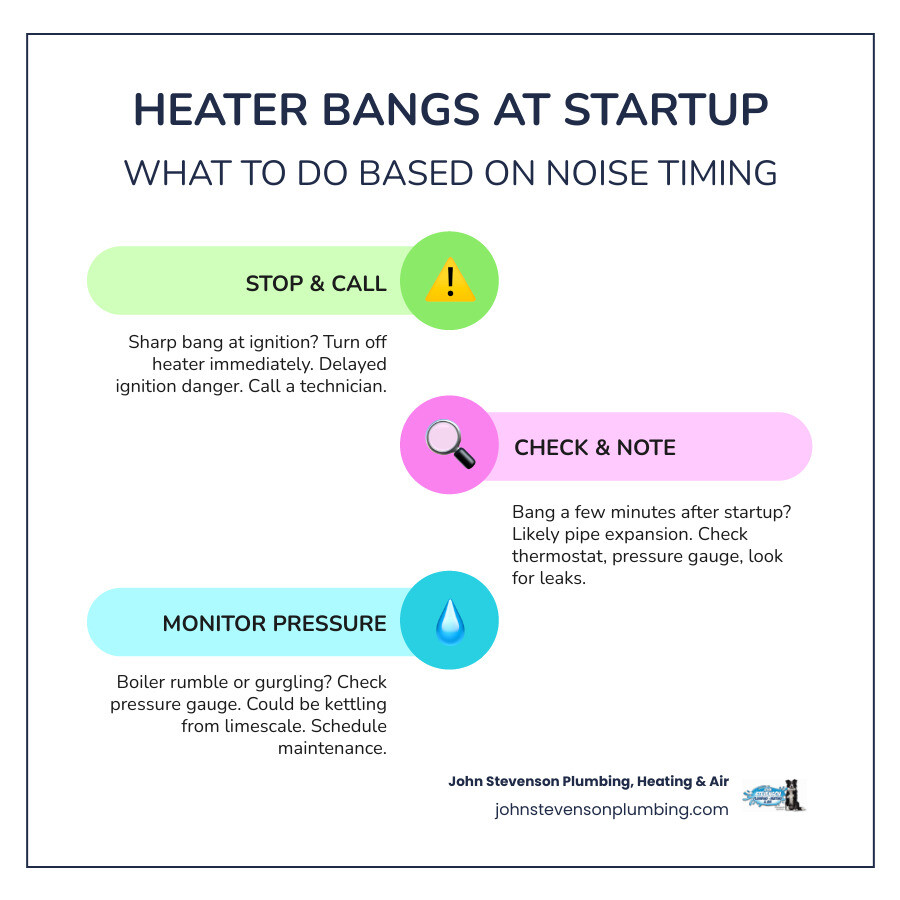
If your heater makes a loud bang when it starts, turn it off and note when the sound happens. A sharp bang as a gas furnace lights can signal an ignition problem, and this is one common reason behind a heating system making loud banging noise. Do not keep restarting it; call for heating repair in Carlsbad, CA. If the noise starts a few minutes later, it may come from pipes expanding or from poor water flow in a boiler system. You can safely check your thermostat, look for visible leaks, and read a boiler pressure gauge if you have one. Leave burner and internal repairs to a technician.
Explore heating and furnace services in Carlsbad or request heating repair.
The timing and location of the bang can help narrow down the cause, but they cannot confirm it on their own. I’m John Stevenson; schedule a heating repair visit so our team can inspect the noise safely.
Primary Causes of a Heating System Making Loud Banging Noise
When you hear a sudden, jarring sound echoing through your home, it is easy to assume the worst. A heating system making loud banging noise is rarely something you should ignore, as acoustic shockwaves inside mechanical equipment usually indicate physical stress or delayed combustion. Whether you have a modern forced-air furnace or a hydronic boiler, these sounds stem from specific mechanical and thermodynamic triggers.
| Noise Symptom | Probable Underlying Cause | Urgency Level | Typical Location |
|---|---|---|---|
| Sharp “boom” at burner startup | Delayed gas ignition | High (Immediate Shutoff) | Furnace/Boiler Burner Box |
| Loud rumbling or kettle-like popping | Scale / Magnetite sludge kettling | Moderate to High | Boiler Heat Exchanger |
| Rhythmic ticking or metallic pinging | Thermal expansion against framing | Low to Moderate | Baseboards / Wall Cavities |
| Single heavy thud upon valve close | Water hammer / Rapid zone shutoff | Moderate | Distribution Pipework |
| Metallic rattling and vibration | Worn circulation pump bearings | Moderate | Near Boiler Circulator |
If your system is producing any of these jarring acoustic symptoms, scheduling heating furnace repairs in Carlsbad will prevent secondary circuit damage and keep your living spaces comfortable.
Delayed Burner Ignition in Gas Furnaces
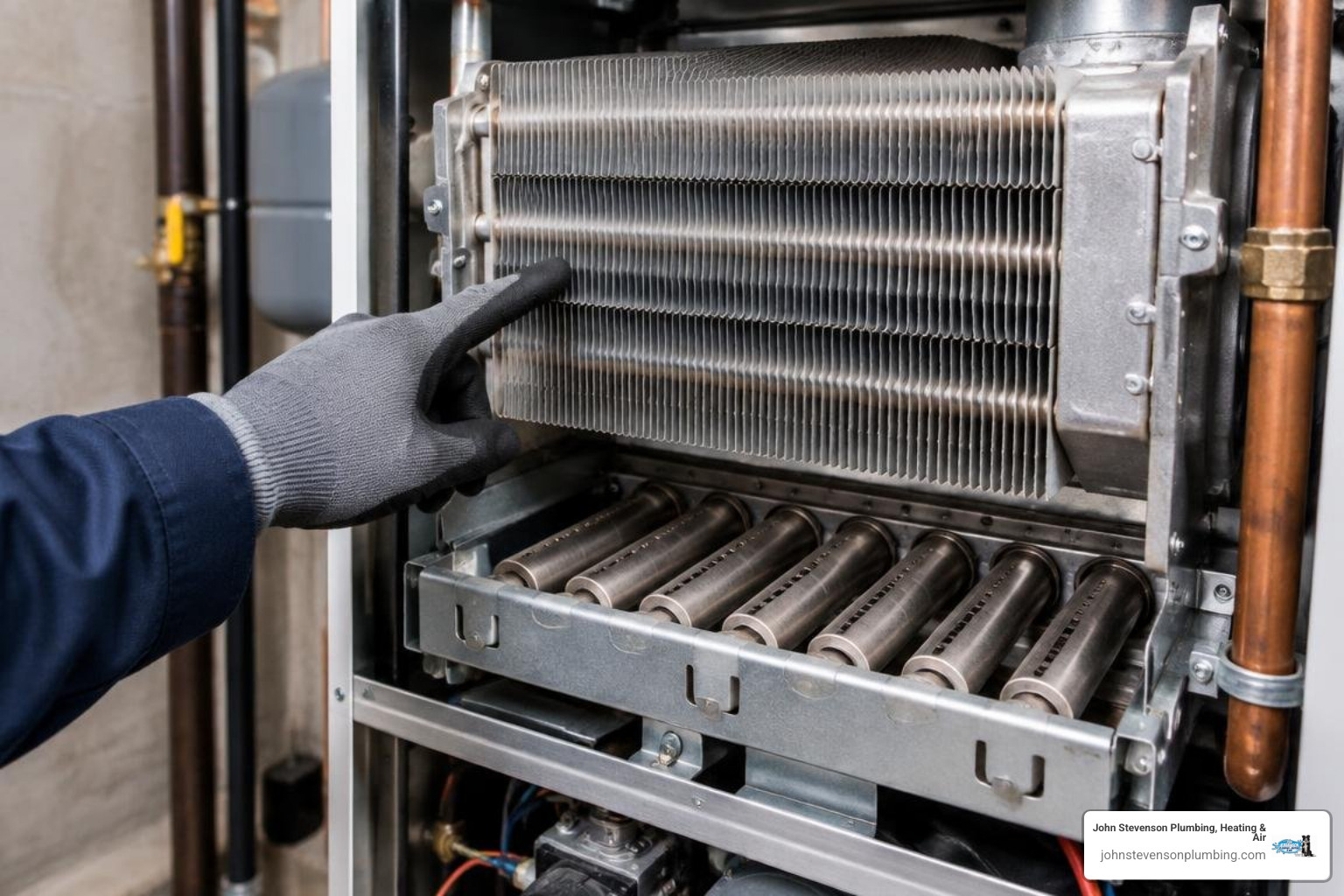
In forced-air gas furnaces, a loud boom right at startup is frequently caused by delayed ignition. When your thermostat calls for heat, the gas valve opens, releasing fuel across the burner assembly where an electronic igniter or pilot light should ignite it immediately.
If the burners are coated in corrosion, soot, or debris, the gas cannot light instantaneously. Instead, unburnt gas accumulates in the combustion chamber for several seconds. When the flame finally jumps across the accumulated gas cloud, it ignites all at once, producing a small contained explosion. This rapid expansion creates a sharp acoustic boom that rattles the cabinet and can crack your heat exchanger over time.
Boiler Kettling from Limescale and Magnetite Sludge
In hydronic heating setups and boilers, a rumbling or banging noise often indicates a phenomenon known as kettling. Over years of operation, dissolved minerals (calcium and magnesium) precipitate out of hard water and adhere to the internal surfaces of the heat exchanger. In closed-loop systems, corrosion debris also creates fine black iron oxide, known as magnetite sludge. Sentinel Laboratories analysis indicates that untreated systems can accumulate up to 1.2 kg/m³ of magnetite sludge over a decade of operation.
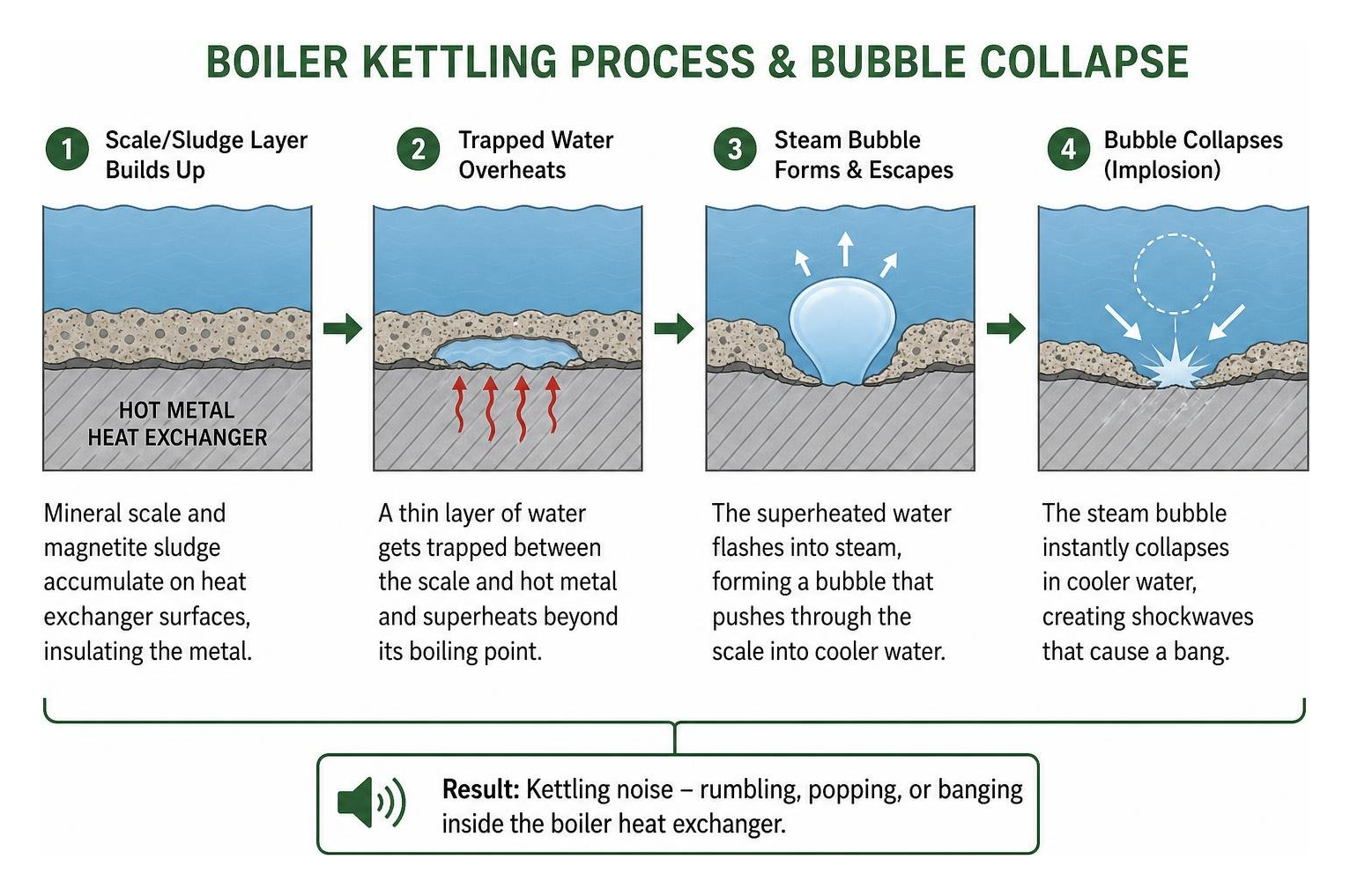
This mineral and sludge layer acts as a thermal insulator, trapping a thin layer of water directly against the ultra-hot metal walls of the heat exchanger. That trapped water superheats past its boiling point, forming localized steam bubbles. As these steam bubbles escape the scale layer into cooler surrounding water, they instantly collapse and implode. The resulting cavitation shockwaves strike the heat exchanger walls, mimicking the sound of an old whistling tea kettle boiling violently or popcorn popping inside iron piping.
Thermal Expansion and Constrained Pipework
Not every bang is an explosive combustion event or steam cavitation. Copper and steel hydronic distribution pipes expand significantly when heated. For example, copper expands predictably across standard heating cycles.
When installers route copper piping through tight structural wooden joists or clamp runs with rigid brackets that lack rubberized isolation gaskets, the pipe binds against the wood as it expands. As thermal tension builds, the pipe suddenly slips free with a sharp, loud pop or ping. Audits by the Chartered Institute of Plumbing and Heating Engineering (CIPHE) revealed that 41% of surveyed domestic installations had bracket spacing exceeding 1.8 meters on 15 mm runs, directly correlating with audible pinging and ticking transmitting straight into living areas.
Diagnosing Noise Timing and System Location
Pinpointing when and where the noise occurs provides valuable diagnostic clues before a technician even opens their tool bag.
What Sound Timing Reveals About a Heating System Making Loud Banging Noise
Tracking the exact timestamp of the noise relative to your heating cycle can help differentiate between fuel combustion, hydraulic dynamics, and structural expansion:
- Instantaneous Ignition Bang (0–5 seconds): Occurs the exact moment the burner attempts to ignite. This points toward delayed combustion or faulty igniter alignment. Contact our team for professional heating repair immediately to ensure combustion safety.
- Delayed Expansion Ticking (2–10 minutes after startup): Begins a few minutes into the cycle as supply water or warm air reaches peak distribution temperatures. This points toward constrained ductwork or expanding hydronic pipework slipping against joists.
- Mid-Cycle Rumbling and Knocking: Continuous popping or banging that worsens as the heating unit reaches maximum operating temperature indicates boiler kettling or poor water circulation.
- Sudden Shutdown Bang (Water Hammer): A single heavy thud that happens the instant the system shuts off or a motorized zone valve snaps shut indicates hydraulic shock waves traveling through water lines.
Diagnosing a Radiator or Hydronic Heating System Making Loud Banging Noise
Industry service records indicate that trapped air in radiator circuits accounts for roughly 67% of reported banging incidents. When air pockets sit trapped inside pipe runs or radiator panels, circulating water compresses these pockets. Rapid temperature shifts cause these compressed air pockets to collapse violently, generating localized shockwaves.
Beyond trapped air, system balancing and pump velocity play massive roles:
- Circulation Pump Sizing and Speed: If your circulator pump is running at an excessive speed setting, water velocity can exceed the recommended 1.5 m/s threshold. In one monitored case study, a circulator producing 3.1 m/s velocity generated an 87 dB bang measured just one meter from the pipe run.
- Failing Circulator Bearings: When internal pump impellers or bearings wear out, water stalls in the boiler loop. Water temperatures quickly spike past 95°C, causing flash-steaming and metallic knocking inside the main manifold.
- Valve Imbalance: Seized lockshield valves or faulty thermostatic radiator valves (TRVs) cause severe flow restrictions. Testing by the Energy Saving Trust found that 31% of aging TRVs deviated significantly from their setpoints, creating erratic flow surges, localized cavitation, and micro-boiling.
Is a Banging Heater Dangerous and When to Shut It Off
A banging heating system should never be treated as normal background noise. While thermal pipe expansion is primarily an acoustic annoyance, delayed ignition and severe kettling carry real risks to your home and equipment.
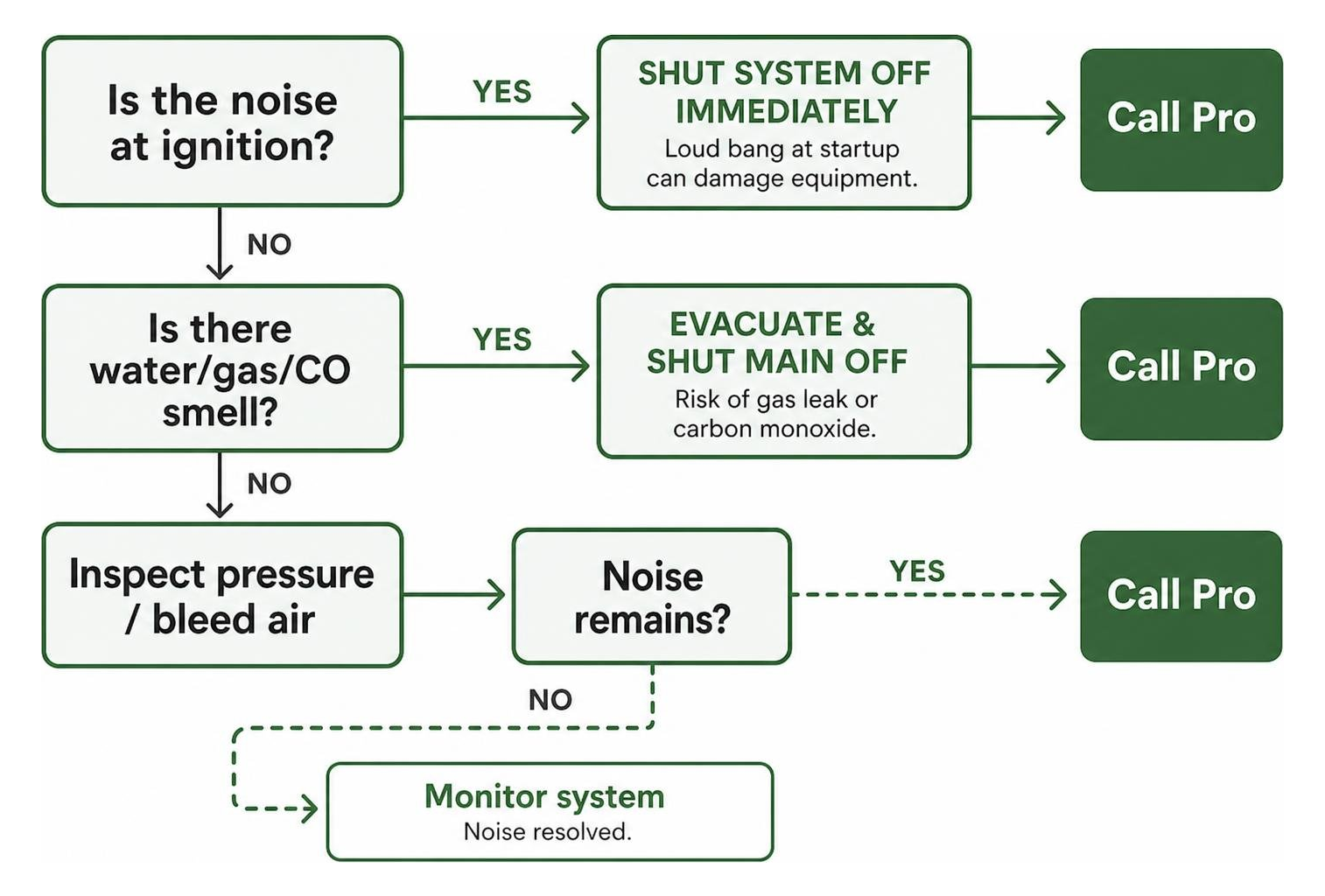
- Combustion Chamber & Heat Exchanger Damage: Repeated explosive ignitions place extreme physical stress on the heat exchanger. Field service data shows that roughly 23% of warranty claims for residential units involve secondary circuit damage linked directly to unaddressed noise events. A cracked heat exchanger can allow toxic flue gases, including carbon monoxide (CO), to enter your indoor airflow.
- Pressure Relief Blowouts: Severe kettling causes dramatic, localized pressure spikes. If system pressure exceeds safe limits (typically 30 psi / 2.0 bar on residential boilers), the pressure relief valve will discharge scalding water onto your floor.
- Emergency Shutoff Protocol: If you hear a loud bang upon startup accompanied by any sulfurous odor, visible scorch marks, or a CO alarm activation, shut down the system immediately via the emergency electrical switch or your breaker panel, turn off the manual gas valve, and evacuate the home before calling for service.
To prevent sudden ignition failures and hazardous component wear, schedule routine inspections using our comprehensive furnace maintenance checklist.
Safe Homeowner Diagnostic Checks Before Calling a Technician
While internal combustion diagnostics and electrical testing require a certified professional, you can safely perform several non-invasive checks beforehand:
- Check the Thermostat: Confirm your thermostat is set to heat mode, calling for a temperature above the current room reading, and has fresh batteries to avoid rapid on/off cycling.
- Inspect the Electrical Panel: Verify that the dedicated circuit breaker for your heating system has not tripped partially, which can cause erratic component behavior.
- Read the Boiler Pressure Gauge: Look at the temperature-pressure gauge (tridicator) on your boiler. For most residential closed-loop systems, static cold pressure should read between 12 and 15 psi (approximately 1.0 to 1.2 bar). If the needle drops below 0.5 bar or climbs above 2.5 bar, the system is operating outside its safe hydraulic range.
- Look for External Leaks: Inspect visible piping around the unit for weeping joints, green mineral staining, or pooling water beneath the expansion tank and pressure relief discharge line.
- Bleed Radiators (For Experienced Homeowners): If you are comfortable using a radiator key, bleed radiators on upper floors to release trapped air until a steady trickle of water emerges, then confirm your system pressure remains stable.
Repair vs. Replacement: Professional Solutions
When our certified technicians inspect a noisy heating system, we use structured diagnostics to pinpoint the root cause rather than relying on guesswork. In real-world diagnostic trials across multi-unit housing developments, structured testing protocols resolved 91% of chronic banging issues within 2.3 hours by accurately targeting hydraulic and combustion faults.
Professional solutions typically include:
- Power Flushing and Descaling: If kettling is present, technicians connect a high-flow power flushing unit with specialized chemical cleaners to dissolve limescale and clear dense magnetite deposits from the heat exchanger. Dosing the system with a protective chemical inhibitor (such as Sentinel X100) reduces subsequent magnetite formation by up to 94%, preventing future noise recurrences.
- Circulation Pump Calibration or Replacement: If the circulator has seized or its internal bearings have degraded, we install a properly sized variable-speed pump calibrated to maintain water velocities below 1.5 m/s.
- Burner Cleaning and Gas Manifold Adjustment: For delayed ignition in gas furnaces, we clean burner ports, clear ignition cross-over channels, test flame sensors, and verify manifold gas pressure to ensure smooth, quiet ignition.
- Pipework Realignment and Isolating Brackets: For expansion noises, we remount constrained piping runs using vibration-dampening brackets lined with EPDM rubber and trim restrictive framing clearances.
Enrolling in routine heating maintenance ensures these components remain clean, balanced, and properly lubricated throughout their operational lifespan.
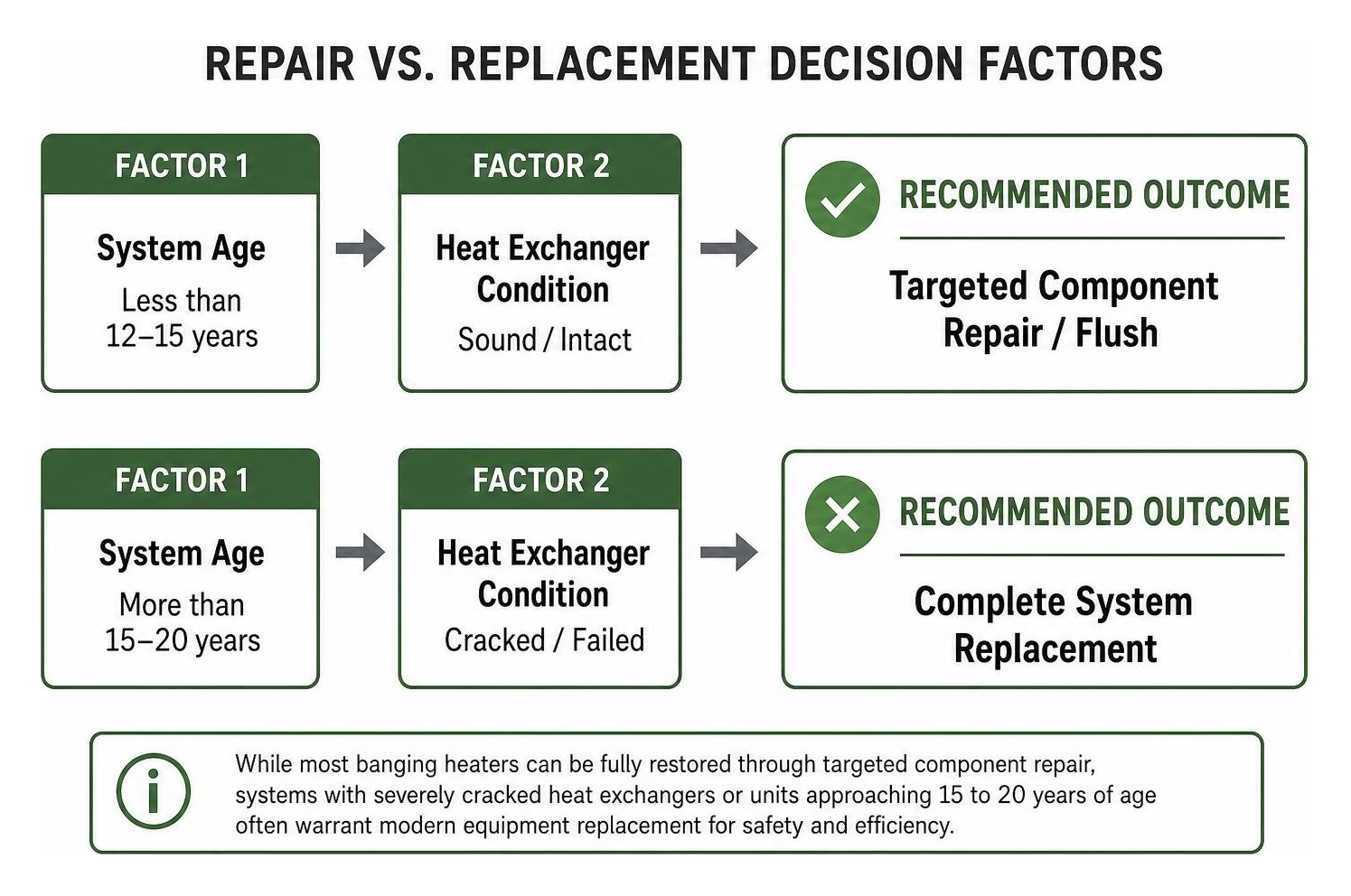
While most banging heaters can be fully restored through targeted component repair, systems with severely cracked cast-iron sections, breached heat exchangers, or units approaching 15 to 20 years of age often warrant modern equipment replacement to maximize safety and operating efficiency.
Frequently Asked Questions About Heater Noises
Can trapped air alone cause loud banging in pipes?
Yes. Trapped air pockets inside closed piping loops can generate surprisingly loud banging sounds. As water circulates, air pockets compress and decompress erratically. When these compressed air pockets pass through narrow valve openings or encounter sudden temperature shifts, they collapse violently. This micro-cavitation creates hydraulic shockwaves that cause pipes to shudder and slam against structural framing. Bleeding radiators and ensuring automated air vents are functioning will eliminate air-related banging.
How long does it take to diagnose a heating system making loud banging noise?
A thorough diagnostic visit typically takes between one and three hours, depending on the complexity of your system and how many components require testing. Technicians use structured protocols to isolate the source of the noise, checking combustion performance, hydraulic pressure, circulation pump operation, and pipework mounting. Because a heating system making loud banging noise can stem from multiple interacting causes, a systematic approach ensures the root issue is identified rather than just the symptom.
Does a loud banging noise mean my entire system must be replaced?
Not necessarily. The vast majority of heating noises stem from replaceable wear-and-tear components or water chemistry imbalances. Issues like failing zone valves, worn pump impellers, trapped air pockets, and limescale buildup can all be resolved without replacing the main unit. Complete system replacement is typically only required if delayed ignition has physically cracked the primary heat exchanger, or if an aging boiler has suffered catastrophic internal corrosion that makes replacement parts unavailable.
Conclusion
A heating system that bangs, pops, or booms at startup is signaling that mechanical, hydraulic, or combustion parameters are out of balance. By paying close attention to whether the sound occurs immediately upon burner ignition or several minutes into the cycle, you can make informed decisions to safeguard your home. Always prioritize safety: shut down your unit if you suspect delayed gas ignition or combustion issues, and rely on certified technicians to handle complex internal diagnostics.
To keep your home warm, efficient, and quiet throughout the colder months, schedule your seasonal Carlsbad HVAC maintenance with John Stevenson Plumbing, Heating & Air Conditioning. Our licensed team proudly provides comprehensive heating, plumbing, and expert HVAC services backed by our 5-Star Service Guarantee across Carlsbad, San Diego County, and Orange County.