
How a Tankless Water Heater Works — and Why Carlsbad Homeowners Are Making the Switch
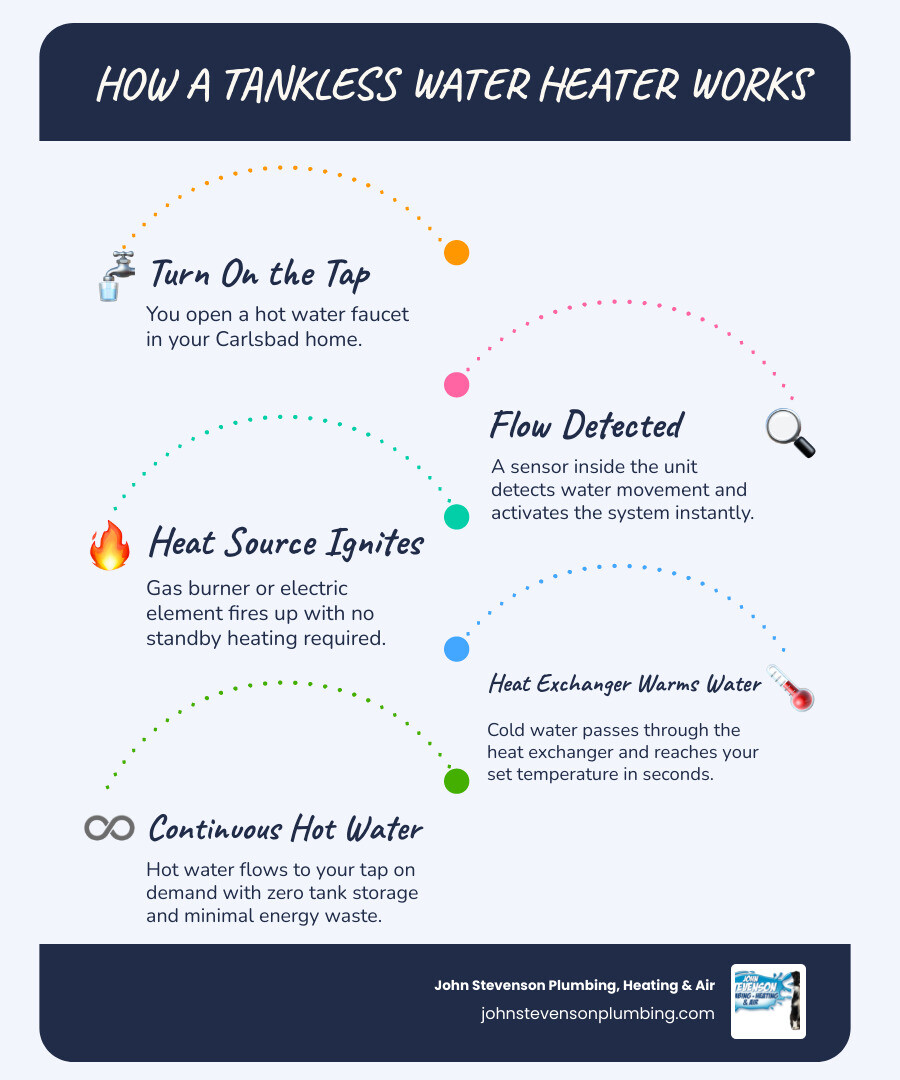
How does a tankless water heater work? Here’s the short answer:
- You turn on a hot water tap.
- Cold water flows into the unit through a pipe.
- A flow sensor detects the movement and activates the system.
- A gas burner or electric heating element fires up instantly.
- Water passes through a heat exchanger and is warmed to your set temperature.
- Hot water arrives at your tap — continuously, with no storage tank needed.
That’s the core of it. No tank to refill. No standby energy wasted keeping 50 gallons hot around the clock. Just hot water, exactly when you need it.
For homeowners in Carlsbad, CA, where energy costs and home efficiency matter, understanding how this system works can help you decide if it’s the right upgrade for your household. Whether you’re tired of cold showers, paying too much on utility bills, or simply replacing an aging unit, a tankless system offers a fundamentally different approach to hot water — one that heats water on demand rather than storing it in advance.
In this guide, we’ll walk through exactly how these systems work, the different types available, how to size one correctly for your home, and what to expect in terms of maintenance and lifespan.
What Is an On-Demand System and How Does a Tankless Water Heater Work?
To truly appreciate a tankless system, it helps to look at what came before it. Traditional storage-tank water heaters have been the standard in Southern California homes for decades. These large, cylindrical tanks (typically holding 40 to 80 gallons) work on a simple principle: they heat a massive volume of water and hold it at a set temperature 24 hours a day, 7 days a week.
Whether you are sleeping, at work, or away on vacation, that tank is constantly burning energy to keep that water hot. This continuous reheating cycle is known as “standby energy loss.” It is the thermodynamic equivalent of leaving your car idling in the driveway just in case you need to run to the grocery store later.
Tankless Water Heaters, on the other hand, are strictly “on-demand” or “instantaneous” systems. They do not store a single drop of hot water. Instead, they remain completely idle until a hot water tap is opened somewhere in your house.
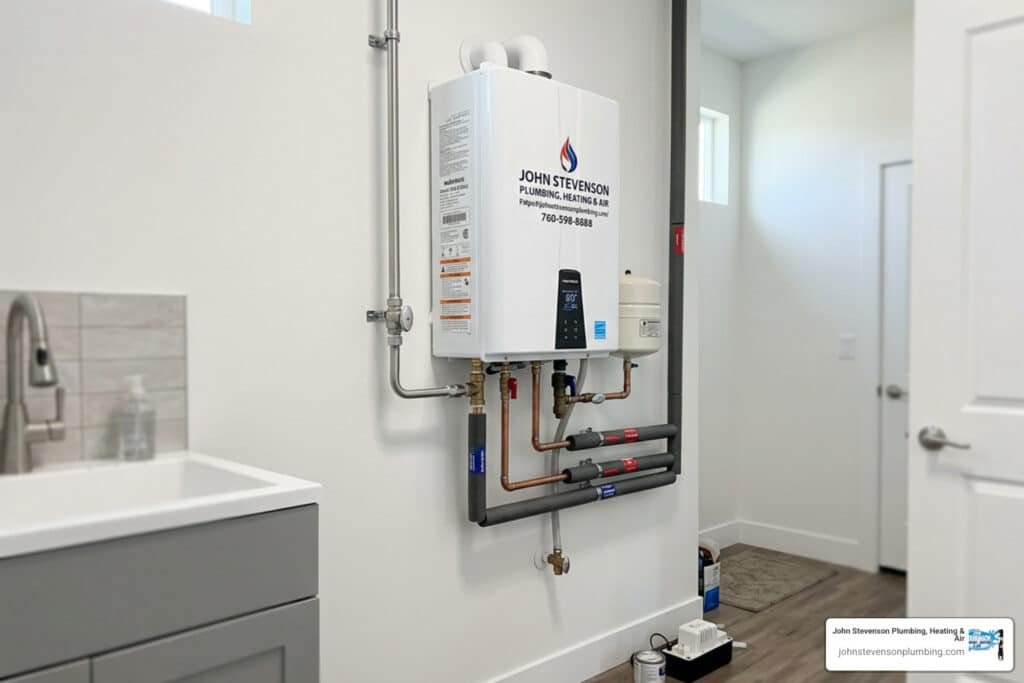
Because they do not require a massive storage reservoir, tankless units are incredibly compact. Usually about the size of a small suitcase, they mount directly to a wall, freeing up valuable square footage in your garage, closet, or utility room. This space-saving design is a major benefit for space-conscious Carlsbad homes.
More importantly, because they only heat water as it travels through the unit, they completely eliminate standby energy loss. This translates to an incredibly efficient system that provides a virtually endless supply of hot water—provided you do not exceed the unit’s maximum flow rate.

Step-by-Step: How does a tankless water heater work when you turn on the tap?
What actually happens inside that compact metal box when you flip your shower handle to “hot”? It is a highly synchronized, high-tech process that takes place in mere seconds:
- The Flow Sensor Triggers the System: The moment a hot water faucet is opened, water begins moving through the plumbing system. A highly sensitive internal flow sensor detects this movement. Most modern tankless units require a minimum flow rate of about 0.4 to 0.5 gallons per minute (GPM) to activate.
- The Control Board Computes the Demand: The flow sensor sends a signal to the unit’s computer control board. The computer immediately checks the incoming water temperature and compares it to your desired thermostat setting. It instantly calculates exactly how much thermal energy (BTUs for gas, or kilowatts for electric) is required to heat the incoming water to the target temperature.
- Burner Ignition or Element Activation: Once the calculations are complete, the system initiates the heating source. In a gas-fired unit, an electronic ignition sparks, the gas valve opens, and a powerful burner ignites. In an electric unit, heavy-duty electrical resistance heating elements switch on.
- Heat Transfer in the Heat Exchanger: Cold water is routed through a winding path of tubing inside a component called the heat exchanger. The heat exchanger is typically made of copper or stainless steel due to their high thermal conductivity. As the cold water flows through this tubing, the intense heat from the gas burner or electric elements is transferred directly through the tube walls into the water.
- Temperature Monitoring and the Feedback Loop: As the heated water exits the heat exchanger, it passes a secondary temperature sensor. If the water is a degree or two too hot or too cold, the control board modulates the gas valve or stages the electric elements up or down. This continuous negative feedback loop ensures the output temperature remains incredibly stable, usually within a fraction of a degree.
- Automatic Shutdown: The moment you turn off the faucet, the flow sensor detects that water has stopped moving. The control board immediately shuts off the gas burner or electric elements. The system goes back into a silent, energy-saving standby mode.
Comparing the Main Types of Tankless Systems
When exploring your options and Choosing the Right Water Heater for Your Home, you will quickly find that tankless systems are not one-size-fits-all. They are categorized by their fuel sources (gas vs. electric) and their venting/heating mechanisms (condensing vs. non-condensing).
To help you visualize the differences, here is a quick comparison of the primary tankless technologies:
| Feature | Gas Tankless (Non-Condensing) | Gas Tankless (Condensing) | Electric Tankless | Hybrid Tankless |
|---|---|---|---|---|
| Primary Fuel Source | Natural Gas or Propane | Natural Gas or Propane | Electricity | Gas + Small Storage Tank |
| Average Efficiency | 80% – 85% | 90% – 98% | 98% – 99% | ~86% |
| Typical Flow Rate | High (5.0 – 11.0+ GPM) | Very High (5.0 – 11.0+ GPM) | Low to Moderate (2.0 – 5.0 GPM) | High (Continuous supply) |
| Venting Required | High-temp stainless steel | Low-temp PVC | None | PVC or stainless steel |
| Best Suited For | Whole-house (moderate use) | Whole-house (high-demand) | Point-of-use or small homes | High simultaneous demand |
Gas vs. Electric: How does a tankless water heater work with different fuel sources?
The choice between a gas and an electric tankless water heater is one of the most critical decisions you will make. Both systems achieve the same goal, but their internal mechanics and infrastructure requirements are vastly different.
Gas Tankless Water Heaters use a burner fueled by natural gas or liquid propane. These systems are incredibly powerful, with BTU ratings ranging from 120,000 to over 200,000 BTUs. Because gas combustion releases a tremendous amount of heat instantly, gas-fired units can produce significantly higher flow rates than electric models. This makes them the preferred choice for whole-home applications in Southern California, where multiple fixtures might run at the same time.
However, gas units require proper venting to safely exhaust combustion gases outside. They also require a dedicated gas line (often upgraded to a 3/4-inch line to support the high BTU demand when firing up).
Electric Tankless Water Heaters use high-wattage electrical resistance elements to heat the water. These units are highly efficient—often converting up to 99% of the electrical energy directly into heat—and they do not require any venting or gas lines.
To heat a whole house, however, an electric tankless water heater requires an enormous amount of electrical power, typically ranging from 15,000 to 36,000 watts. This often necessitates a major electrical panel upgrade (sometimes requiring 150 to 300 amps of dedicated service with multiple double-pole circuit breakers).
Because of these power limitations, electric models are often best utilized as “point-of-use” heaters—installed directly under a kitchen sink or in a remote bathroom to provide localized hot water.
Condensing vs. Non-Condensing Technology
If you decide to go with a gas tankless system, you will need to choose between condensing and non-condensing technology. This distinction centers entirely on how the unit handles combustion exhaust and efficiency.
- Non-Condensing Tankless Heaters: These are the traditional style of gas tankless units. They use a single heat exchanger to warm the water. The hot exhaust gases from combustion—which can reach temperatures of up to 300°F to 400°F—are vented directly out of the home. Because the exhaust is so hot, these units require expensive, category-III stainless steel venting pipes. They typically operate at around 80% to 85% energy efficiency.
- Condensing Tankless Heaters: These units represent the cutting edge of energy efficiency. They feature a secondary stainless steel heat exchanger. Before the hot exhaust gases leave the unit, they pass through this secondary exchanger, which preheats the incoming cold water. This process cools the exhaust gases dramatically (down to about 100°F), causing the water vapor in the exhaust to condense into liquid. Because the exhaust is so cool, condensing units can be vented using inexpensive, easy-to-install PVC pipes. They achieve incredible efficiency ratings of 90% to 98%.
Sizing Your System: Flow Rates and Temperature Rise
One of the most common myths about tankless systems is that they provide “endless hot water for the entire house, no matter what.” While a tankless unit will indeed provide continuous hot water without running out, it has a strict physical limit on how much hot water it can produce at any single moment.
If you attempt to run three showers, the washing machine, and the dishwasher all at once, you will likely exceed the unit’s capacity, resulting in a sudden drop in water temperature. This is why proper sizing is absolutely vital.
When sizing a tankless water heater, we look at two primary numbers: Flow Rate and Temperature Rise.
1. Calculating Flow Rate (GPM)
First, you must determine your household’s peak simultaneous hot water demand. To do this, add up the gallons per minute (GPM) of every fixture you expect to run at the exact same time. Under the Federal Energy Policy Act, modern fixtures have restricted flow rates, but older fixtures may draw more.
Here are typical flow rates for common household fixtures:
- Low-flow showerhead: 1.5 to 2.0 GPM
- Standard showerhead: 2.2 to 2.5 GPM
- Bathroom sink faucet: 0.5 to 1.5 GPM
- Kitchen faucet: 1.5 to 2.2 GPM
- Dishwasher: 1.0 to 2.0 GPM
- Washing machine: 1.5 to 3.0 GPM
Example Scenario: If you want to be able to run two standard showers (2.5 GPM each) and the dishwasher (1.5 GPM) at the same time, your peak demand is:
2.5 + 2.5 + 1.5 = 6.5 GPM
2. Determining Temperature Rise
Temperature rise is the difference between the temperature of the cold groundwater entering your home and your desired hot water output temperature (typically set to 120°F).
Here is where our Southern California geography works highly in our favor! In colder northern climates, winter groundwater temperatures can plunge to a freezing 40°F, requiring a massive 80-degree temperature rise to reach 120°F. This drastically reduces the GPM capacity of tankless heaters in those regions.
In Carlsbad and surrounding coastal areas, our average year-round groundwater temperature is much warmer—usually hovering between 65°F and 70°F.
To calculate your required temperature rise:
Target Temperature (120°F) - Incoming Groundwater Temp (65°F) = 55°F Temperature Rise
Because we only need a modest 55°F temperature rise, a tankless water heater installed in our service area can deliver significantly higher flow rates than the exact same unit installed in a cold climate.
Understanding these dynamics is a key reason Why Homeowners Are Going Tankless to Save Money in our local communities.
Pros, Cons, and Maintenance Requirements
Transitioning to a tankless system is an excellent investment, but it is important to have a balanced, realistic view of the advantages, limitations, and ongoing care these units require.
The Advantages (The Pros)
- Continuous Hot Water: You will never have to worry about being the last person in line for a shower. As long as you stay within the unit’s GPM limit, it will heat water indefinitely.
- Lower Utility Bills: Because tankless units eliminate standby energy losses, they are incredibly efficient. For homes that use 41 gallons or less of hot water daily, demand water heaters can be 24%–34% more energy efficient than conventional storage tank water heaters. Even for busy households using around 86 gallons per day, they remain 8%–14% more energy efficient.
- Exceptional Lifespan: Most tankless water heaters have a life expectancy of more than 20 years with proper care. In contrast, traditional storage water heaters typically last only 10 to 15 years.
- Space Savings: Freeing up garage or closet floor space by wall-mounting a compact unit is a major win for coastal Southern California homes.
- Reduced Flood Risk: Traditional tanks eventually rust from the inside out, which can lead to catastrophic tank failures and flooded garages or basements. Tankless units hold very little water, virtually eliminating this risk.
The Considerations (The Cons)
- Higher Upfront Investment: Tankless systems are highly sophisticated pieces of technology. The initial purchase price of the unit, combined with the specialized labor required for proper venting, gas line upgrades, or electrical modifications, means the upfront installation is more intensive than simply swapping out a standard tank.
- Lag Time: Because the unit must detect water flow, ignite the burner, and heat the heat exchanger, it takes a few additional seconds for hot water to start traveling down your pipes compared to a tank system that already has hot water pressurized and waiting.
Crucial Maintenance: Fighting Hard Water and Scale Buildup
Many homeowners believe that because tankless systems lack a storage tank, they are entirely maintenance-free. This is a costly misconception. In fact, regular maintenance is the single most important factor in ensuring your unit reaches its 20+ year life expectancy.
The primary enemy of a tankless water heater is scale buildup. Southern California is known for having moderately hard water. As hard water is heated inside the heat exchanger, dissolved minerals (primarily calcium and magnesium) crystallize and cling to the metallic walls of the tubing.
Over time, this scale forms an insulating barrier. Because the heat cannot easily pass through the scale to reach the water, the unit’s burner has to run hotter and work much harder to achieve the target temperature. This decreases energy efficiency, strains internal components, and can eventually cause the heat exchanger to overheat and fail prematurely.
To protect your system, we highly recommend:
- Annual Descaling (Flushing): This involves connecting a small utility pump to the unit’s isolation valves and circulating a food-grade descaling solution (or pure white vinegar) through the heat exchanger for about 45 to 60 minutes. This safely dissolves and flushes away all mineral deposits.
- Water Softeners: If you live in an area with particularly hard water, installing a whole-home water softener or a dedicated scale-prevention system alongside your water heater will drastically reduce scale accumulation and keep your system running at peak efficiency.
If you are located in coastal areas or South County, our teams specializing in Orange County Tankless Water Heater Services and Lake Forest Tankless Water Heaters can assist with professional sizing, code-compliant installations, and routine annual flushing to keep your investment protected.
Frequently Asked Questions About Tankless Water Heaters
Can a tankless water heater supply multiple fixtures at once?
Yes, a properly sized tankless water heater can easily supply multiple fixtures simultaneously. The key is ensuring that the total GPM demand of those fixtures does not exceed the unit’s maximum output capacity at our local Southern California temperature rise.
For instance, a high-capacity gas tankless unit rated for 9.0 GPM can comfortably handle two showers running at the same time while the dishwasher is operating. However, if you attempt to run multiple high-demand appliances beyond that limit, the system’s computer will automatically restrict the water flow to ensure that the water leaving the unit still reaches the desired temperature.
Why does my tankless water heater occasionally deliver a burst of cold water?
This phenomenon is commonly referred to as a “cold water sandwich.” It typically happens when someone turns a hot water faucet on, runs it briefly, turns it off, and then turns it back on a minute later.
When the faucet is first turned on, the water heater fires up and delivers hot water. When the faucet is shut off, a small amount of hot water remains in the pipes, but the heater shuts down. When the faucet is turned back on, the heater takes a few seconds to re-ignite and warm up.
During this brief delay, a small pocket of unheated cold water enters the line, sandwiched between the residual hot water already in the pipes and the newly heated water coming from the unit.
To eliminate this issue, many modern high-end tankless water heaters feature built-in mini-buffer tanks or advanced programming designed to minimize these temperature fluctuations. Incorporating an on-demand recirculating pump can also help maintain instant, consistent temperatures throughout your home’s plumbing loops.
How long do tankless water heaters last compared to traditional tanks?
With proper care and routine annual maintenance, a high-quality tankless water heater boasts a life expectancy of 20 years or more. This is roughly double the lifespan of a traditional storage-tank water heater, which typically needs to be replaced every 10 to 15 years.
Because tankless systems do not continuously hold water, they are far less susceptible to internal rust, corrosion, and structural tank fatigue. Investing in a tankless system means you are investing in a durable, long-term solution that will reliably serve your home for decades.
Conclusion
Understanding how does a tankless water heater work reveals that these systems are far more than just compact alternatives to traditional tanks—they are highly engineered, energy-efficient solutions designed to provide continuous comfort while lowering your monthly utility bills. By heating water only when you need it, eliminating standby energy losses, and offering a lifespan that doubles that of standard tanks, a tankless system is an exceptional upgrade for any Southern California home.
However, the key to maximizing the efficiency, performance, and longevity of a tankless system lies in professional sizing, expert installation, and consistent maintenance. Because these units require precise gas line sizing, specialized venting, and accurate electrical configurations, DIY installation is highly discouraged.
At John Stevenson Plumbing, Heating & Air Conditioning, our team of certified Carlsbad plumbing experts is dedicated to helping you find the perfect hot water solution for your household. Backed by our signature 5-Star Service Guarantee, we provide thorough diagnostics, transparent upfront pricing, and a 24-hour satisfaction check-in to ensure your new system is installed flawlessly.
If you are ready to enjoy endless hot water and lower energy bills, contact us today to schedule a consultation for your Tankless Water Heaters upgrade!