
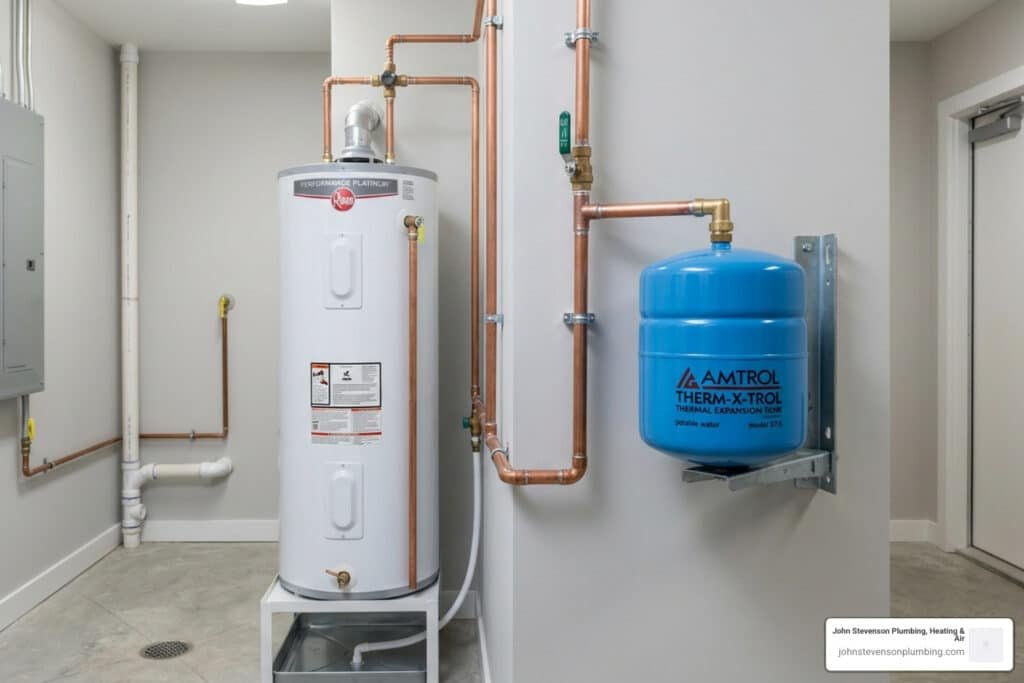
Why Expansion Tank Requirements for Water Heaters in California Matter for Your Home
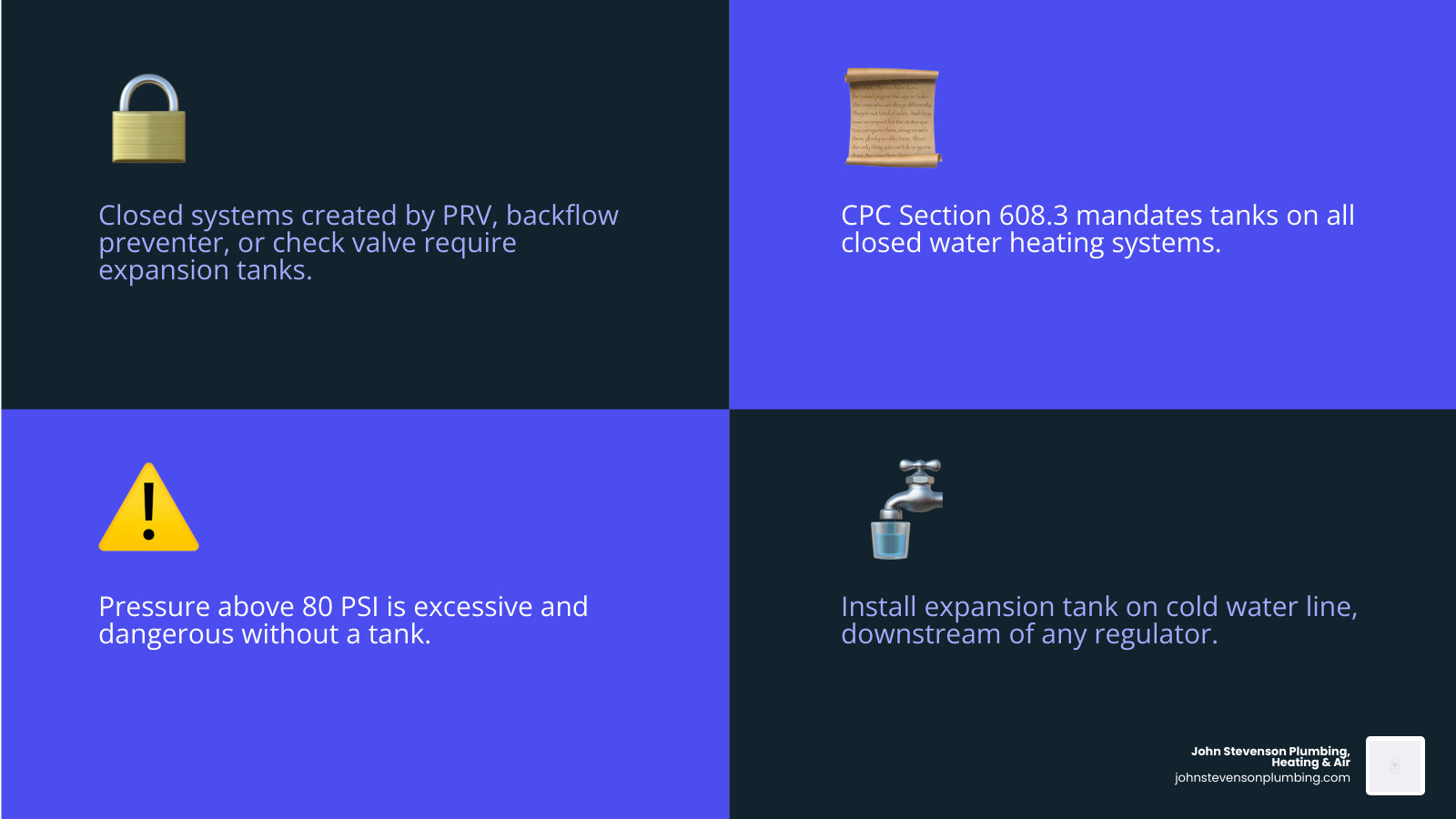
Expansion tank requirements for water heaters California homeowners need to follow come down to one core rule: if your home has a closed plumbing system — created by a pressure reducing valve (PRV), backflow preventer, or check valve — California law requires a thermal expansion tank on your water heater.
Here is a quick summary of what the code requires:
- California Plumbing Code (CPC) Section 608.3 mandates a thermal expansion tank or approved equivalent on all closed water heating systems
- California Mechanical Code (CMC) Section 1005.0 reinforces this requirement to prevent excessive pressure buildup during heating
- A closed system exists when any device (PRV, backflow preventer, check valve) blocks water from flowing back into the municipal supply line
- Pressure above 80 PSI is considered excessive and dangerous without an expansion tank in place
- Expansion tanks must be installed on the cold water supply line, downstream of any pressure regulator
- All new and replacement water heater installations in California require a permit, inspection, and compliance with these rules
Most homes in California have a closed plumbing system and don’t even know it. When water heats up inside your tank, it expands. In an open system, that extra volume flows back into the city main — no problem. But in a closed system, that pressure has nowhere to go. Without an expansion tank, it builds until something gives: a dripping relief valve, a burst pipe, or a flooded floor.
One plumber described taking a panic call from a homeowner whose water was cascading down her staircase, flooding brand-new oak floors — all because her system had quietly switched to a closed loop and there was no expansion tank to absorb the pressure. That kind of damage is preventable, and California code exists precisely to stop it from happening.
What is a Thermal Expansion Tank and How Does it Work?
To understand why we need these tanks, we first have to look at the physics of water. When water is heated, it undergoes thermal expansion. This means it physically grows in volume. For example, 50 gallons of cold water can expand to roughly 52 gallons once it reaches 120°F. In a confined space like a Water Heater, that extra two gallons of water creates a massive amount of internal pressure.
A thermal expansion tank is a small, secondary tank—usually about the size of a basketball—that acts as a safety “shock absorber” for your plumbing. Inside the tank, there is a rubber diaphragm that separates a chamber of compressed air from a chamber where water can enter.
When your water heater kicks on and the water expands, the extra volume pushes against that diaphragm, compressing the air on the other side. This safely absorbs the pressure spike. Once the water cools down or a faucet is turned on, the air pressure pushes the water back out into the system. Without this device, your pipes, joints, and the water heater tank itself take the full brunt of that pressure, leading to premature failure and leaks.
Expansion Tank Requirements for Water Heaters California: Navigating the CPC
In California, plumbing safety isn’t just a recommendation—it’s the law. The state has some of the strictest building codes in the country to protect homeowners from water damage and mechanical failures. Our team at John Stevenson Plumbing, Heating & Air sees these codes in action every day during our Water Heater Services.
The primary governing document is the California Plumbing Code (CPC). Specifically, Section 608.3 states that a device for controlling thermal expansion must be installed whenever a check valve, backflow preventer, or pressure-reducing valve is present. This is mirrored in the California Mechanical Code (CMC) Section 1005.0, which mandates that excessive pressure must be relieved during the heating process.
Compliance is mandatory for any new installation or when you are replacing an old unit. This means if you are pulling a building permit for a new water heater in Carlsbad or Oceanside, the city inspector will check to ensure a properly sized expansion tank is installed. Failing to meet these requirements can lead to failed inspections, legal liability, and even voided manufacturer warranties on your plumbing fixtures.
Understanding Closed Systems vs. Open Systems
Why does one house need a tank while another might not? It all comes down to whether your plumbing is “Open” or “Closed.”
- Open Systems: In older configurations, there is nothing blocking the flow of water between your home and the city’s water main. If the water in your heater expands, it simply pushes back out into the municipal supply line. The city’s massive network of pipes acts as your expansion tank.
- Closed Systems: Modern plumbing often includes a backflow preventer, a check valve, or a pressure reducing valve (PRV). These devices are designed to keep water flowing in only one direction—into your house. While this protects the city’s water from contamination and keeps your home’s pressure steady, it creates a “one-way street.” When the water heats up and expands, it is trapped. It cannot go back to the city main, so the pressure builds up inside your home’s pipes.
If you have a PRV (which is common in areas with high municipal pressure), you officially have a closed system and will likely need Water Heater Repair or an upgrade to include an expansion tank if one isn’t already there.
When is an Expansion Tank Mandated by Code?
The expansion tank requirements for water heaters California residents must follow are triggered by several specific conditions:
- Presence of a PRV or Backflow Device: If your home has a pressure regulator (usually found where the main water line enters the house), a tank is required.
- Pressure Threshold: Any system where the static water pressure exceeds 80 PSI is considered at risk. High pressure combined with thermal expansion is a recipe for disaster.
- Downstream Installation: Code dictates that the expansion tank must be installed on the cold water distribution piping, specifically downstream of the pressure regulator.
- New Construction and Replacements: Whether you are building a new home or just getting a Water Heater Installation, current codes apply. You cannot “grandfather in” an old system that lacks a tank if you are replacing the heater itself.
Risks of Non-Compliance and High-Pressure Damage
Ignoring these codes isn’t just a legal risk; it’s a financial one. When thermal expansion has nowhere to go, your plumbing system experiences “stress events” every time the heater runs.
| Feature | Open Plumbing System | Closed Plumbing System (No Expansion Tank) |
|---|---|---|
| Pressure Relief | Backflows into city main | Trapped in home pipes |
| T&P Valve | Stays dry | Frequently drips or leaks |
| Pipe Stress | Minimal | High (leads to bursts) |
| Fixture Life | Normal | Shortened (leaky faucets/toilets) |
| Code Status | Permitted in older homes | Violation of CPC 608.3 |
One of the most common symptoms we see is a dripping Temperature and Pressure (T&P) relief valve. This valve is designed to open at 150 PSI or 210°F to prevent the tank from exploding. If you see it dripping, it means your tank is reaching dangerous pressure levels daily. Over time, this constant “hammering” causes leaks at pipe joints, damages the internal lining of your water heater, and can lead to a catastrophic tank failure.
If you live in Ramona and notice these signs, you should seek Water Heater Repair in Ramona CA immediately. Beyond the physical damage, most manufacturers will void your warranty if they find the heater was operated in a closed system without an expansion tank.
Installation, Sizing, and Seismic Safety Standards
Proper installation is key to meeting expansion tank requirements for water heaters California standards. It isn’t enough to just “have” a tank; it must be installed correctly to pass inspection and function safely.
The tank should be installed on the cold water supply line, usually within 18 inches of the water heater inlet. While some older tanks could be installed in any orientation, most modern manufacturers and local codes prefer they be mounted upright and independently supported. This means you shouldn’t rely on the plumbing pipes alone to hold the weight of the tank, especially if it ever fills with water (which makes it quite heavy).
In some cases, a listed “thermal expansion control valve” may be used as an alternative to a tank, but these are less common and must be specifically approved by your local building department. For the most reliable protection, we always recommend a high-quality Water Heater Installation that includes a standard expansion tank.
How to calculate sizing for expansion tank requirements for water heaters California
Sizing isn’t a “one size fits all” situation. The size of the expansion tank you need depends on two main factors: the capacity of your water heater (in gallons) and your incoming water pressure (in PSI).
- 2-Gallon Tanks: Generally sufficient for standard 40-gallon or 50-gallon water heaters with water pressure below 60 PSI.
- 5-Gallon Tanks: Often required for larger 75-gallon or 80-gallon heaters, or for 50-gallon heaters where the home’s water pressure is on the higher side (near 80 PSI).
Before installation, a technician must “pre-charge” the air chamber of the expansion tank using a tire pump and pressure gauge. The air pressure inside the tank must match the static water pressure of your home. If your home pressure is 60 PSI, the tank needs 60 PSI of air. If the pressures don’t match, the tank won’t work correctly. If you are unsure about your settings, our team can help with Water Heater Repair and calibration.
California Seismic Strapping and Placement Rules
Because we live in earthquake country, California has additional safety rules that go beyond standard plumbing. Every water heater must be secured with earthquake straps to prevent it from tipping over during a tremor.
- Two Straps Required: You must have one strap in the top one-third of the tank and another in the bottom one-third.
- Clearance: The bottom strap must be at least 4 inches above the water heater’s controls to prevent interference or fire hazards.
- Bracing: The straps must be securely anchored to the wall studs or the home’s structure.
Local jurisdictions—from Paradise and Roseville down to Marin County and our service areas in San Diego—may have slight variations in how they enforce these seismic rules, but the “top third/bottom third” rule is the gold standard for Water Heaters statewide.
Frequently Asked Questions about Expansion Tank Requirements for Water Heaters California
As experts in California plumbing, we get a lot of questions about these devices. Here are the most common things homeowners ask us.
Are tankless models exempt from expansion tank requirements for water heaters California?
Generally, yes. Because tankless water heaters do not store a large volume of water, there is very little thermal expansion to manage. Since there is no “tank” of water being heated and held, the pressure spikes are negligible. However, if you are moving from a traditional tank to a tankless system, you will still need to ensure your overall system pressure is regulated. You can learn more about these efficient options through our Tankless Water Heater Services or by exploring the benefits of Tankless Water Heaters.
What are the signs that an expansion tank needs replacement?
Expansion tanks typically last between 5 and 10 years, roughly matching the lifespan of the water heater itself. We usually recommend replacing them at the same time you get a new heater. Signs of failure include:
- Water Hammer: Hearing a loud “bang” in the pipes when a faucet is turned off.
- Fluctuating Pressure: Noticeable drops or surges in water pressure.
- The “Thump” Test: If you tap the top of the tank and it sounds “solid” or “full” rather than hollow, the internal diaphragm has likely failed, and the tank is “waterlogged.”
- Heavy Tank: If the tank feels extremely heavy, it is full of water and no longer has an air cushion.
If you suspect your tank has failed, it’s best to call for Water Heater Repair before the excess pressure damages the rest of your home.
Conclusion
Understanding the expansion tank requirements for water heaters California mandates is about more than just passing an inspection—it’s about protecting your home, your family, and your investment. Thermal expansion is a powerful force, but with a properly installed and sized expansion tank, it’s one you never have to worry about.
At John Stevenson Plumbing, Heating & Air, we take the “pressure” out of plumbing. Our certified technicians are experts in California codes and are dedicated to providing the highest level of safety and service. Whether you are in Carlsbad, San Diego, or anywhere in our wide service area, we offer a 5-Star Service Guarantee that includes thorough diagnostics and upfront pricing.
Don’t wait for a dripping valve or a flooded floor to tell you there’s a problem. Ensure your home is up to code and protected from high-pressure damage. Schedule your professional water heater service today and let us give you the peace of mind you deserve.