
Is Hydro Jetting Overkill for Your Clog? Here’s How to Know
When is hydro jetting overkill for a clog? It’s a fair question — and one that can save you real money. Hydro jetting is a powerful drain cleaning method that blasts water through your pipes at up to 4,000 PSI. For the right problem, it’s an excellent tool. But for a simple, localized blockage in your Carlsbad home, it can be far more than the job actually calls for.
Hydro jetting is overkill when:
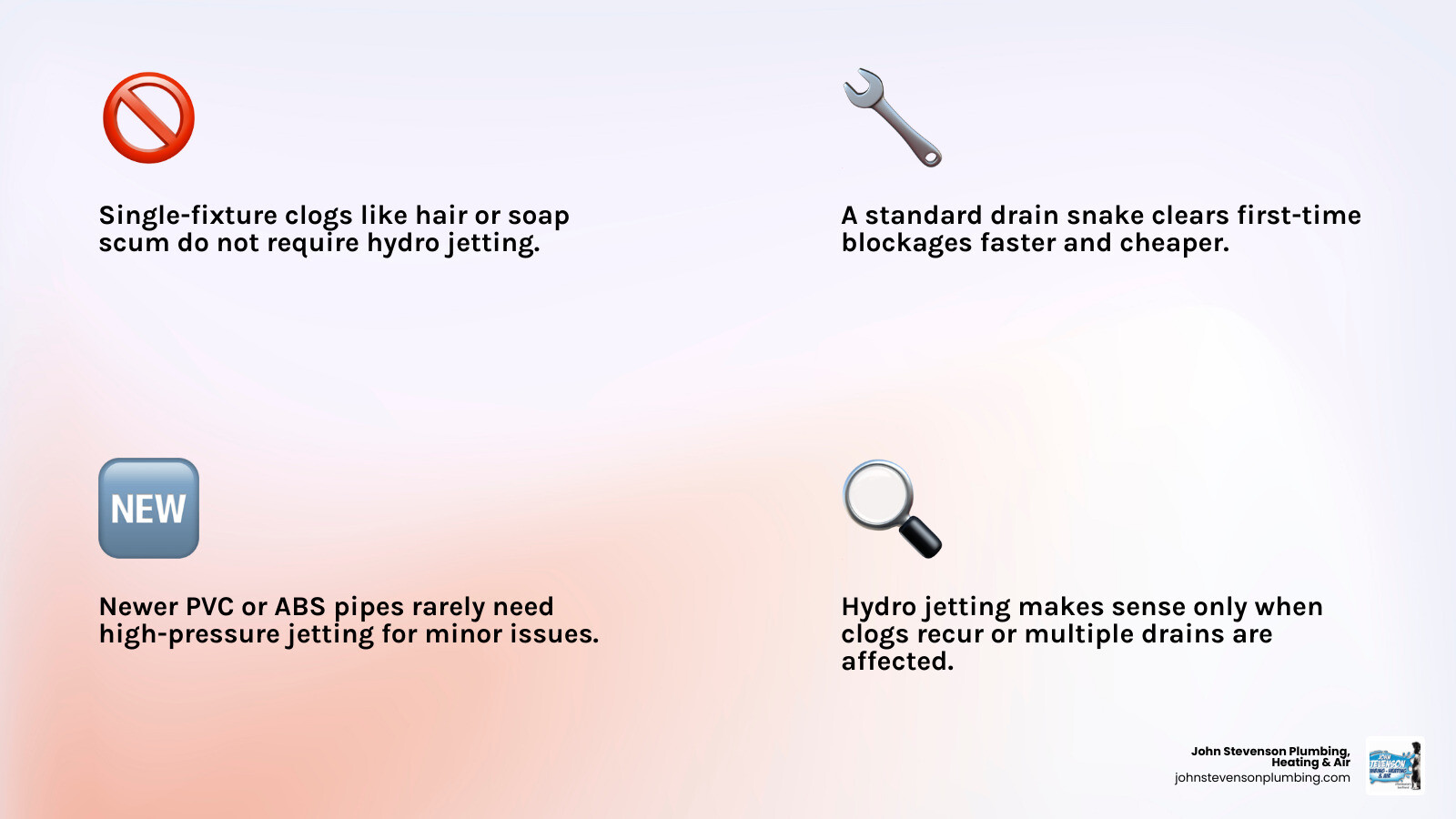
- The clog is in a single fixture (one sink, one shower drain)
- The blockage is caused by hair, soap scum, or a small physical object
- It’s your first time experiencing a clog in that drain
- Your pipes are newer PVC or ABS with no history of buildup
- No camera inspection has confirmed a deeper or recurring problem
For these situations, a standard drain snake is faster, less aggressive, and gets the job done just as well.
Hydro jetting makes more sense when clogs keep coming back, when grease or tree roots are involved, or when multiple drains in your home are slow at the same time. The key is matching the tool to the actual problem — not defaulting to the most powerful option available.
When is hydro jetting overkill for a clog vocab to learn:
Understanding the Tools: Drain Snaking vs. Hydro Jetting
To make an informed decision for your home, it helps to understand how these two common drain cleaning methods work. While both are designed to restore water flow, they use completely different physical mechanisms to achieve that goal.
The Traditional Drain Snake (Mechanical Auger)
A drain snake, also known as a mechanical auger, is a time-tested plumbing tool. It consists of a flexible metal cable that is inserted directly into the drain line. When the cable is rotated—either manually or by a motorized machine—it punches a hole straight through the blockage.
The primary goal of drain snaking is to restore immediate drainage by breaking up physical obstructions or pulling them back up to the surface. It is highly effective for localized clogs, such as a ball of hair caught in a bathroom sink P-trap or a small physical object accidentally flushed down a toilet. However, because the snake only clears a path as wide as its tip, it often leaves behind sticky residue along the pipe walls.
Professional Hydro Jetting (High-Pressure Water)
Hydro jetting is a modern, heavy-duty solution designed to scour the entire interior of your plumbing system. Instead of using a metal cable to punch through debris, a hydro jetting machine pumps water at extreme high pressure—typically ranging from 1,500 to 4,000 PSI—through a specialized nozzle. This nozzle features both forward-facing jets to clear blockages and rear-facing jets that propel the hose forward while scrubbing the pipe walls clean.
Think of hydro jetting as a pressure washer for the inside of your sewer lateral. It does not just create a temporary path; it completely emulsifies grease, pulverizes tree roots, and strips away years of built-up mineral scale, restoring the pipe to its near-original internal diameter.
To help you visualize how these two methods compare, we have put together a quick breakdown of their capabilities:
| Feature | Drain Snaking | Hydro Jetting |
|---|---|---|
| Primary Mechanism | Rotating metal cable (mechanical) | High-pressure water streams (hydraulic) |
| Best Suited For | Localized, physical blockages (hair, small objects) | Systemic buildup (grease, scale, heavy tree roots) |
| Action on Pipe Walls | Leaves residue and biofilm intact | Scours walls clean to original diameter |
| Safety on Fragile Pipes | Safe for most older, fragile systems | High risk of damaging weakened or cracked pipes |
| Result Longevity | Temporary relief (weeks to months) | Long-term restoration (typically years) |
Choosing the wrong method can lead to unnecessary expenses or, worse, damaged pipes. To learn more about how we evaluate these options on the job, take a look at our guide on Snake or Spray Choosing the Best Way to Clear Your Clogs.
When Is Hydro Jetting Overkill for a Clog in Your Carlsbad Home?
It is easy to assume that the most powerful plumbing tool is always the best choice. However, using a hydro jetter on a basic, localized clog is the plumbing equivalent of using a sledgehammer to hang a picture frame. It is simply unnecessary, and it can expose your plumbing system to avoidable risks.

In Carlsbad and across North County, we encounter many homes built in different eras—from mid-century bungalows to brand-new developments. Each neighborhood has its own unique plumbing layout, but the rule of thumb remains the same: match the strength of your solution to the nature of the blockage. If you want to keep your drains flowing smoothly day in and day out, practicing good habits is the first step. You can read more about preventative habits in our article Stop the Clog Before It Starts.
Minor and Localized Blockages: Why Hydro Jetting Is Overkill for a Clog
When you are dealing with a localized clog, the obstruction is confined to a single plumbing fixture. This means the rest of your home’s drains are running perfectly, and the issue is likely sitting right in or just past the immediate P-trap.
Common examples of minor, localized blockages include:
- Bathroom Sinks and Showers: These are almost always caused by a combination of hair, soap scum, and grooming products. Because these clogs are soft and sit close to the drain opening, a standard mechanical snake can easily hook the debris and pull it out in a matter of minutes.
- Toilet Obstructions: If a toilet is backed up because someone used too much toilet paper or dropped a small personal item inside, a specialized toilet auger (closet snake) is the safest and most efficient tool. Blasting water at 3,000 PSI inside a toilet bowl will only cause a massive, unsanitary mess.
- Kitchen Sink Food Waste: A simple buildup of food scraps or a minor pocket of grease can usually be cleared with a light mechanical snake.
In all of these scenarios, when is hydro jetting overkill for a clog becomes incredibly clear. Paying for a high-pressure water blast to clear a shallow hair clog provides zero durable benefit. A traditional mechanical snake clears the obstruction entirely, leaving your drain fully functional without the need for heavy-duty industrial equipment.
First-Time Clogs in Modern Pipes: When Is Hydro Jetting Overkill for a Clog?
If your home was built after 1980, it likely features modern PVC or ABS plastic drain lines. These materials are incredibly smooth, meaning they do not collect grease or mineral scale nearly as fast as older cast iron pipes do.
If you experience a first-time clog in a modern plastic pipe—such as a kitchen sink that is suddenly draining slowly—it is highly likely a one-off physical obstruction rather than a systemic, deep-seated buildup. A mechanical drain snake is more than enough to punch through the blockage and restore flow.
Because modern plastic pipes do not suffer from the same interior rusting or heavy scaling as metal pipes, there is no wall buildup for a hydro jetter to clean. Utilizing hydro jetting on a simple, one-time clog in a healthy PVC line is an unnecessary service that adds no long-term value to your plumbing system.
Pipe Safety: Risks of High-Pressure Jetting and the Role of Camera Inspections
While hydro jetting is an incredibly effective way to restore a sewer line, it is not a risk-free procedure. Water pressurized up to 4,000 PSI exerts massive force on whatever it touches. If your pipes are not structurally sound, that force can lead to catastrophic failure.
Understanding the structural integrity of your plumbing system is essential before any high-pressure work begins. To dive deeper into how pipe condition affects your service options, read our detailed Hydro Jetting vs Snaking Cost Comparison 101.
Fragile Pipe Materials and Age Considerations
In older coastal neighborhoods of Carlsbad, Solana Beach, and Oceanside, many homes still rely on original, aging sewer lines. If your home was built before 1980, your pipes may be constructed from materials that simply cannot handle industrial-grade water pressure:
- Pre-1960 Clay Pipes: Clay tile sewer lines are highly susceptible to shifting, cracking, and offset joints. Blasting high-pressure water into a misaligned clay joint can wash away the supporting soil surrounding the pipe, leading to a total line collapse.
- Orangeburg Pipes: Popular from the 1940s through the 1970s, Orangeburg pipes are made of compressed wood fiber saturated with coal tar. Over time, these pipes absorb water, flatten, and become incredibly soft. Hydro jetting an Orangeburg pipe will literally shred the pipe walls, requiring an immediate and costly sewer line replacement.
- Rusted Cast Iron Pipes: Older cast iron pipes develop severe internal corrosion and scale over decades. While hydro jetting can sometimes be adjusted to a lower “step-down” pressure to clean cast iron safely, heavily rusted or paper-thin cast iron walls can easily rupture under standard jetting pressures.
If a plumbing technician suggests hydro jetting without asking about the age of your home or checking your pipe material, that is a major red flag.
Why Camera Inspections Must Precede Hydro Jetting
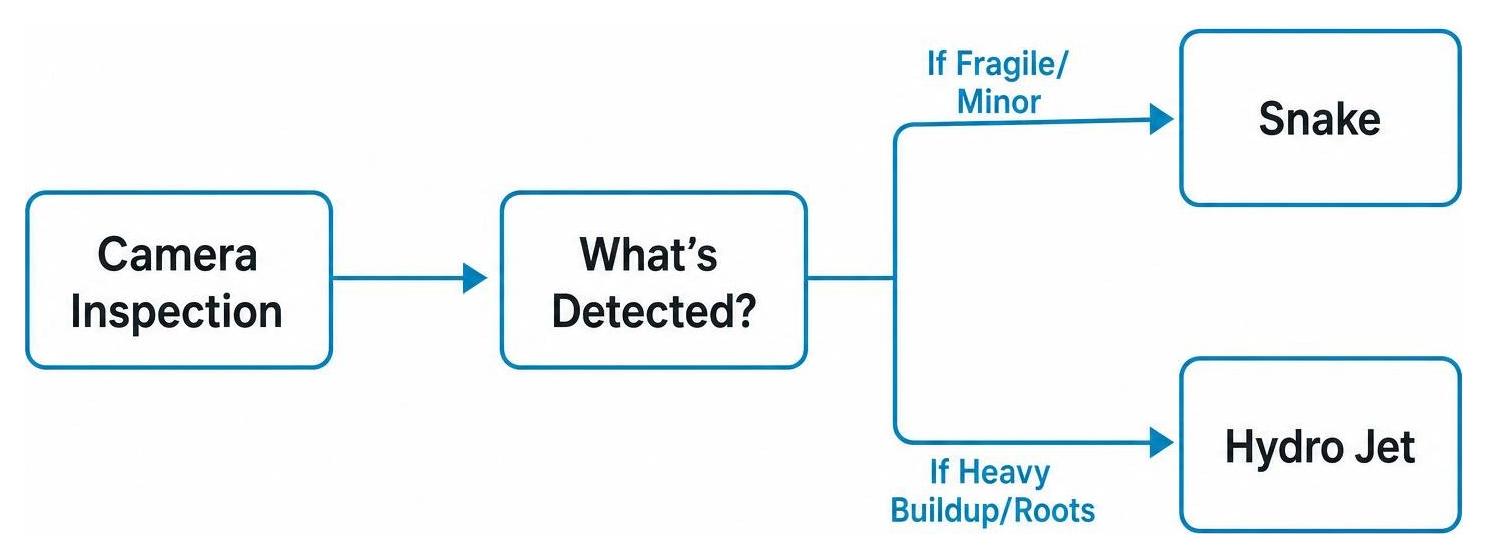
We enforce a strict rule in our daily operations: never hydro jet a sewer line without performing a professional camera inspection first.
A fiber-optic sewer camera is threaded down your drain line to provide a real-time, high-definition look at the interior of your pipes. This diagnostic step is crucial for several reasons:
- Verifying Structural Integrity: A camera inspection reveals whether your pipes have existing cracks, holes, offset joints, or structural sags (bellies) that would make hydro jetting dangerous.
- Identifying the Clog Type: It allows us to see exactly what is causing the blockage. If the camera reveals a solid physical object like a toy or a broken piece of pipe, we know hydro jetting won’t help and that a different repair method is required.
- Preventing Unnecessary Upsells: Sadly, some big-name plumbing chains push expensive hydro jetting packages for pipes that are already completely clear. Demanding to see the live video footage ensures you only pay for the services your home actually needs.
Frequently Asked Questions About Carlsbad Drain Cleaning
Can hydro jetting damage older cast iron pipes?
Yes, hydro jetting can absolutely damage older cast iron pipes if they are heavily corroded or weakened. Over decades of use, cast iron pipes undergo internal rusting, which thins the pipe walls and creates weak points.
If a technician applies full water pressure (up to 4,000 PSI) to a severely deteriorated cast iron pipe, it can crack or punch holes right through the metal. However, if a professional camera assessment shows that the cast iron is still structurally sound, a trained plumber can use a calibrated “step-down” pressure setting to safely scour away scale and restore the pipe’s original flow capacity.
How do I know if my main sewer line needs hydro jetting?
Your main sewer line likely needs hydro jetting if you are experiencing systemic, recurring issues rather than a single slow drain. Watch out for these common warning signs:
- Multiple Slow Drains: Your kitchen sink, bathroom shower, and laundry line are all draining slowly at the same time.
- Gurgling Toilets: Your toilets make bubbling or gurgling noises when you run the washing machine or take a shower.
- Sewage Backups: Raw sewage backs up into your lowest-level tubs or floor drains.
- Recurring Tree Root Intrusions: You have to get your sewer line snaked every 6 to 12 months to clear out invading tree roots.
In these cases, a camera inspection will usually reveal heavy grease, sludge, or root systems that require the scouring power of a hydro jet to fully clear.
Is snaking better than hydro jetting for a simple kitchen clog?
Yes, a traditional mechanical snake is almost always the better, more practical choice for a simple, one-time kitchen clog. Most localized kitchen blockages are caused by food debris, soap film, or a small pocket of cooking grease caught near the sink’s P-trap.
A mechanical snake can easily break up these soft materials and restore full flow in a matter of minutes. Hydro jetting is only necessary for kitchen lines if the pipe has accumulated years of hardened, systemic grease buildup along its entire length, causing the line to choke back up immediately after being snaked.
Conclusion
At the end of the day, hydro jetting is an outstanding, long-term solution for clearing out stubborn tree roots, heavy grease, and systemic pipe scaling. But when it comes to minor, localized clogs or fragile, historic pipes, it is often an unnecessary and potentially risky choice. Understanding when is hydro jetting overkill for a clog helps you make the smartest, safest decision for your home’s plumbing system and your wallet.
At John Stevenson Plumbing, Heating & Air, we believe in honest diagnostics and transparent service. We don’t believe in high-pressure sales pitches or pushing expensive, unnecessary upgrades. When you call us to resolve a drainage issue in Carlsbad or the surrounding Southern California communities, we start with a thorough assessment to pinpoint the exact cause of your problem.
Our highly trained, certified technicians back every job with our signature 5-Star Service Guarantee—which includes upfront pricing, thorough diagnostics, and a 24-hour satisfaction check-in to ensure the job was done right.
If you are dealing with a stubborn drain or simply want an honest, professional opinion on the health of your home’s plumbing, we are here to help. Contact us today to schedule our Professional Carlsbad Drain Services and experience the peace of mind that comes with working with a team you can truly trust.