
What SEER2 Rating Should You Look For in a New AC or Heat Pump?
If you’re wondering what SEER2 rating should I look for when replacing your air conditioner or heat pump in Carlsbad, here’s the quick answer:
| Your Situation | Recommended SEER2 Rating |
|---|---|
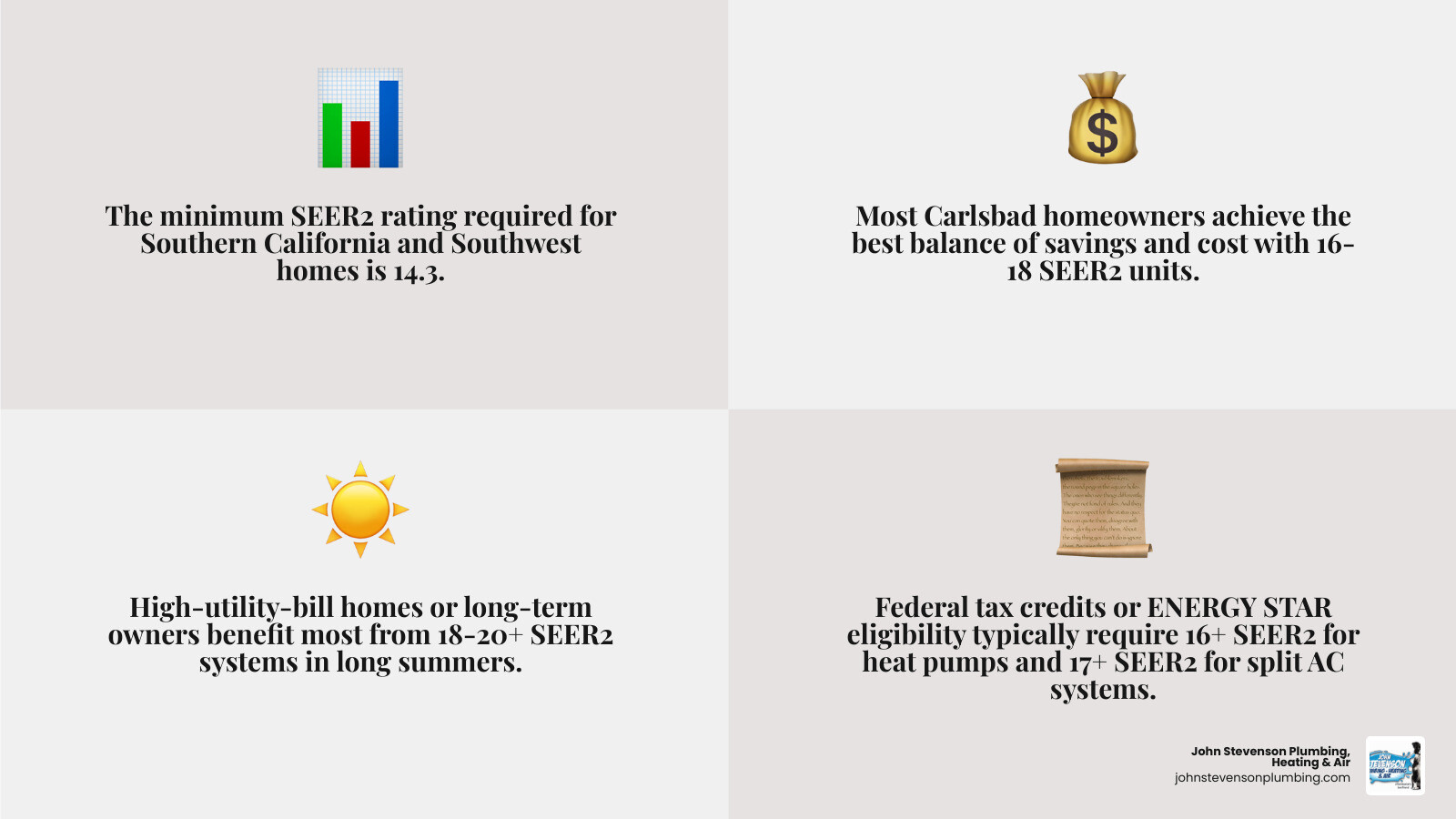
| Minimum legal requirement (Southern CA / Southwest) | 14.3 SEER2 |
| Budget-conscious, shorter-term homeowner | 14.3 to 15.1 SEER2 |
| Most Carlsbad homeowners (best balance) | 16 to 18 SEER2 |
| Long summers, high utility bills, long-term owner | 18 to 20+ SEER2 |
| Seeking federal tax credits or ENERGY STAR | 16+ SEER2 (heat pumps), 17+ SEER2 (split AC) |
For most homeowners in Carlsbad and the greater San Diego area, a rating between 16 and 18 SEER2 hits the sweet spot — efficient enough to meaningfully lower your utility bills through Southern California’s long cooling season, without overpaying for efficiency you may not fully recoup.
That said, the right number for your home depends on more than just the label. Your climate, how long you plan to stay, the condition of your ductwork, and what compressor technology is inside the unit all shape whether a higher SEER2 rating actually delivers real-world savings — or just looks good on paper.
This guide walks you through everything you need to know to make a confident, informed decision.
What seer2 rating should i look for basics:
- choosing the right ac for a southern california home
- single stage vs variable speed ac explained
- what size air conditioner do i need
Understanding SEER2 vs. Traditional SEER Ratings
If you have started researching new air conditioning systems in 2026, you have likely noticed that the old “SEER” labels have been replaced by a new acronym: SEER2. This change represents a major shift in how the heating, ventilation, and air conditioning (HVAC) industry measures energy efficiency.
Before you decide which system is right for you, it is vital to understand what this transition means for your comfort and your wallet. Knowing the difference will help you determine what to look for when buying a new AC unit so you do not buy outdated, inefficient inventory.
What is a SEER2 Rating and How Does It Work?
SEER stands for Seasonal Energy Efficiency Ratio. It is a metric used to evaluate how efficiently an air conditioner or heat pump cools your home over an entire cooling season.
Mathematically, a SEER rating is calculated by dividing the total cooling output (measured in British Thermal Units, or BTUs) by the total electrical energy input (measured in Watt-hours) consumed during a typical annual cooling period. Think of it like a car’s miles-per-gallon (MPG) rating: the higher the number, the more cooling you get for every dollar spent on electricity.
In contrast, EER2 (Energy Efficiency Ratio 2) measures steady-state efficiency at peak performance conditions — specifically when the outdoor temperature is a scorching 95°F, indoor temperature is 80°F, and relative humidity is 50%. While SEER2 gives you a picture of average seasonal consumption, EER2 is crucial for desert-like climates where the system has to run flat-out during peak afternoon heat.
Why SEER2 Ratings Look Lower Than Old SEER
Effective January 1, 2023, the U.S. Department of Energy (DOE) mandated a new testing procedure known as the M1 standard. This update was designed to address a major flaw in the old SEER testing process: lab conditions did not accurately represent real-world installations.
Under the old SEER testing rules, systems were evaluated against an external static pressure of just 0.1 inches of water column (in. w.c.). However, once a system is connected to actual ductwork in a home, the resistance to airflow is much higher. The new SEER2 M1 testing protocol increases this external static pressure to 0.5 in. w.c.—a fivefold increase that mirrors the physical resistance of a typical home’s duct system.
Because the equipment must work harder to push air against this realistic static pressure, SEER2 ratings are approximately 4.5% to 4.7% lower than traditional SEER ratings for the exact same physical equipment.
To translate between the two, you can use these quick approximations:
- A legacy 14 SEER unit translates to roughly 13.4 SEER2.
- A legacy 16 SEER unit translates to roughly 15.2 SEER2.
- A legacy 18 SEER unit translates to roughly 17.2 SEER2.
When shopping, always make sure you are comparing apples to apples. If one contractor quotes you a legacy “16 SEER” system and another quotes a “16 SEER2” system, the latter is actually a more efficient machine!
Regional Minimums and Climate Considerations for 2026
The Department of Energy enforces different minimum efficiency standards across three main regions in the United States: the North, the Southeast, and the Southwest. These regional standards ensure that homeowners in hotter climates install systems capable of handling high thermal loads efficiently.
Because we live and work in Carlsbad, San Diego County, and Orange County, our homes are subject to the strict standards of the Southwest region. If you want to dive deeper into how our coastal and inland microclimates impact your selection, check out our comprehensive guide to choosing the right AC for a Southern California home.
Southwest and Southern California Standards
In Southern California, the legal minimum for a newly installed split-system central air conditioner under 45,000 BTU/h (which covers most residential systems up to 3.5 tons) is 14.3 SEER2.
Additionally, the Southwest region enforces peak-load EER2 requirements. For split systems with a rating under 45,000 BTU/h, they must also meet:
- 11.7 EER2 for systems rated at less than 15.2 SEER2.
- 10.2 EER2 for systems rated at 15.2 SEER2 or higher.
If you choose a packaged air conditioning unit (where the condenser and blower are housed in a single outdoor cabinet), the minimum requirement sits at 13.4 SEER2 with a 10.6 EER2.
Heat Pump vs. Air Conditioner Minimums
If you are planning to install an air-source heat pump instead of a traditional air conditioner, the standards are unified nationally. Because heat pumps provide both heating and cooling, they are evaluated on both their SEER2 rating and their heating efficiency, measured as HSPF2 (Heating Seasonal Performance Factor 2).
- Split-system heat pumps must meet a minimum of 14.3 SEER2 and 7.5 HSPF2 nationwide.
- Single-packaged heat pumps are permitted to remain at a minimum of 13.4 SEER2 and 6.7 HSPF2.
These regulations mean you cannot legally install a system below these minimum thresholds in our Southern California service areas.
What SEER2 Rating Should I Look For in My Home?
When asking yourself, “what SEER2 rating should I look for?” it helps to understand the market’s three primary efficiency tiers.
| Tier | SEER2 Range | Typical Compressor Type | Best Suited For |
|---|---|---|---|
| Standard Efficiency | 13.4 to 15.1 | Single-Stage | Shorter cooling seasons, mild coastal zones, tight budgets |
| High Efficiency | 15.2 to 17.0 | Two-Stage | Moderate-to-hot climates, balanced budgets, energy-conscious owners |
| Premium Efficiency | 17.1 to 20.0+ | Variable-Speed (Inverter) | Long hot summers, maximum energy savings, solar homes, ultimate comfort |
To help you decide which system type fits your property, you might want to read the definitive guide to central AC vs ductless mini split comparison.
Standard Efficiency (13.4 to 15.1 SEER2)
Standard-efficiency systems represent the baseline entry point for modern climate control. In Southern California, these units will hover right at the legal minimum of 14.3 SEER2.
- Pros: Lowest upfront equipment cost; simple, time-tested technology that is straightforward to repair.
- Cons: Higher monthly operating costs; louder operation; basic single-stage compressor technology that cycles on and off frequently.
- Who it’s for: Homeowners in mild, immediate coastal areas (like parts of Carlsbad or Del Mar) where the AC only runs a few weeks out of the year, or those planning to sell their home in the near future.
High Efficiency (15.2 to 17.0 SEER2)
This mid-tier range offers a fantastic balance of performance and long-term savings. Upgrading from a legacy 14 SEER system to a 16 SEER (roughly 15.2 SEER2) system provides approximately a 14% efficiency improvement.
- Pros: Noticeable drop in monthly utility bills; quieter operation; often utilizes two-stage compressors for better humidity control and even temperatures.
- Cons: Moderate upfront cost premium compared to base models.
- Who it’s for: The average Southern California homeowner looking for a solid return on investment, lower bills, and improved indoor comfort without paying premium prices.
Premium Efficiency (17.1+ SEER2)
Premium systems represent the pinnacle of modern HVAC engineering. Upgrading from a standard 14 SEER system to a 20 SEER2 system can result in energy savings of 30% or more. If you are upgrading from an old, failing 10 SEER system from the early 2000s to a modern 20 SEER2 system, you can cut your cooling-related electricity consumption by roughly 50%.
- Pros: Maximum energy savings; whisper-quiet performance; superior dehumidification; constant, steady temperatures with no hot or cold spots.
- Cons: Highest upfront investment.
- Who it’s for: Homeowners in hotter inland areas (like Escondido, Poway, or Yorba Linda), those with solar panels looking to achieve net-zero energy use, or anyone who prioritizes the absolute highest standard of indoor comfort.
How Compressor Technology and Installation Quality Affect Real-World Efficiency
Many homeowners assume that buying a high-SEER2 system guarantees lower energy bills. However, the number on the box is only a rating of potential efficiency. The compressor technology inside the cabinet and the quality of the physical installation determine whether your system actually achieves those ratings.
To learn more about how different compressor designs impact performance, read our comprehensive guide to single stage vs variable speed AC.
Single-Stage, Two-Stage, and Variable-Speed Compressors
The heart of your air conditioner is the compressor, which pumps refrigerant through the system. How it operates directly dictates the unit’s SEER2 capability:
- Single-Stage Compressors: These operate like a light switch — they are either 100% on or completely off. Because they run at full capacity even on mild days, they cycle on and off frequently. This constant cycling consumes extra electricity and creates temperature swings.
- Two-Stage Compressors: These operate more like a high/low switch, typically running at about 65% capacity for mild days and stepping up to 100% capacity when outdoor temperatures soar. This allows them to run longer, quieter, and more efficient cycles.
- Variable-Speed (Inverter) Compressors: These operate like a dimmer switch, adjusting their output incrementally between 30% and 100% capacity. By running almost continuously at lower speeds, they maintain precise temperatures, offer unmatched dehumidification, and achieve the highest SEER2 ratings (often exceeding 20 SEER2).
Why Proper Sizing and Installation Matter More Than the Rating
An improperly installed 20 SEER2 system can easily perform worse than a properly installed 14.3 SEER2 system. If your contractor does not perform a proper Manual J load calculation to size the system, you run the risk of buying an oversized unit. Oversized systems “short-cycle” (turn on and off rapidly), which prevents them from ever reaching their rated efficiency and leaves your home humid and clammy.
Furthermore, ductwork plays an incredibly important role. In many older Southern California homes, ductwork leakage can waste up to 30% of your conditioned air before it ever reaches your living spaces. If your ducts are leaky, restricted, or poorly insulated, a premium SEER2 rating will not save you money.
To make sure your new unit is sized perfectly for your home’s unique layout, follow our guide on how to calculate required AC size in 4 easy steps.
Frequently Asked Questions About SEER2 Ratings
Navigating HVAC efficiency standards can raise a lot of questions. Here are some of the most common questions we hear from homeowners in our Southern California service areas.
What SEER2 rating should i look for to qualify for tax credits?
Under the federal Inflation Reduction Act (IRA), homeowners can qualify for significant tax credits and rebates by choosing high-efficiency systems:
- Split Air Conditioners: Must meet or exceed 16.0 SEER2 and 12.0 EER2 to qualify for ENERGY STAR certification and federal tax credits.
- Split Heat Pumps: Must achieve a minimum of 16.0 SEER2, 12.0 EER2, and 9.0 HSPF2 to qualify for up to $2,000 in Energy Efficient Home Improvement Tax Credits (Section 25C).
Always verify the official AHRI (Air-Conditioning, Heating, and Refrigeration Institute) certificate with your installer before purchasing to guarantee compliance.
What SEER2 rating should i look for if I have solar panels?
If you have a solar panel array, your goal is likely to maximize self-consumption—using your own solar power to run your home rather than buying expensive power from the grid during peak evening hours.
If you have a modern NEM 3.0 solar agreement, you want a highly efficient variable-speed heat pump (18+ SEER2). Because variable-speed systems run continuously at very low wattages, they can easily be powered directly by your solar panels throughout the day, preventing you from drawing high-amperage spikes from the grid.
Will a higher SEER2 system cool my home faster?
No. SEER2 measures energy efficiency (how much electricity is used), not cooling capacity (how much heat is removed).
A 3-ton system rated at 14.3 SEER2 and a 3-ton system rated at 20 SEER2 have the exact same cooling capacity. However, the 20 SEER2 system will use significantly less electricity to achieve the target temperature. To illustrate, a 3-ton system at 14 SEER2 uses about 3,860 kWh per year, while a 20 SEER2 system uses only about 2,700 kWh per year (based on an illustrative estimate of 1,500 cooling hours per year at $0.17/kWh).
Conclusion
Choosing the right SEER2 rating is all about finding the perfect balance between your upfront budget, your long-term energy savings, and your personal comfort goals. While a minimum-efficiency 14.3 SEER2 system is legally compliant, stepping up to a high-efficiency 16 to 18 SEER2 system often provides the best return on investment for Southern California homeowners.
At John Stevenson Plumbing, Heating & Air, we have spent decades helping our neighbors in Carlsbad, Oceanside, Encinitas, San Marcos, and throughout San Diego and Orange Counties find the perfect comfort solutions for their homes. We stand behind every single installation with our signature 5-Star Service Guarantee, featuring thorough diagnostics, upfront pricing, certified technicians, and a 24-hour satisfaction check-in.
When you work with a local specialist, you get tailored expertise that national chains simply cannot match. Learn more about why local HVAC beats the big franchises when it comes to long-term reliability.
Ready to lower your utility bills and upgrade your home’s comfort? Schedule your professional AC installation in Carlsbad today and let our certified team design the perfect, high-efficiency system for your home.