
Do Smart Thermostats Really Save Money? Here’s the Short Answer
Do smart thermostats really save money? Yes — but how much depends on your home, your habits, and your HVAC system.
Here’s a quick breakdown before we dig into the details:
| Scenario | Likely Savings |
|---|---|
| Upgrading from a manual thermostat | 10–20% on heating and cooling |
| Upgrading from a programmable thermostat you actually use | 6–8% |
| Upgrading from a programmable thermostat you never programmed | Up to 20% |
| Working from home full-time | Minimal — fewer opportunities for setbacks |
| Using utility rebates to offset cost | Payback in as little as 9 months |
| Variable-speed heat pump without compatible settings | Potentially no savings |
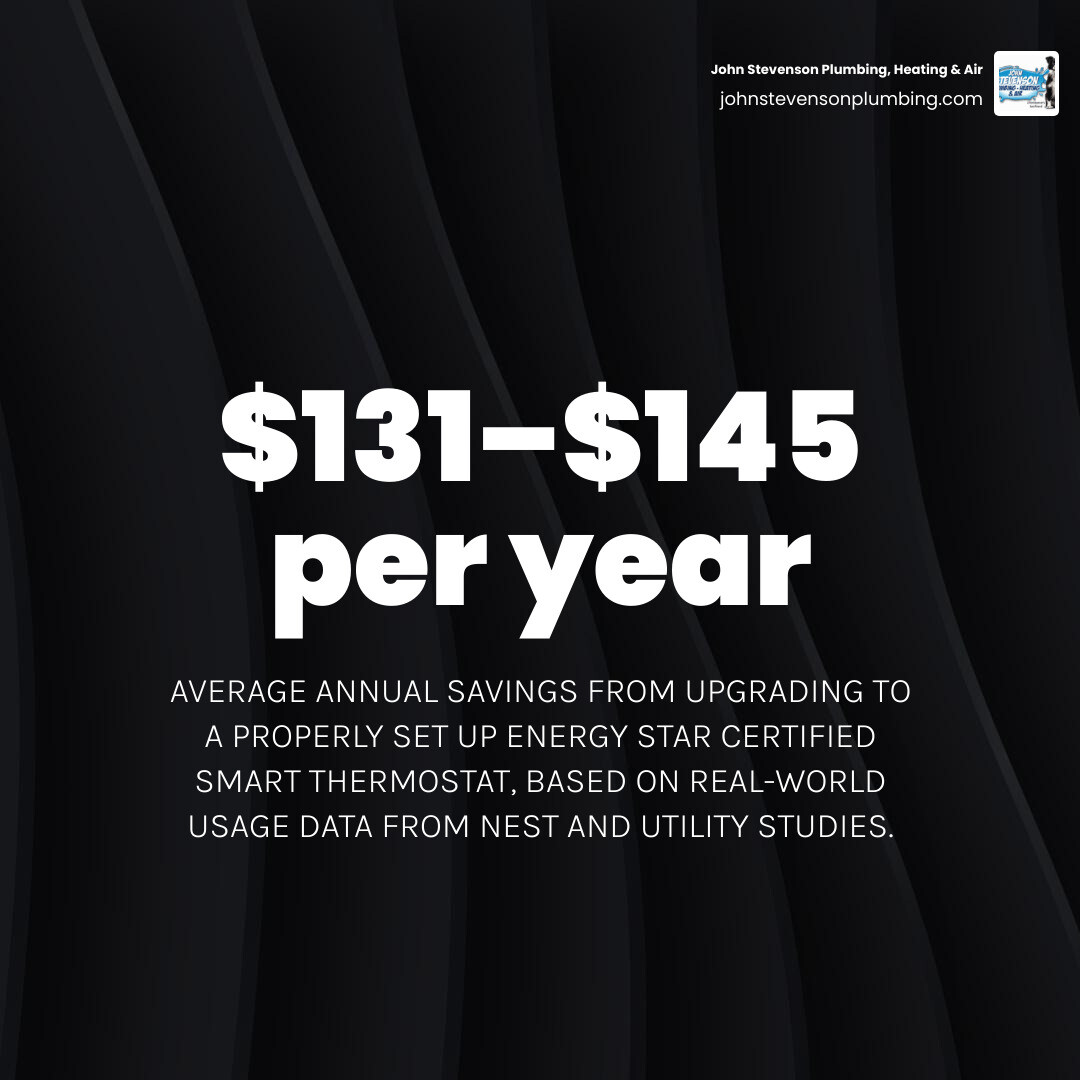
For most Carlsbad homeowners, a properly set up smart thermostat can meaningfully cut HVAC costs. ENERGY STAR certified models save an average of 8% on heating and cooling bills. Google Nest reports its users save roughly 10–12% on heating and about 15% on cooling. That adds up to an estimated $131–$145 per year in real-world savings.
But here’s the thing: those numbers assume the thermostat is actually set up and used correctly. Nearly half of all programmable thermostat owners never program them at all, according to research. Smart thermostats solve that problem by automating the savings — but only when the right features are turned on and your HVAC system is in good working order.
In this guide, we break down exactly when smart thermostats save money, when they don’t, which features drive the biggest results, and how Carlsbad homeowners can stack utility rebates to speed up the payback.
Do Smart Thermostats Really Save Money on Heating and Cooling?
When we look at the core data compiled by federal agencies and independent testing labs, the answer is a resounding yes. An ENERGY STAR certified smart thermostat is designed to optimize your heating and cooling cycles, cutting down on wasted energy when you are asleep or away from home. On average, these devices reduce HVAC energy consumption by 8% to 12%.
Because heating and cooling make up nearly half of the average household’s utility bills, reducing your HVAC runtime by even a small percentage can lead to substantial, compounding savings over time. However, to truly maximize these benefits, you have to understand how to pair your lifestyle with the technology. Knowing How to Skyrocket Your Energy Savings with Best Thermostat Settings is the first step toward transforming your smart thermostat from a high-tech wall decoration into a genuine money-saving tool.
How Smart Thermostats Compare to Basic Programmable Models
Many homeowners ask us: “If I already have a programmable thermostat, why should I upgrade?”
On paper, a basic programmable thermostat can save you plenty of money. But in reality, human behavior gets in the way. A nationally representative survey conducted by Consumer Reports found that 29% of programmable thermostat owners do not take advantage of their device’s scheduling features. In fact, nearly 50% of households with programmable thermostats never set them up at all. They are simply treated as manual thermostats, which defeats their entire purpose.
Smart thermostats eliminate this human friction. Instead of requiring you to navigate a confusing, low-contrast digital screen to program a rigid schedule, smart models use automated scheduling, geofencing, and learning algorithms to adjust temperatures dynamically.
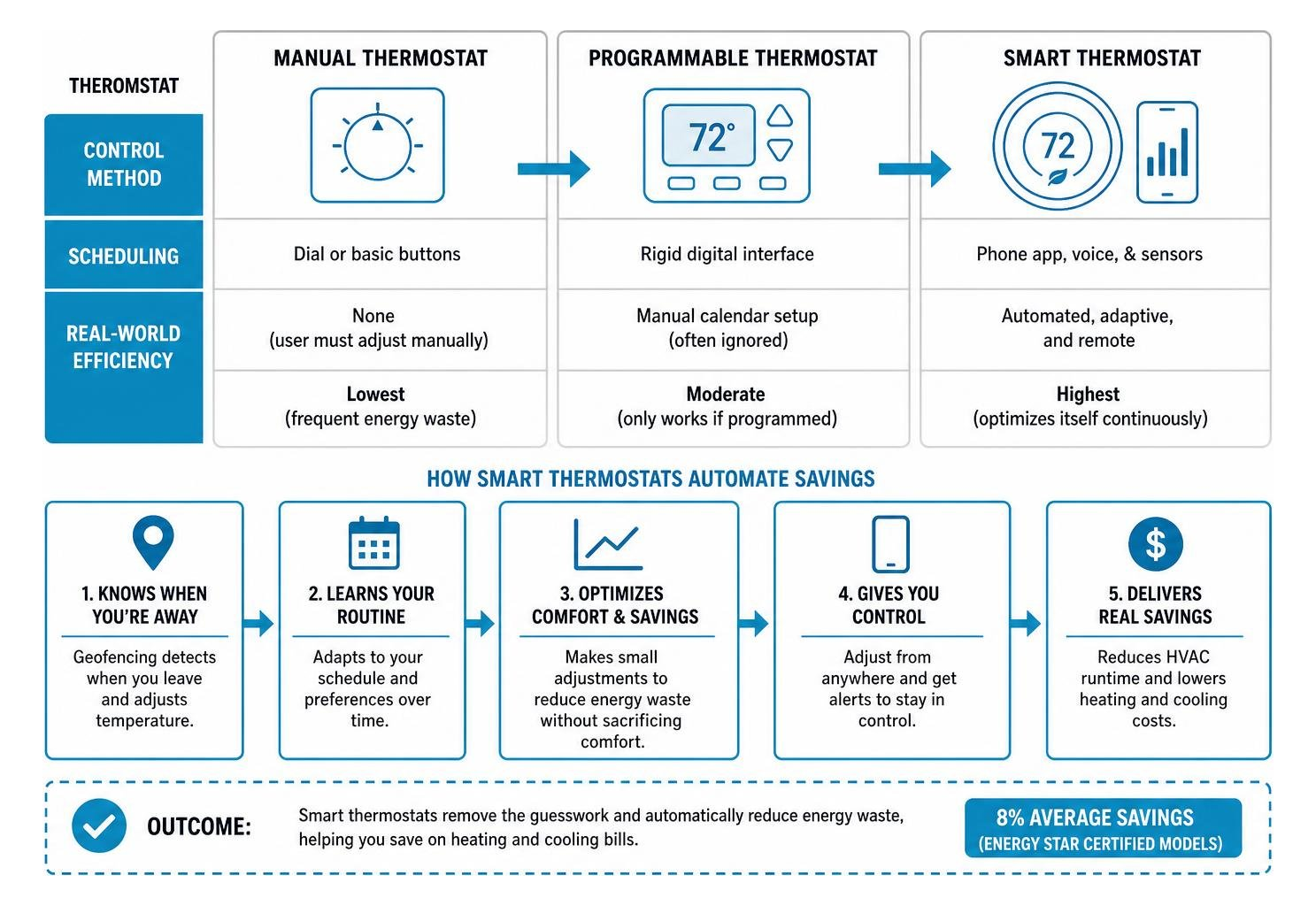
| Thermostat Type | Control Method | Scheduling | Real-World Efficiency |
|---|---|---|---|
| Manual Thermostat | Dial or basic buttons | None (user must adjust manually) | Lowest (frequent energy waste) |
| Programmable Thermostat | Rigid digital interface | Manual calendar setup (often ignored) | Moderate (only works if programmed) |
| Smart Thermostat | Phone app, voice, & sensors | Automated, adaptive, and remote | Highest (optimizes itself continuously) |
Regional Climate Impact on Energy Savings
Where you live plays a massive role in how much money a smart thermostat will save you. In the United States, climate zones dictate HVAC usage patterns:
- Cooling-dominated zones (such as Texas, Florida, and parts of Southern California) see 10% to 15% savings primarily on the cooling portion of their bills.
- Heating-dominated zones (such as the Pacific Northwest or Northeast) see 6% to 9% savings on the heating portion of their bills.
Here in Southern California—spanning Carlsbad, San Diego, and Orange County—we enjoy a coastal climate, but our summers can still bring intense heat waves that put immense strain on our air conditioners. Additionally, our local electricity rates are among the highest in the country. This means that even a modest 10% reduction in your AC runtime during a blistering August afternoon can translate to huge relief on your monthly statement. To make sure you are running your system as efficiently as possible during our warmest months, consult our guide on How to Save Energy with Best Thermostat Settings for Summer.
Key Features That Drive Real-World Utility Savings
The magic of a smart thermostat isn’t just that it connects to Wi-Fi; it’s the suite of advanced features working behind the scenes to minimize energy waste. If you want to achieve peak performance, you need to understand how these features work:
- Geofencing Technology: By linking to the GPS on your family’s smartphones, the thermostat knows when the last person has left the house. It automatically shifts into an energy-saving “Away” mode, preventing you from cooling or heating an empty home.
- Occupancy Sensors: Built-in motion and infrared sensors detect physical activity in the home. If you have an irregular schedule, these sensors act as a backup to geofencing, ensuring the system doesn’t run unnecessarily.
- Learning Algorithms: Premium models track your manual adjustments over the first few weeks of installation. If you consistently turn the temperature down before bed, the thermostat learns this pattern and begins doing it for you automatically.
Using these automated features is particularly critical when energy grid demand is at its highest. For a deeper look at managing your power consumption during peak periods, read our expert tips on Peak Performance: How to Save on Electricity During Peak Summer.
Why Do Smart Thermostats Really Save Money Through Time-of-Use Optimization?
In Southern California, our local utilities utilize Time-of-Use (TOU) rate plans. Under these plans, electricity is significantly more expensive during peak hours (typically 4:00 PM to 9:00 PM) than during off-peak hours.
Smart thermostats excel at navigating these variable rates through Time-of-Use optimization. When linked to your utility provider, the thermostat automatically implements pre-cooling or pre-heating strategies. It will slightly lower your home’s temperature before peak hours begin when electricity is cheap. Once peak hours hit, the thermostat scales back your HVAC usage, allowing your home to slowly coast through the expensive window without sacrificing comfort.
Furthermore, you can enroll in utility demand-response programs. During periods of extreme grid strain, your utility provider can send a signal to your smart thermostat to temporarily adjust your temperature by a few degrees. In exchange for participating, homeowners receive direct incentives, such as enrollment credits and annual bill rebates.
The Role of Remote Room Sensors in Balancing Comfort and Efficiency
In many multi-story or older homes in Carlsbad, temperature imbalances are a constant headache. The upstairs bedroom might feel like a sauna while the downstairs living room is freezing.
Remote room sensors solve this by measuring temperatures in specific rooms rather than relying solely on the thermostat’s central location. While remote sensors are fantastic for comfort, they must be managed carefully. If you place a sensor in a hot upstairs office, it may signal your air conditioner to keep running, which can actually increase your energy bills.
The best practice is to pair room sensors with a zoned HVAC system or use them to average out home temperatures during specific times of the day, ensuring you only heat or cool the spaces you are actively using.
When Smart Thermostats Fail to Deliver Expected Savings
While the savings potential is clear, a smart thermostat is not a magical cure-all. In some scenarios, installing one can result in minimal savings, or even increase your energy consumption if not configured correctly.
One major exception involves variable-speed heat pumps and air conditioners. Unlike traditional single-stage systems that turn completely on or off, variable-speed systems run continuously at lower, highly efficient speeds to maintain a steady temperature. If you use aggressive temperature setbacks with a variable-speed system, the heat pump has to work incredibly hard to recover from those deep setbacks. This can force the system into its expensive auxiliary heating mode, erasing your savings. To understand how these systems operate, check out our guide on The Simple Way a Heat Pump Heats and Cools Your Home.
Additionally, if your household has constant occupancy (for example, if you work from home full-time or have retired family members in the house), the thermostat will have fewer opportunities to drop into energy-saving setback modes.
Common Homeowner Mistakes That Prevent Lower Bills
If you’ve installed a smart thermostat but haven’t seen your bills drop, one of these common behavioral or physical mistakes might be the culprit:
- Frequent Manual Overrides: If you constantly walk up to the wall and override the programmed schedule, you teach the thermostat’s algorithm to maintain high-energy settings, rendering its learning capabilities useless.
- Extreme Temperature Setbacks: Setting your thermostat to 60°F in the summer or 80°F in the winter in an attempt to quickly heat or cool your home does not make the system work faster; it only causes it to overshoot and waste energy.
- Improper Thermostat Placement: If your thermostat is installed in a drafty hallway, near a window in direct sunlight, or close to a hot kitchen, it will read inaccurate temperatures and cycle your HVAC system unnecessarily.
- Clogged Air Filters: No matter how smart your thermostat is, it cannot overcome a physically restricted HVAC system. Dirty filters force your system to run longer and work harder, driving up your energy bills.
Addressing Underlying HVAC Issues Before Upgrading Controls
A smart thermostat only manages your HVAC system’s runtime; it cannot fix physical mechanical inefficiencies. If your home has underlying structural issues, upgrading your thermostat is like putting a racing steering wheel on a car with a broken engine.
Before investing in smart controls, we highly recommend addressing issues like leaky air ducts and poor attic insulation. If your ductwork is full of holes, up to 30% of your conditioned air could be escaping into your attic or crawlspace. Similarly, inadequate insulation allows heat to rapidly transfer into your home during summer and escape during winter.
Ensuring your overall system is highly rated and physically sealed is key to true efficiency. To learn more about how system efficiency is measured, read Everything You Need to Know About SEER2 Ratings.
Maximizing Your Return on Investment with Rebates and Incentives
To get the fastest possible return on your investment, you should never pay full price for a smart thermostat. Because these devices reduce strain on the electrical grid, local utilities and government programs offer excellent financial incentives to encourage homeowners to upgrade.
Most major investor-owned utilities offer instant or mail-in rebates ranging from $50 to $125 for ENERGY STAR certified models. By stacking these utility rebates with manufacturer discounts, you can significantly reduce your out-of-pocket costs. To explore the available financial assistance for homeowners in our region, read our comprehensive overview of Don’t Sweat the Cost with These California HVAC and Water Heater Rebates.
Navigating California Energy Incentives for Smart Upgrades
For homeowners in Carlsbad and San Diego County, navigating these programs can unlock incredible savings. Through the federal Inflation Reduction Act (IRA), homeowners can access tax credits and rebates for energy-efficient home upgrades, including smart control systems.
Additionally, San Diego Gas & Electric (SDG&E) offers localized incentives for smart home tech and high-efficiency HVAC equipment. Combining federal tax credits with local utility rebates makes upgrading your home’s climate controls incredibly cost-effective. To make sure you don’t miss out on any savings, check out our guides on:
- How the IRA Makes Your California Home Efficiency Upgrade Much Cheaper
- Navigating the California Energy Rebate Application Process Like a Pro
How Heat Pump Upgrades Work with Smart Controls
If you are planning to upgrade your heating and cooling system to a modern heat pump, pairing it with a compatible smart thermostat is a smart move. Modern smart thermostats feature “heat-pump-aware” algorithms. These algorithms manage the auxiliary heat lockout, preventing the system from turning on expensive backup electric resistance heat strips unless absolutely necessary.
For homeowners in coastal San Diego, heat pumps are exceptionally efficient because of our mild winters. To see how these systems can transform your comfort and lower your bills, read San Diego Homeowners Can Save Big on Heat Pumps with SDGE Incentives and discover Why Your San Diego Home Is Begging for a Heat Pump Upgrade.
Frequently Asked Questions About Smart Thermostat Savings
Do smart thermostats really save money if you work from home?
Yes, but the savings will be lower compared to a household where everyone leaves for nine hours a day. If you work from home, your thermostat won’t have long stretches of “Away” time to utilize deep temperature setbacks. However, you can still save money by using zoned sensors to only heat or cool your home office during the day, utilizing Time-of-Use optimization to avoid peak utility rates, and setting up automated nighttime setbacks.
Do you need a C-wire to install a smart thermostat?
In most cases, yes. The C-wire (common wire) provides continuous 24V power to run the smart thermostat’s Wi-Fi radio and color display. Older homes with basic manual thermostats often lack this wire. While some smart thermostats claim to work without a C-wire by “power stealing” from your HVAC system, this can cause system short-cycling and damage your control board over time. If your home lacks a C-wire, a professional technician can easily install a power adapter or run a new wire to ensure safe operation.
What is the realistic payback period for a smart thermostat?
If you purchase a standard ENERGY STAR certified smart thermostat and take advantage of a $50 to $75 utility rebate, your out-of-pocket hardware cost is minimal. With average annual energy savings of $130 to $145, the device will completely pay for itself in roughly 9 to 12 months. Even without a rebate, most homeowners achieve a full return on investment within 18 months of installation.
Conclusion
Investing in a smart thermostat is one of the easiest and most cost-effective ways to cut your monthly energy bills, improve your home comfort, and reduce your carbon footprint. However, the key to unlocking those double-digit savings lies in professional installation, proper system calibration, and ensuring your underlying HVAC system is operating at peak efficiency.
At John Stevenson Plumbing, Heating & Air, our certified Carlsbad HVAC experts are here to help you select the perfect smart thermostat for your unique home layout and heating and cooling system. With our thorough diagnostics, upfront pricing, and our signature 5-Star Service Guarantee, you can rest assured your home comfort is in the best hands.
Ready to take control of your utility bills? Schedule your energy-efficient thermostat installation today with our friendly team!