
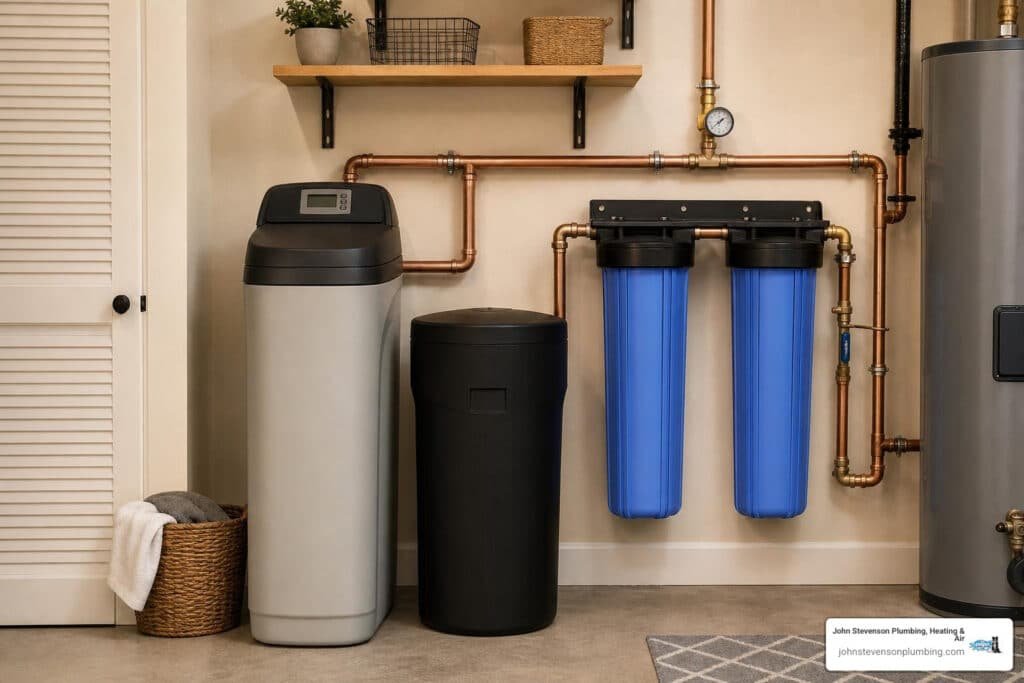
Can You Have Both a Water Softener and Filter? What Carlsbad Homeowners Need to Know
Can you have both a water softener and filter in your home at the same time? Yes — and for most homeowners in Carlsbad and across Southern California, using both is not just possible, it is the smarter choice. Here is a quick breakdown:
Quick Answer:
- A water softener removes hardness minerals (calcium and magnesium) that cause scale buildup on pipes, fixtures, and appliances.
- A water filter removes contaminants like chlorine, lead, sediment, and chemicals that affect the safety and taste of your water.
- They solve completely different problems and do not replace each other.
- You can — and often should — run both systems together, installed in the correct order (filter first, softener second).
- If your water is both hard and contains chemical contaminants, a dual system gives you complete protection.
Many homeowners assume that soft water equals safe, clean drinking water. It does not. A water softener only targets hardness minerals. It will not touch chlorine, heavy metals, or other contaminants that may be flowing through your taps. Conversely, a water filter will not prevent the white crusty scale creeping up your showerhead or quietly damaging your water heater. Southern California’s water is notoriously hard, and Carlsbad municipal water — like most of the region — is also chlorinated, meaning both problems often exist under the same roof at the same time.
I’m John Stevenson, and at John Stevenson Plumbing, Heating & Air, we help Carlsbad homeowners navigate exactly these kinds of water quality decisions every day.
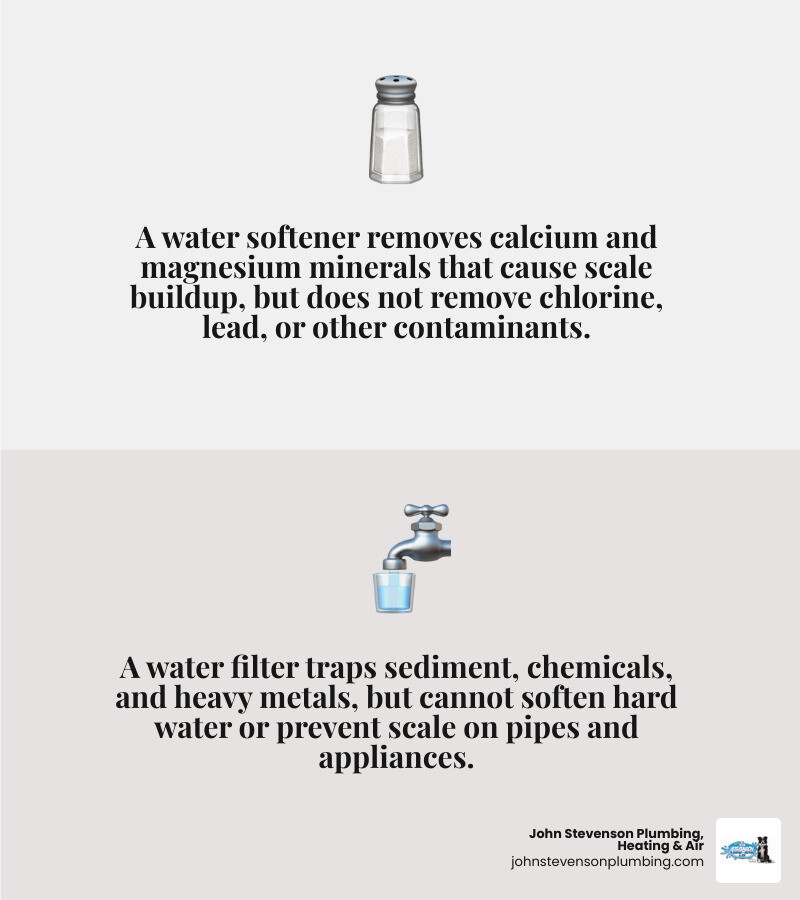
Water Softener vs. Water Filter: Understanding the Key Differences
To understand why combining these two systems works so beautifully, we first have to clear up the single most common point of confusion in residential water treatment: confusing a water filter with a water softener. They are not interchangeable, they do not use the same technology, and they do not target the same water issues.
When you are Choosing Between a Water Softener and Filtration System, it helps to think of them as specialists with entirely different jobs.
What is a Water Softener?
A water softener is a chemical treatment system designed specifically to combat hard water. It does this through a process called ion exchange. Inside a water softener is a tank filled with millions of microscopic, negatively charged polystyrene resin beads. These beads are initially coated with sodium or potassium ions.
As hard water enters the tank, the dissolved calcium and magnesium ions—which carry a strong positive charge—are magnetically attracted to the resin beads. The beads grab onto the hard minerals and, in exchange, release a tiny, harmless amount of sodium or potassium into the water. Once the resin beads are fully saturated with calcium and magnesium, the system runs a regeneration cycle, flushing the hard minerals down the drain with a saltwater brine solution and resetting the beads for another round of softening.
What is a Water Filter?
A water filter, on the other hand, relies on physical filtration and chemical adsorption to clean your water. Rather than swapping minerals, water filters act as physical barriers or chemical sponges.
Depending on the type of filter you install, the system might use a sediment screen to trap physical dirt, rust, and silt, or an activated carbon bed to adsorb chemical impurities. Carbon filters work like giant chemical magnets, attracting and trapping organic compounds, chlorine, chloramines, pesticides, and volatile organic compounds (VOCs) so they never reach your glass or your skin.
To make these differences easier to visualize, let’s look at how they compare side-by-side:
| Feature | Water Softener | Water Filter (Carbon/Sediment) |
|---|---|---|
| Primary Target | Calcium, magnesium, and dissolved iron | Chlorine, chloramines, heavy metals, sediment, chemicals |
| Core Technology | Ion exchange (resin beads & salt brine) | Physical barrier, adsorption, and catalytic media |
| Prevents Scale? | Yes (completely eliminates mineral scale) | No (does not remove dissolved hardness minerals) |
| Improves Taste & Odor? | No (does not remove chemical tastes or chlorine) | Yes (removes chlorine, sulfur, and chemical tastes) |
| Protects Plumbing? | Yes (stops pipe narrowing and appliance scaling) | Yes (sediment filters stop physical clogs and abrasion) |
| Key Maintenance | Adding salt pellets; annual system cleaning | Replacing cartridges or backwashing carbon media |
Can You Have Both a Water Softener and Filter?
Absolutely. In fact, if you live in Southern California, pairing these two systems is often the only way to achieve truly clean, scale-free water.
Our local water infrastructure faces a double whammy of water quality issues. To understand why your tap water behaves the way it does, it helps to read about how we Don’t Get Drained by Southern California’s Complex Water Quality Issues.
Because a significant portion of our water in Carlsbad and San Diego County is imported from the Colorado River and the State Water Project, it travels over hundreds of miles of mineral-rich soil and rock before it ever reaches our local treatment plants. By the time it arrives, it is packed with dissolved calcium and magnesium.
Simultaneously, municipal water departments must treat this water with chlorine or chloramines to keep it safe from biological pathogens during its journey through the municipal pipe network. While this disinfection is vital for public health, it leaves homeowners with water that is both incredibly hard and heavily chlorinated.
Assessing Your Carlsbad Home: Can You Have Both a Water Softener and Filter?
How do you know if your home is a candidate for a dual-system setup? The first step is always a professional water test to analyze your water chemistry.
Water hardness is typically measured in Grains Per Gallon (GPG) or Parts Per Million (PPM). The United States Geological Survey (USGS) classifies water hardness on a clear scale:
- Soft: 0 to 3.5 GPG
- Moderately Hard: 3.5 to 7.0 GPG
- Hard: 7.0 to 10.5 GPG
- Very Hard: 10.5+ GPG
In Carlsbad and surrounding areas like Oceanside, Vista, and San Marcos, tap water hardness frequently measures anywhere from 12 to 20+ GPG. This is well above the “very hard” threshold.
If you are experiencing the classic symptoms of hard water—such as white, crusty scale buildup on your showerheads, water spots on your glassware, dry and itchy skin after showering, and flat lather when using soap—you definitely need a water softener.
However, if you also notice a distinct chemical or “swimming pool” smell when you turn on your kitchen tap, or if you are concerned about trace heavy metals, industrial runoff, and microplastics, you also need a water filtration system. If you have both sets of symptoms, can you have both a water softener and filter running in tandem? Not only can you, but doing so provides a level of water quality that neither system can achieve alone.
The Benefits of Knowing Can You Have Both a Water Softener and Filter Installed
When you combine a high-quality water filter with a water softener, you aren’t just doubling up on equipment; you are creating a highly efficient, synergistic water treatment system.
Here are the primary benefits of installing a dual system in your home:
- Resin Bed Protection: Chlorine is a powerful oxidizer. When chlorinated municipal water flows directly into a water softener, the chlorine physically attacks the plastic polymer structure of the softener’s resin beads. Over time, this oxidation turns the beads mushy and brittle, cutting their operational lifespan from a healthy 15–20 years down to just 5–8 years. Placing a carbon filter ahead of your softener removes the chlorine, acting as a protective shield for your softener’s expensive resin.
- Massive Soap and Detergent Savings: Hard water minerals interfere with the chemical reaction of soap, preventing it from lathering and forcing you to use more product. When your water is both soft and filtered, you can use up to 50% less soap, shampoo, dish detergent, and laundry soap to achieve the exact same level of cleanliness.
- Maximum Appliance Protection: Just 1/8 inch of mineral scale buildup inside your water heater can reduce its heating efficiency by as much as 25% to 30%. By removing these minerals with a softener, you protect your water heater, dishwasher, and washing machine from premature failure.
- Elimination of Chemical Inhalation: When you take a hot shower, chlorine and other volatile chemicals in the water vaporize into the air. A 10-minute hot shower in chlorinated water can result in your body absorbing and inhaling significant amounts of chemical byproducts. A whole-house carbon filter eliminates this risk entirely.
- Great-Tasting Drinking Water from Every Tap: No more relying on plastic water bottles or slow countertop pitchers. With a dual system, every faucet in your house delivers crisp, clean, odorless water that is perfect for drinking, cooking, and brewing coffee.
The Golden Rule of Installation: Why Order Matters
If you decide to install both a water filter and a water softener, there is one non-negotiable rule that every professional plumber follows: The filter must always come before the water softener.
This is known in the water treatment industry as the “Golden Rule of Installation” or “upstream filtration.”
Plumbing the systems in this specific sequence ensures that your water treatment equipment operates at peak efficiency and lasts as long as possible. Let’s look at the step-by-step journey your water should take from the main municipal water line to your household taps:
- The Main Water Shutoff: Water enters your home from the street or your well.
- The Sediment Pre-Filter (Stage 1): This is your first line of defense. A simple, physical sediment filter (usually rated at 5 to 10 microns) catches dirt, sand, silt, and rust particles. If these physical particles were allowed to flow directly into your water softener or carbon filter, they would clog the delicate control valves and foul the filtration media.
- The Carbon Filter (Stage 2): Next, the water flows through an activated carbon or catalytic carbon filter. This stage adsorbs chlorine, chloramines, bad tastes, odors, and chemical contaminants. By removing these harsh oxidizers here, we ensure that the water entering the next stage is completely free of chlorine.
- The Water Softener (Stage 3): Now that the water is clean and chlorine-free, it enters the water softener. The ion exchange resin beads can now focus entirely on swapping out calcium and magnesium ions without being chemically degraded by chlorine.
- The Point-of-Use Filter (Optional Stage 4): For the ultimate drinking water experience, many homeowners add an under-sink Reverse Osmosis (RO) system at the kitchen tap. This final stage removes up to 99% of remaining total dissolved solids (TDS), including the tiny amount of sodium introduced during the softening process.
If you were to reverse this order and place the water softener first, the raw, chlorinated water filled with sediment would quickly ruin the softener. The control valve would get jammed with grit, and the resin beads would oxidize and fail prematurely, leading to expensive repairs and early replacement.
Separate Systems vs. Combo Units: Which Is Best?
As you research water treatment systems, you will likely run across “all-in-one” or hybrid combo units. These are single-tank systems that contain both carbon media and water softening resin inside a single cylinder. While these combo units can seem appealing because they take up less space in your garage or utility closet, they come with significant technical drawbacks.
For most homes, separate, dedicated tanks are vastly superior to combo units. Here is why:
- No Compromise on Capacity and Pressure: In a combo unit, the single tank must be split between carbon media and softening resin. This means you get less of both materials. If you have a larger household or high peak water usage, a combo system can struggle to maintain adequate water pressure, and the media will exhaust much faster.
- Independent Maintenance and Lifespans: Carbon filtration media typically wears out and needs to be replaced every 3 to 5 years, whereas high-quality water softener resin can easily last 15 to 20 years if protected from chlorine. In a combo unit, once the carbon section is exhausted, it is incredibly difficult—and sometimes impossible—to replace just the carbon without discarding the perfectly good softening resin as well. Separate tanks allow you to maintain and replace each media bed independently.
- Customized Water Treatment: Every home’s water chemistry is slightly different. With separate systems, we can precisely tailor the filtration stage to your specific water test results (such as using catalytic carbon if your local municipality uses persistent chloramines instead of standard chlorine) without affecting the sizing or operation of your water softener.
Keeping your plumbing systems separate also makes troubleshooting much easier. If you ever experience a drop in water pressure or suspect a leak, having clear, individual units allows for quick diagnostics.
If you are ever concerned about the integrity of your home’s plumbing, it is always a good idea to understand How to Find Hidden Water Leaks the Right Way to protect your property from water damage.
Frequently Asked Questions About Dual Water Systems
We hear many of the same questions from homeowners trying to make sense of residential water treatment. Here are the facts behind the most common myths.
Does a water softener remove contaminants and make water safe to drink?
No. A water softener is not a purification system. Its sole chemical job is to swap calcium and magnesium ions for sodium or potassium ions.
Water softeners do not remove:
- Chlorine or chloramines
- Heavy metals like lead, mercury, or copper
- Volatile organic compounds (VOCs)
- Pesticides, herbicides, or pharmaceuticals
- Bacteria, viruses, or cysts
Furthermore, because water softeners introduce a small amount of sodium into the water (typically about 30 to 50 mg/L depending on your initial water hardness), some homeowners prefer not to drink softened water unless it has also passed through a reverse osmosis drinking water filter to remove the dissolved salts.
Does a water filter soften hard water or remove scale?
No. Standard physical and carbon water filters have absolutely no effect on water hardness. Dissolved calcium and magnesium are microscopic ions that easily pass straight through physical sediment filters and carbon block pores.
While some manufacturers market “salt-free water conditioners” as saltless softeners, these systems do not actually remove the hardness minerals from your water. Instead, they use technologies like Template Assisted Crystallization (TAC) to alter the physical structure of the minerals so they are less likely to stick to surfaces. While this can help reduce scale buildup inside your pipes, it does not actually soften the water, meaning you will not get the classic benefits of soft water, such as richer soap lather, softer skin, and brighter laundry.
What maintenance is required when using both systems?
Owning a dual water treatment system does require some routine care, but the tasks are straightforward and highly manageable.
To keep your dual system running at peak performance, you should expect to perform the following routine maintenance:
- Refill the Softener Salt (Every 4 to 8 Weeks): Check your water softener’s brine tank regularly and add high-quality salt pellets (or potassium chloride if you prefer a salt-free alternative) to keep the brine tank at least half full.
- Replace the Sediment Pre-Filter (Every 3 to 6 Months): Swap out the inexpensive sediment cartridge as soon as you notice it turning brown or if you experience a slight drop in household water pressure.
- Replace Carbon Filtration Media (Every 3 to 5 Years): If you have a large, backwashing whole-house carbon tank, the carbon media inside will eventually lose its ability to adsorb chemicals and will need to be rebedded.
- Schedule an Annual Professional Inspection: Having a certified plumber inspect your systems once a year ensures that the regeneration cycles are running efficiently, the control valves are clear of debris, and there are no hidden leaks.
Conclusion
At the end of the day, answering the question of can you have both a water softener and filter comes down to your household goals. If you want to protect your home’s plumbing infrastructure, keep your appliances running efficiently, eliminate dry skin and hair, and enjoy bottle-quality drinking water from every tap in your house, combining a water filter and a water softener is the ultimate solution.
At John Stevenson Plumbing, Heating & Air, we have spent years helping homeowners in Carlsbad, Oceanside, Encinitas, and throughout San Diego County find the perfect balance for their home’s water quality. From performing thorough, accurate water diagnostics to installing top-tier, certified dual-tank systems, we stand behind our work with our signature 5-Star Service Guarantee.
We don’t just install equipment; we make sure your entire plumbing system is healthy and leak-free. If you want to learn more about how we protect local homes, take a look at A Comprehensive Guide to How Leak Detection Technology Works to see how we keep your pipes safe.
Ready to say goodbye to crusty scale and chemical smells? Improve Your Home’s Water Quality Today by scheduling a professional water analysis with our certified local technicians. We’ll help you design the perfect, custom filtration and softening sequence for your home.