
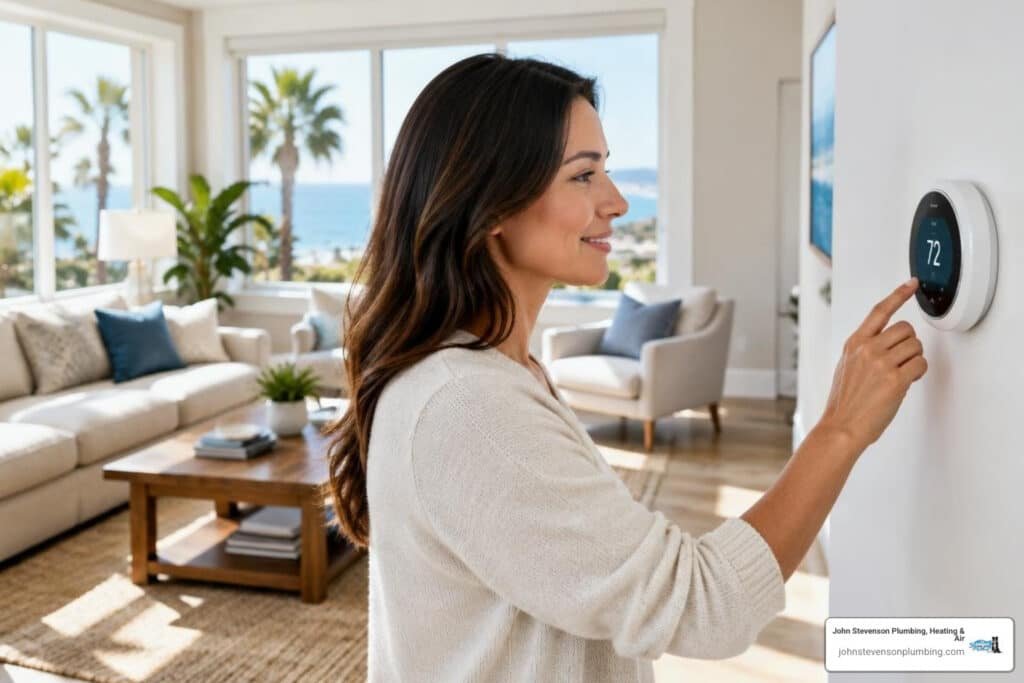
Lower AC Bills in Carlsbad Without Losing Comfort
To lower your AC bill without giving up comfort, start with a thermostat setting you can live with, use ceiling fans in occupied rooms, and close shades when the sun hits your windows. If your home still feels unevenly cooled or the AC runs for long stretches, AC maintenance in Carlsbad, CA can help find problems such as dirty coils, clogged filters, or poor airflow. A technician can check the system before you consider replacing it. That way, you can focus on fixes that keep cool air where you need it.
Explore home cooling services or schedule AC maintenance.
I’m John Stevenson, and if your AC is working harder than it should, schedule an AC maintenance visit to find out why.
Explore more about reducing ac bills without sacrificing comfort:
Key Local HVAC Solutions for Reducing AC Bills Without Sacrificing Comfort
Air conditioning accounts for roughly 19% of residential electricity consumption across the country, and space conditioning represents nearly half of a typical home’s overall energy demand. When hot weather settles over Southern California, keeping your home cool can place heavy demands on your equipment. However, cutting your energy usage does not mean sitting in a stuffy living room.
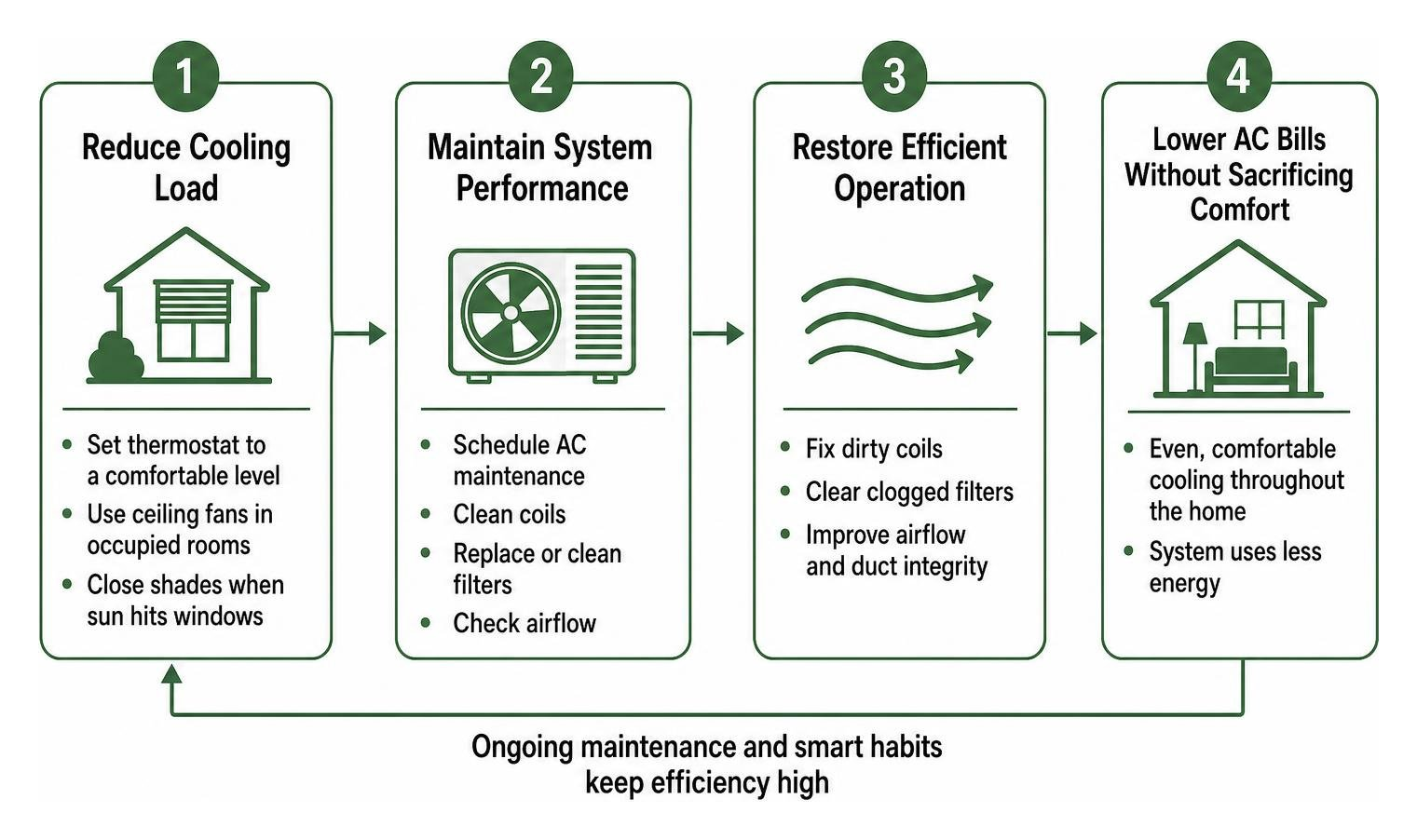
Focusing on cooling load reduction, duct airflow integrity, and targeted mechanical tune-ups allows your cooling system to deliver crisp, even temperatures throughout your home while drawing substantially less power from the grid.
Professional AC Tune-Ups, Coil Cleaning, and Filter Management
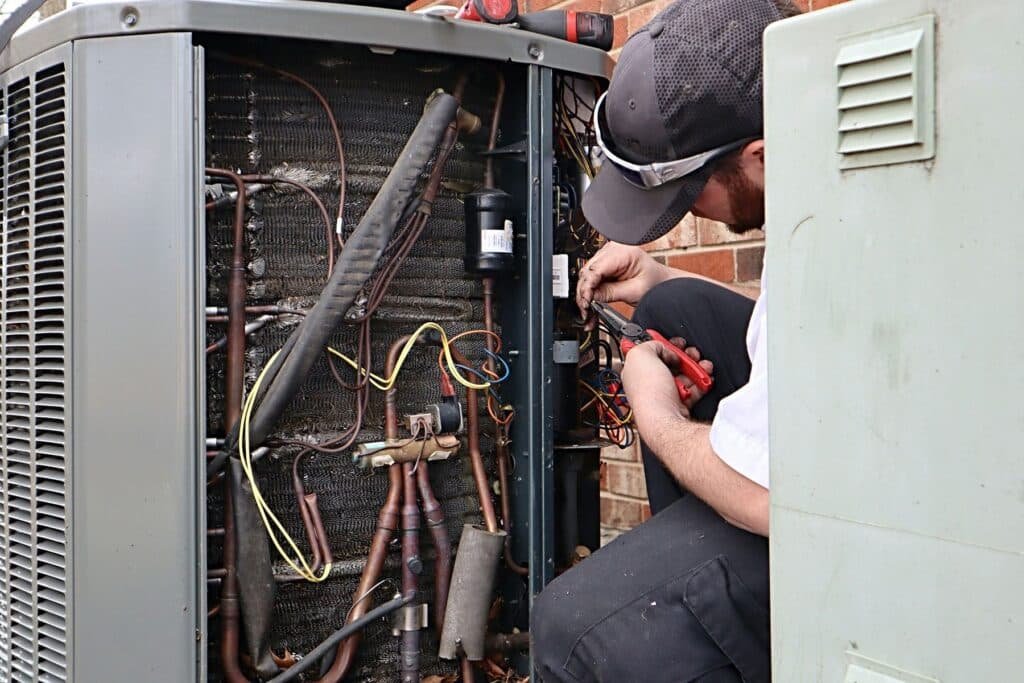
The condition of your equipment directly dictates how hard it must work to pull heat out of your living spaces. When dust, coastal pollen, and debris settle across outdoor condenser coils and indoor evaporator coils, heat transfer degrades rapidly. The compressor is forced to run longer cycles at higher pressures, consuming excess electricity while failing to reach your desired indoor temperature.
During a comprehensive inspection, technicians evaluate refrigerant charge levels, clean the outdoor and indoor coils, inspect electrical contacts, and verify blower motor airflow. Routine maintenance restores mechanical efficiency and helps prevent premature component failures.
Simple airflow habits also deliver major returns. The Department of Energy notes that replacing a clogged, dirty air filter with a fresh one can lower an air conditioner’s energy consumption by 5% to 15%. Understanding how often to change your HVAC air filter keeps system static pressure low and airflow moving smoothly. For long-term reliability and lower electric bills, scheduling regular professional AC maintenance services keeps your equipment running at its peak design performance.
Smart Thermostat Upgrades and Setup for Reducing AC Bills Without Sacrificing Comfort
Leaving a manual thermostat set at a single low temperature all day wastes energy cooling an empty home. According to ENERGY STAR, certified smart thermostats save an average of 8% on annual heating and cooling expenses, with total savings reaching up to 26% when combined with scheduled setbacks and automated routines.
To evaluate whether a connected unit fits your household, explore how smart thermostats save money. Modern smart controls offer high-impact capabilities:
- Automated Setback Schedules: Pre-programmed shifts that raise target temperatures while you are away at work or asleep, cooling down the home right before you return.
- Geofencing Technology: Uses smartphone location sensors to detect when the last family member leaves the house, automatically activating eco-modes without manual input.
- Demand-Response Integration: Lets you take advantage of local utility incentives and credits by subtly trimming cooling loads during high-demand grid windows.
Installing these controls requires proper wiring. Many advanced models require a dedicated common wire (C-wire) to supply consistent low-voltage power without short-cycling your system. Booking a professional energy-efficient thermostat installation ensures proper voltage balancing, correct system staging, and full control over your equipment.
Duct Inspection, Sealing, and Airflow Optimization
Even the most efficient air conditioner cannot perform properly if the distribution network is compromised. In typical forced-air systems, the Department of Energy estimates that duct leaks lose 20% to 30% of conditioned air into unconditioned attics, crawlspaces, or wall cavities.

ENERGY STAR data shows that leaky ductwork can reduce heating and cooling efficiency by up to 20%. When supply ducts leak, cooled air escapes before reaching your living areas, forcing the unit to run continuously. When return ducts pull hot, dusty air from the attic, indoor humidity climbs and indoor air quality plummets.
Professional duct testing identifies static pressure imbalances, disconnects, and unsealed joints. Sealing these transitions with mastic sealant or specialized metal-backed tape restores airflow integrity, balances room-by-room temperatures, and significantly reduces cooling runtimes.
Optimizing Thermostat Settings and Daily Operating Habits
Smart hardware works best when paired with effective daily habits. Small adjustments in target temperatures yield major reductions in electrical consumption without creating uncomfortable indoor conditions.
Strategic Thermostat Setpoints and Scheduling
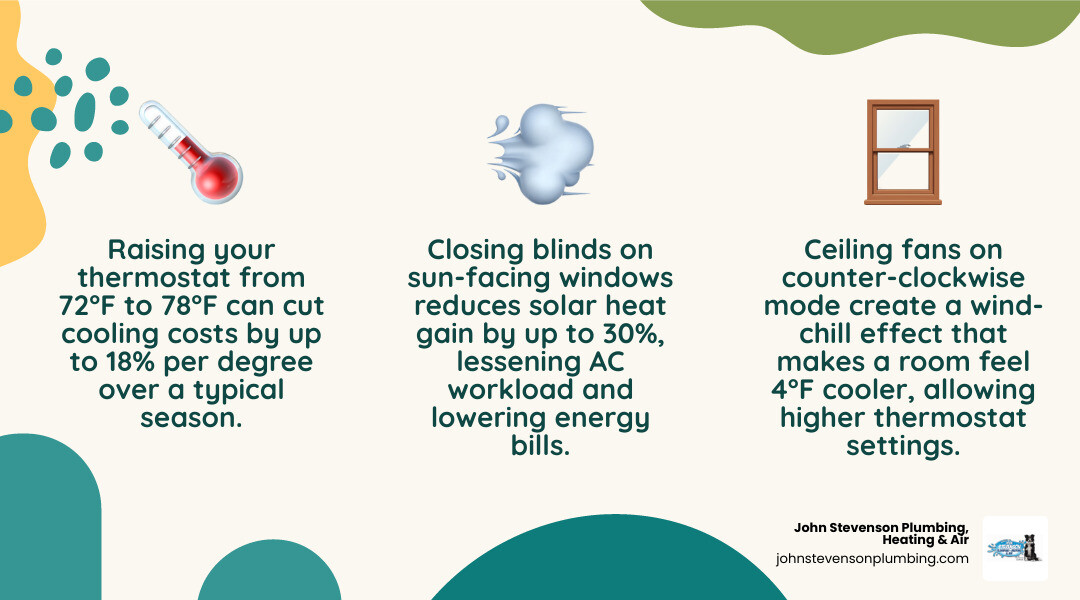
Every degree you raise your thermostat reduces cooling energy demand. The Department of Energy reports that rolling back your thermostat by 7°F to 10°F for eight hours a day can save up to 10% annually on heating and cooling costs.
A practical baseline for occupied summer hours is 78°F. While 78°F might sound warm on paper, gentle indoor air movement and managed humidity make this setting feel comfortable. When you leave for the day, setting the thermostat to 82°F–85°F prevents your unit from cooling an empty house.
For deeper insights into dialing in your summer routine, review our guides on optimizing summer thermostat settings and managing peak electricity rates. Applying these strategies lets you maximize thermostat energy savings across all seasons.
Leveraging Ceiling Fans and Humidity Control for Reducing AC Bills Without Sacrificing Comfort
Ceiling fans cool people, not rooms. By creating a gentle breeze across exposed skin, ceiling fans create an evaporative wind-chill effect. The Department of Energy points out that running a ceiling fan makes the room feel roughly 4°F cooler than the actual thermometer reading. A person resting in a 78°F room with a ceiling fan enjoys the same perceived comfort as someone in a 74°F room with stagnant air.
To maximize fan efficiency:
- Set Summer Rotation: Ensure your fan blades rotate counter-clockwise (when looking up) to push a cooling downdraft into the living space.
- Turn Fans Off When Leaving: Because fans cool occupants rather than air volume, running a fan in an empty room wastes electricity.
- Harness Cost Differences: A standard ceiling fan consumes only 20 to 50 watts of electricity, making it vastly less energy-intensive to run than a multi-ton central air conditioning compressor.
Indoor moisture levels also directly influence how warm you feel. High relative humidity prevents perspiration from evaporating, making warm indoor air feel heavy and muggy. Running bathroom exhaust fans during showers and kitchen range hoods while cooking removes excess moisture before it spreads into the home. Maintaining indoor relative humidity below 50% to 55% ensures higher thermostat setpoints feel fresh and comfortable.
Whole-Home Thermal Envelope and Solar Heat Defenses
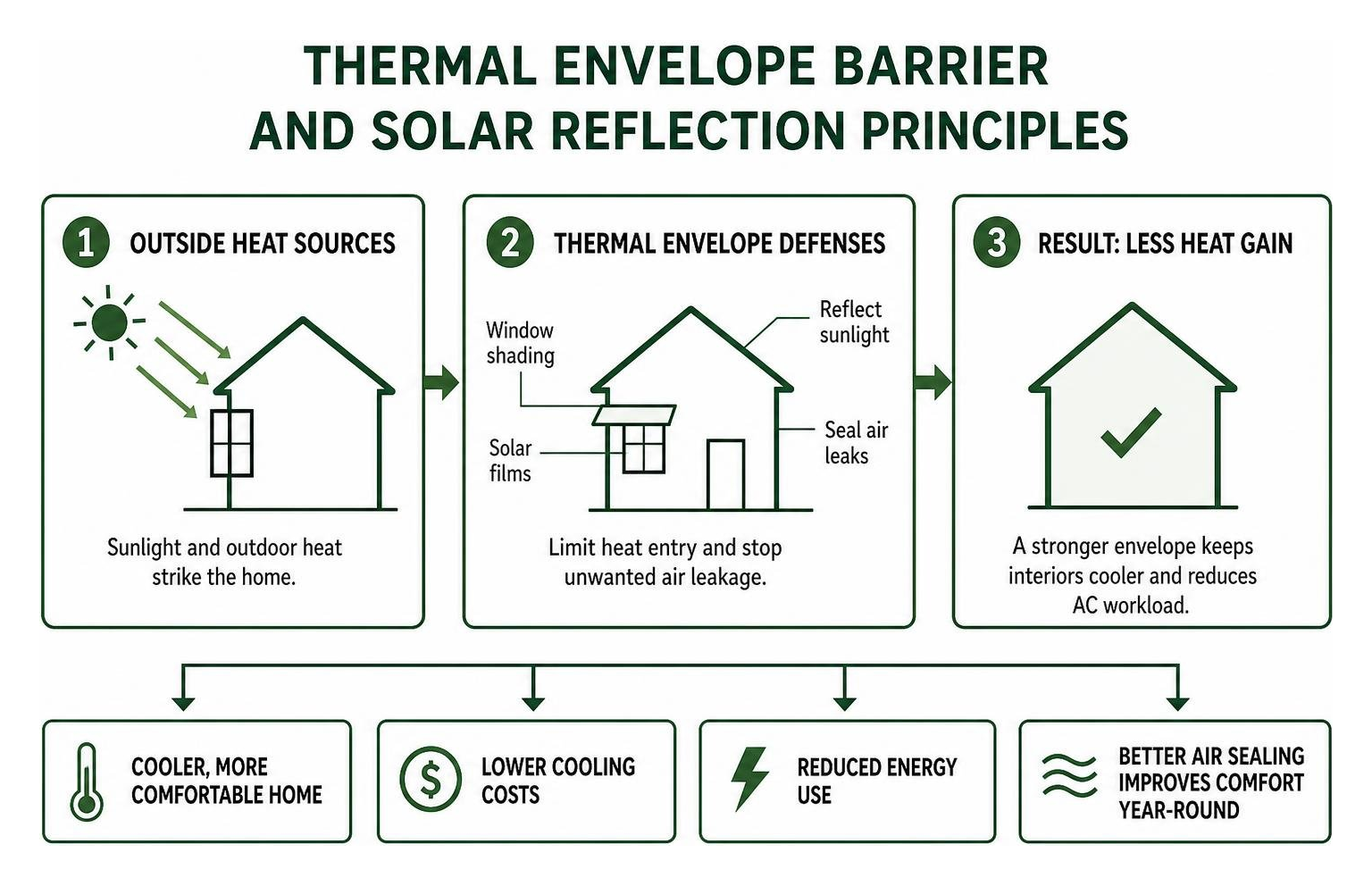
An air conditioner removes heat from inside your home, but reinforcing your building envelope prevents outdoor heat from entering in the first place.
Window Shading, Solar Films, and Air Leak Sealing
Unshaded windows act like magnifying glasses on warm afternoons. Radiant heat from direct sunlight passes through standard glass panes and gets absorbed by floors, furniture, and interior walls, driving up cooling loads.
Effective solar defense strategies include:
- Exterior Shading and Solar Screens: Awnings, shade trees, or exterior solar screens can absorb or reflect up to 90% of radiant solar heat before it strikes the glass.
- Low-E Window Films: Applying spectrally selective solar films to south- and west-facing windows blocks 50% to 80% of solar heat gain while preserving natural light.
- Interior Window Coverings: Keeping cellular shades, blinds, or thermal curtains closed during peak sun hours provides an insulating barrier against heat transfer.
Air infiltration through building cracks accounts for 25% to 40% of heating and cooling energy loss, according to Department of Energy estimates. Applying weatherstripping around doors, caulking window frames, and sealing attic access hatches can save 10% to 20% on space conditioning by keeping hot outdoor air from seeping inside.
Eliminating Internal Heat Sources and Standby Electrical Draws
Your appliances and lighting can introduce surprising amounts of unwanted heat into your home during the summer:
- Switch to LED Lighting: Incandescent and halogen bulbs convert roughly 90% of their energy into heat rather than light. Upgrading to ENERGY STAR certified LEDs keeps fixtures cool to the touch and cuts lighting energy consumption by up to 75%–90%.
- Eliminate Phantom Electrical Draws: Televisions, gaming consoles, and electronics draw standby power and emit residual heat 24 hours a day. Plugging entertainment centers and home offices into smart power strips eliminates idle loads when devices are turned off.
- Time Large Appliance Use: Running dishwashers, clothes dryers, and ovens during the heat of the day forces your air conditioner to fight both outdoor temperatures and indoor heat generation. Shift heavy appliance cycles to cooler evening hours.
Upgrading Aging Equipment: Heat Pumps, Mini-Splits, and Modern SEER2 Ratings
If your cooling equipment is over 10 to 15 years old, it may be operating at a fraction of modern efficiency standards. Older systems rely on single-stage compressors that cycle completely on at 100% capacity and then slam off, creating noticeable temperature swings, high inrush currents, and uneven dehumidification.
Modern high-efficiency heat pumps and ductless mini-split systems utilize variable-speed inverter technology. These systems continuously modulate their output to match the precise cooling demand of the home. By running longer cycles at low, quiet speeds, variable-speed systems remove more humidity, maintain exact temperatures, and draw significantly less power.
When evaluating replacement options, review everything you need to know about SEER2 ratings to understand how modern efficiency standards translate into everyday savings.
| Feature / Metric | Older Single-Stage AC System | High-Efficiency Variable-Speed Heat Pump |
|---|---|---|
| Compressor Operation | 100% full capacity or 0% off | Modulates continuously (25% to 100% output) |
| Indoor Temperature Stability | Noticeable 2°F to 4°F temperature swings | Consistent, steady temperature maintenance |
| Humidity Control | Limited moisture removal due to short cycles | Extended low-speed runtimes for superior dehumidification |
| Airflow & Sound Levels | Abrupt start-ups and high-velocity duct noise | Ultra-quiet, low-speed continuous air circulation |
| Energy Efficiency (SEER2) | Typically 10 to 13 SEER (older standards) | 16 to 22+ SEER2 efficiency performance |
Frequently Asked Questions About Lowering AC Costs
What is the fastest zero-cost way to lower summer AC bills?
The fastest zero-cost strategy is adjusting your thermostat target. Setting the cooling baseline to 78°F when you are home and using ceiling fans in occupied rooms creates a perceived temperature of roughly 74°F. Increasing the setback to 82°F–85°F when away prevents energy waste, trimming your cooling bill without changing your daily lifestyle.
How much can sealing air leaks and ductwork save on cooling?
ENERGY STAR data shows that comprehensive air sealing and insulation improvements save an average of 15% on heating and cooling costs. Adding professional duct sealing—which targets the 20% to 30% of conditioned air typically lost in forced-air duct systems—can recover another 10% to 20% in system operating efficiency.
Is it better to leave the AC fan setting on ‘Auto’ or ‘On’?
For virtually all residential applications, keeping the fan set to Auto is the superior choice. In Auto mode, the blower fan runs only when the cooling system actively cycles on. Setting the fan to On runs the blower continuously, which uses more electricity and can blow moisture from the evaporator coil back into your living spaces between cooling cycles, raising indoor humidity.
Conclusion: Achieve Lasting Cooling Efficiency and Peak Comfort
Reducing home cooling costs does not require sweating through hot summer afternoons. By combining smart thermostat scheduling, ceiling fan usage, window shading, and routine maintenance, you can keep your home pleasantly cool while keeping monthly electric bills under control.
When you need local support, John Stevenson Plumbing, Heating & Air Conditioning provides complete residential HVAC solutions throughout Carlsbad, San Diego County, and Orange County. From seasonal system tune-ups and duct sealing to smart thermostat installations and variable-speed heat pump replacements, our certified technicians deliver thorough diagnostics and our dedicated 5-Star Service Guarantee.
Keep your home comfortable and efficient all season long. Contact John Stevenson Plumbing, Heating & Air Conditioning today to schedule dependable local HVAC services for your home.