
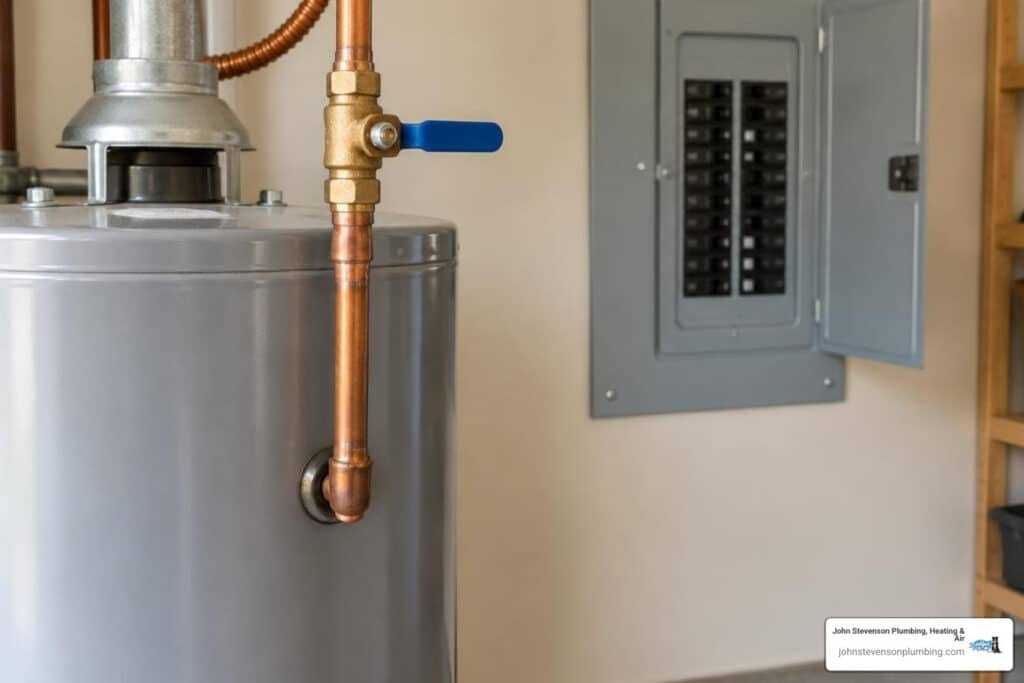
Understanding Water Heater Operation When the Grid Goes Down
If your water heater stops working after a major outage in Carlsbad, call John Stevenson Plumbing, Heating & Air Conditioning for prompt diagnostics and repair. Before calling, turn off the dedicated water heater breaker in your electrical panel and close the cold water inlet valve to prevent dry firing or pressure-related damage. When a major blackout sweeps through Southern California, homeowners often discover that their hot water reacts in surprisingly different ways depending on the type of appliance in their garage or closet. While some units shut down entirely, others quietly keep heating as if nothing happened. Knowing where your unit falls is the first step toward choosing the right water heater for your home and managing expectations during an emergency.
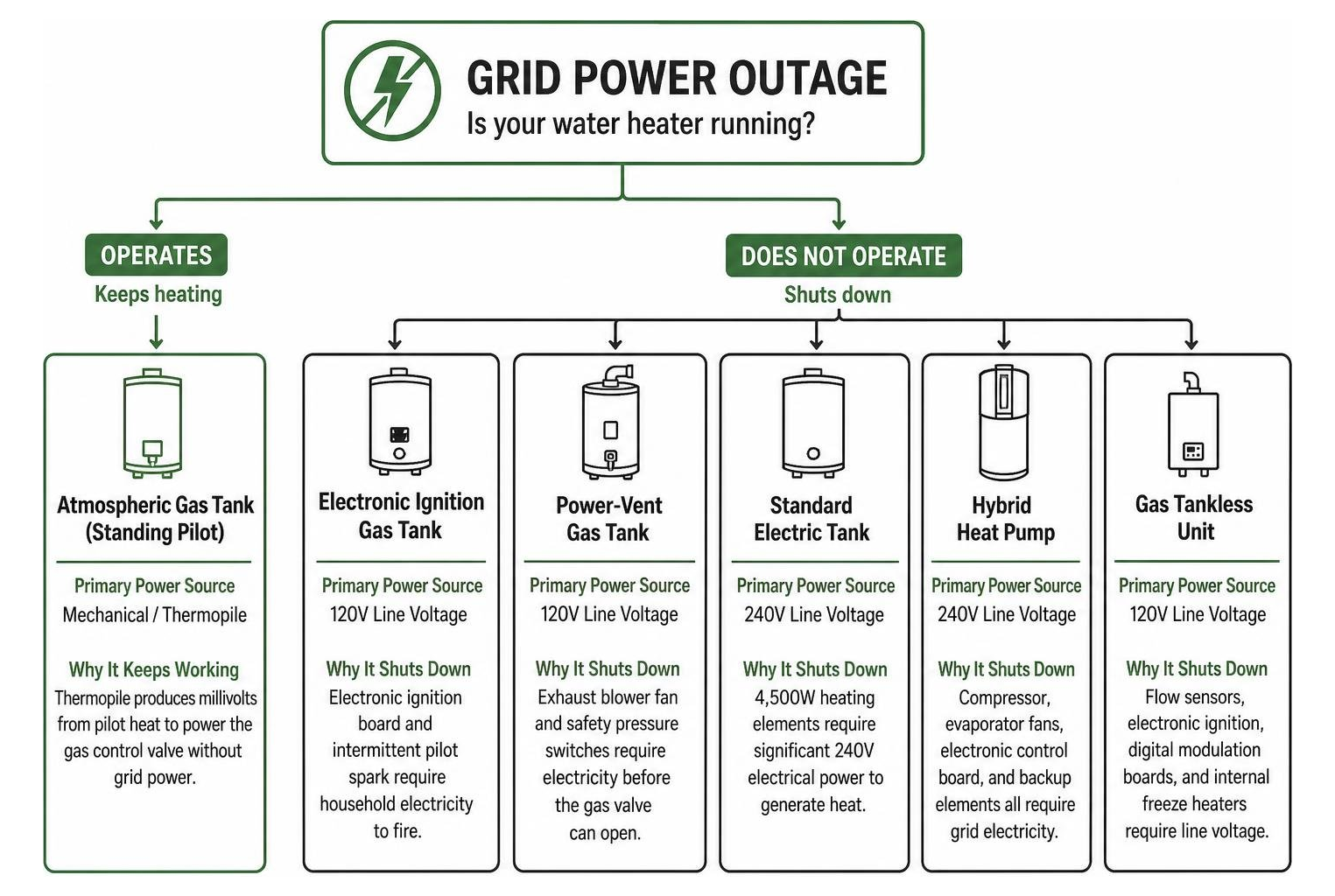
| Water Heater Type | Operates During Outage? | Primary Power Source | Why It Keeps Working or Shuts Down |
|---|---|---|---|
| Atmospheric Gas Tank (Standing Pilot) | Yes | Mechanical / Thermopile | Thermopile produces millivolts from pilot heat to power the gas control valve without grid power. |
| Electronic Ignition Gas Tank | No | 120V Line Voltage | Electronic ignition board and intermittent pilot spark require household electricity to fire. |
| Power-Vent Gas Tank | No | 120V Line Voltage | Exhaust blower fan and safety pressure switches require electricity before the gas valve can open. |
| Standard Electric Tank | No | 240V Line Voltage | 4,500W heating elements require significant 240V electrical power to generate heat. |
| Hybrid Heat Pump | No | 240V Line Voltage | Compressor, evaporator fans, electronic control board, and backup elements all require grid electricity. |
| Gas Tankless Unit | No | 120V Line Voltage | Flow sensors, electronic ignition, digital modulation boards, and internal freeze heaters require line voltage. |
The humble atmospheric gas tank heater with a standing pilot is the happy exception during blackouts. Its pilot light heats a small metal probe called a thermopile, which generates just enough millivolts of internal electricity to operate the gas valve. No plug, no battery, and no grid connection required. Conversely, any unit with a digital display, an exhaust fan, or a standard wall plug stops producing heat the moment the power drops.
How Long Does Stored Hot Water Last in a Tank?
If your water heater stops heating, you still have an insulated thermal reservoir sitting in your utility room. A standard residential tank holds between 40 and 80 gallons of water heated to roughly 120°F to 140°F. Because residential storage tanks feature thick layers of polyurethane foam insulation, they retain heat for a substantial period when left completely undisturbed.
In typical Southern California conditions, an undisturbed 50-gallon tank stays warm enough for a comfortable wash for 12 to 24 hours. However, drawing water rapidly changes that equation. As you draw hot water from the top outlet, cold municipal water enters the bottom through the dip tube, steadily diluting the remaining thermal mass.
Because incoming cold water mixes into the bottom, roughly three-quarters of a 50-gallon tank provides genuinely usable hot water (around 35 to 38 gallons). That gives an average household roughly three standard eight-minute showers before the thermal layer is depleted and only lukewarm or cold water remains.
Why Tankless and Electric Units Shut Down Instantly
Tankless systems and electric storage tanks experience an immediate, total operational shutdown during a blackout. Electric storage tanks rely on heavy-duty 4,500-watt heating elements operating across a dedicated 240-volt circuit. Without massive line voltage flowing through the panel, the elements cannot generate thermal energy.
Tankless systems—even those burning natural gas or propane—rely heavily on sophisticated microprocessors. When you open a hot water faucet, internal flow sensors must detect water movement, signal the control board, spin the intake fan, trigger the electronic igniter, and modulate the gas valve. Without a steady 120-volt current, these microprocessors cannot communicate, leaving the unit completely dormant. Homeowners evaluating modern upgrades can learn more by evaluating if a tankless water heater is worth it for their specific emergency backup needs.
Essential Protocols for Protecting Your Water Heater During Power Outages
Taking proactive steps during a blackout prevents costly secondary damage to your plumbing system. When grid instability strikes, sudden voltage fluctuations and municipal supply drops can wreak havoc on unattended appliances. Following systematic protocols for protecting your water heater during power outages safeguards critical components like thermostats, control boards, and heating elements until reliable utility service returns.
Preventing Dry Firing and Element Burnout
One of the most destructive hazards for an electric water heater is a phenomenon known as “dry firing.” An electric heating element is designed to operate fully submerged in water, which rapidly absorbs and dissipates the immense heat it generates.
If municipal water pressure drops or you drain the tank while power is active, the upper element becomes exposed to air. When energized in an air pocket, an electric element can surpass 2,000°F and burn out in as little as 30 to 60 seconds. To prevent this:
- Locate your main electrical panel and switch the dedicated 240-volt double-pole breaker for the water heater to the OFF position as soon as an outage begins.
- If you have a gas unit and suspect the water supply is interrupted, adjust the gas control knob to Pilot or Vacation mode rather than shutting off the gas valve completely, which keeps the pilot lit without firing the main burner against an empty tank.
- Label the electrical breaker clearly so family members do not flip it back on before confirming the plumbing lines are fully recharged with water.
If your system sustained damage before you could flip the switch, our team offers professional water heater repair to replace scorched elements and restore safe operation.
Avoiding Freeze Cracks and Pipe Bursts
While coastal Carlsbad enjoys mild weather, severe winter storms can push inland temperatures in San Diego and Orange County uncomfortably close to freezing. Tankless water heaters mounted on exterior walls are particularly vulnerable.
Modern outdoor gas tankless units feature built-in electric ceramic freeze heaters rated to protect internal copper heat exchangers down to -30°F. However, those freeze heaters rely entirely on grid electricity. When the power goes out during a cold snap, that protection disappears. Because water expands roughly 9% by volume when turning to ice, trapped water inside a tankless heat exchanger can split the copper tubing in just a few sub-freezing hours.

To protect an exterior tankless unit during a freezing outage:
- Shut off the cold water supply valve on the isolation valve kit beneath the unit.
- Turn off the gas supply cock and disconnect the electrical plug.
- Remove the drain port caps on both the hot and cold isolation valves.
- Open the purge valves and allow all water inside the heat exchanger to drain completely into a bucket.
- For storage tanks located in unheated garages, wrap exposed cold inlet and hot outlet pipes with foam insulation or self-regulating heat-trace cable, as these narrow connecting lines consistently freeze and burst long before a massive 50-gallon tank freezes solid.
Tapping Stored Tank Water for Emergency Drinking Supplies
A clean residential storage tank holds between 40 and 80 gallons of potable water, serving as a critical survival reservoir during prolonged municipal water outages. You can safely access this water using standard household fittings:
- Cut Power and Gas: Ensure the electrical breaker is OFF or the gas valve is set to Pilot/Vacation.
- Shut Inflow: Close the cold water inlet valve at the top of the tank to isolate it from potentially contaminated municipal lines.
- Attach a Hose: Connect a clean garden hose to the brass or composite drain valve at the bottom of the tank and route it into clean containers.
- Break the Vacuum: Open a hot water faucet at the highest point in your home (such as an upstairs bathroom sink) or lift the test lever on the temperature and pressure (T&P) relief valve on the tank to allow air inside. Without venting, water will not flow from the drain.
- Filter and Purge: The first few gallons may contain accumulated mineral sediment; drain this into a bucket for sanitation use (like flushing toilets), and collect the clean water that follows for drinking and cooking.
Power Backup Strategies: Generators, Batteries, and Load Priorities
Attempting to run household appliances during a prolonged power outage requires calculating your available wattage and setting firm electrical priorities. While powering a gas water heater requires minimal energy, backing up an electric storage tank is a major undertaking that can overwhelm standard portable generators. Understanding these demands helps you make informed choices on how to extend the life of your water heater and preserve your backup equipment.
Generator Sizing for Electric and Gas Water Heaters
A standard residential electric storage tank utilizes 4,500-watt heating elements wired to a 240-volt circuit. Reheating a cold 50-gallon tank from scratch consumes approximately 12 kilowatt-hours (kWh) of energy.
- 5,000-Watt Generators: A 5,000W generator can theoretically power a single 4,500W element, but only if virtually every other household breaker (including lights, refrigerators, and pumps) is completely turned off.
- 7,500-Watt to 10,000-Watt Generators: A 7,500W or larger generator handles a 4,500W heating element comfortably while leaving sufficient headroom for critical refrigeration and lighting circuits.
- Battery Power Stations: A high-capacity 3,840-watt-hour (Wh) split-phase battery bank can supply power to a 4,500W element for roughly 43 minutes before being completely drained.
For most households, dedicating massive generator capacity to an electric water heater is inefficient. A far more practical strategy is using portable power to run essential medical equipment, refrigerators, and communication devices, relying instead on insulated tank storage or boiling small amounts of water on a camp stove for washing.
Electrical Safety and Carbon Monoxide Prevention
Connecting any generator to your home’s electrical system requires strict adherence to life-safety codes.
Never attempt to “back-feed” power by plugging a generator directly into a household dryer or wall outlet. Back-feeding bypasses safety switches and can send high-voltage electricity backward through local utility lines, creating lethal hazards for electrical line workers repairing the neighborhood grid. Always route backup power through an electrician-installed manual or automatic transfer switch.
Additionally, internal combustion generators produce high concentrations of odorless, invisible carbon monoxide (CO) gas. Always run portable generators outdoors on stable ground at least 20 feet away from open windows, exterior doors, and fresh air intake vents. Test all home carbon monoxide alarms twice annually to verify their backup batteries are fully functional.
Safe Post-Storm Restart and Troubleshooting Protocols
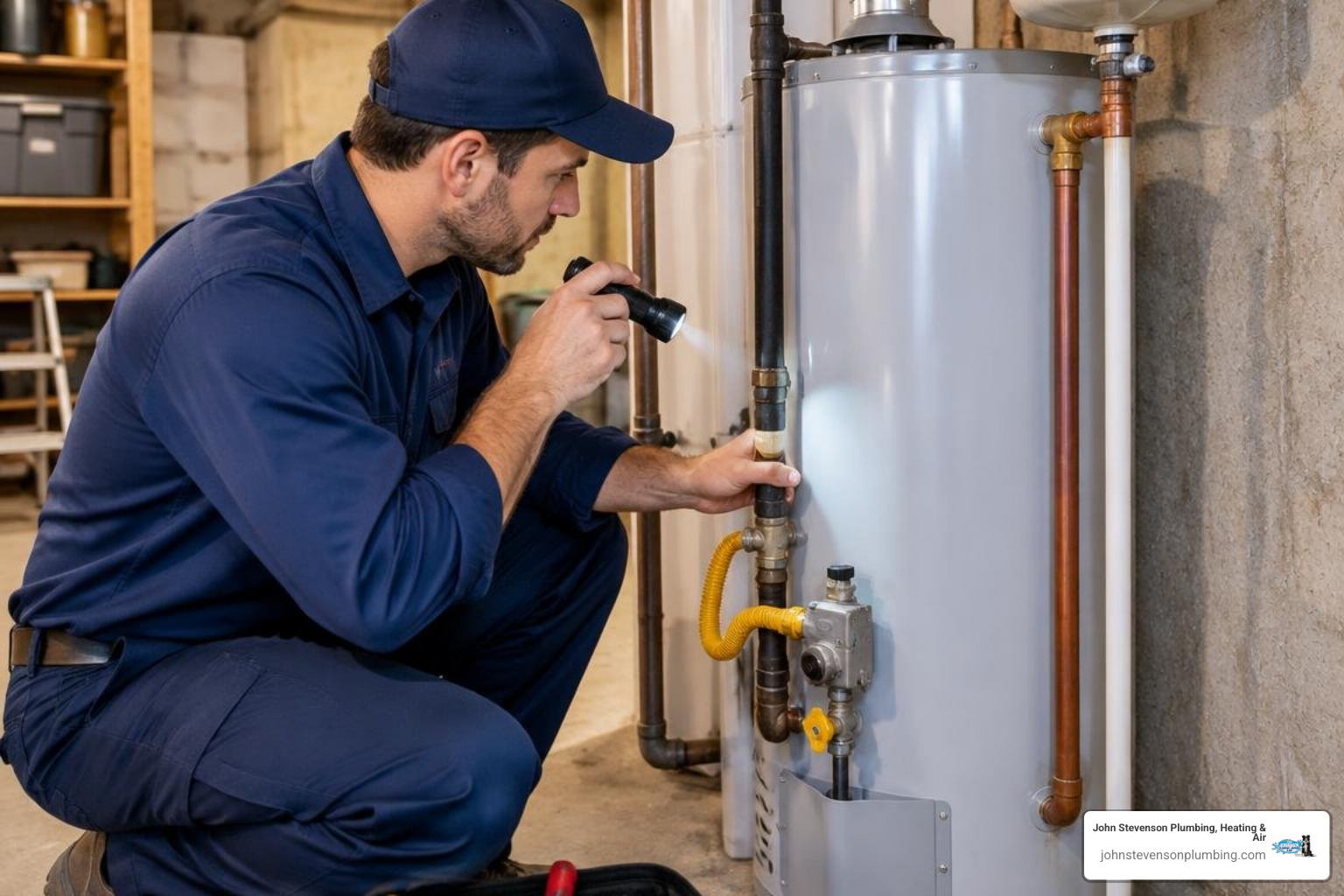
When neighborhood power lines are repaired and electricity surges back into the home, avoid rushing to turn everything on at once. Power restoration often carries electrical voltage spikes and transient pressure drops that can damage delicate plumbing controls. Scheduling comprehensive water heater services or following a step-by-step inspection protocol ensures your system returns to normal operation smoothly.
How to Purge Air and Refill the Tank Before Restoring Power
If your water lines drained or lost pressure during the storm, air pockets will form inside your plumbing lines and the top of the water heater tank. You must fully purge these air pockets before restoring power to an electric water heater to eliminate dry fire hazards.
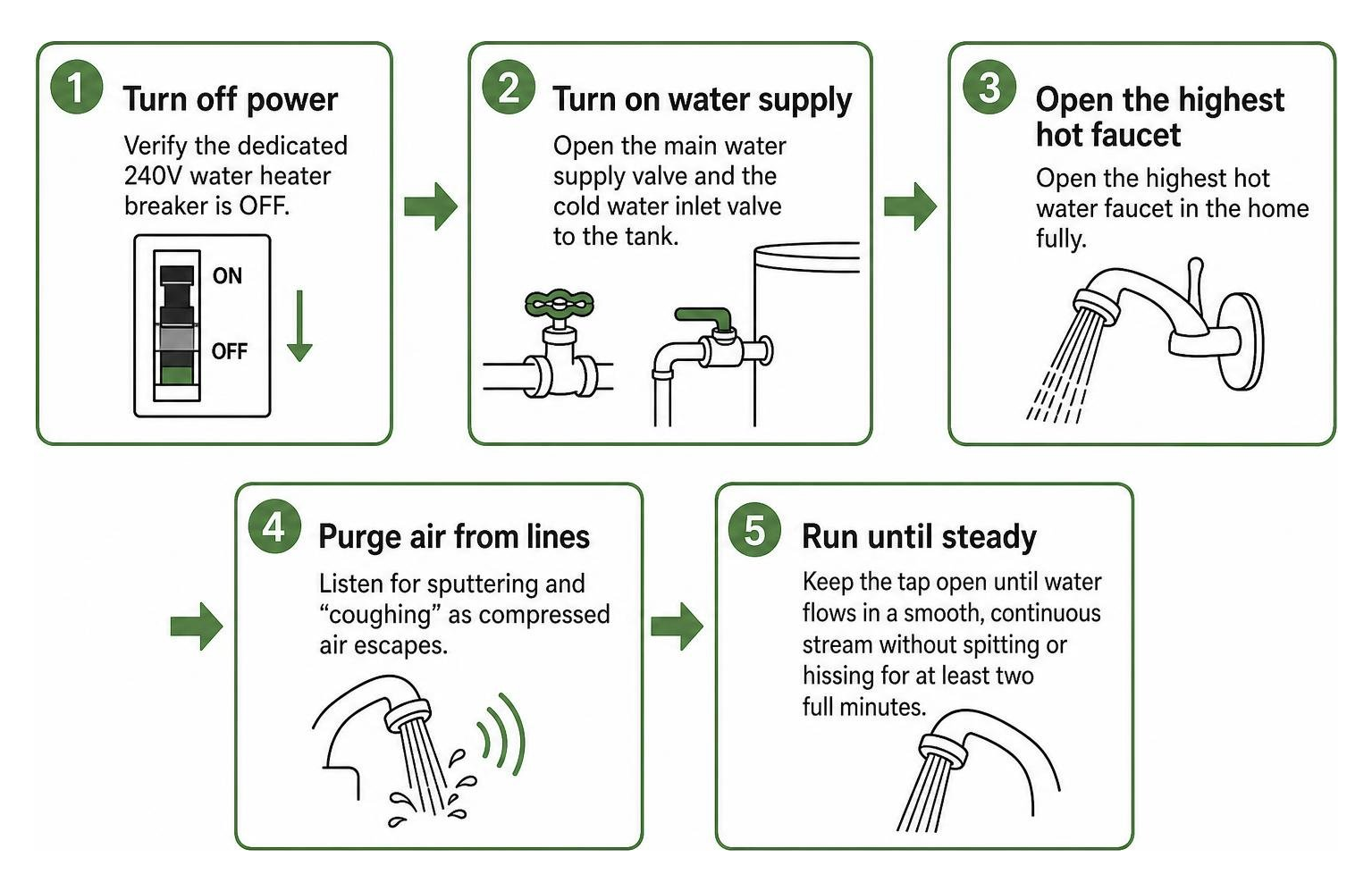
- Verify that the dedicated 240V water heater breaker remains in the OFF position.
- Turn on your home’s main water supply valve and the cold water inlet valve leading into the tank.
- Walk to the highest hot water faucet in your home (such as an upstairs shower or bathroom sink) and open the hot tap completely.
- Listen for sputtering and “coughing” sounds as compressed air escapes through the plumbing lines.
- Keep the tap open until water flows in a completely smooth, continuous stream without spitting or hissing for at least two full minutes.
- Once full saturation is confirmed and the tank is completely full, switch the 240V breaker back to ON.
Relighting Pilots and Clearing Error Codes on Gas Heaters
If your gas water heater failed to reignite automatically after the storm, you may be dealing with an extinguished pilot, a locked electronic control board, or an obstructed exhaust flue:
- Standing Pilot Relighting: Turn the gas control knob to Pilot, press and hold the button down firmly, and repeatedly click the piezo igniter button until the pilot flame appears in the sight glass. Continue holding the knob down for 30 to 60 seconds to allow the thermopile to heat up before releasing it and rotating the dial to your desired temperature setting.
- Electronic Ignition Lockouts: Power-vent and tankless models often trigger a soft lockout code (such as an ignition failure code) if power flickered rapidly during the storm. Reset the unit by disconnecting its 120V power cord for 60 seconds, reconnecting it, and testing for normal startup.
- Exhaust Flue Clearance: After heavy winds or storm debris, visually inspect the exterior termination caps of PVC or metal vent pipes. Ensure fallen tree branches, leaves, or nesting material are not blocking combustion exhaust, which will cause safety pressure switches to lock out the unit.
When to Call a Carlsbad Plumbing Specialist for Water Heater Recovery
While many water heater issues after an outage involve simple resets or pilot relights, major weather events can cause structural and mechanical failures that require certified expertise. Knowing how to know when to replace your water heater versus when a simple repair will suffice saves time and protects your home from water damage. If severe storm damage threatens your property, contacting an emergency plumber in San Marcos or your local Carlsbad team provides immediate peace of mind.
Signs of Outage-Related Damage Requiring Immediate Service
If you observe any of the following symptoms after a major storm or blackout, turn off your unit’s power and water supply immediately and call our service department:
- Active Tank or Valve Leaks: Puddles forming around the base of the tank indicate internal vessel cracking, failed drain valves, or a blown temperature and pressure relief valve.
- Persistent Electrical Tripping: If resetting the water heater breaker causes it to trip instantly, the internal heating elements have likely dry-fired and shorted against the tank casing.
- Gas Odors: If you smell natural gas or rotten eggs (mercaptan) near the appliance, evacuate the area immediately, call your gas utility from outside, and contact an emergency plumber in Escondido for emergency gas valve diagnostics.
- Corroded or Scorched Wiring: Power surges can melt terminal wire nuts, burn thermostat contact points, and destroy sensitive tankless circuit boards.
Long-Term Upgrades: Replacement and Resilient Installations
If your water heater is over 10 to 12 years old and struggled through recent grid disruptions, upgrading to a modern, energy-efficient system can provide superior reliability and lower monthly utility bills. Modern installations can include dedicated isolation valve drain kits, surge protective devices, and expansion tanks designed to withstand utility fluctuations. Homeowners across Southern California can explore our professional water heater installation in Rancho Bernardo and surrounding areas to explore resilient replacement options suited for their household.
Frequently Asked Questions About Outages and Water Heaters
Does a gas water heater work during a power outage?
It depends entirely on the ignition style and venting design. Conventional atmospheric gas water heaters featuring a standing pilot light do not require any household electricity; the thermopile creates its own millivolt power to operate the gas valve. However, modern gas units with electronic igniters, digital displays, or power-vent exhaust fans require standard 120V electrical power and will shut down during a blackout.
How many showers can I get out of a 50-gallon tank without power?
An average 50-gallon electric or gas tank provides roughly three standard eight-minute showers before the water turns uncomfortably cold. While the tank physically holds 50 gallons, incoming cold municipal water mixes with the remaining hot layer during every draw, reducing the volume of truly usable hot water to roughly 75% of the total tank capacity.
Why did my electric water heater stop working after the power came back on?
The two most common reasons are a tripped high-limit safety thermostat or burned-out heating elements. Electrical surges during grid restoration can trip the red “ECO” reset button located beneath the upper thermostat access panel. If water pressure dropped during the outage and the tank lost volume, the upper element may have dry-fired and oxidized within 60 seconds of electricity returning, requiring element replacement.
Restoring Reliable Hot Water in Carlsbad
Navigating storm season and unexpected utility failures is challenging, but protecting your plumbing equipment does not have to be a guessing game. By cutting electrical breakers before water pressure drops, insulating vulnerable outdoor lines, and following safe refill protocols, you can prevent expensive post-storm plumbing disasters.
At John Stevenson Plumbing, Heating & Air Conditioning, we are proud to serve homeowners across Carlsbad, San Diego County, and Orange County with dependable solutions backed by our 5-Star Service Guarantee. Our certified technicians deliver thorough diagnostics, transparent recommendations, and follow-up satisfaction check-ins on every call. Whether you need an emergency repair, element replacement, or a complete system upgrade, explore our comprehensive plumbing and HVAC services today to keep your home’s hot water flowing safely through every season.