
How Often Should Backflow Be Tested in Carlsbad, CA?
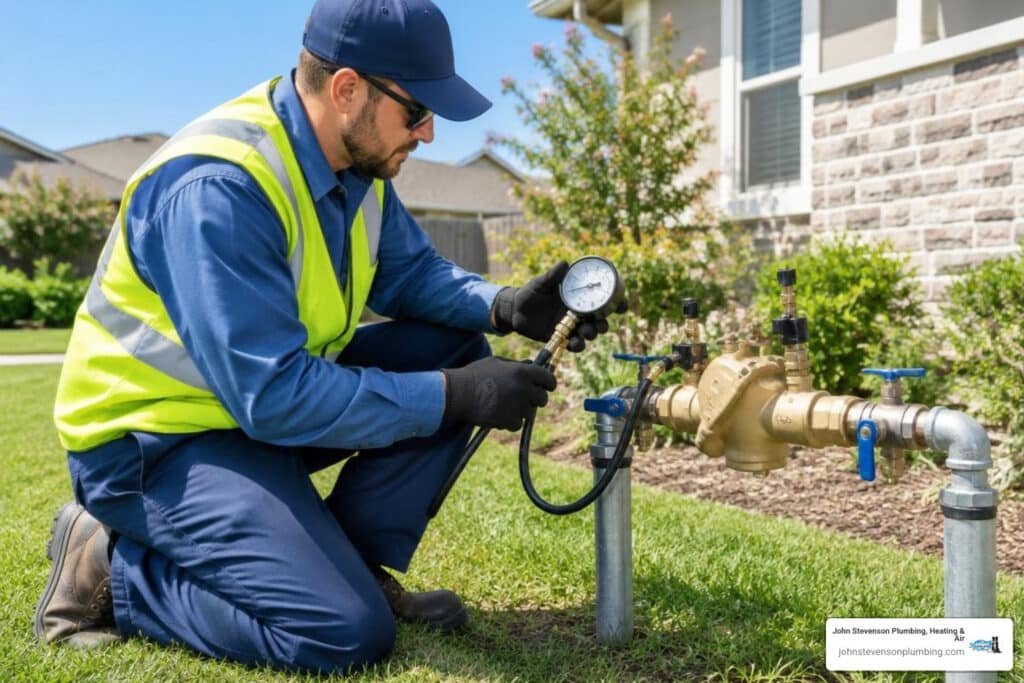
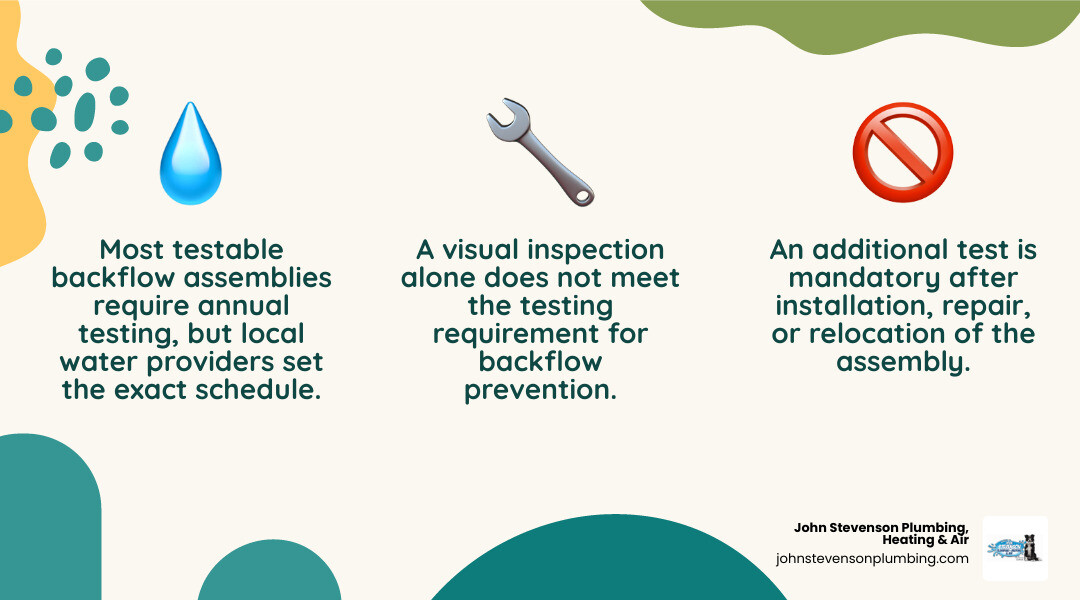
Most testable backflow prevention assemblies need backflow testing once a year, but your local water provider sets the schedule for your property. If you have an irrigation system or a backflow preventer at your water meter in Carlsbad, CA, check your notice or ask your water provider when the next test is due. Arrange another test after the assembly is installed, repaired, or moved. A passing test helps protect drinking water from water that could flow backward through an irrigation line or another plumbing connection. A visual check alone may not meet the testing requirement.
Explore our plumbing services or schedule backflow testing.
I’m John Stevenson, and you can schedule a backflow testing visit to help meet your local deadline.
Understanding Cross-Connection Risks and Backflow Prevention Assemblies
Clean drinking water relies on a one-way street. Under normal conditions, treated water travels under continuous municipal pressure straight from the main supply into your building fixtures. However, an unprotected physical link between a potable water line and any non-potable source creates what the plumbing industry terms a cross-connection hazard.
When pressure dynamics fluctuate, non-potable liquids, chemicals, or fertilizers can travel upstream into the clean water supply. This reversal happens via two distinct hydraulic phenomena:
- Backsiphonage: A sudden drop in the main supply line pressure causes negative pressure, creating a vacuum effect. This pulls contaminated water backward into clean lines, similar to sipping liquid through a straw. Main breaks, heavy firefighting demand, or nearby line flushing frequently trigger backsiphonage.
- Backpressure: Downstream pressure exceeds the incoming supply pressure, forcing water backwards. This occurs when downstream systems use mechanical pumps, boilers, or pressurized storage tanks.
The Federal Safe Drinking Water Act mandates strict local oversight to safeguard clean water systems. In California, local water districts require properties with potential cross-connections to maintain mechanical barriers. Our comprehensive plumbing services help keep these protective barriers up to date across coastal North County and Orange County communities.
Contamination risks are divided into two fundamental classifications:
- High-Hazard (Health Hazard): A cross-connection involving toxic substances, chemicals, or biological waste that could cause illness, disease, or severe bodily harm if consumed.
- Low-Hazard (Non-Health Hazard / Pollutant): An aesthetic nuisance that alters water taste, color, or odor without posing an immediate toxic threat to human health.
Testable Assemblies vs. Non-Testable Devices
Not every plumbing fitting designed to restrict reverse flow is created equal. The plumbing code draws a strict technical distinction between mechanical assemblies that can be field-tested and simpler non-testable devices.
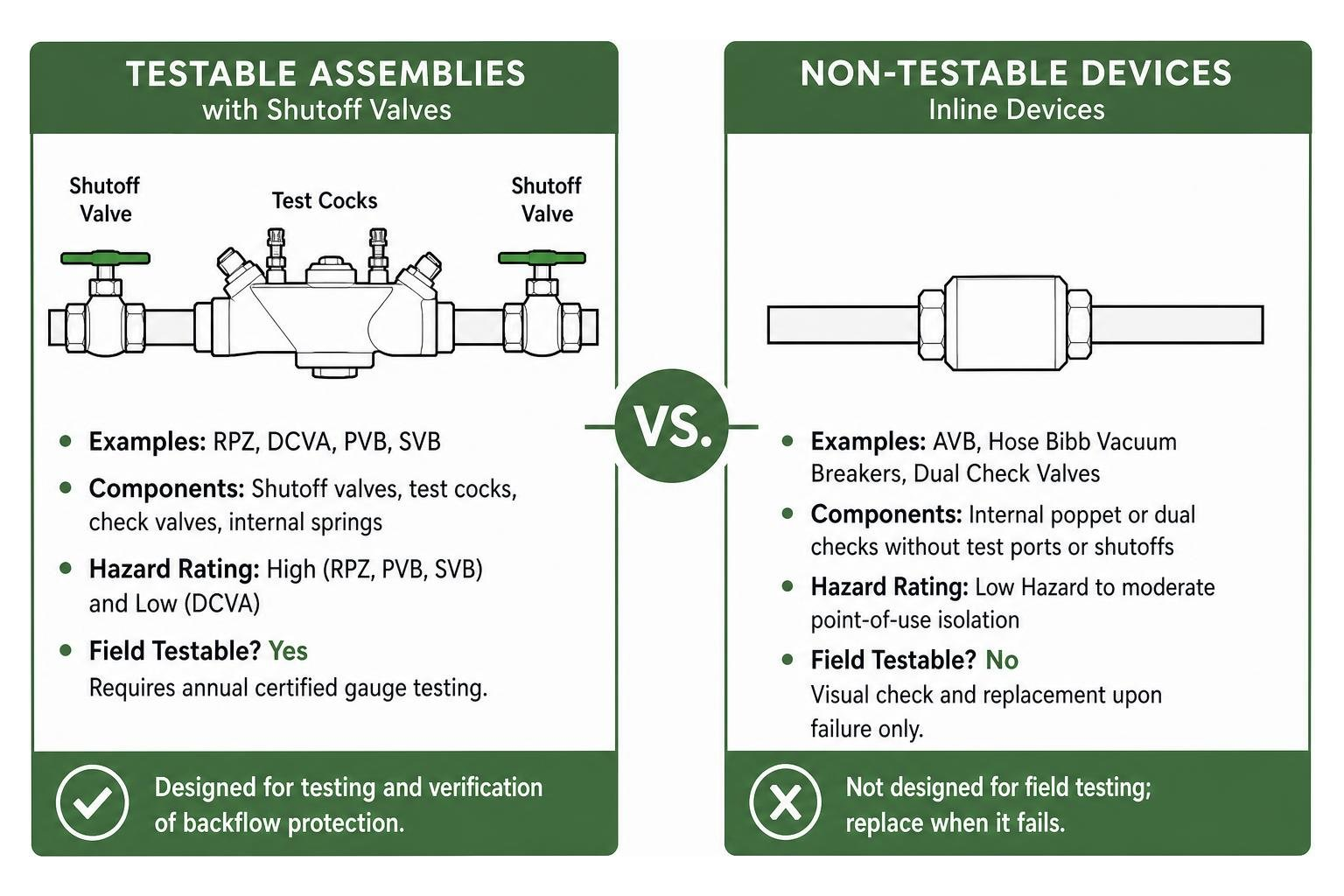
| Type | Examples | Key Components | Hazard Rating | Field Testable? |
|---|---|---|---|---|
| Testable Assemblies | Reduced Pressure Zone (RPZ), Double Check Valve (DCVA), Pressure Vacuum Breaker (PVB), Spill-Resistant Vacuum Breaker (SVB) | Resilient shutoff valves, internal springs, independent check valves, integrated test cocks | High Hazard (RPZ, PVB, SVB) and Low Hazard (DCVA) | Yes — requires annual certified gauge testing |
| Non-Testable Devices | Atmospheric Vacuum Breakers (AVB), Hose Bibb Vacuum Breakers, Dual Check Valves | Internal poppet or dual checks without test ports or shutoffs | Low Hazard to moderate point-of-use isolation | No — visual check and replacement upon failure only |
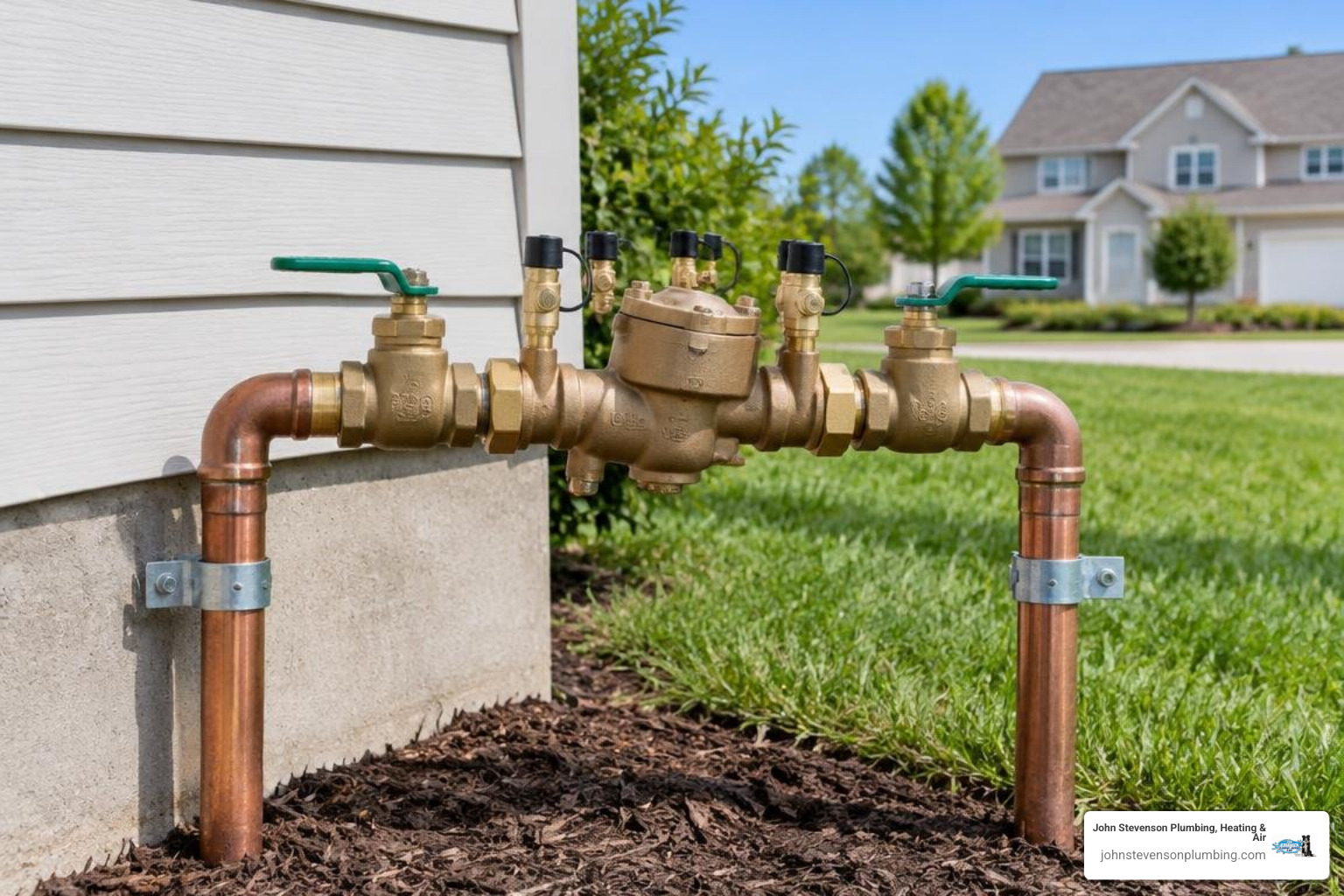
Testable assemblies feature dedicated shutoff valves and calibrated test cocks. These access points allow licensed testers to measure internal spring tensions and differential relief valve operation using precision gauges.
Containment Protection at the Water Meter vs. Internal Isolation
Cross-connection control employs two strategic layers of defense:
- Containment (Point-of-Delivery Protection): Installing an approved assembly directly downstream of the main city water meter before any private branch lines. This ensures zero contaminants from the private property migrate back into the municipal water main. If you are upgrading your main supply line, integrating proper meter isolation through our water line installation and repair ensures full municipal compliance.
- Isolation (Point-of-Use Protection): Placing assemblies or devices immediately upstream of specific internal hazards, such as commercial boilers, chemical aspirators, or darkroom sinks.
While internal isolation safeguards the occupants within a building, local water utilities prioritize boundary containment assemblies to protect the broader community grid.
How Often Should Backflow Be Tested for Residential and Commercial Properties?
The fundamental baseline standard established by the Uniform Plumbing Code (UPC), the International Plumbing Code (IPC), and local Southern California water district rules is straightforward: testable backflow assemblies must undergo physical testing at least once every 12 months.
Whether managing single-family residential properties with dedicated irrigation meters or overseeing facilities through our commercial plumbing and HVAC services, staying ahead of testing windows prevents service interruptions and keeps you code-compliant.
How Often Should Backflow Be Tested for High-Hazard vs. Low-Hazard Systems?
Testing frequency is driven by the severe potential consequences of a hydraulic failure:
- High-Hazard Applications (Annual Testing Required): Reduced Pressure Principle (RPZ) assemblies and Pressure Vacuum Breakers (PVB) protecting chemical injection lines, commercial car washes, medical offices, and fire suppression systems containing chemical additives must be tested annually by a certified professional. Some high-risk industrial facilities may require semi-annual or quarterly test cycles.
- Low-Hazard Applications (Annual to Multi-Year Baseline): While certain low-hazard Double Check Valve Assemblies (DCVA) are permitted three-year testing cycles under specific non-community state guidelines, California municipal water suppliers and plumbing codes enforce an annual testing cadence across all active assemblies to guarantee potable purity. When managing sensitive distribution systems, pairing regular backflow testing with our advanced water quality services helps ensure clean, balanced tap water.
How Often Should Backflow Be Tested After Installation, Relocation, or Repairs?
The 12-month calendar is not the only trigger for testing. The answer to how often should backflow be tested also depends on physical changes to your plumbing infrastructure.
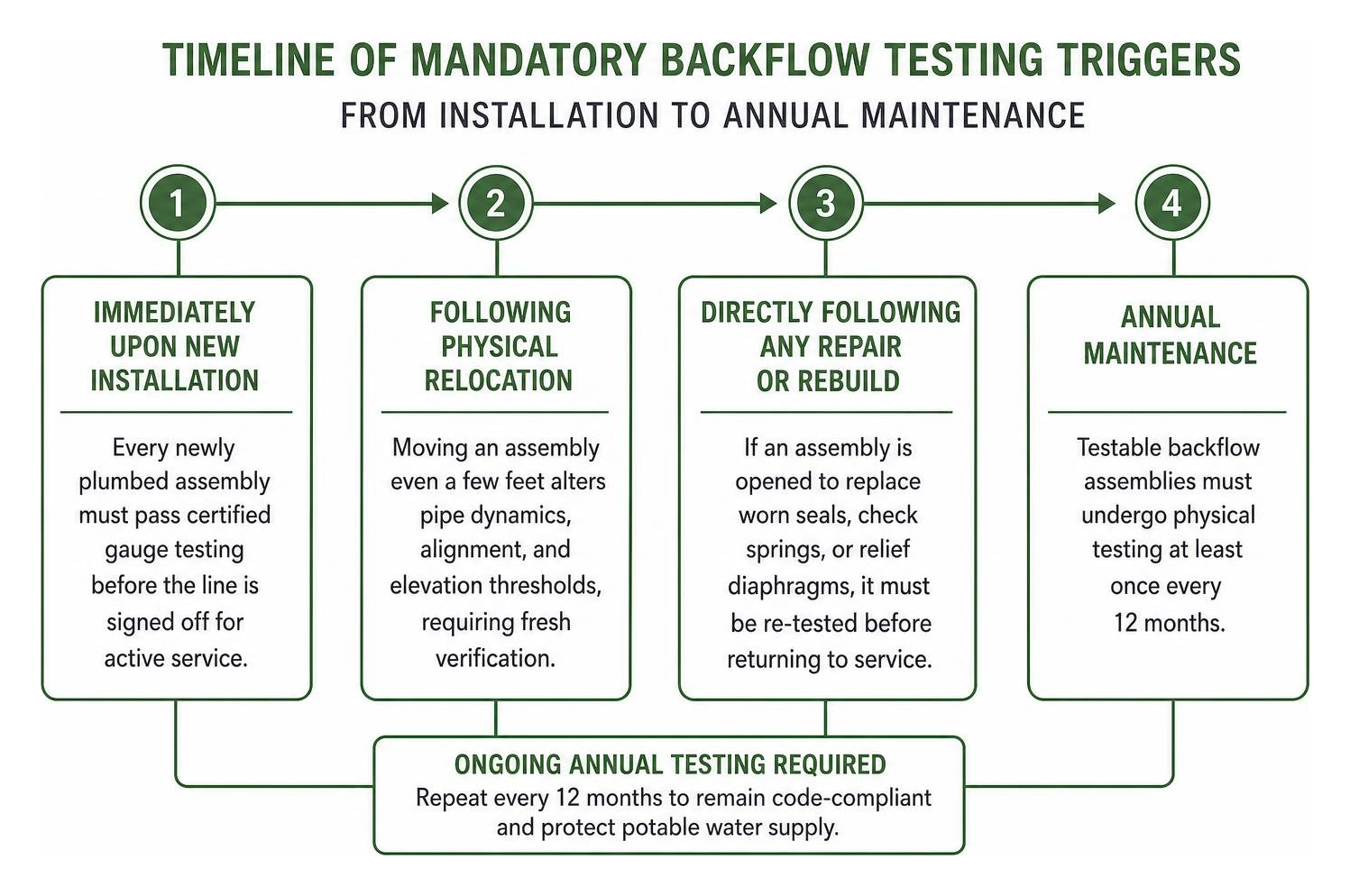
A certified inspection is legally mandatory under these immediate circumstances:
- Immediately Upon New Installation: Every newly plumbed assembly must pass certified gauge testing before the line is signed off for active service.
- Following Physical Relocation: Moving an assembly even a few feet alters pipe dynamics, alignment, and elevation thresholds, requiring fresh verification.
- Directly Following Any Repair or Rebuild: If an assembly is opened to replace worn seals, check springs, or relief diaphragms, it must be re-tested before returning to service. Our team provides prompt plumbing repair services to restore internal parts and clear administrative hold notices quickly.
Seasonal Considerations and Irrigation System Startup Testing
Residential lawn sprinkler lines and estate drip configurations are prime cross-connection points because sprinkler heads rest directly in soil containing fertilizer and lawn chemicals.
In microclimates prone to cold snaps, seasonal shutdowns help prevent freeze damage to exposed vacuum breakers and relief assemblies. Before reactivating outdoor lines each spring, review our essential spring plumbing inspection tips to check for split castings or degraded o-rings before scheduling your spring startup test.
Tester Certification, Failure Protocols, and Compliance Documentation
Backflow testing requires specialized training, precise equipment, and careful record-keeping to meet local municipal standards.
Who Is Legally Authorized to Perform Backflow Assembly Testing?
Testing cannot be completed by a standard handyman or uncertified tradesperson. To be legally recognized by local water districts across Carlsbad, San Diego County, and Orange County, the professional must hold:
- Active certification from an accredited body such as the American Society of Sanitary Engineering (ASSE 5110) or the American Water Works Association (AWWA).
- Current registration with the local municipal water department.
- A recently calibrated differential pressure test kit (re-calibrated annually to ensure measurement accuracy).
What Happens When an Assembly Fails and Required Repair Windows
If check valves leak, relief ports vent continuously, or internal spring tensions fall below minimum PSI thresholds during field testing, the unit fails.
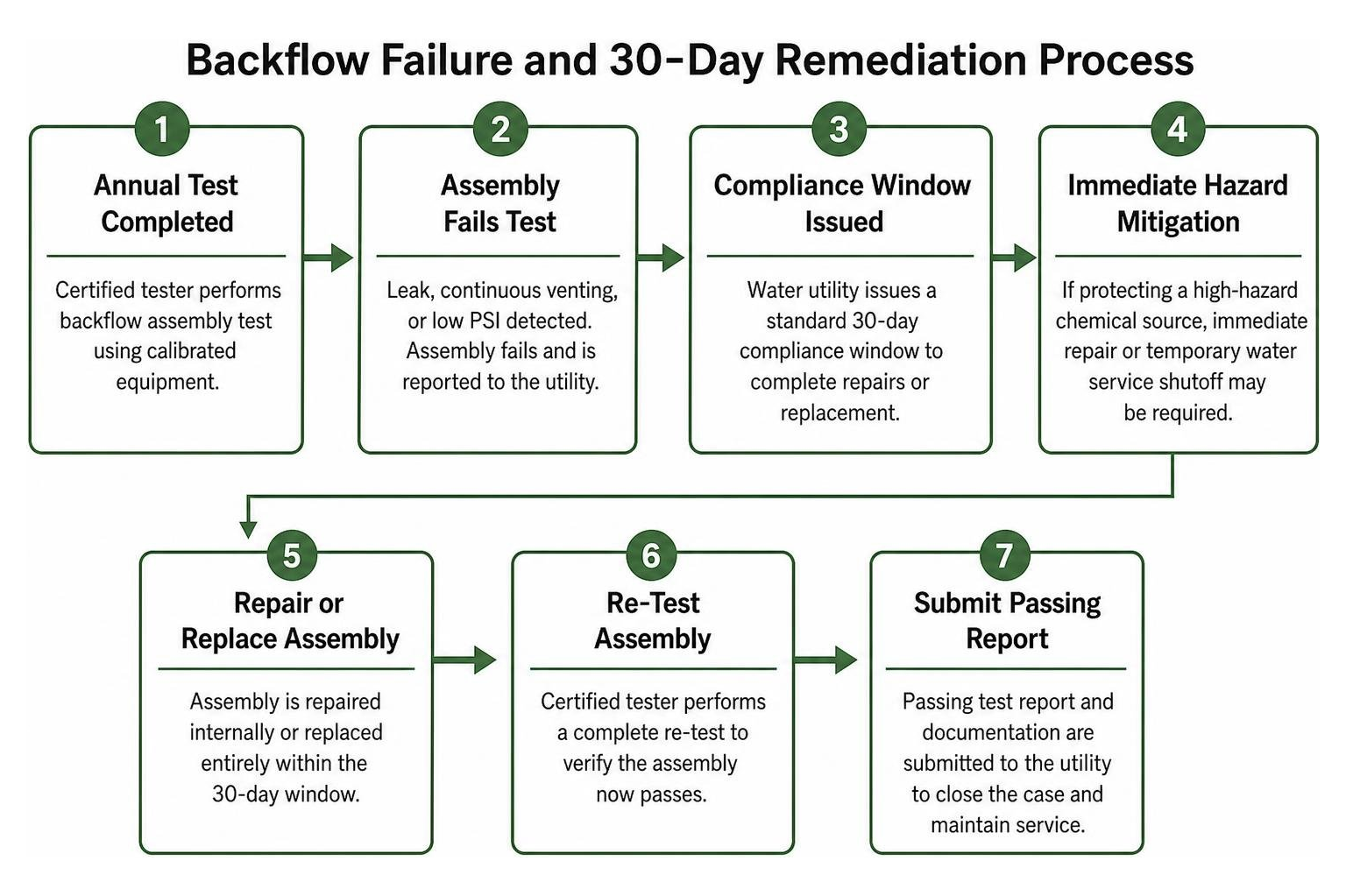
- The Compliance Window: Water utilities generally issue a standard 30-day compliance window to complete internal repairs or total replacements.
- Immediate Hazard Mitigation: If the assembly protects an active, high-hazard chemical source, immediate repair or temporary water service shutoff may be required.
- Post-Repair Certification: Once the unit has been rebuilt, a complete re-test must be conducted, and passing paperwork must be filed with the utility to prevent water service shutoff.
Record Retention and Submitting Compliance Reports to Water Authorities
Once your backflow test is complete, our technicians document differential pressures, relief opening points, and line pressures on official test forms. We submit the completed documentation directly to your local water utility on your behalf.
Property owners should also keep copies of all test forms, rebuild invoices, and certification papers in their maintenance files for at least five years to ensure seamless compliance during municipal audits.
Frequently Asked Questions About Backflow Testing
Do residential homeowners in Carlsbad need annual backflow testing?
Yes. If your residential property has a dedicated landscape irrigation meter, a swimming pool autofill tied directly to domestic lines, an auxiliary well, or a fire sprinkler system, local water districts require an annual backflow inspection by a certified tester.
What is the difference between an RPZ and a DCVA assembly?
A Double Check Valve Assembly (DCVA) utilizes two spring-loaded check valves in series, making it suitable for low-hazard applications. A Reduced Pressure Zone (RPZ) assembly includes two independent check valves plus a hydraulically operated differential pressure relief valve between them. If either check valve leaks, the RPZ vents the water out to the atmosphere, preventing backpressure and backsiphonage contamination in high-hazard installations.
How much time do I have to fix a failed backflow preventer?
Most municipal water authorities allow a 30-day window from the test date to complete necessary repairs and submit a passing re-test report. Addressing repairs promptly prevents formal compliance warnings or potential service disruptions.
Conclusion
Routine backflow testing keeps your drinking water clean, protects public health, and ensures full compliance with local municipal codes. At John Stevenson Plumbing, Heating & Air Conditioning, our licensed, certified plumbers provide thorough diagnostics and our 5-Star Service Guarantee across Carlsbad, San Diego County, and Orange County communities.
Don’t let an upcoming compliance deadline catch you off guard. Contact our team today to schedule certified backflow prevention and testing services and keep your water system safe and fully compliant.