
How Long Does a Tankless Water Heater Last in Carlsbad, CA?
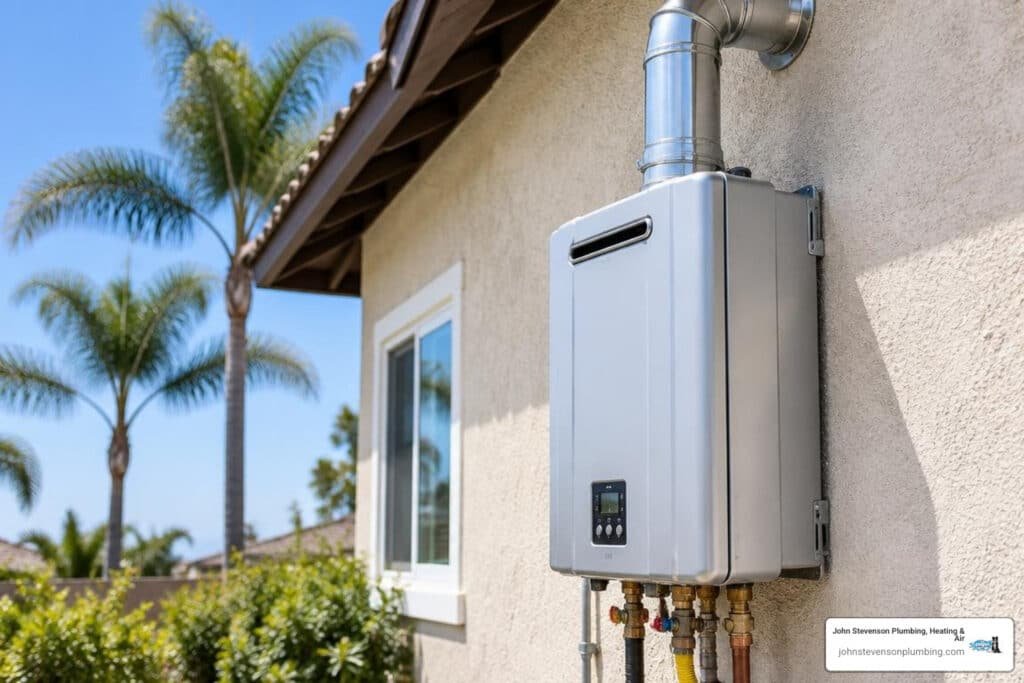
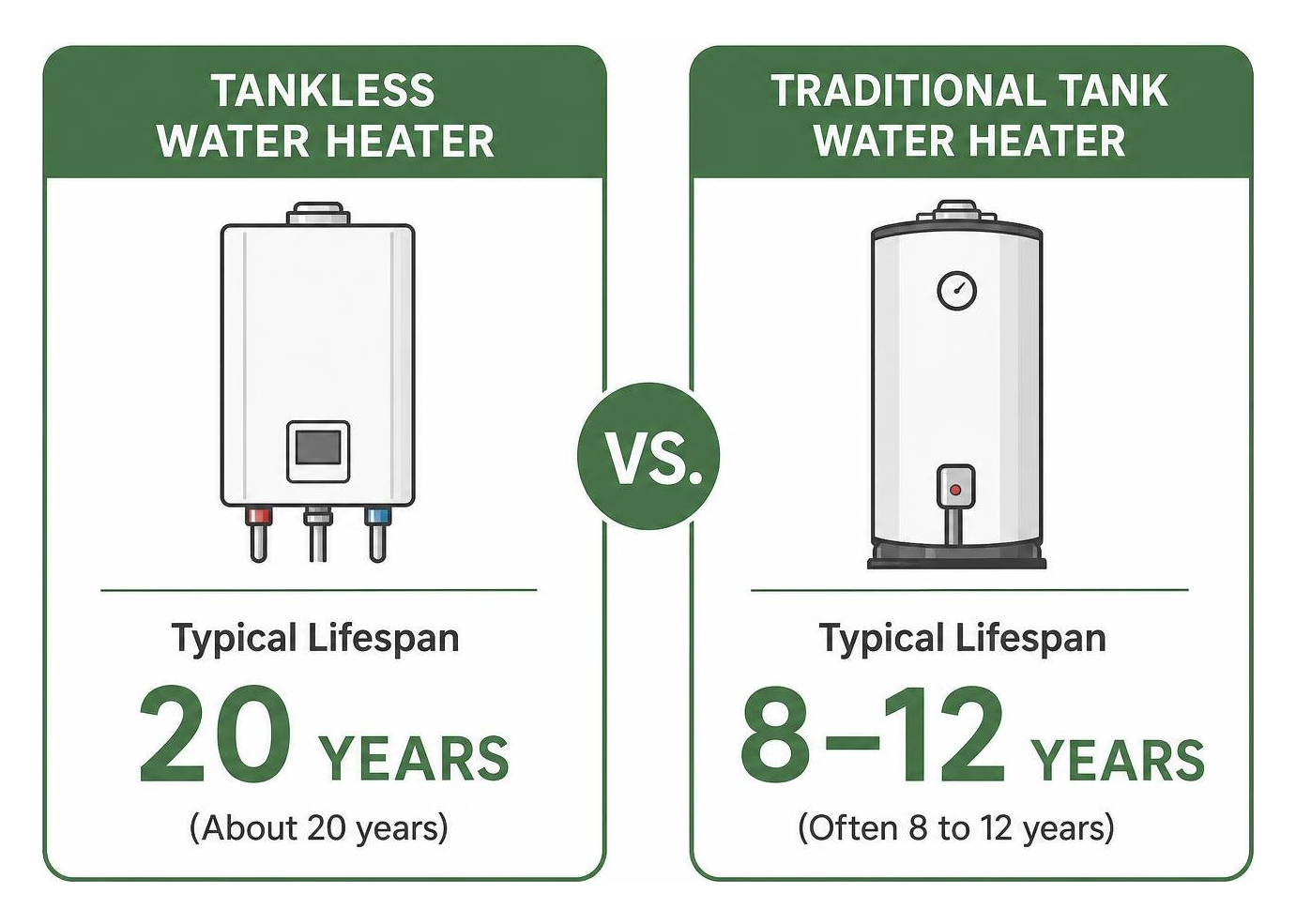
A tankless water heater typically lasts about 20 years with proper care. Some last 25 years, while a traditional tank water heater often lasts 8 to 12 years. If you need a tankless water heater inspection in Carlsbad, CA, you may be wondering whether yours needs service or is nearing replacement. The answer depends on its age, water quality, and maintenance history. Mineral buildup can shorten its life, so a drop in hot water flow or repeated error codes is worth checking.
Learn more about John Stevenson Plumbing, Heating & Air or explore our tankless water heater services.
I’m John Stevenson, and this guide will help you understand what affects your heater’s lifespan and when to have it inspected.
If your hot water has become less reliable, ask us to inspect your tankless water heater.
How Long Does a Tankless Water Heater Last Compared to a Traditional Tank?
When homeowners ask us how long does a tankless water heater last, the comparison to conventional storage systems is striking. A quality tankless unit provides 20 to 25 years of reliable service when maintained correctly. In contrast, standard storage tank water heaters average only 8 to 12 years before requiring total replacement.
The fundamental reason for this longevity gap comes down to design. Traditional water heaters store 40 to 50 gallons of water continuously under pressure. Over time, standing water causes internal tank corrosion, rust, and heavy sediment accumulation at the bottom of the vessel. Eventually, the steel inner liner fractures or rusts through, resulting in an unrepairable leak.
Tankless units operate on demand. Water only flows through the system when a hot water tap opens, eliminating continuous standby pressure and standby heat loss. Because there is no storage reservoir holding stagnant water day and night, the risk of tank rupture is eliminated. We often walk homeowners through these key factors in comparing tank and tankless systems to help them plan for long-term comfort.
| Feature | Standard Storage Tank | On-Demand Tankless Unit |
|---|---|---|
| Typical Lifespan | 8–12 Years | 20–25 Years |
| Primary Failure Cause | Tank corrosion & rupture | Heat exchanger scale buildup |
| Standby Heat Loss | Continuous (stores hot water 24/7) | None (heats only on demand) |
| Part Replaceability | Limited (tank leak = full scrap) | Modular (individual parts replaceable) |
| 20-Year Replacements | 2 to 3 full unit installations | 1 unit with routine maintenance |
Gas vs. Electric: How Long Does a Tankless Water Heater Last by Fuel Type?
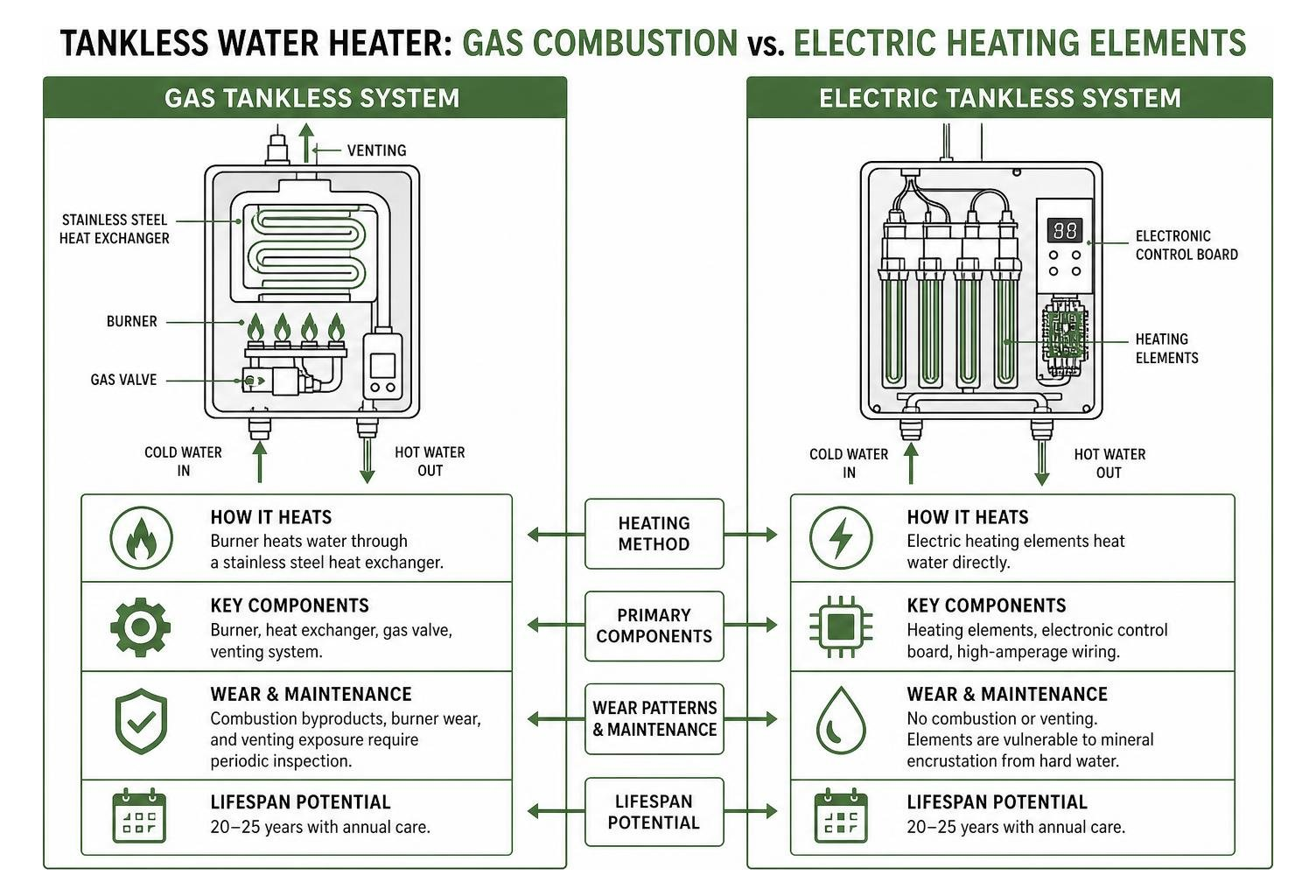
Both gas-fired and whole-home electric tankless models offer multi-decade potential, but their internal wear patterns differ:
- Gas Tankless Systems: Utilize copper or stainless steel heat exchangers combined with powerful burners and specialized venting. Gas units deliver high flow rates suitable for entire households, but combustion byproducts, burner wear, and venting exposure require periodic inspection. Modern condensing gas units use durable stainless steel secondary heat exchangers designed to resist acidic condensation, easily reaching 20 to 25 years with annual care.
- Electric Tankless Systems: Rely on high-amperage electric heating elements and advanced electronic control boards. Because they lack combustion chambers, burners, and venting, there are fewer moving mechanical parts to corrode. However, electric elements remain vulnerable to mineral encrustation from hard water, making it easy to understand why homeowners choose energy-efficient upgrades paired with whole-home filtration.
20-Year Financial Value: Energy Efficiency and Replacement Cycles
According to data from the U.S. Department of Energy, on-demand water heaters achieve 24% to 34% greater energy efficiency than conventional storage tank models in homes using 41 gallons or less of hot water daily.
Over a 20-year homeownership window, a traditional tank unit must be purchased, permitted, and installed at least twice—and frequently three times. A single well-maintained tankless unit runs continuously across that same span. By cutting out continuous standby heating and avoiding back-to-back tank changeouts, homeowners capture significant long-term operational savings.
Key Factors That Shorten or Extend Tankless System Longevity
While engineering gives on-demand systems a clear lifespan advantage, a unit will not automatically reach its 20-year milestone without proper operating conditions.
Several critical installation and operational variables directly influence system durability:
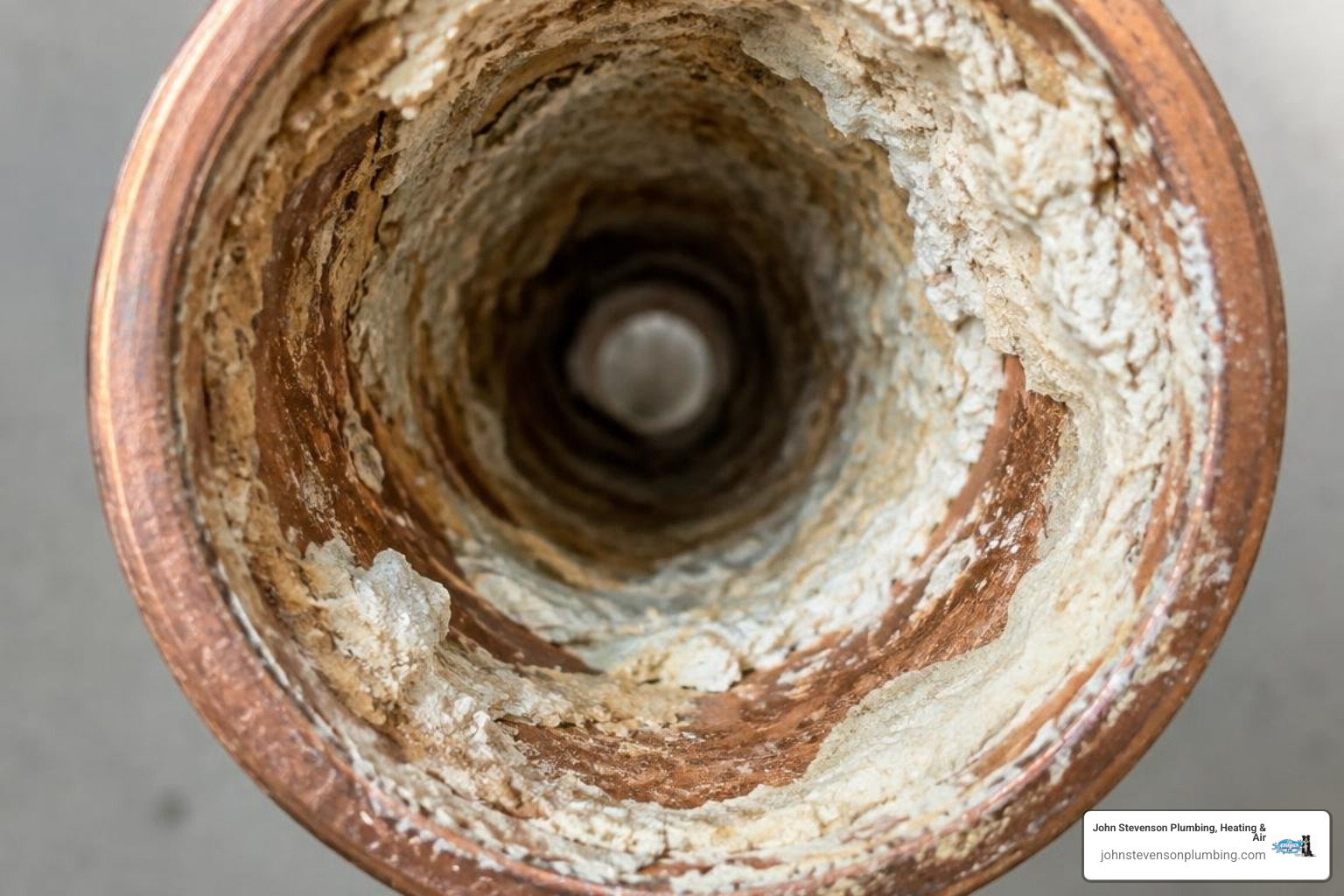
- Water Quality & Hardness: Dissolved minerals act as an insulating blanket inside heat exchanger passages, trapping intense heat against metal walls.
- System Sizing & Gas Supply: An undersized unit running at maximum burner output continuously suffers accelerated thermal fatigue. Proper gas line sizing and correct fuel pressure ensure clean, smooth combustion.
- Recirculation Setup: Dedicated hot water recirculation loops provide instant hot water at distant fixtures. However, running a recirculation pump continuously 24/7 accelerates wear on the heat exchanger. Smart timers or on-demand push-button controls prevent unnecessary operating hours.
- Combustion Air & Venting: Clean intake air prevents burner contamination. Restricted intake airflow creates soot deposits that shorten component life.
Taking these operational variables seriously is essential when evaluating overall water heater lifespan across Southern California homes.
How Long Does a Tankless Water Heater Last in Hard Water Areas Like Carlsbad?
Across Carlsbad and coastal San Diego County, municipal tap water carries substantial dissolved calcium and magnesium carbonates. In hard water conditions, water flowing through tight heat exchanger pathways drops mineral deposits whenever temperatures rise above 120°F.
The Battelle Memorial Institute conducted landmark laboratory testing on water heating equipment under severe mineral conditions. Their findings revealed that a gas tankless system operating on untreated, 26-grain hard water without periodic descaling suffered complete heat exchanger failure in just 1.6 years.
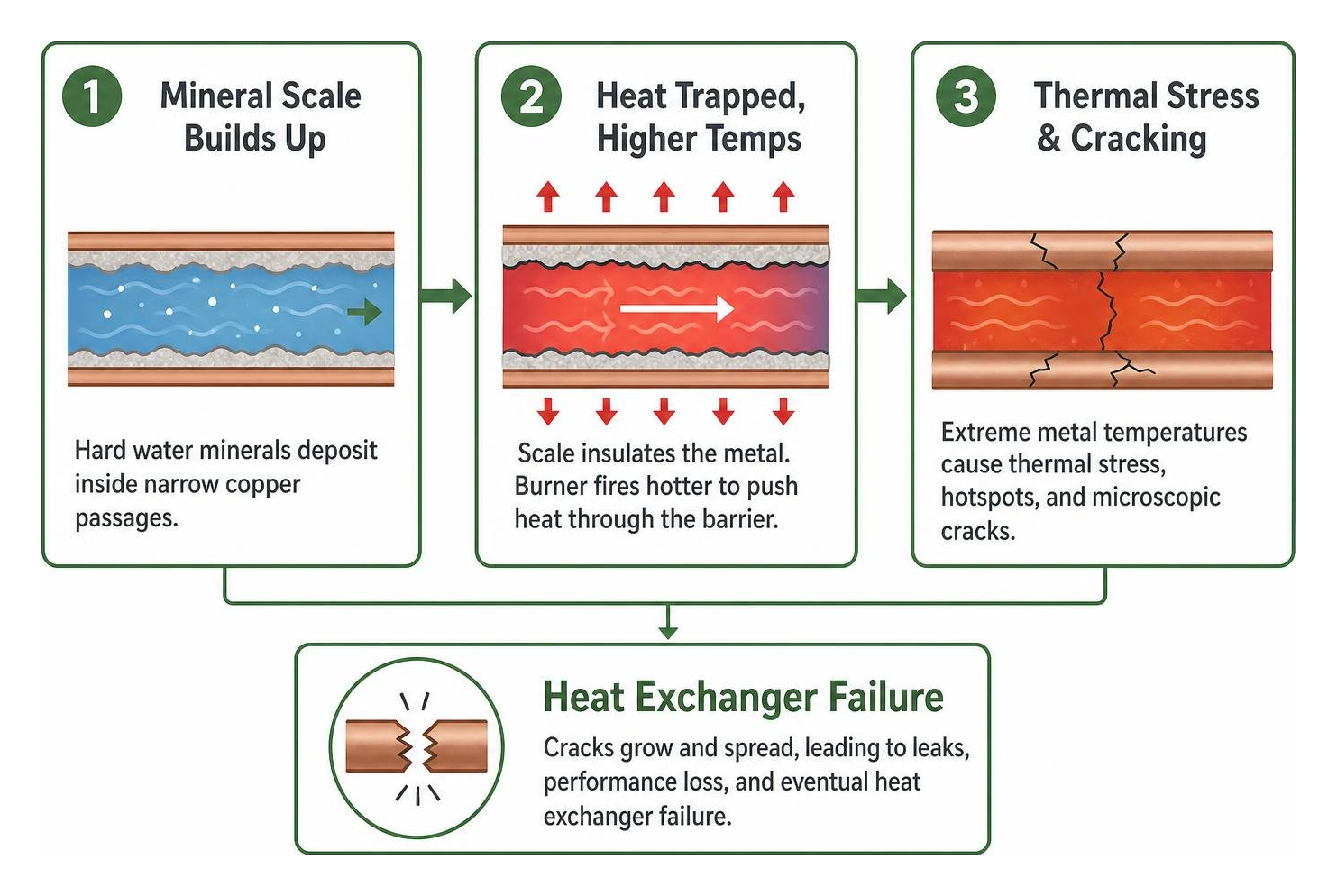
When scale forms inside narrow copper passages:
- Minerals insulate the metal from the water flow.
- The gas burner must fire at hotter temperatures to push heat through the chalky mineral barrier.
- Extreme localized metal temperatures cause thermal stress, hotspots, and eventual microscopic cracks.
Pairing your unit with whole-home water conditioning or scheduling regular descaling neutralizes this threat, allowing the system to achieve its full design life.
Understanding Heat Exchanger Warranties and Coverage Exclusions
Leading manufacturers provide robust warranty coverage on their primary heat exchangers—frequently ranging from 10 to 15 years, with select models offering up to 25 years for single-family residential use.
However, manufacturer warranties contain specific conditions:
- Scale Damage Exclusions: Warranties explicitly exclude repairs or replacements caused by mineral scale buildup or unconditioned hard water.
- Operating Hour Caps: Many commercial and high-demand warranties cap heat exchanger protection at 12,000 total operating hours.
- Temperature Limits: Operating residential units above standard residential thresholds (such as 140°F to 160°F) often reduces warranty terms down to commercial levels.
- Registration Timeframes: Most manufacturers require product registration within 60 to 90 days of installation to secure maximum multi-decade warranty terms.
Maintenance Habits That Ensure a 20-Year Lifespan
Ensuring your tankless unit reaches its second decade requires straightforward, proactive maintenance habits.
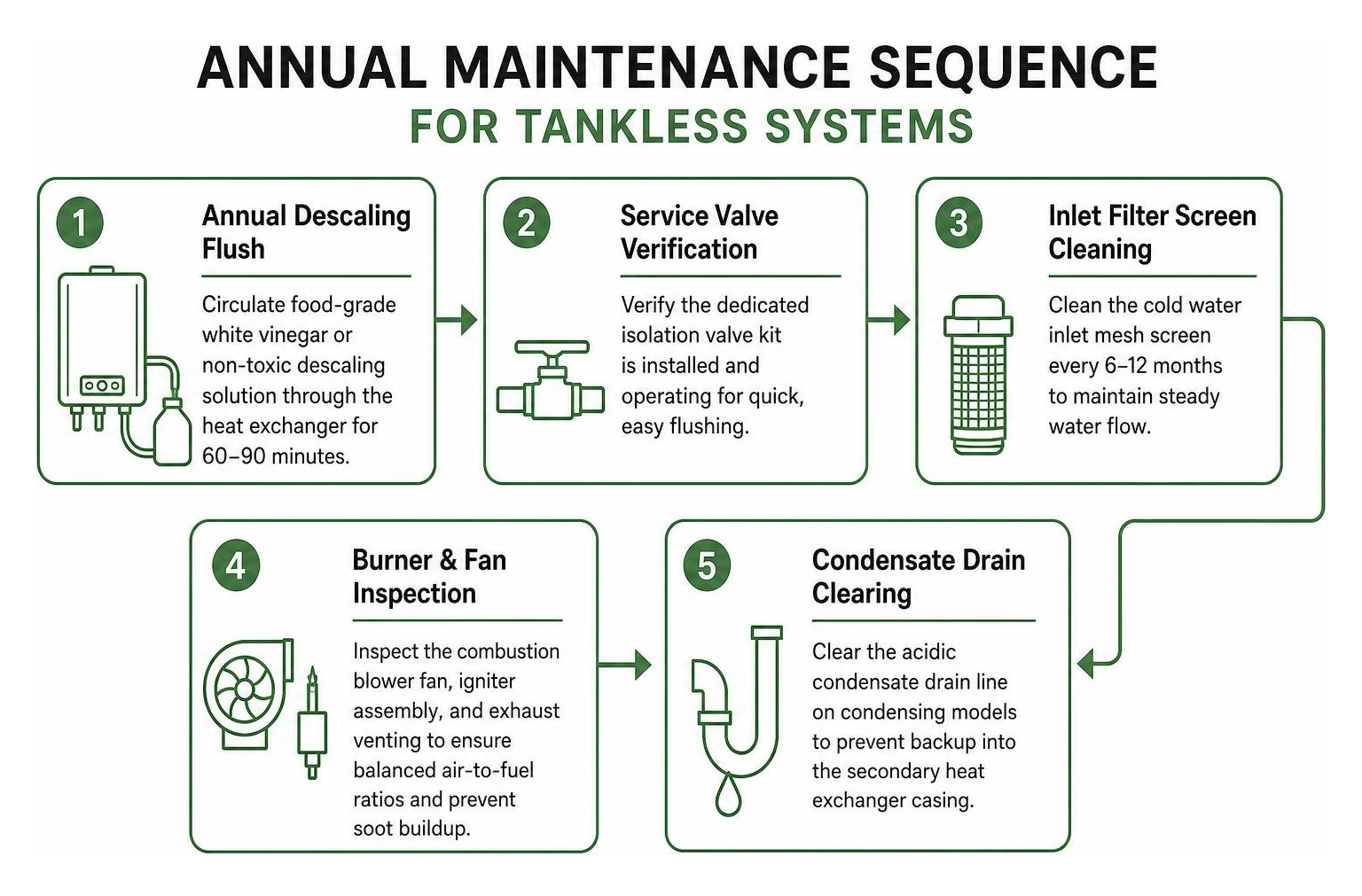
To keep your water heater operating smoothly, we recommend these proven ways to extend system life:
- Annual Descaling Flushes: Circulating food-grade white vinegar or specialized non-toxic descaling solution through the heat exchanger for 60 to 90 minutes dissolves calcium and magnesium crust.
- Service Valve Verification: Installing a dedicated isolation valve kit during initial setup allows quick flushing without cutting or dismantling house plumbing lines.
- Inlet Filter Screen Cleaning: The cold water inlet contains a mesh debris screen designed to capture pipe scale and sand. Cleaning this filter screen every 6 to 12 months maintains steady water flow.
- Burner & Fan Inspection: Checking the combustion blower fan, igniter assembly, and exhaust venting ensures balanced air-to-fuel ratios, preventing soot accumulation.
- Condensate Drain Clearing: On condensing models, clearing the acidic condensate drain line prevents backup into the secondary heat exchanger casing.
Signs of Failure: Is It Time to Repair or Replace Your Unit?
Because tankless water heaters are built modularly, a malfunction does not automatically mean the entire appliance is finished. Unlike traditional storage tanks where a leak signifies catastrophic structural loss, most tankless parts—including igniters, flow sensors, flame rods, fan motors, and control boards—can be serviced individually.
Watch for these warning signs that indicate your system needs immediate professional evaluation:
- Recurring Overheat or Scale Codes: Error codes indicating high internal temperatures (such as common codes for scale detection or exhaust limit warnings) signal reduced heat transfer.
- The “Cold Water Sandwich” Effect: Brief blasts of cold water during continuous showers indicate failing flow sensors or slow ignition sequences.
- Water Dripping Inside Cabinet: Internal moisture indicates gasket failure, loose connections, or a hairline breach in the heat exchanger.
- Yellow Flames or Soot Residue: Indicates incomplete combustion, clogged burner ports, or venting blockages.
When evaluating an aging system, we apply the 50 percent rule: if a repair on a 15-year-old unit exceeds 50% of the replacement value—or if the primary heat exchanger itself has ruptured out of warranty—reviewing these signs you need a system replacement helps you choose the safest, most economical path forward.
Frequently Asked Questions About Tankless Water Heater Lifespan
Can a tankless water heater really last 25 years?
Yes. When installed with appropriate water treatment, descaled annually, and sized correctly for household peak demand, tankless units regularly achieve 20 to 25 years of service. Replacing minor serviceable components (like sensors or control boards) along the way preserves the main heat exchanger, validating whether a tankless upgrade is worth the investment over decades of homeownership.
Does hard water void a tankless water heater warranty?
While hard water itself does not void the equipment warranty, premature heat exchanger failure directly caused by mineral scale accumulation is excluded by all major manufacturers. Homeowners must maintain proof of regular flushing or install approved water-softening solutions to protect both their warranty and their plumbing system.
Is it worth repairing a 15-year-old tankless unit?
If the issue involves straightforward modular components—such as a dirty flame sensor, worn exhaust fan, or faulty water flow valve—repairing the system is usually practical and cost-effective. However, if the primary copper or stainless steel heat exchanger has cracked or developed internal leaks after 15 years, replacing the full appliance provides higher energy efficiency, renewed manufacturer warranties, and peace of mind.
Conclusion
A tankless water heater is one of the most durable, energy-efficient appliances you can install in your home. By understanding local water quality, scheduling annual descaling, and addressing error codes promptly, you can expect two full decades of reliable, on-demand hot water.
At John Stevenson Plumbing, Heating & Air Conditioning, our licensed and certified technicians deliver expert care backed by our 5-Star Service Guarantee, thorough diagnostics, and 24-hour satisfaction check-ins. Whether you live in Carlsbad, Oceanside, Encinitas, San Marcos, Solana Beach, or anywhere across San Diego County and Orange County, our local team is here to help.
Keep your hot water running strong for decades to come—contact our team today to schedule your comprehensive professional tankless water heater services.