
Hard Water in Carlsbad: What Every Homeowner Needs to Know Before Choosing a Treatment System
When it comes to a water softener vs descaler comparison, the core difference comes down to one question: do you want to remove hard water minerals, or simply stop them from causing damage?
Here’s a quick breakdown:
| Feature | Water Softener | Water Descaler |
|---|---|---|
| How it works | Removes calcium and magnesium via ion exchange | Alters mineral structure so they can’t stick to surfaces |
| Removes minerals? | Yes, completely | No |
| Requires salt? | Yes | No |
| Maintenance level | Moderate (salt refills, brine tank cleaning) | Very low |
| Best for water hardness | Above 10–15 GPG (grains per gallon) | Below 10–15 GPG |
| Produces wastewater? | Yes | No |
| Improves soap lathering? | Yes | No |
| Protects pipes and appliances? | Yes | Yes |
| Electricity required? | Yes | Not always |
If your water is severely hard — as is common throughout Carlsbad and San Diego County — a water softener is typically the stronger choice. If your hardness levels are moderate and your main concern is scale buildup on pipes and appliances, a descaler may be all you need.
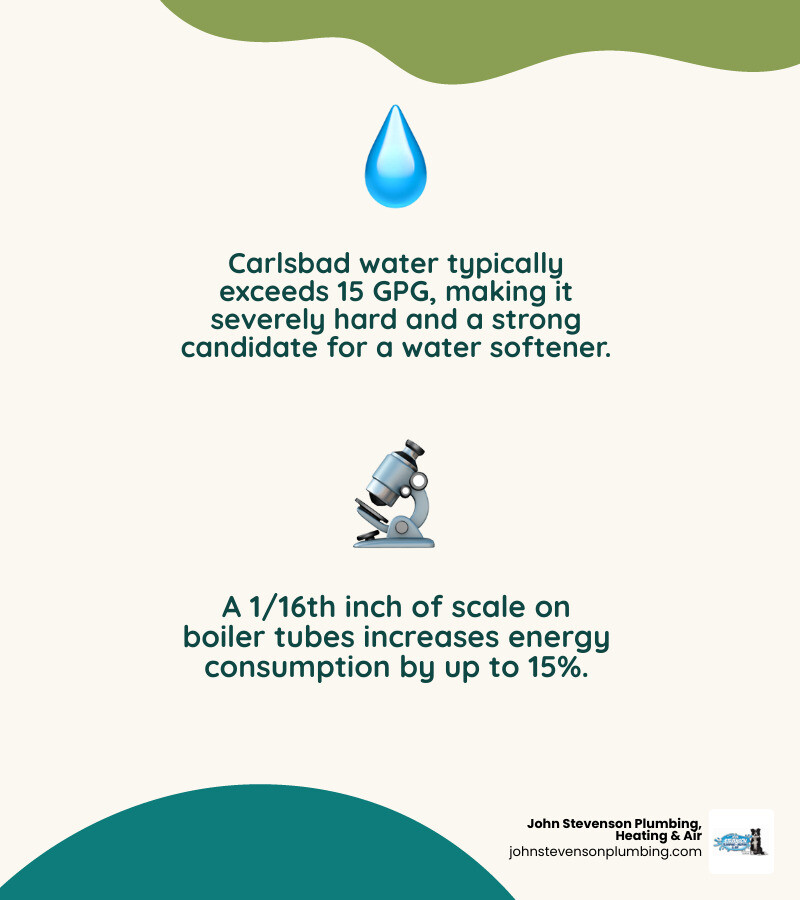
Hard water is one of those slow, invisible problems. You might notice spots on your glassware, a filmy residue in the shower, or your soap just won’t seem to lather properly. Over time, the same minerals behind those small annoyances — primarily calcium and magnesium — build up inside your pipes, water heater, and appliances, quietly driving up energy bills and shortening equipment life. In fact, even a 1/16th of an inch of scale on a boiler tube can increase energy consumption by 15%.
Southern California’s water is notoriously hard. Choosing the right treatment system matters more here than in most parts of the country, and the wrong choice can mean wasted money, unnecessary maintenance, or a system that simply doesn’t solve your problem.
I’m John Stevenson, and after years of helping Carlsbad homeowners navigate water quality challenges, I want to walk you through everything you need to make a confident, informed decision.
Water Softener vs Descaler Comparison: The Core Differences
To truly understand how these systems compare, we have to look at what they do to the chemistry of your water. A traditional water softener is a physical removal system. It takes the calcium and magnesium ions—the primary culprits behind hard water—and physically extracts them from your water supply. In their place, it leaves behind a tiny, harmless amount of sodium or potassium.
A water descaler, on the other hand, is a physical conditioning system. It does not remove a single grain of calcium or magnesium. Instead, it alters the physical structure of these minerals so they lose their adhesive properties. Think of it like putting a non-stick coating on the minerals; they still flow through your pipes, but they can no longer cling to the walls of your copper plumbing, the inside of your water heater, or your glass shower doors.
This chemical difference has a massive impact on how the water actually feels and behaves in your home. Because softeners remove the minerals entirely, they completely eliminate the “soap barrier.” You will notice that soaps, shampoos, and detergents lather beautifully, and you can actually reduce your soap and detergent usage by up to 50%. Softened water also eliminates that dry, itchy feeling on your skin and hair after a shower.
Descalers do not change the “feel” of the water. Because the minerals are still present, you will not get that slippery, silky sensation of soft water, and your soap will not lather any better. However, you will still enjoy excellent scale prevention inside your plumbing system and major appliances.
If you are trying to decide whether you want to completely change your water’s chemistry or simply protect your home’s infrastructure, reading our guide on Choosing Between a Water Softener and Filtration System can help clarify your options.
Key Factors in a Water Softener vs Descaler Comparison
When we evaluate these systems side-by-side, several key factors come to the forefront:
- Water Hardness Levels (GPG): Water hardness is measured in Grains per Gallon (GPG). If your home’s water tests above 15 GPG, a water softener is highly recommended. The minerals are simply too dense for a descaler to manage effectively. If your water is below 10 to 15 GPG, a descaler is often more than sufficient to keep scale at bay.
- Soap and Lathering: Only a water softener will resolve issues with poor soap lathering, soap scum on shower walls, and spotted dishes. Because descalers leave the minerals in the water, the soap-binding chemistry of hard water remains unchanged.
- Water Taste: Softened water contains trace amounts of sodium, which some people find gives the water a slightly flat or different taste. Descaled water retains its natural mineral content, which many homeowners prefer for drinking, pet bowls, and household plants.
- Appliance Protection: Both systems protect your appliances, but they do so differently. A water softener prevents scale from ever entering the appliance. A descaler allows the minerals to pass through without sticking. By preventing scale buildup, water softeners can reduce water heater energy consumption by up to 20% to 30%, keeping heating elements completely clean.
How Water Softeners and Descalers Work
To make the right choice for your household, it helps to understand the engineering behind these systems. Both are designed to tackle hard water, but their mechanical processes are completely different.
Understanding Ion Exchange in a Water Softener vs Descaler Comparison
Traditional water softeners rely on a chemical process called ion exchange.
Inside the main tank of a water softener are millions of tiny, negatively charged plastic resin beads. Because opposites attract, these negatively charged beads hold onto positively charged sodium or potassium ions.
As hard water enters the tank, the positively charged calcium and magnesium ions in the water pass over the resin beads. These hard minerals carry a much stronger positive charge than the sodium ions. As a result, the calcium and magnesium physically bump the sodium ions off the beads and take their place, sticking to the resin. The water leaving the tank is now completely free of hardness minerals.
Eventually, the resin beads become completely saturated with calcium and magnesium and cannot hold any more. This is where the regeneration cycle comes in. The system draws a highly concentrated salt-water solution (brine) from the adjacent brine tank and flushes it through the resin tank. The sheer volume of sodium in the brine forces the calcium and magnesium off the beads and washes them down the drain as wastewater. Once the resin beads are recharged with sodium, the system is ready to soften your water again.
Because of this cycle, water softeners require ongoing maintenance. You must regularly replenish the salt in the brine tank, and the system will periodically generate wastewater during its self-cleaning cycles.
How Descalers Alter Minerals Without Removing Them
Water descalers use physical processes to change how minerals behave without using salt or generating wastewater. The most effective descalers utilize Template-Assisted Crystallization (TAC) technology.
Inside a TAC descaler, water passes through a specialized catalytic media. This media provides template sites that attract dissolved calcium and magnesium ions, converting them into microscopic, inert crystalline structures. Once these crystals form, they detach from the media and float harmlessly through your water supply. Because they are already stable crystals, they lose their electrical charge and cannot bind to metal, glass, or heating elements.
Studies show that TAC-based water systems are incredibly efficient, reducing scale by more than 88%. This makes them a highly legitimate, scientifically backed alternative to traditional softeners.
It is important to distinguish TAC systems from cheaper electromagnetic descalers. Electromagnetic units wrap around the outside of your incoming pipe and use magnetic fields to disrupt mineral behavior. However, real-world testing shows they are far less effective, reducing scale by only about 50%. Furthermore, their efficiency can vary wildly based on your water’s pH, temperature, and flow rate.
TAC descalers require virtually no electricity, produce zero wastewater, and need no salt refills, making them an exceptionally low-maintenance and eco-friendly choice.
Choosing the Right System for Your Carlsbad Home
Selecting the ideal water treatment system in Carlsbad, CA, requires looking closely at our local water conditions.
Southern California is famous for its beautiful beaches, but it is equally famous among plumbers for having incredibly hard water. Most of our municipal water comes from the Colorado River and the State Water Project. As this water travels hundreds of miles through natural rock formations, limestone, and soil, it absorbs massive amounts of calcium and magnesium.
In Carlsbad and surrounding San Diego County communities, water hardness frequently exceeds 15 GPG, putting it firmly in the “extremely hard” category. If you are experiencing low water pressure, recurring appliance failures, or heavy white crust on your fixtures, you are dealing with the harsh reality of our regional water. To understand how these unique local issues affect your home, take a look at our detailed breakdown: Don’t Get Drained by Southern California’s Complex Water Quality Issues.
When choosing between a softener and a descaler for your local home, keep these practical points in mind:
- Space Requirements: Water softeners are two-tank systems (a resin tank and a brine tank) that require a dedicated footprint, usually in a garage or utility closet. They also require access to a drain line for wastewater discharge and a nearby electrical outlet. Descalers are compact, single-cartridge units that can easily fit into tight crawlspaces or small equipment closets without needing a drain or electrical hookup.
- Environmental Regulations: Because traditional water softeners discharge salty brine water during regeneration, some Southern California municipalities have strict regulations or restrictions regarding brine discharge into the local sewer system. TAC descalers produce absolutely zero wastewater and discharge no salt, making them 100% compliant with all local eco-friendly guidelines.
- Physical Maintenance: If you do not want to haul heavy bags of salt every few weeks or perform regular system maintenance, a descaler is the clear winner. If you want the luxurious feel of genuinely soft water on your skin and hair, the minor chore of keeping the salt tank full is well worth the effort.
Frequently Asked Questions About Water Treatment
Can you use a water softener and descaler together?
While you can use them together, doing so is generally redundant and an unnecessary investment. Because a water softener physically removes 100% of the hardness minerals from your water, there are no minerals left for a descaler to alter.
Instead of combining a softener and a descaler, a much smarter configuration is a dual-stage system that pairs a water softener with a whole-home carbon filtration system. In this setup, the carbon filter goes first, removing chlorine, sediment, and chemical impurities that can degrade your water softener’s resin beads. The water softener then finishes the job, delivering pure, soft water throughout your entire home.
Do water descalers actually remove hard water minerals?
No, water descalers do not remove minerals. If you install a descaler and then perform a standard chemical droplet water hardness test, the results will still show that your water is “hard.”
This is completely normal. Because the calcium and magnesium are still physically present in the water (just converted into inert, suspended crystals), the chemical test will still detect them. However, even though the minerals are there, they will no longer stick to your pipes or form rock-hard limescale inside your water heater.
Which system is better for homes with extremely high water hardness?
For homes dealing with severe water hardness (above 15 GPG), a traditional salt-based water softener is the superior choice.
While a TAC descaler is excellent at protecting pipes from scale in moderate water, it cannot handle the sheer volume of minerals found in extremely hard water. Furthermore, a descaler will not solve the lifestyle issues associated with severe hard water, such as dry skin, dull hair, ruined laundry, and soap that refuses to lather. For complete whole-home comfort and total mineral elimination, a water softener is the only bulletproof strategy.
Conclusion
At the end of the day, deciding on a water softener vs descaler comparison comes down to your personal household goals, your physical space, and the specific hardness level of your water.
If you want to completely eliminate soap scum, enjoy softer skin and hair, and achieve spot-free dishes, a traditional water softener is your best bet. If you want a zero-maintenance, eco-friendly way to protect your plumbing and water heater from scale without adding sodium or wasting water, a template-assisted crystallization (TAC) descaler is an exceptional alternative.
Because Carlsbad water is uniquely challenging, we always recommend starting with a professional water analysis. At John Stevenson Plumbing, Heating & Air Conditioning, our certified technicians can test your exact grains of hardness and help you choose the perfect system for your home, family, and lifestyle. Every installation we perform is backed by our signature 5-Star Service Guarantee, giving you complete peace of mind.
Ready to transform your home’s water quality? Schedule a water quality consultation with our experts today!