
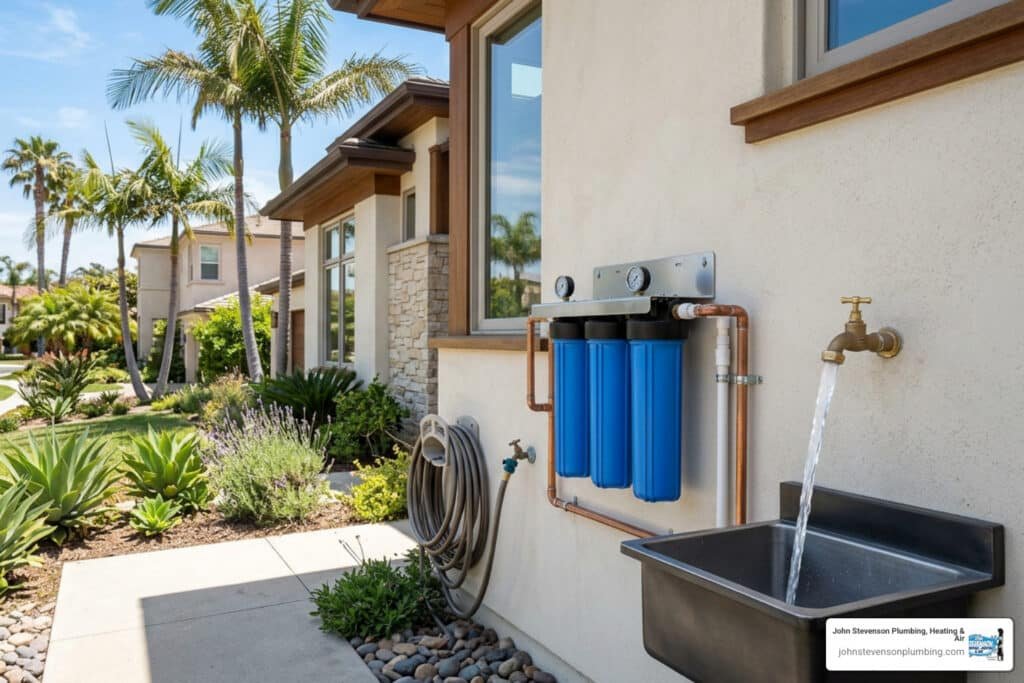
Is Your Southern California Tap Water Actually Safe for Your Home?
Finding the best water treatment for Southern California homes starts with understanding one uncomfortable truth: water that meets legal standards isn’t always water that’s safe or kind to your home.
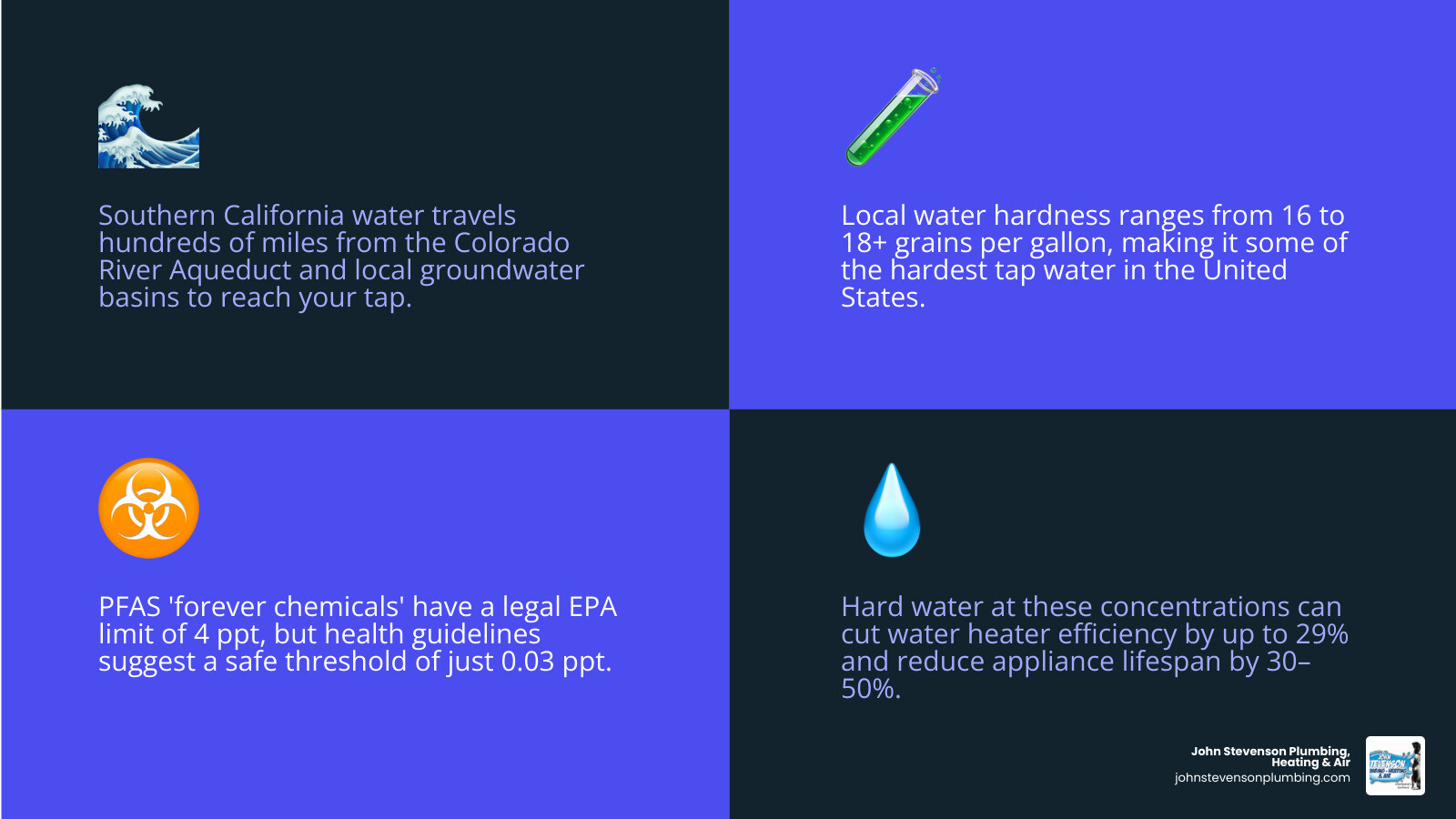
Southern California tap water is some of the hardest in the country. Much of it pulls from the Colorado River aqueduct and local groundwater basins, arriving at your home loaded with calcium and magnesium minerals, chloramines, elevated Total Dissolved Solids (TDS), and in some areas, PFAS (forever chemicals). The EPA’s legal limit for PFAS sits at 4 parts per trillion — but health guidelines suggest the safe threshold is closer to 0.03 ppt. That gap matters.
For most homeowners in Carlsbad and across San Diego County, the right answer isn’t a single system — it’s a layered approach:
Best Water Treatment Options for Southern California Homes (Quick Answer)
- Whole-house water softener or salt-free conditioner — Tackles hard water minerals (16–18+ grains per gallon in San Diego) to protect pipes, appliances, and water heaters from scale buildup
- Whole-house carbon filtration — Removes chloramines, VOCs, sediment, and chemical contaminants at the point of entry so every tap in your home runs cleaner
- Under-sink reverse osmosis (RO) system — Filters drinking water down to 0.0001 microns, removing PFAS, lead, arsenic, fluoride, nitrates, and TDS for safe, great-tasting water at the kitchen tap
- Combined softener + filtration + RO system — The most comprehensive solution for Southern California homes dealing with both extreme hardness and chemical contaminants
The hard reality is that hard water at Southern California concentrations can reduce appliance lifespan by 30 to 50 percent and cut water heater efficiency by up to 29%. Ignoring the problem isn’t just an inconvenience — it’s an expensive one.
This guide walks you through every major system type, how they compare, and how to choose the right combination for your specific home and local water supply.
Understanding Southern California’s Complex Water Quality Issues
To choose the best water treatment for Southern California homes, we first have to understand what we are fighting. Our regional water supply is a complex cocktail. Depending on whether you live in Carlsbad, Oceanside, San Diego, or up in Irvine, your water travels hundreds of miles through aqueducts or is pumped from deep underground aquifers.
Along this journey, the water dissolves heavy amounts of calcium and magnesium from mineral-rich soils. By the time it reaches your home, it is incredibly hard.
But minerals are only half the battle. To keep this water safe from bacteria during its long journey, municipal water districts treat it with chloramines—a chemical bond of chlorine and ammonia. While chloramines are highly effective at disinfecting water over long distances, they have a nasty side effect: they degrade rubber plumbing seals, shorten the life of your fixtures, and leave a strong chemical taste and odor.
Furthermore, run-off, industrial activity, and aging infrastructure introduce other unwanted elements into our local water supplies:
- PFAS (Forever Chemicals): These synthetic chemicals do not break down in the environment or the human body. While federal standards are tightening, local levels often exceed strict health guidelines.
- Total Dissolved Solids (TDS): This measures the total concentration of dissolved substances in your water. High TDS levels (often ranging from 400 to 700 mg/L in Southern California) leave a dry, chalky taste and white spots on your glassware.
- Trihalomethanes (TTHMs): These are disinfection byproducts created when chlorine reacts with organic matter in the water. The EPA’s legal limit is 80 ppb, but health guidelines recommend keeping them below 0.15 ppb.
If you want to dive deeper into how these unique regional factors interact with your home’s infrastructure, read our guide on how to Dont Get Drained By Southern Californias Complex Water Quality Issues.
Salt-Based Water Softeners vs. Salt-Free Conditioners: Which is Best?
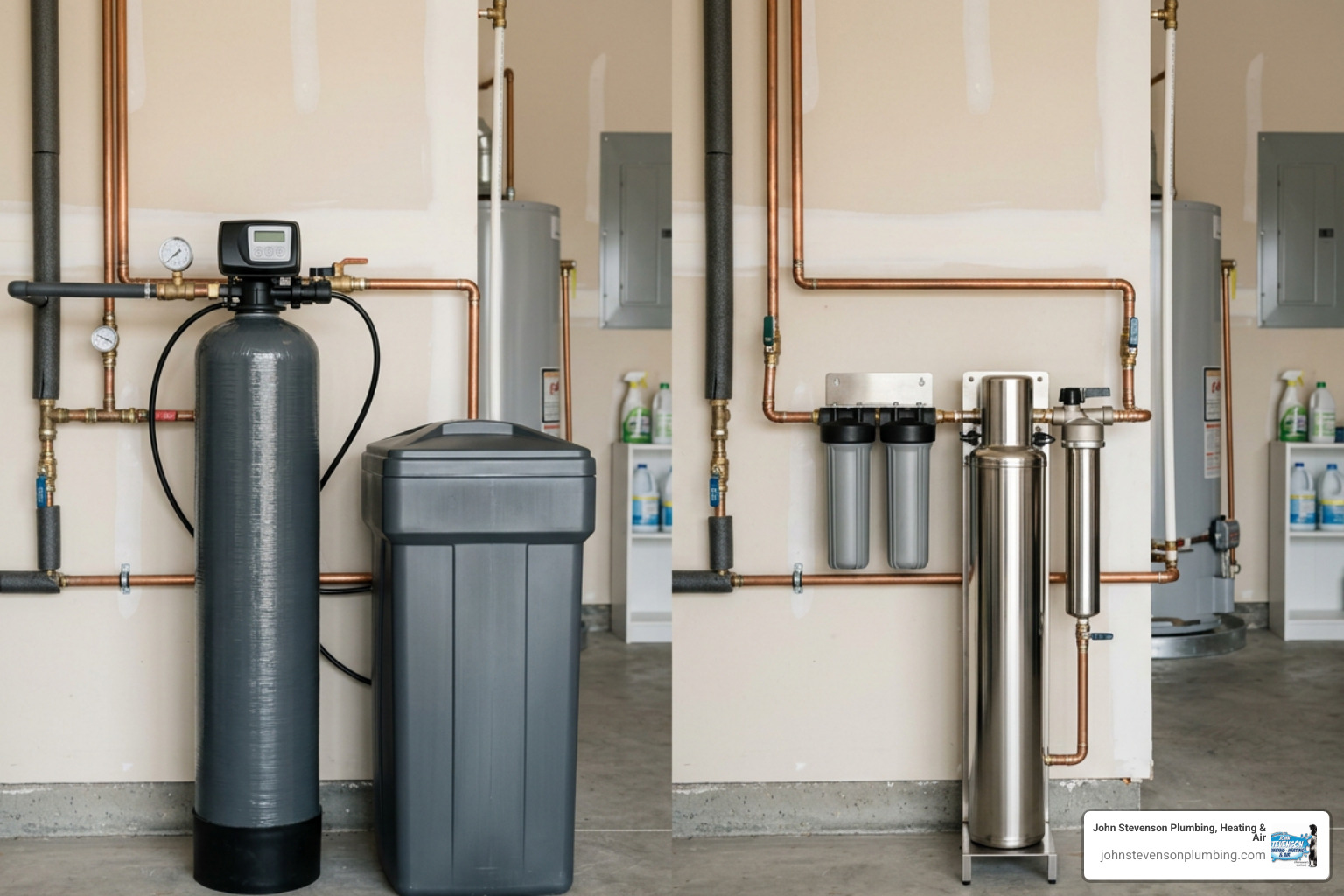
When looking for the best water treatment for Southern California homes, one of the most common debates is choosing between a traditional salt-based water softener and a salt-free water conditioner. Both tackle hard water, but they do so in completely different ways.
Traditional Salt-Based Water Softeners
These systems use a process called ion exchange. As hard water enters the system, it passes through a tank filled with resin beads coated in sodium ions. The calcium and magnesium minerals stick to the resin, swapping places with the sodium.
- The Result: True soft water. You get that signature “slick” feeling in the shower, soap lathers effortlessly, and minerals are physically removed from the water.
- The Catch: They require regular salt replenishment and discharge a salty brine during their self-cleaning cycle. Some Southern California municipalities restrict or heavily regulate these brine discharges to protect local agricultural soils and recycled water systems.
Salt-Free Water Conditioners
Instead of removing minerals, salt-free systems use Template Assisted Crystallization (TAC). This physical process changes the chemical structure of the calcium and magnesium minerals, turning them into microscopic crystals that cannot stick to your pipes, fixtures, or heating elements.
- The Result: Excellent limescale prevention without adding sodium to your water, wasting water during regeneration cycles, or requiring heavy bags of salt.
- The Catch: The minerals are still in the water, meaning you won’t get the “slick” lathering feel of traditional soft water, and water can still leave temporary, easily wipeable powder spots if left to evaporate on surfaces.
Head-to-Head Comparison
| Feature | Salt-Based Water Softeners | Salt-Free Water Conditioners (TAC) |
|---|---|---|
| Primary Technology | Ion Exchange | Template Assisted Crystallization (TAC) |
| Mineral Removal | Yes (Physically removes calcium/magnesium) | No (Alters crystal structure to prevent sticking) |
| Maintenance | High (Requires monthly salt refills) | Extremely Low (No salt, media lasts years) |
| Water Waste | Yes (Wastes water during regeneration) | No (Zero wastewater produced) |
| Electricity Required | Yes | No |
| Eco-Friendliness | Low (Discharges salt brine into sewers) | High (No chemical discharge, completely green) |
| Best For | Homeowners wanting luxurious, slick soft water | Eco-conscious homes and areas with brine restrictions |
Why You Need a Multi-System Approach: Softening, Filtration, and Reverse Osmosis
A common mistake we see homeowners make is expecting a single piece of equipment to solve all their water problems.
A water softener is designed to solve hard water issues (scale, soap scum, and dry skin). It is not a filter and will not remove chlorine, chloramines, PFAS, or heavy metals. Conversely, a whole-house carbon filter will make your water smell and taste great by removing chemicals, but it won’t do a single thing to reduce water hardness.
To get the absolute best water treatment for Southern California homes, we recommend a multi-system approach:
- Point-of-Entry (POE) Whole-House Carbon Filtration: Installed where water enters your home. It acts as the first line of defense, using high-capacity catalytic carbon to strip away chloramines, chlorine, and sediment before the water reaches your pipes.
- Point-of-Entry Water Softener or Conditioner: Working right alongside your filter, this step neutralizes or removes the calcium and magnesium minerals, ensuring every shower, appliance, and pipe is protected from scale buildup.
- Point-of-Use (POU) Under-Sink Reverse Osmosis (RO) System: Installed under your kitchen sink. While whole-house systems protect your plumbing, an RO system purifies your drinking and cooking water down to 0.0001 microns. It strips away dissolved solids, fluoride, nitrates, lead, arsenic, and PFAS. To keep your drinking water tasting crisp and fresh, we recommend a system with an alkaline remineralization stage that adds back tiny, healthy amounts of beneficial calcium and magnesium to balance the water’s pH.
Choosing the Best Water Treatment for Southern California Homes to Protect Appliances
Your home’s plumbing and appliances are major investments. Hard water is their silent enemy. When hard water is heated, calcium and magnesium minerals precipitate out of the liquid, forming a rock-hard crust of limescale.
This scale coats the heating elements of your dishwasher, washing machine, and water heater. Over time, it forces these appliances to work much harder to achieve the same temperatures, leading to:
- Reduced Lifespan: Hard water can cut the operational lifespan of major water-using appliances by 30% to 50%.
- Energy Efficiency Loss: Just a 1/4-inch of scale buildup inside a water heater can reduce its heating efficiency by up to 29%, driving up your monthly gas or electric utility bills.
- Tankless Water Heater Failures: High-efficiency tankless water heaters are incredibly sensitive to scale. Without proper water treatment, scale can completely disable a tankless unit in less than two years.
To protect your home and keep your utility bills low, learning How To Extend The Life Of Your Water Heater is essential. If you are considering upgrading your system to maximize efficiency, check out our insights on Why Homeowners Are Going Tankless To Save Money.
Selecting the Best Water Treatment for Southern California Homes Based on Local Hardness
Water hardness is measured in Grains per Gallon (GPG). The EPA defines “hard water” as anything over 7 GPG. In Southern California service areas like Carlsbad, Oceanside, and San Diego, our local water hardness routinely measures between 16 and 18+ GPG, which is classified as “extremely hard.”
Because our water is so hard, sizing your treatment system correctly is vital. An undersized water softener will quickly deplete its capacity, leading to hard water slipping through to your faucets and frequent, water-wasting regeneration cycles.
When sizing a system for your home, we calculate: $$text{Daily Hardness Load} = text{Number of People in Home} times 80text{ Gallons/Day} times text{Local Water Hardness (GPG)}$$
To prevent water waste, we recommend systems equipped with demand-initiated regeneration. Instead of regenerating on a simple timer (which cleans the system on a set schedule regardless of actual water use), demand-initiated systems monitor your actual water consumption. They only regenerate when the resin is nearly depleted, saving you thousands of gallons of water and hundreds of pounds of salt every year.
How Local Water Quality Dictates the Best Water Treatment for Southern California Homes
Water quality is highly localized. The water running through the taps in Carlsbad can have a completely different mineral and chemical footprint than the water in Oceanside, Escondido, or Poway.
For example, coastal communities might deal with different groundwater blending ratios than inland communities. This means a one-size-fits-all water filter bought from a big-box retail store often misses the mark. To get the best results, you need a system configured to target the exact contaminants present at your specific address.
Before investing in a system, we recommend having a licensed plumbing professional perform a comprehensive, on-site water analysis. This test identifies your water’s exact hardness, TDS, chlorine, and pH levels, allowing us to build a tailored solution that protects your home without unnecessary add-ons.
If you are located in North County, you can learn more about local plumbing and water heater demands by reading our guide on Hot Solutions Finding Professional Water Heater Services In Carlsbad.
Frequently Asked Questions About Southern California Water Treatment
What is the difference between a whole-house filter and a reverse osmosis system?
A whole-house filter is a point-of-entry system designed to treat all the water entering your home. It focuses on removing chlorine, chloramines, sediment, and bad odors to protect your skin, hair, and plumbing.
A reverse osmosis (RO) system is a highly precise point-of-use system installed under your kitchen sink. It uses a semipermeable membrane to filter water down to 0.0001 microns, removing up to 99% of microscopic contaminants like PFAS, lead, fluoride, and nitrates specifically for drinking and cooking.
How does hard water affect my home’s plumbing and water heater?
Hard water leaves mineral deposits inside your pipes, which can restrict water flow and lower water pressure over time. In water heaters, these minerals settle at the bottom of the tank (or coat the copper heat exchangers in tankless systems), creating a barrier between the burner and the water. This causes the tank to overheat, degrade, and eventually fail prematurely.
If you suspect your system is already suffering from scale damage, read our troubleshooting guide on How To Diagnose A Failing Water Heater.
How often do water treatment systems require maintenance?
Maintenance depends on the system type:
- Salt-Based Softeners: Require salt refills every 4 to 6 weeks and a professional system check-up once a year.
- Salt-Free Conditioners: Require no regular maintenance, though the internal media typically needs replacement every 10 to 15 years depending on household size.
- Reverse Osmosis Systems: Require sediment and carbon pre-filter replacements every 6 to 12 months, and membrane replacements every 2 to 5 years.
Conclusion
Investing in the best water treatment for Southern California homes is one of the smartest decisions you can make to protect your health, preserve your plumbing, and extend the life of your appliances. Whether you want to eliminate scale buildup, remove chemical disinfectants, or enjoy pure, bottled-quality drinking water from your kitchen tap, a customized, professionally installed system is the ultimate solution.
At John Stevenson Plumbing, Heating & Air Conditioning, Inc., we have spent decades helping homeowners in Carlsbad, Oceanside, Encinitas, and across San Diego and Orange Counties find perfect comfort in their homes. Our certified technicians don’t rely on guesswork—we run thorough diagnostics, offer upfront pricing, and back all of our work with our signature 5-Star Service Guarantee and a 24-hour satisfaction check-in.
Ready to transform your home’s water quality? Contact our friendly team today to schedule your custom water quality consultation and take the first step toward cleaner, safer water. Learn more about our comprehensive Water Quality and Filtration Services.