
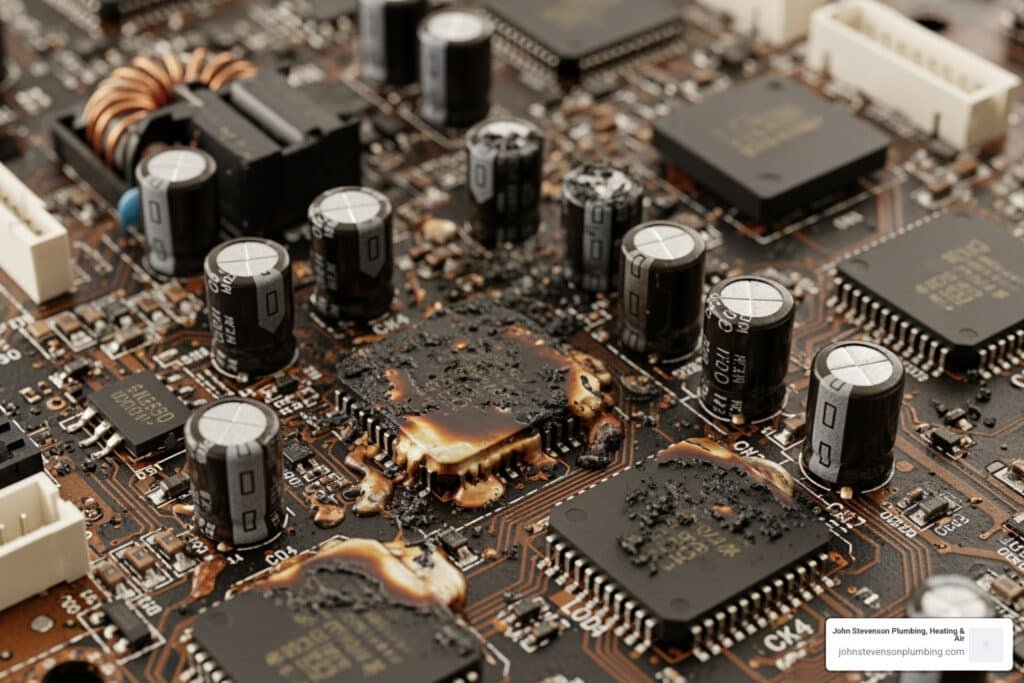
Understanding how power surges affect HVAC and plumbing systems
To protect your home, it helps to understand what a power surge actually is. In simple terms, a power surge is a sudden spike in voltage that exceeds the standard flow of electricity. While our homes in Carlsbad are designed to handle a steady 120-volt supply, a surge can send thousands of volts through your wiring in a fraction of a second.
There are several common culprits behind these spikes:
- Lightning Strikes: While less frequent than other causes, a direct or nearby strike is the most “high-severity” event. It can send a massive wave of electricity through utility lines, instantly frying everything in its path.
- Utility Grid Switching: Sometimes, the utility company needs to switch power loads or perform maintenance on the grid. These transitions can create brief voltage fluctuations that hit your home’s systems.
- Internal Motor Surges: As mentioned in our intro, over 60% of surges start inside your own four walls. When high-power devices like your refrigerator or air conditioner kick on, they demand a lot of “inrush current.” This creates a small spike that ripples through the rest of the house.
- Downed Power Lines: High winds or accidents can knock down lines, causing unpredictable electrical behavior before the breakers at the substation trip.
When these spikes hit, they look for the path of least resistance. Often, that path leads straight into the delicate circuitry of your comfort systems. If you are currently dealing with a system that seems to be struggling after a storm, you might be doing the math on old AC repair vs buying a new system. Often, the cost of replacing a fried compressor or main control board can rival the cost of a modern, more efficient unit.
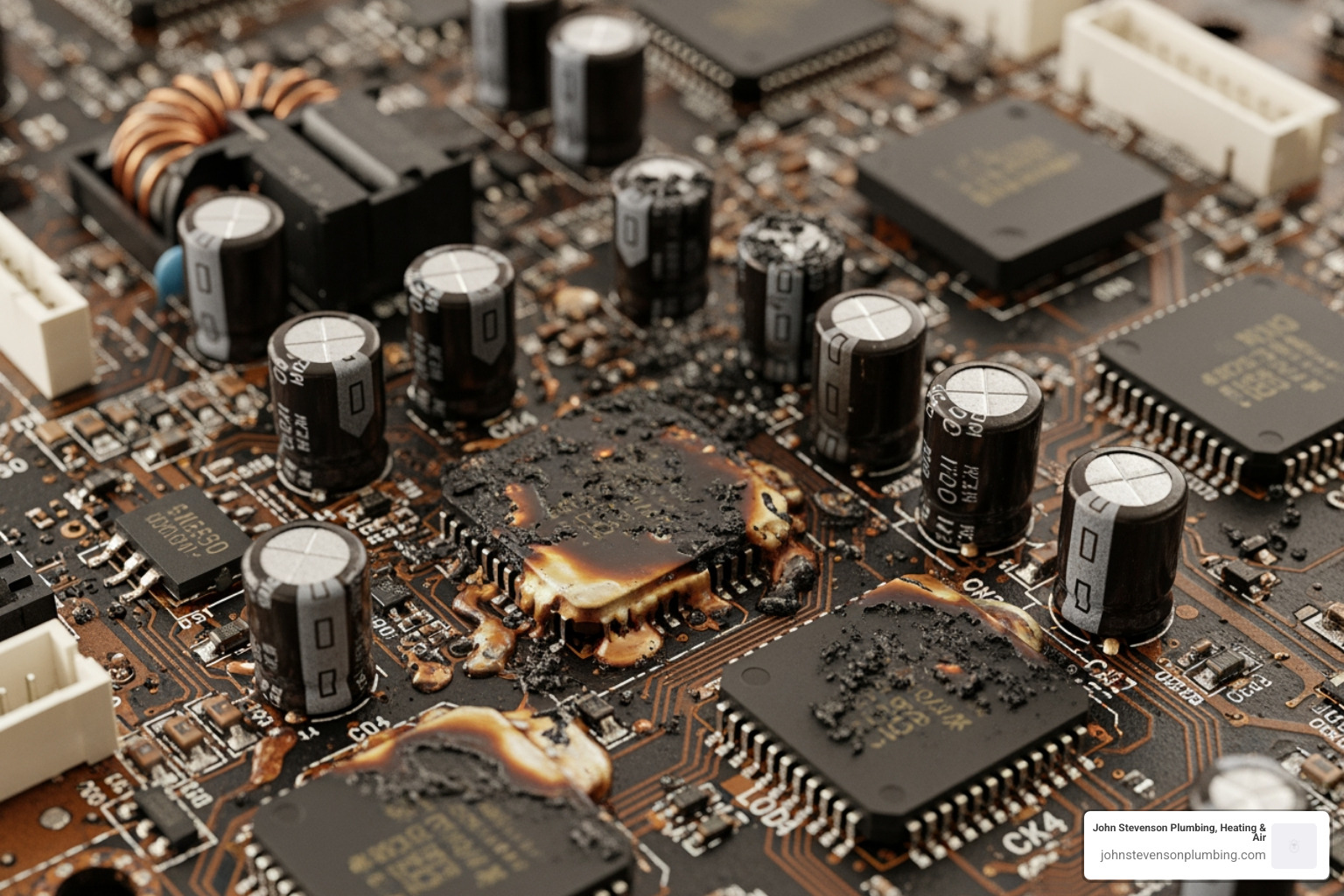
Why modern HVAC systems are more vulnerable to power surges
You might wonder why your parents’ old “clunker” of an AC unit from the 90s seemed to survive every storm, while your brand-new high-efficiency model is more temperamental. The answer lies in the technology.
Modern HVAC systems are built for comfort and energy savings, which means they rely on:
- Sensitive Microprocessors: These act as the “brain” of your unit. They are much faster and smarter than old mechanical relays, but they are also made of microscopic circuits that can melt under the heat of a voltage spike.
- Variable-Speed Motors: These motors allow your system to run at different speeds to maintain a perfect temperature. However, the “inverters” that control these speeds are highly sensitive to electrical “noise” and surges.
- Smart Thermostat Technology: Your thermostat is no longer just a mercury switch; it’s a computer on your wall. A surge can wipe its memory or destroy its communication module, leaving you unable to control your climate.
Whether you have a traditional central air setup or you’ve learned the simple way a heat pump heats and cools your home, the vulnerability remains the same. The more efficient and “smart” the system, the more it needs protection from the “dumb” brute force of a power surge.
Identifying surge damage in plumbing and HVAC systems
How do you know if how power surges affect hvac and plumbing systems has become a reality for you? Sometimes the damage is catastrophic and immediate, but often it’s subtle. Look and listen for these “red flags”:
- Burning Smells: This is the most obvious sign. If you smell ozone or “burnt plastic” near your indoor air handler or outdoor condenser, a component has likely shorted out.
- Buzzing or Humming Noises: If a capacitor (the “battery” that helps your motor start) is damaged, the motor might hum but fail to turn over.
- Tripped Circuit Breakers: If your AC or water heater trips the breaker immediately after you reset it, there is likely a short circuit caused by surge damage.
- System Lockouts: Many modern units have a safety “lockout” mode. If the brain detects an electrical fault, it will shut the whole system down to prevent a fire.
- Inaccurate Thermostat Readings: If your thermostat display is blank, flickering, or showing a “communication error,” it may have taken a hit.
If your system is running but things just don’t feel right, it’s worth investigating. You might want to check what to check first when your AC runs constantly without cooling, as a damaged control board can sometimes cause the system to “hang” in the “on” position without actually engaging the cooling cycle.
The impact of electrical spikes on your home’s plumbing and water heaters
We often forget that our plumbing systems are now just as “high-tech” as our HVAC units. In the past, a water heater was just a tank with a pilot light. Today, Southern California homes are filled with sophisticated plumbing appliances that are just as susceptible to electrical spikes.
Tankless water heaters are a prime example. These units are beloved for their endless hot water and space-saving design, but they are essentially “computers that heat water.” They use electronic sensors to monitor water flow, digital displays to set temperatures, and electronic ignition systems to spark the gas. A single surge can fry the main PCB (Printed Circuit Board), leaving you with a very expensive, very cold box on your wall.
Even traditional tank heaters aren’t safe if they have electronic controls or power-venting fans. If you have an older unit, a surge might be the final straw that convinces you it’s time to upgrade. It’s a good idea to monitor your unit’s health so you don’t get into hot water over your heater’s lifespan.

Protecting plumbing and HVAC systems from power surges with multi-level defense
So, how do we stop these invisible enemies? The best approach is a “layered” defense. Think of it like a security system for your home’s electricity. There are three main types of protection we recommend:
| Protection Level | Device Type | Where It’s Installed | What It Does |
|---|---|---|---|
| Type 1 | Service Entrance Protector | At the meter or main breaker | Stops massive external surges from the utility grid before they enter the house. |
| Type 2 | Whole-House Protector | Inside your main electrical panel | Shields all the circuits in your home from both external and internal surges. |
| Type 3 | Point-of-Use / Dedicated | At the HVAC disconnect or appliance | Provides the final “fine-tuned” protection for your most sensitive and expensive equipment. |
For the best results, we suggest a “Type 2” whole-house system paired with “Type 3” dedicated protectors for your AC condenser and your tankless water heater. This ensures that even if a surge originates inside the house (like from your vacuum cleaner), it gets diverted to the ground before it hits your AC’s control board.
When you’re looking at your options, make sure you stop getting into hot water over your choice of water heater by ensuring your new installation includes proper surge protection from day one.
Essential steps to take after a major power event in San Diego County
If a major storm has just rolled through San Marcos or Oceanside and your power flickered or went out entirely, don’t just flip the switch and hope for the best. Follow these steps to ensure your systems are safe:
- Wait Before Restarting: When power is first restored, the grid is often unstable. Wait 5 to 10 minutes for the voltage to stabilize before turning your HVAC system back on at the thermostat.
- Perform a Visual Check: Walk out to your AC condenser and look at your water heater. Do you see any scorch marks? Do you smell anything unusual?
- Check the Electrical Panel: If the breaker is tripped, reset it once. If it trips again immediately, do not try a third time. This indicates a permanent fault that needs a professional eye.
- Reset Your Thermostat: Sometimes a “soft” reset (removing it from the wall or using the reset button) can clear communication errors caused by a minor spike.
- Monitor Performance: Even if the system starts, watch it closely for the next 48 hours. Is it making new noises? Is it cycling on and off too quickly?
Surge damage can be a “slow killer.” A component might be weakened but not fully broken, leading to a failure weeks later during a heatwave. Knowing how to know if your AC is going bad before the heatwave hits can save you from an emergency service call in the middle of a 100-degree July day.
The role of regular maintenance in surge prevention
You might be surprised to learn that regular maintenance is actually one of your best defenses against power surges. During a standard tune-up, a technician does more than just change filters. We perform several “surge-proofing” tasks:
- Grounding Verification: A surge protector is useless if it has nowhere to “dump” the excess electricity. We ensure your system is properly grounded.
- Tightening Electrical Connections: Loose wires create resistance, which generates heat and makes it easier for a surge to cause an arc (a mini-lightning strike inside your equipment).
- Inspecting Capacitors: We test these components to see if they are within their factory-rated range. A weakened capacitor is much more likely to fail during a minor voltage fluctuation.
- Clearing Debris: Keeping the area around your electrical disconnects clear of spider webs, dust, and moisture reduces the risk of short circuits.
Whether it’s for your cooling system or your furnace, professional oversight is key. You can use the ultimate checklist for furnace maintenance in Carlsbad CA to see just how thorough these inspections should be.
Frequently Asked Questions about electrical surges
Does homeowner’s insurance typically cover surge damage?
It depends on the cause. Most policies cover damage from “sudden and accidental” events like a lightning strike. However, they often exclude damage caused by “utility power surges” or the cumulative wear and tear of internal micro-surges. Furthermore, the burden of proof is on you to show the damage was caused by a surge and not just an old part wearing out. Having a professional diagnostic report from us can be a huge help if you decide to file a claim.
Can a power surge damage my AC if the system is turned off?
Yes, absolutely. Even if the system isn’t “running,” it is still physically connected to the electrical grid. The control board and the thermostat are always “live” and waiting for a signal. A major spike can travel through the wiring and fry these components whether the compressor is spinning or not. This is why “Type 2” whole-house protection is so vital—it guards the system 24/7.
How long after a surge will equipment failure symptoms appear?
While a major surge will cause immediate failure, many surges cause “latent” damage. This means the spike weakens the insulation on a motor winding or degrades a semiconductor just enough that it begins to overheat. The part might continue to work for days, weeks, or even months before finally giving out. If your AC fails shortly after a particularly stormy month, there’s a high probability that a surge was the underlying cause.
Conclusion
Protecting your home from the invisible threat of electrical spikes isn’t just about saving your computer; it’s about safeguarding the major investments that keep your family comfortable. Understanding how power surges affect hvac and plumbing systems is the first step toward a more resilient home.
At John Stevenson Plumbing, Heating & Air, we’ve seen how a single split-second event can lead to thousands of dollars in repairs. That’s why we’re committed to helping our neighbors in Carlsbad and throughout San Diego County stay ahead of the storm. Whether you need a dedicated surge protector installed, a post-storm diagnostic check, or a routine maintenance visit to ensure your grounding is secure, our team is ready to help.
We stand behind every job with our 5-Star Service Guarantee. That means you get thorough diagnostics, upfront pricing, and the peace of mind that comes with knowing the job was done by a certified local expert. Don’t wait for the next lightning storm or grid fluctuation to find out if your systems are vulnerable.
Contact our team for professional HVAC and plumbing services today, and let’s make sure your home is ready for whatever the Southern California weather throws its way.