
What Size Air Conditioner Do I Need for My Carlsbad Home?
Figuring out what size air conditioner do I need is one of the most important steps before buying or replacing a cooling system. Whether you’re dealing with a warm Carlsbad afternoon or trying to keep your San Diego County home comfortable during inland heat, picking the wrong AC size can lead to poor comfort, humidity issues, and extra strain on your system.
Here’s a quick reference to match your home’s square footage to the right AC size:
| Home Size (Sq Ft) | Recommended Tonnage | BTU Capacity |
|---|---|---|
| Up to 600 sq ft | 1 ton | 12,000 BTU |
| 600 – 1,000 sq ft | 1.5 tons | 18,000 BTU |
| 1,000 – 1,500 sq ft | 2 tons | 24,000 BTU |
| 1,500 – 2,000 sq ft | 2.5 – 3 tons | 30,000 – 36,000 BTU |
| 2,000 – 2,500 sq ft | 3 – 3.5 tons | 36,000 – 42,000 BTU |
| 2,500 – 3,000 sq ft | 3.5 – 4 tons | 42,000 – 48,000 BTU |
| 3,000+ sq ft | 4 – 5 tons | 48,000 – 60,000 BTU |
Note: These are starting estimates only. Climate zone, insulation quality, sun exposure, ceiling height, and occupancy all affect the final number. Southern California homes often need adjustments beyond a simple square footage lookup.
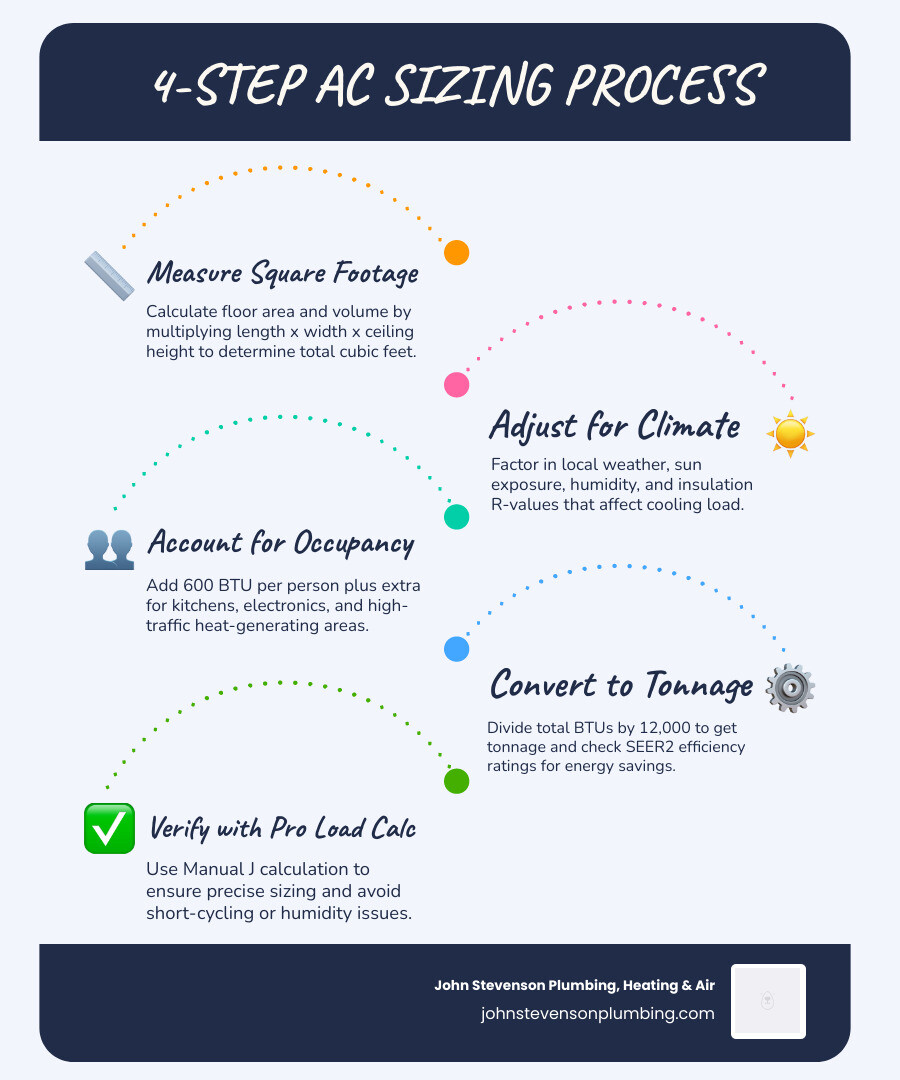
The good news? You don’t need an engineering degree to get a solid starting point. In this guide, we’ll walk you through four straightforward steps to calculate the correct AC size for your home so you can stay cool and avoid the common problems that come with buying a unit that’s too big or too small.
Step 1: Measure Your Square Footage and Volume
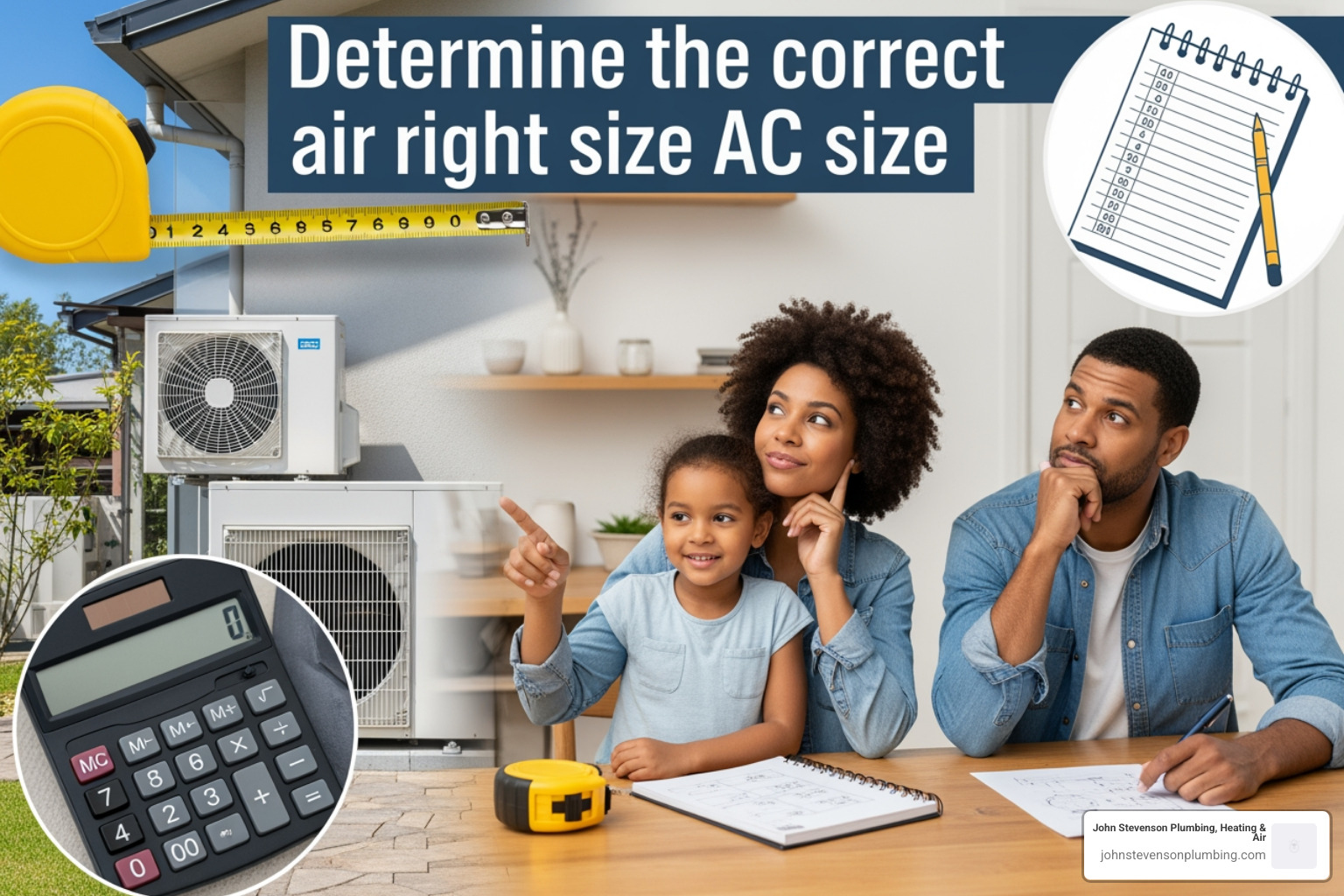
The journey to answering “what size air conditioner do I need” begins with a tape measure. While most people think only of “square footage,” the volume of air in your home is what actually needs to be cooled. A room with 20-foot vaulted ceilings has much more air to treat than a room with standard 8-foot ceilings, even if the floor area is the same.
Start by measuring the length and width of every room you want to cool. Multiply these two numbers to get the square footage of each room. For example, a 15′ x 20′ living room is 300 square feet. If you are looking for Cooling Services for your entire home, add the square footage of all conditioned spaces together. Do not include uncooled areas like garages or unfinished basements.
Next, consider your ceiling height. Most standard sizing charts assume an 8-foot ceiling. If your ceilings are 10 feet or higher, you’ll need to increase your cooling capacity estimate by about 10% to 20% to account for the extra volume of air. This is a critical step often missed in basic online calculators.
Calculating the base load for your home
Once you have your total square footage, you can establish a “base load.” A traditional rule of thumb is to multiply your square footage by 20 BTUs (British Thermal Units). However, for many modern Southern California homes, a 25 BTU per square foot rule is often safer to ensure comfort during peak May 2026 heatwaves.
- 1,500 sq ft home x 20 BTU = 30,000 BTU (2.5 Tons)
- 1,500 sq ft home x 25 BTU = 37,500 BTU (Approx. 3 Tons)
If your home is older or has poor insulation, using the 25 BTU multiplier is recommended. If you have a newer, high-efficiency home in a city like Carlsbad, the 20 BTU rule might suffice. Keeping up with regular AC Maintenance helps ensure that whatever size you choose, it operates at peak efficiency for its entire lifespan.
Step 2: Apply Climate and Insulation Factors to Determine What Size Air Conditioner Do I Need
In Southern California, our geography plays a massive role in HVAC sizing. A 2,000-square-foot home in coastal Carlsbad experiences a much different “heat load” than the same-sized home inland in Escondido or Irvine. When asking yourself, “what size air conditioner do I need,” you must account for how much heat your home gains from the environment.
Insulation quality is the primary barrier against this heat. If your home has R-19 or R-21 walls and R-38+ in the attic, your AC won’t have to work nearly as hard. Conversely, older homes in neighborhoods like Leucadia or Oceanside with original single-pane windows and thin insulation will require a larger unit to offset the constant heat “leakage” into the home. For these homes, a professional AC Installation is vital to ensure the system is tuned to the home’s specific envelope.
How local climate affects what size air conditioner do i need in Carlsbad
Our local climate zones are generally divided into coastal and inland. Coastal areas benefit from the marine layer, but humidity can be higher, requiring an AC that runs long enough to dehumidify. Inland areas like Rancho Bernardo or Yorba Linda face much higher dry heat.
- Sun Exposure: If your home is heavily shaded by trees, you can reduce your BTU requirement by 10%. If your home is in full sun with no shade, increase it by 10%.
- Window Orientation: Large south-facing or west-facing windows act like giant heaters. A west-facing window can add as much as 1,050 to 1,200 BTUs of heat load during the afternoon.
- Coastal Humidity: In places like Del Mar or Solana Beach, the AC isn’t just lowering the temperature; it’s removing moisture. If the unit is too large, it will cool the air so fast that it shuts off before removing the “clammy” feel.
If you are planning an Orange County AC Installation, these environmental factors are often the difference between a system that feels “just right” and one that leaves you sweating in specific rooms.
Step 3: Account for Occupancy and Heat-Generating Appliances
People and appliances are essentially small heaters. Every person living in your home adds about 600 BTUs of heat to the environment. While a standard calculation usually accounts for two residents, a large family in a home in San Marcos or Poway will need a system with a bit more “oomph.”
Appliances also contribute significantly. This is why we often recommend a dedicated AC Repair check if you notice your kitchen is always five degrees warmer than the rest of the house — your system might not have been sized to handle the “latent load” of cooking and electronics.
Calculating what size air conditioner do i need for high-traffic rooms
When determining what size air conditioner do I need, pay special attention to the kitchen and the “tech hubs” of your home.
- The Kitchen Rule: Add 4,000 BTUs to your total calculation if the AC will be cooling the kitchen. Between the oven (which can add 6,800 BTUs when on) and the refrigerator, this is the hardest room to keep cool.
- Electronics: A high-end gaming PC or a home server setup can add 1,500 BTUs or more. If you work from home in a small office in Mission Viejo or Aliso Viejo, that room may need its own mini-split or a larger central air allowance.
- Laundry Rooms: Washers and dryers generate significant heat and humidity. If your laundry area is centrally located, it adds to the overall load.
For homeowners in areas with high-traffic households, regular San Diego HVAC Services AC Maintenance is the best way to ensure your system can handle these internal heat spikes without failing.
Step 4: Convert BTUs to Tonnage and Check SEER2 Ratings
Once you have added your base square footage BTUs, adjusted for sun and insulation, and added surcharges for people and kitchens, you’ll have a final BTU number. Now, you need to convert that to “Tons.”
In the HVAC world, 12,000 BTUs = 1 Ton of cooling.
| Total Calculated BTUs | Required Tonnage |
|---|---|
| 18,000 BTU | 1.5 Tons |
| 24,000 BTU | 2.0 Tons |
| 30,000 BTU | 2.5 Tons |
| 36,000 BTU | 3.0 Tons |
| 42,000 BTU | 3.5 Tons |
| 48,000 BTU | 4.0 Tons |
| 60,000 BTU | 5.0 Tons |
Residential central AC units typically come in half-ton increments. If your calculation lands you between sizes — for example, 33,000 BTUs — you generally want to round up to the 3-ton unit, but never exceed the required size by more than half a ton.
When choosing a new unit, you also need to look at the SEER2 (Seasonal Energy Efficiency Ratio) rating. Federal minimum efficiency standards have increased in recent years, and moving from an older low-efficiency system to a modern high-efficiency unit can improve energy performance and comfort. This is a major factor when considering an AC Replacement.
Decoding your existing unit’s capacity
If you’re wondering what size you currently have, you can usually find it in the model number on the outdoor condenser unit. Look for a string of numbers; you are looking for a multiple of 6 or 12.
- If the model number contains 24, you have a 2-ton unit.
- If it contains 36, you have a 3-ton unit.
- If it contains 42, you have a 3.5-ton unit.
Knowing your current size is a great starting point, but don’t assume it was the right size to begin with. Before you buy, check out our guide on What to Look for When Buying a New AC Unit to ensure you’re getting the latest technology for your Southern California home.
Why Precision Matters: The Dangers of Oversizing and Undersizing
When it comes to AC, “bigger is better” is a dangerous myth. If you install a 5-ton unit in a home that only needs a 3-ton unit, you will experience “short-cycling.” This means the unit turns on, blasts the house with cold air for 5 minutes, hits the target temperature, and shuts off.
The problems with an oversized unit include:
- High Humidity: An AC needs to run for at least 15-20 minutes to effectively pull moisture out of the air. Short-cycling leaves your home feeling cold and “clammy,” which can lead to mold and mildew.
- Increased Wear and Tear: The most stressful part of an AC’s life is starting up. An oversized unit starts and stops 3x more often than a correctly sized one, leading to premature compressor failure.
- Higher Bills: It takes a massive surge of electricity to start a large compressor. Frequent starts mean higher energy spikes.
Conversely, an undersized unit will run 24/7 and never reach your desired temperature on a 95-degree day in Vista or Fallbrook. This leads to a shortened lifespan and constant repairs. You can learn more about how sizing affects durability in our article: Will Your AC Survive the Decade? Average Lifespans Explained.
The benefits of a professional Manual J load calculation
While the 4-step method above gives you a great ballpark, the only way to be 100% sure of what size air conditioner do I need is through a Manual J load calculation. This is a scientific protocol developed by the Air Conditioning Contractors of America (ACCA).
A professional Manual J calculation accounts for:
- The exact R-value of your wall and attic insulation.
- The “U-factor” and solar heat gain coefficient of your windows.
- The airtightness of your home’s “envelope.”
- Ductwork integrity and potential airflow losses.
If your ductwork is leaky or undersized, even the perfectly sized AC unit won’t perform correctly. This is why we always recommend a professional evaluation to see How to Decide if Your AC Needs a Tune-Up or a Retirement Party.
Frequently Asked Questions about What Size Air Conditioner Do I Need
How do I know if my current AC is the wrong size?
If your AC turns off and on every 10 minutes (short-cycling), it is likely too large. If it runs all day without stopping but the house still feels warm, it is likely too small or failing. Uneven cooling — where one room is a freezer and another is a sauna — can also be a sign of improper sizing or poor duct design. If your system is older and struggling, read The Cold Hard Truth About Fixing Your Ancient Air Conditioner.
What size AC do I need for a 2,000 square foot home in San Diego?
Typically, a 2,000-square-foot home in the San Diego area will require a 3.5-ton to 4-ton system. However, if you are right on the coast in Carlsbad, you might get away with a 3-ton unit if the home is well-insulated. If you are inland in a place like Scripps Ranch, you should lean toward 4 tons. Before you commit, it’s worth reviewing Doing the Math on Old AC Repair vs. Buying a New System.
Is a bigger air conditioner always better for cooling?
Absolutely not. As mentioned, an oversized unit fails to dehumidify, which is essential for comfort in Southern California. It can also lead to more wear and tear and a shorter equipment lifespan. For more on how to choose the right technology for your home, visit our main Air Conditioning page.
Conclusion
Determining what size air conditioner do I need is the foundation of home comfort. By following these four steps — measuring volume, adjusting for climate, accounting for internal heat, and converting to tonnage — you are already ahead of most homeowners. However, every home in Carlsbad and the surrounding San Diego and Orange County areas has its own unique layout, insulation level, and cooling demands.
At John Stevenson Plumbing, Heating & Air Conditioning, we don’t believe in guesswork. We provide thorough diagnostics and upfront recommendations to help homeowners choose the right system for their homes. Our licensed and certified technicians perform professional load calculations to take the stress out of your Orange County AC Installation.
Don’t leave your comfort to a rule of thumb alone. Whether you’re in Rancho Santa Fe, Ladera Ranch, or right here in Carlsbad, we’re here to help you get the size exactly right. Contact us today to schedule a professional consultation and make sure your home stays comfortable through the hottest part of the year.