
Why Energy Efficient Water Heater Options Matter for Carlsbad Homeowners
The best energy efficient water heater options for most homes in 2026 are:
| Water Heater Type | Efficiency Level | Best For |
|---|---|---|
| Heat Pump (Hybrid) | Highest (2-4x standard electric) | Most households |
| Tankless (On-Demand) | High | Smaller homes, lower peak demand |
| Solar | High (climate-dependent) | Sun-rich regions like Southern California |
| Gas Storage Tank | Moderate | Homes with existing gas lines |
| Standard Electric Storage | Lowest | Budget-conscious, smaller households |
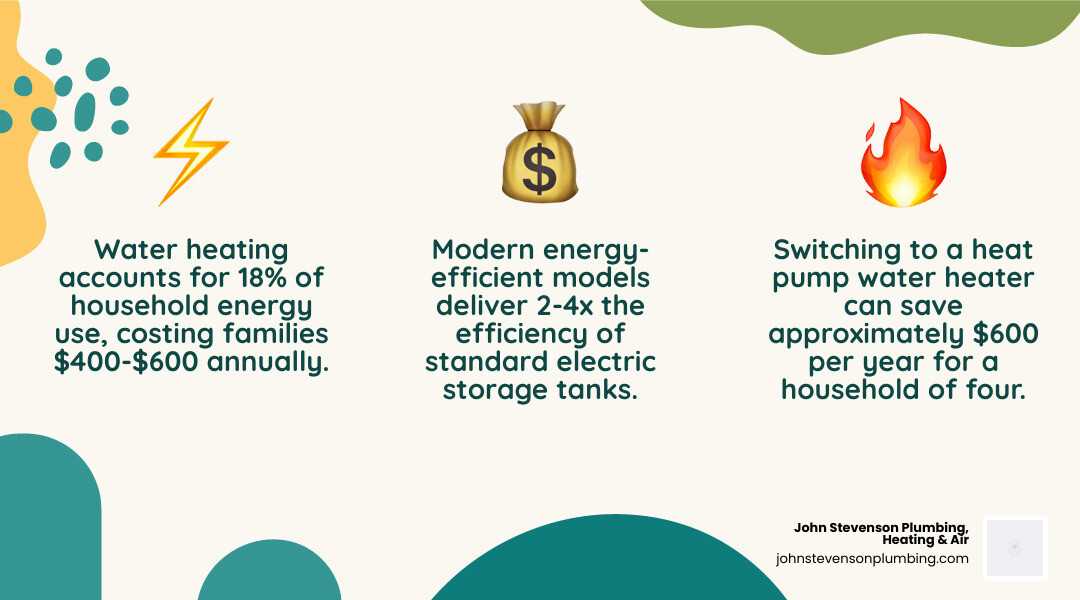
Water heating is the second-largest energy expense in most homes, accounting for roughly 18% of a household’s total energy use — and costing the average family somewhere between $400 and $600 every year. For homeowners in Carlsbad, CA and across San Diego County, that’s a line item worth taking seriously.
If your water heater is aging or underperforming, the good news is this: nearly any modern replacement will be more efficient than what you’re running now. And if you step up to a heat pump or tankless model, the savings can be substantial — ENERGY STAR data shows a household of four can save approximately $600 per year by switching from a standard electric model to a certified heat pump water heater.
This guide walks you through every major option — how they work, what they cost to run, and how to choose the right one for your home and budget.
Comparing the Best Energy Efficient Water Heater Options for Your Home
Choosing a water heater is a little like choosing a car: what works great for one family may be completely wrong for another. The right fit depends on fuel source, household size, installation space, recovery speed, and long-term efficiency.
Here is a practical side-by-side look at the main options homeowners in Carlsbad, San Diego County, and Orange County usually consider.
| Water Heater Type | How It Works | Efficiency | Performance | Installation Notes | Good Fit For |
|---|---|---|---|---|---|
| Storage Tank | Heats and stores hot water in a tank | Moderate to low, depending on fuel | Reliable, simple, limited by tank size | Usually easiest replacement | Homes wanting straightforward replacement |
| Tankless | Heats water only when needed | High | Endless hot water within flow limits | Gas line, venting, or electrical upgrades may be needed | Smaller to midsize homes, efficient point-of-use needs |
| Heat Pump (Hybrid) | Pulls heat from surrounding air to warm water | Very high | Excellent savings, slower heat recovery in heat-pump-only mode | Needs air space, drain, proper location | Most all-electric homes and many gas-to-electric conversions |
| Solar | Uses solar collectors with backup heat source | High in sunny climates | Strong efficiency when well-designed | Roof, plumbing, storage, and backup system required | Homes committed to renewable energy |
| Gas Storage Tank | Burns gas to heat stored water | Moderate | Fast recovery, familiar performance | Requires gas supply and venting | Homes with existing gas infrastructure |
| Standard Electric Storage | Uses electric resistance elements in a tank | Lowest among common electric options | Dependable, simple | Straightforward if replacing like-for-like | Smaller homes or simple replacements |
For a broader overview of replacement factors, see our guide to choosing the right water heater for your home.
A few quick takeaways:
- Heat pump water heaters are generally the efficiency leader for most households.
- Tankless systems reduce standby losses because they do not keep a full tank hot all day.
- Solar can be excellent in Southern California, but it is more dependent on roof layout, collector placement, and system design.
- Gas storage tanks remain common because they are familiar and recover hot water quickly.
- Standard electric tanks are usually the least efficient option, even though they are simple.
Understanding the Uniform Energy Factor (UEF)
If you compare water heaters without checking the UEF, you are basically shopping blindfolded.
Uniform Energy Factor, or UEF, measures overall efficiency under standardized testing. In simple terms, a higher UEF means more hot water delivered per unit of energy used. It helps us compare models on a fair basis, even across different technologies.
What UEF tells us:
- How efficiently the unit converts energy into hot water
- How much heat is lost while water sits in the system
- How the heater performs under typical usage patterns
As a rule:
- Standard electric and gas storage tanks tend to have lower UEF ratings
- Tankless models are often higher than storage tanks
- Heat pump water heaters usually have the highest UEF ratings by a wide margin
ENERGY STAR certification is another useful shortcut. It does not replace reading the specs, but it does signal that the unit meets recognized efficiency standards. When we help homeowners compare models, we usually recommend looking for both a strong UEF rating and ENERGY STAR certification where available.
For more on making a smart choice, read Stop Getting Into Hot Water Over Your Choice of Water Heater.
Why Homeowners Are Switching to Tankless Systems
Tankless water heaters have earned a lot of attention for one simple reason: they heat water on demand instead of storing it in a tank.
That means:
- No standby heat loss from keeping 40 to 80 gallons hot all day
- A smaller footprint on the wall
- Continuous hot water as long as the unit is sized correctly
They also tend to have long service lives, with many tankless systems lasting around 20 years when maintained properly. That longevity is a major reason homeowners consider them during replacement planning.
Still, tankless is not automatically the best answer for every home. The main limitation is flow rate. If three showers, the dishwasher, and laundry all hit at once, an undersized unit will struggle. Gas tankless models also need proper venting and often larger gas supply capacity, while whole-home electric tankless units may require significant electrical capacity.
In other words: tankless can be great, but sizing matters. A lot.
If this style sounds appealing, check out Why Homeowners Are Going Tankless to Save Money.
Why Heat Pump Water Heaters Are the Top Choice in Carlsbad

For many homes we serve in coastal and inland Southern California, heat pump water heaters are the standout choice. They use electricity, but they do not create heat the same way a standard electric water heater does. Instead, they move heat from the surrounding air into the water tank.
That is the secret sauce.
Because they transfer heat rather than generate it directly, heat pump water heaters are often two to four times more efficient than conventional electric resistance models. Research also shows ENERGY STAR certified heat pump units can use about one-quarter of the energy of a standard model.
Why that matters in real life:
- Lower energy use
- Lower operating costs over time
- Less indoor combustion risk than gas-fired systems
- No carbon monoxide risk from the unit itself
- Potentially lower energy costs than some conventional gas storage heaters, depending on the home and utility rates
They also have a useful side effect in the right location: they can cool and dehumidify the surrounding air. In a garage or utility area, that can be a welcome bonus. In a small interior closet, not so much.
For homeowners looking at electrification and home efficiency upgrades, How the IRA Makes Your California Home Efficiency Upgrade Much Cheaper is a helpful next read.
Maximizing Savings with Energy Efficient Water Heater Options and Rebates
One big reason homeowners keep searching for energy efficient water heater options is simple: incentives can significantly reduce upgrade costs.
In California, available programs may include:
- Federal energy-efficiency tax incentives, when active and applicable
- Local utility rebates
- Regional electrification or energy-upgrade programs
- Limited-income assistance programs, depending on eligibility and current funding
Important note for 2026: incentive rules can change, expire, or be updated. For example, some federal tax credit programs previously applied through the end of 2025, so homeowners should always verify current eligibility before buying equipment.
Our advice is to confirm three things before installation:
- The exact model qualifies
- The installing contractor meets program requirements
- You keep all required documentation
For California-focused rebate guidance, visit Don’t Sweat the Cost With These California HVAC and Water Heater Rebates.
Installation Requirements for Hybrid Systems
Heat pump water heaters are efficient, but they are not plug-it-anywhere appliances.
Most models need:
- Adequate surrounding air volume, often around 700 cubic feet
- Good airflow around the unit
- A location that does not regularly get too cold
- Condensate drainage
- Enough clearance for service and filter access
Some newer models can operate with less surrounding air, but installation requirements vary by manufacturer and model. If the unit is placed in a tighter closet, a full louvered door may be needed to support airflow.
Other key considerations:
- Condensate drain: Heat pump units produce clean, non-acidic condensate that must be routed properly to a drain.
- Sound: Many models are fairly quiet, but they still make noise somewhat like a refrigerator or small appliance.
- Location: Garages, larger laundry rooms, and utility spaces are often better choices than tight interior closets or bedrooms.
- Replacement planning: Switching from gas to electric may involve circuit evaluation, panel capacity review, and possible plumbing updates.
If you are planning a replacement in San Diego County, our water heater installation page explains the process in more detail.
Sizing Your System for Southern California Household Needs
A super-efficient water heater that is too small will still make your mornings miserable. Efficiency is important, but comfort matters too.
The goal is to size the system around peak demand, not just total daily use.
For tank water heaters, the key sizing metric is first-hour rating, or FHR. This tells us how many gallons of hot water the heater can deliver in the busiest hour of use.
For tankless systems, we look at gallons per minute, or GPM. This tells us how much hot water the unit can deliver continuously at one time.
Examples of peak demand:
- A shower often uses around 2 gallons per minute
- A washing machine may use 10 to 20 gallons per load depending on type
- Dishwashers and other fixtures can overlap with shower use
If your home regularly has back-to-back showers plus laundry, a system that looks fine on paper may still feel undersized in practice. That is why we assess actual habits, not just bedroom count.
For more on water heater service and replacement planning, visit our water heater services page.
Selecting Energy Efficient Water Heater Options Based on Household Size
There is no universal perfect size, but these guidelines are a solid starting point for tank-style systems:
- 1 to 3 people: often around 50 gallons
- 2 to 4 people: often around the mid-50-gallon range
- 4 or more people: often 80 gallons, especially with heavy simultaneous use
For heat pump water heaters, going slightly larger can make sense if space allows. A bigger tank helps reduce how often the unit relies on backup electric resistance elements, which preserves efficiency.
For tankless sizing, we calculate expected simultaneous demand:
- 1 shower plus a sink: lower GPM requirement
- 2 showers at once: moderate GPM requirement
- 3 bathrooms with overlapping use: higher GPM requirement, often beyond the comfort zone of smaller units
This is why some households love tankless and others end up asking why the hot water turns into a negotiation. If you want help weighing tankless capacity, see our Orange County tankless water heater services page.
Compliance with California Plumbing Codes
In our service area, water heater replacement is not just about swapping boxes. California code and local requirements matter, especially for safety.
Important compliance issues can include:
- Earthquake bracing
- Drain pan and drain line requirements where applicable
- Temperature and pressure relief valve discharge piping
- Combustion air and venting for gas models
- Seismic safety and strapping
- Permit requirements for replacement
These are not little technicalities. They protect your home and help prevent leaks, tipping, pressure hazards, and code issues during future home sales.
If you want to dig deeper, read Don’t Get Burned by California Plumbing Code Water Heater Rules. For seismic protection, The Ultimate Guide to California Earthquake Bracing for Water Heaters is also worth bookmarking, and Permit or Perish: Your Guide to California Water Heater Replacements covers the permit side.
Maintenance Tips to Protect Your Investment and Efficiency
Even the best water heater needs maintenance. Skip it long enough, and efficiency drops, wear increases, and lifespan usually shrinks.
Basic maintenance varies by type:
- Storage tanks: periodic flushing, anode rod inspection, pressure relief valve checks
- Tankless: filter cleaning and periodic descaling
- Heat pump: air filter cleaning, condensate path checks, tank maintenance
- Solar: collector inspection, pump and fluid checks depending on design
For homeowners trying to decide whether their existing unit is worth repairing or replacing, How to Decide If Your Water Heater Is a Keeper or a Goner can help.
Extending the Lifespan of Your Unit
A few maintenance habits make a real difference.
For storage-type water heaters:
- Flush sediment from the tank periodically
- Check the anode rod every few years
- Test the temperature and pressure relief valve annually
- Watch for rust, leaking, or rumbling noises
For tankless units:
- Clean any inlet filters as recommended
- Descale the heat exchanger periodically, especially in areas with mineral-heavy water
- Inspect venting and connections during professional maintenance
For heat pump water heaters:
- Clean or replace the air filter regularly
- Keep the surrounding area clear for airflow
- Make sure condensate drains properly
- Inspect the tank and standard safety components just as you would on a storage water heater
A longer warranty can sometimes indicate better components, but maintenance still matters. If you are wondering how long your unit should last, Don’t Get Into Hot Water Over Your Heater’s Lifespan offers a helpful overview.
Smart Features for Long-Term Reliability
Modern water heaters are getting smarter, and in many cases that is a good thing.
Useful features may include:
- WiFi connectivity for monitoring and alerts
- Leak detection
- Automatic shut-off accessories
- Vacation mode
- Usage tracking
- Diagnostic alerts
These features will not magically eliminate maintenance, but they can help catch leaks early, reduce wasted energy, and give homeowners more control. Leak alerts, in particular, can be very valuable since water heater failures rarely wait for a convenient time.
If your unit is acting up or showing signs of trouble, our water heater repair page is a good place to start.
Beyond equipment upgrades, homeowners can also lower bills by reducing hot water use:
- Wash clothes in cold water when appropriate
- Install low-flow showerheads
- Fix leaking fixtures
- Insulate hot water pipes
- Spread out high-demand hot water activities
- Consider drain-water heat recovery where practical
Frequently Asked Questions about Energy Efficient Water Heaters
What is the most efficient water heater for a home in San Diego?
For most homes in San Diego County, a heat pump water heater is the most efficient mainstream option. These systems are typically two to four times more efficient than standard electric resistance water heaters, and ENERGY STAR certified models can use about one-quarter of the energy of a standard model.
That said, “most efficient” is not always the same as “best fit.” If your home has limited installation space, unusual hot water demand, or existing gas infrastructure that makes a tankless system more practical, another option may make more sense.
Can I switch from a gas water heater to an electric heat pump model?
Yes, many homeowners can switch from gas to electric heat pump, but the home must support the change.
We typically look at:
- Electrical capacity
- Available installation space
- Air volume around the unit
- Condensate drainage
- Plumbing modifications
- Location suitability for sound and airflow
In some homes, newer 120-volt heat pump models may simplify installation. In others, a 240-volt circuit or panel review is still necessary. This is one of those projects where proper planning beats emergency replacement every time.
How do I apply for California energy rebates in 2026?
Start by verifying which programs are currently active in your utility or service area. Rebate rules can change year to year.
A good process is:
- Identify eligible equipment models
- Confirm installation requirements
- Review program deadlines and documentation rules
- Save invoices, model numbers, and proof of installation
- Submit the application promptly
For a more detailed walkthrough, read Navigating the California Energy Rebate Application Process Like a Pro.
Conclusion
The best energy efficient water heater options depend on your home, fuel source, hot water habits, and installation space, but for many homeowners in Carlsbad and surrounding Southern California communities, heat pump and tankless systems are leading the conversation for good reason. They can reduce energy use, improve comfort, and support long-term savings when properly sized and installed.
If you need help comparing options, planning a replacement, or making sure your new system meets California code requirements, John Stevenson Plumbing, Heating & Air Conditioning is here to help. We bring our 5-Star Service Guarantee, thorough diagnostics, upfront pricing, certified technicians, and 24-hour satisfaction check-ins to every job.
To schedule service or learn more, visit Orange County Water Heater Services.