
Why Choosing Between Central Air vs Mini Split for Older Homes Matters More Than You Think
When it comes to central air vs mini split for older homes, the right choice can mean the difference between a comfortable, energy-efficient house and one that bleeds cool air — and money — all summer long.
Here’s a quick answer to help you decide:
| Your Situation | Better Choice |
|---|---|
| No existing ductwork | Mini split |
| Good, sealed ductwork already in place | Central air |
| Historic home, plaster walls, or pier-and-beam foundation | Mini split |
| Need room-by-room temperature control | Mini split |
| Replacing an existing central system with working ducts | Central air |
| Adding cooling to a new room addition or converted space | Mini split |
| Want heating and cooling in one system | Mini split (heat pump) |
Older homes in Carlsbad, CA have a lot going for them — character, craftsmanship, and charm that newer builds simply can’t replicate. But when summer arrives and temperatures climb, those same homes often reveal a hidden problem: they were built long before modern air conditioning existed. Many have no ductwork at all. Others have duct systems that are decades old, poorly sealed, and quietly wasting 25% to 30% of every dollar you spend on cooling.
That’s not a small number. And it means the system you choose — and how it’s installed — has a real impact on your comfort and your energy bills for years to come.
Structural Challenges and Ductwork Requirements in Older Properties
When we walk into a classic Southern California bungalow or a mid-century home in San Diego County, the first thing we look at isn’t the thermostat—it’s the walls and the foundation. Older properties present unique architectural hurdles that make the central air vs mini split for older homes debate very personal for every homeowner.
The Plaster Wall Dilemma
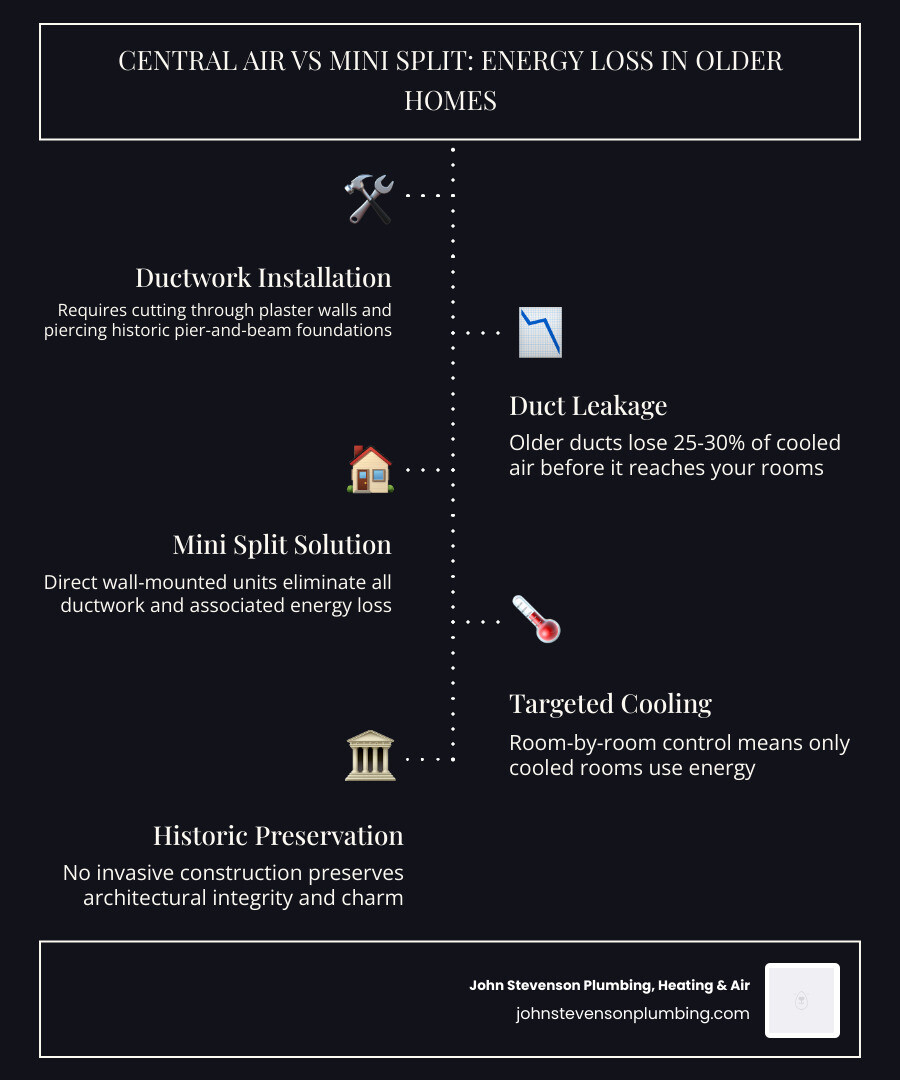
Many homes built before the 1950s feature plaster-and-lath walls. Unlike modern drywall, plaster is brittle and prone to cracking. Installing a traditional central air system requires extensive ductwork, which often means cutting large channels into these historic walls or dropping ceilings to hide the vents. For many of our neighbors in Carlsbad and Vista, this kind of invasive construction is a dealbreaker because it compromises the home’s original craftsmanship.
Foundations and Space Constraints
Older homes often sit on pier-and-beam foundations with limited crawlspace, or they may be built on a concrete slab. Without a spacious attic or a basement, there is simply no “invisible” place to put bulky metal ducts. In these scenarios, a Ductless Mini Split is often the only practical solution. Instead of massive duct runs, mini splits require only a small, three-inch hole in an exterior wall to connect the indoor unit to the outdoor condenser.
Invasive vs. Minimal Installation
If you opt for a traditional AC Installation, be prepared for a multi-day (or even multi-week) project if new ducts are required. This involves significant dust, noise, and structural modification. Conversely, a mini split system can often be installed in a single day with almost zero disruption to your home’s structural integrity.
Comparing Central Air vs Mini Split for Older Homes: Efficiency and Performance
As of May 2026, energy efficiency standards (SEER2) have become more rigorous to reflect real-world operating conditions. When comparing central air vs mini split for older homes, the efficiency gap is one of the most compelling reasons homeowners are making the switch to ductless technology.
Understanding SEER2 and Energy Loss
SEER2 (Seasonal Energy Efficiency Ratio 2) measures how much cooling a system delivers per watt of electricity used.
- Central Air: High-efficiency central systems typically top out around 21 to 26 SEER2.
- Ductless Mini Splits: These systems are the undisputed champions of raw efficiency, with high-end models reaching 35 to 42 SEER2.
However, the “sticker price” of the SEER2 rating doesn’t tell the whole story. In an older home, the ductwork is often the weakest link. Research shows that typical duct systems lose 20% to 30% of conditioned air through leaks, gaps, and poor insulation. This means even if you buy a high-efficiency central unit, you might only be getting 70% of the cooling you’re paying for. Mini splits eliminate this “duct tax” entirely because they deliver air directly into the room.
The Power of Inverter Technology
Most modern mini splits utilize variable-speed inverter compressors. Think of a traditional central AC like a light switch—it’s either 100% on or 100% off. This constant cycling creates temperature swings and wastes energy. Inverter technology works more like a dimmer switch; it adjusts the cooling output in tiny increments to maintain a perfectly steady temperature. This is particularly helpful in the drafty structures often found in older parts of Solana Beach or Encinitas.
| Feature | Central Air | Ductless Mini Split |
|---|---|---|
| Max SEER2 Rating | Up to 26 | Up to 42 |
| Duct Energy Loss | 20% – 30% | 0% |
| Compressor Type | Often Single/Two-Stage | Variable-Speed Inverter |
| Lifespan | 15 – 20 Years | 20 – 30 Years (High-end) |
For more details on how these systems can lower your monthly bills, check out The Homeowner Guide to Ductless Mini Split Benefits or explore our full range of Cooling Services.
Is Central Air vs Mini Split for Older Homes Better for Historic Preservation?
Preserving the “soul” of an older home is a priority for many homeowners in places like Rancho Santa Fe and Del Mar. The aesthetic impact of an HVAC system is a major factor in the central air vs mini split for older homes decision.
Central Air Aesthetics: The main advantage here is invisibility. You only see small floor or ceiling registers. However, if your home doesn’t have existing ducts, the “cost” of that invisibility is often the loss of original crown molding or the addition of unsightly “soffits” (bulkheads) to hide the new ductwork.
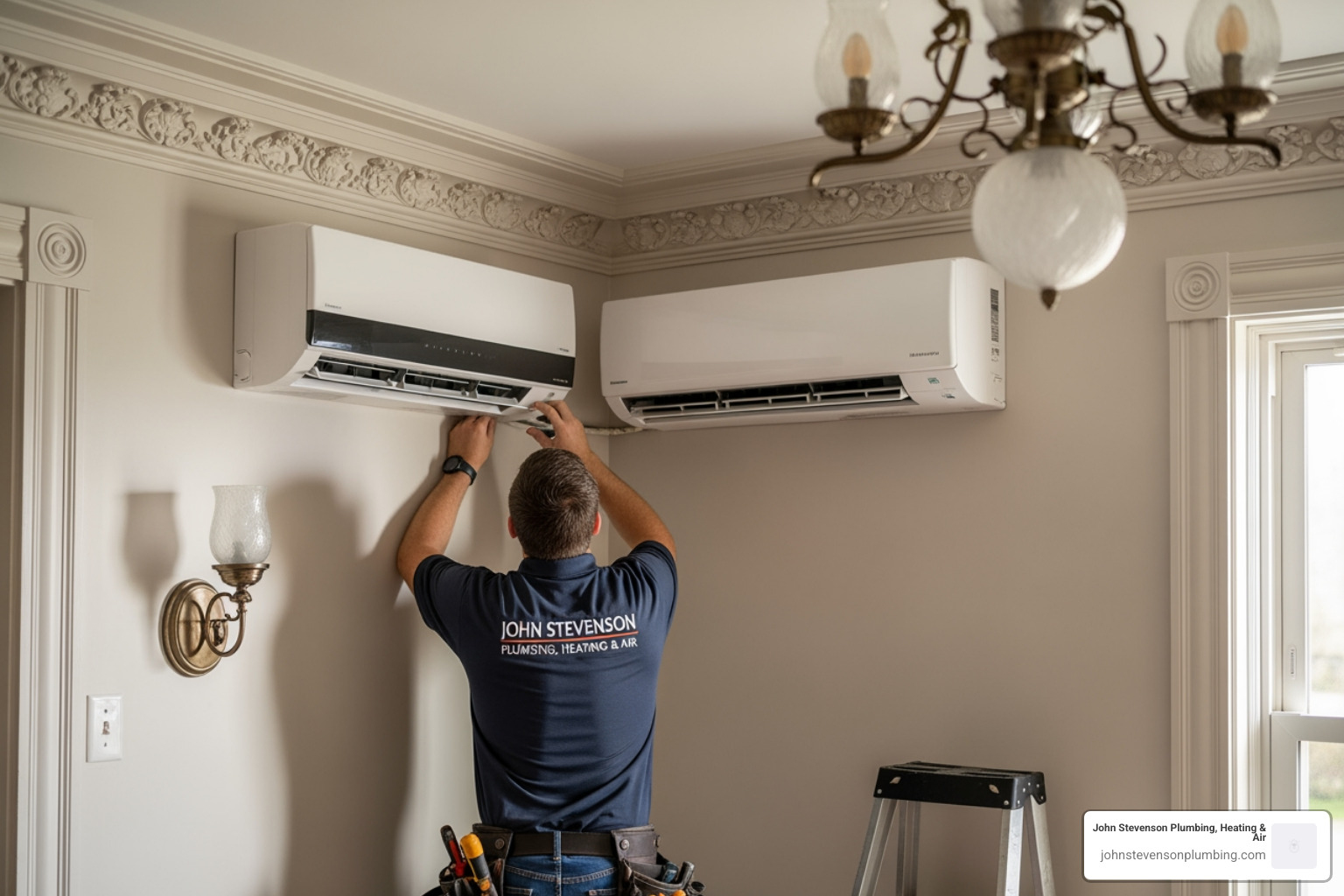
Mini Split Aesthetics: While the indoor “heads” are visible, modern manufacturers have made great strides in design. For historic preservation, you aren’t limited to just wall-mounted units:
- Ceiling Cassettes: These sit flush with the ceiling, showing only a decorative grille.
- Floor-Mounted Units: These resemble traditional radiators and can be tucked away under windows.
- Slim Duct Systems: A hybrid approach where a small indoor unit is hidden in a closet or attic, serving one or two rooms via very short, hidden ducts.
To protect the exterior look of your home, we use “line hides”—decorative covers for the refrigerant lines that can be painted to match your home’s siding, ensuring the upgrade doesn’t detract from your curb appeal. This is a popular choice for our clients seeking Heating Air Conditioning Irvine CA.
Zoning, Temperature Control, and Multi-Room Comfort
One of the biggest complaints we hear about older homes is that they are “impossible to balance.” You know the feeling: the kitchen is freezing, but the upstairs bedroom feels like a sauna. This is where the central air vs mini split for older homes debate shifts toward comfort and control.
Independent Thermostats
A central air system usually relies on one single thermostat to control the entire house. If that thermostat is downstairs, the upstairs will almost always be too hot. While you can add “zoning” to a central system using motorized dampers, it is often expensive and prone to mechanical failure over time.
Ductless mini splits offer inherent, built-in zoning. Each indoor unit has its own thermostat and operates independently. If you’re spending the afternoon in your home office in Mission Viejo, you can cool that room to 72 degrees while leaving the guest bedrooms at 78. This room-by-room control solves “hot spots” instantly and significantly reduces energy waste.
If you’re struggling with uneven temperatures in your home, our experts in Heating Air Conditioning Mission Viejo CA can help you design a multi-zone layout that fits your lifestyle.
Choosing Central Air vs Mini Split for Older Homes with Multi-Story Layouts
Multi-story older homes face the relentless law of physics: heat rises. In many 1920s-era two-story homes, the original ventilation was designed for gravity-fed heating, not forced-air cooling.
Attic Bedrooms and Converted Spaces: If you’ve converted an attic into a bedroom or a garage into an ADU (Accessory Dwelling Unit), extending your existing central air ducts is often impractical or even impossible. A mini split is the “gold standard” for these spaces.
The Heat Pump Advantage: It’s important to remember that most modern mini splits are actually Heat Pumps. This means they provide both high-efficiency cooling in the summer and incredibly efficient heating in the winter. In our mild Southern California climate, a heat pump can often handle 100% of your year-round comfort needs without ever needing a backup furnace. You can learn more about this technology in our guide on The Simple Way a Heat Pump Heats and Cools Your Home.
Maintenance, Longevity, and Long-Term Reliability
No matter which system you choose, your investment is only as good as the care it receives. However, the maintenance requirements for central air vs mini split for older homes differ quite a bit.
Filter Cleaning and Air Quality
- Central Air: These systems use replaceable filters (often MERV-rated) that need to be swapped every 1 to 3 months. Central systems also require periodic duct cleaning to remove dust, pet dander, and mold that can accumulate over decades.
- Mini Splits: These units feature permanent, washable mesh filters. To keep them running efficiently, you should rinse them under a tap every 2 to 4 weeks. Because there are no ducts, there’s no place for hidden dust to build up, which often results in superior indoor air quality.
System Lifespan
A well-maintained central air system typically lasts 15 to 20 years. High-quality ductless mini splits, however, are known for their longevity, often lasting 20 to 30 years with proper professional care. This is because they avoid the strain of pushing air through restrictive, leaky ductwork and benefit from the smoother operation of inverter compressors.
Whether you need a quick AC Repair or are wondering Will Your AC Survive the Decade Average Lifespans Explained, regular professional inspections are the key to protecting your home.
Frequently Asked Questions about Cooling Older Homes
Which system is better for a home with no existing ductwork?
For homes without existing ducts, the mini split is almost always the superior choice. Retrofitting a home with new ductwork can be incredibly invasive, requiring you to sacrifice closet space or original architectural details. Mini splits provide a faster, more efficient, and less destructive path to modern comfort.
Can mini splits provide both heating and cooling in Southern California?
Yes! Most mini splits sold in 2026 are air-source heat pumps. They are perfectly suited for the Carlsbad and San Diego climate, providing whisper-quiet cooling during our heatwaves and highly efficient heating during our cool winter nights.
When does a hybrid approach (using both systems) make sense?
A hybrid approach is very common in older homes. For example, you might keep your existing central system for the main floor where the ductwork is already in place and functional, but add a mini split to a “problem room,” a new sunroom, or a master suite that the central system can’t quite reach.
Conclusion
Choosing between central air vs mini split for older homes doesn’t have to be a headache. Whether you’re looking to preserve the historic charm of a 1920s bungalow or simply want to stop overpaying for electricity in a drafty mid-century ranch, there is a solution that fits your home’s unique DNA.
At John Stevenson Plumbing, Heating & Air Conditioning, we’ve spent years helping our neighbors in Carlsbad, San Diego, and Orange County navigate these exact decisions. We back every project with our 5-Star Service Guarantee, which includes thorough diagnostics, upfront pricing, and a 24-hour satisfaction check-in. Our certified technicians understand the nuances of older Southern California homes and are ready to help you find the perfect balance of comfort and efficiency.
Ready to bring “new cool” to your old house? Schedule your home assessment today and let us help you find the system that works for you.