
Operational Mechanics: How Storage Tanks Compare to On-Demand Systems
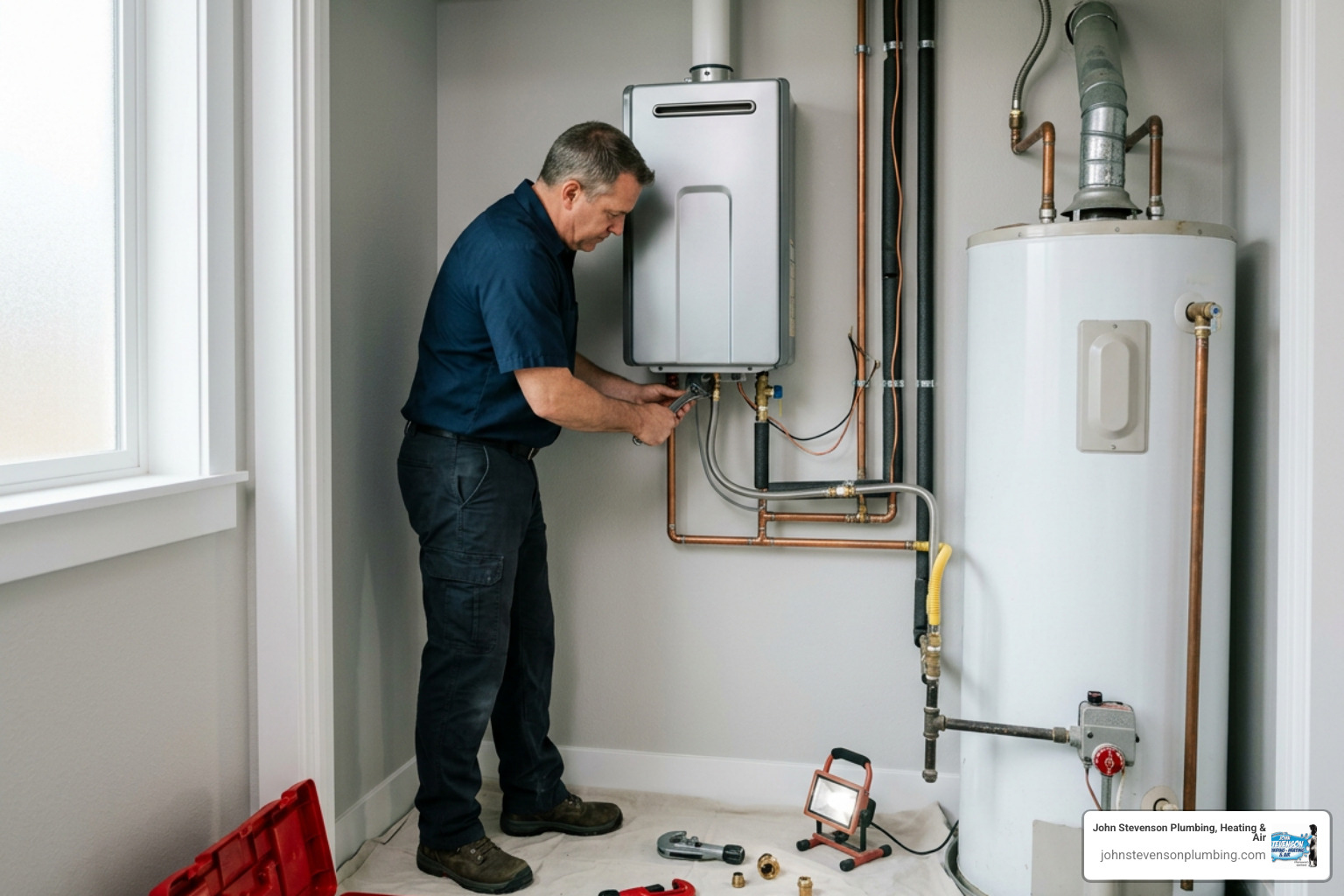
To understand why switching from tank to tankless water heater systems is such a popular conversation in Southern California, we first have to look at what happens behind your utility closet doors.
A traditional storage tank water heater operates on a simple, continuous cycle. Think of it as a giant, insulated kettle that stays on all day. Cold water enters the bottom of the tank, and gas burners or electric heating elements warm it up to your set temperature (typically 120°F). The tank holds this water and constantly fires up to keep it hot, even when you are fast asleep or away at work. This continuous reheating process is known as standby heat loss. It is a highly reliable but inherently inefficient way to manage your home’s energy. Over time, these tanks also face wear and tear from constant water exposure, which we cover in our Stop Getting Into Hot Water Over Your Choice of Water Heater guide.
In contrast, an on-demand, tankless water heater remains completely idle until you turn on a hot water tap. The moment a faucet opens, a flow sensor detects the water movement and ignites a high-powered gas burner or activates heavy-duty electric heating elements. Cold water circulates through a compact, highly conductive copper or stainless steel heat exchanger, absorbing heat instantly. The water reaches your desired temperature in seconds and continues to flow hot for as long as the tap is open.
When you turn off the faucet, the system shuts down immediately. This on-demand process completely eliminates standby heat loss, keeping your energy bills tied strictly to your actual hot water usage. If you are deciding between fuel types for your new setup, you can read our detailed breakdown in our In-Depth Guide to Gas vs Electric Water Heater: Which Is Better?.
Key Considerations When Switching from Tank to Tankless Water Heater
Making the transition to an on-demand system offers a variety of benefits that extend far beyond simply lowering your monthly utility bills. When homeowners ask us about the primary motivations for switching from tank to tankless water heater units, we focus on three major lifestyle improvements: endless hot water, reclaimed floor space, and a massive reduction in the risk of catastrophic property damage.
With a traditional tank, you are limited by the physical volume of the container. Once your 40- or 50-gallon capacity is depleted by back-to-back showers or running the washing machine, you have to wait for the tank to slowly recover. A tankless system, however, provides an endless stream of hot water because it heats the water continuously as it flows.
Additionally, we have helped many families reclaim valuable space. A traditional tank takes up a significant amount of square footage in a closet, laundry room, or garage. A tankless unit is about the size of a carry-on suitcase and mounts directly to the wall, freeing up floor space for storage or other home projects. To explore how these benefits translate to long-term financial returns, check out our article on Why Homeowners Are Going Tankless to Save Money and read The Ultimate Guide to Is a Tankless Water Heater Worth It.
Energy Efficiency and Environmental Impact
One of the most compelling reasons to make the switch is the dramatic improvement in energy efficiency. Traditional storage tank heaters generally operate with a Uniform Energy Factor (UEF) between 0.60 and 0.70. This means that 30% to 40% of the energy consumed by the appliance is lost as waste heat.
Modern tankless water heaters can achieve UEF ratings of 0.94 or higher, converting nearly all of their fuel directly into hot water. For homes that use 41 gallons or less of hot water daily, tankless systems are 24% to 34% more energy-efficient than conventional tank heaters. Even in larger households using over 80 gallons per day, these systems remain 8% to 14% more efficient. This drastically reduces your household’s carbon footprint while yielding consistent, year-round savings on your gas or electric bills. For a deeper look at high-efficiency options, read our In-Depth Guide to Energy Efficient Water Heater Options.
Space Reclamation and Flood Risk Mitigation
Beyond energy savings, switching to a wall-mounted tankless unit is an excellent way to protect your home from water damage. Traditional water heater tanks have a limited lifespan and are highly susceptible to internal corrosion. Over time, the sacrificial anode rod inside the tank degrades, allowing minerals to attack the steel shell. Nearly 75% of traditional tank heaters eventually fail by leaking or bursting, often spilling 40 to 80 gallons of water directly onto your flooring. The average water heater flood causes thousands of dollars in property damage to drywall, flooring, and adjacent rooms.
Because a tankless water heater does not store water, the risk of a catastrophic reservoir burst is completely eliminated. If a leak does occur within a tankless unit, it is typically small and easily contained, saving you from the headache of expensive home remediation.
Sizing and Peak Demand: Meeting Your Household’s Hot Water Needs
Sizing a traditional tank is simple: you choose a volume (such as 40, 50, or 75 gallons) that matches your household size. Sizing a tankless water heater, however, requires a completely different approach. Because there is no stored reserve, a tankless unit must be sized based on peak demand, measured in Gallons Per Minute (GPM), and the required temperature rise.
To determine the right size for your home, you must calculate the maximum number of hot water fixtures you plan to run at the exact same time.
| Fixture Type | Average Flow Rate (GPM) |
|---|---|
| Standard Shower Head | 2.5 GPM |
| Bathroom Faucet | 1.0 GPM |
| Kitchen Faucet | 1.5 GPM |
| Dishwasher | 1.5 GPM |
| Washing Machine | 2.0 GPM |
If you want to run two showers (5.0 GPM total) and a dishwasher (1.5 GPM) simultaneously, your tankless unit must be able to deliver at least 6.5 GPM.
Additionally, the unit’s performance is heavily influenced by incoming groundwater temperatures. In Carlsbad and surrounding Southern California coastal areas, our winter groundwater temperatures rarely drop below 55°F. To reach a comfortable shower temperature of 120°F, your system needs to achieve a “temperature rise” of roughly 65°F. This mild climate works to our advantage, allowing tankless units to achieve higher GPM flow rates in our region than they would in freezing northern climates.
To learn more about calculating your specific household requirements, read our guide on Everything You Need to Know About What Size Water Heater Do I Need and explore our tips on Choosing the Right Water Heater for Your Home.
Infrastructure and Installation Requirements for Carlsbad Homes
Switching to an on-demand system is a major home system upgrade that requires careful planning. Unlike a standard replacement, converting to a tankless system involves adjusting your plumbing, gas lines, venting, and electrical configurations to meet modern safety standards.
In California, these installations must comply fully with local building codes, which mandate proper permits and inspections to ensure safety and preserve your home’s resale value. For a complete breakdown of local rules, read Permit or Perish: Your Guide to California Water Heater Replacements and Don’t Get Burned by California Plumbing Code Water Heater Rules.
Gas Line and Venting Upgrades When Switching from Tank to Tankless Water Heater
The most common infrastructure upgrade required for a gas tankless water heater is upsizing the gas line. A standard 50-gallon tank water heater typically requires a gas input of 30,000 to 50,000 BTUs per hour. Because a tankless system must heat water instantly, it requires a much larger burst of energy—typically between 150,000 and 199,000 BTUs per hour.
To support this high demand, your existing 1/2-inch gas line must usually be upgraded to a 3/4-inch or 1-inch line run directly from your meter. Our team will also evaluate your gas meter to ensure it has the capacity to handle the increased load without starving your home’s furnace or stove.
Venting is another critical safety consideration. Traditional tank heaters use atmospheric venting, sending hot exhaust gases naturally up a metal flue through the roof. However, highly efficient condensing tankless heaters cool the exhaust gases to extract maximum heat, which causes moisture to condense inside the flue.
Because this condensate is slightly acidic, these systems cannot use standard metal vents. Instead, they require direct-venting using specialized PVC or CPVC pipes routed through a side wall. This setup pulls fresh air from outside and safely expels the cool exhaust.
Electrical Panel Capacity and Hard Water Solutions
Even if you choose a gas tankless water heater, the system still requires a dedicated 120-volt electrical outlet nearby to power its internal computer control boards, digital displays, and electronic ignition. If you are considering a whole-home electric tankless unit, the electrical requirements are much more substantial. These systems can draw up to 150 amps of power, which almost always necessitates a service upgrade to a 200-amp or larger electrical panel.
Water quality is another critical factor for Southern California homeowners. Carlsbad and the surrounding communities often deal with hard municipal water, which is rich in calcium and magnesium. When hard water is heated inside the narrow passages of a tankless heat exchanger, these minerals crystallize and form a crusty scale. This scale acts as a layer of thermal insulation, forcing the unit to work harder, lowering its efficiency, and eventually causing the heat exchanger to overheat and fail.
To protect your investment, we highly recommend installing a water softener or a dedicated scale-prevention system alongside your new tankless unit. You can learn more about managing these local water quality challenges in our guide, Don’t Get Drained by Southern California’s Complex Water Quality Issues.
Lifespan, Maintenance, and Long-Term Reliability
One of the strongest arguments for switching from tank to tankless water heater systems is their exceptional longevity. While a standard storage tank water heater typically lasts 8 to 12 years before corrosion takes over, a properly maintained tankless water heater can easily last 20 to 25 years. This is because tankless systems are built with high-grade copper and stainless steel components that can be individually repaired or replaced, whereas a leaking tank heater must be entirely discarded. You can read more about these differences in Don’t Get Into Hot Water Over Your Heater’s Lifespan.
However, achieving this 20+ year lifespan requires consistent maintenance. Because of our local water hardness, we recommend having your tankless system professionally flushed and descaled at least once a year. During this service, we connect a pump to the unit’s isolation valves and circulate a food-grade descaling solution (like concentrated white vinegar) through the heat exchanger for about an hour. This process safely dissolves mineral scale, restoring the unit’s heating efficiency and protecting the heat exchanger from premature failure. To learn more about keeping your system running smoothly, check out our guide on How to Extend the Life of Your Water Heater.
Is Switching from Tank to Tankless Water Heater Right for Your Carlsbad Home?
While tankless water heaters offer incredible benefits, they are not the perfect fit for every single household. The decision ultimately depends on your long-term plans, your daily routine, and your home’s layout.
A tankless conversion is an excellent investment if:
- You plan to stay in your home for at least 5 to 10 years, allowing you to fully recoup your investment through lower utility bills and increased home value.
- You have a large family or high-demand fixtures (like a deep soaking tub) and are tired of running out of hot water.
- You live in a compact home where reclaiming closet or garage floor space would make a major difference.
Conversely, sticking with a traditional tank heater might be the better option if you plan to sell your home in the next year or two, or if your home’s layout makes running new gas lines or venting routes highly impractical. To help you weigh these factors, we have put together a decision-making framework in How to Decide If Your Water Heater Is a Keeper or a Goner and How to Know When to Replace Your Water Heater.
Frequently Asked Questions About Water Heater Conversions
Do gas tankless water heaters require electricity to operate?
Yes, all modern gas tankless water heaters require electricity. They use a standard 120-volt outlet to power their internal computer control boards, safety sensors, digital thermostats, and electronic ignition systems. Because they do not use a standing pilot light, a gas tankless unit will not produce hot water during a power outage unless it is connected to a backup generator or an uninterruptible power supply (UPS) battery backup.
What is the “cold water sandwich” effect and how is it prevented?
The “cold water sandwich” effect occurs when you turn off a hot water tap and then turn it back on a minute later. A small pocket of cold water enters the plumbing line during the brief moment it takes for the tankless burner to reignite and reach full temperature. This results in a temporary burst of lukewarm or cold water in the middle of your hot water flow.
To prevent this, high-end modern tankless units are engineered with small, insulated internal buffer tanks. These buffer tanks store a tiny amount of hot water to bridge the gap during quick on-and-off cycles, ensuring a perfectly consistent temperature at your faucet.
What rebates and incentives are available in 2026 for upgrading?
Because tankless water heaters are highly efficient, there are excellent financial incentives available in 2026 to help offset your installation costs. Homeowners can take advantage of federal energy-efficiency tax credits, which cover up to 30% of the project cost for qualifying high-efficiency models. Additionally, local Southern California utility providers frequently offer cash-back rebates for upgrading from a standard tank to an Energy Star-certified tankless system. You can find the latest available opportunities in our guide to Don’t Sweat the Cost With These California HVAC and Water Heater Rebates.
Conclusion
Switching from tank to tankless water heater systems is one of the smartest upgrades you can make for your home’s comfort, safety, and energy efficiency. While the conversion process requires careful planning and professional expertise to handle gas line upgrades, venting, and local permitting, the long-term payoff—endless hot water, a 20+ year lifespan, and the elimination of flood risks—makes it a highly rewarding investment.
At John Stevenson Plumbing, Heating & Air, we make the transition smooth and stress-free. Every installation we perform is backed by our 5-Star Service Guarantee, which includes thorough diagnostics, clear upfront pricing, certified technicians, and a 24-hour satisfaction check-in to ensure your new system is performing perfectly. Whether you are ready to make the switch today or simply want an honest assessment of your home’s current plumbing system, our team is here to help.
Ready to upgrade your home’s comfort? Schedule your professional water heater consultation with John Stevenson Plumbing, Heating & Air Conditioning today!