
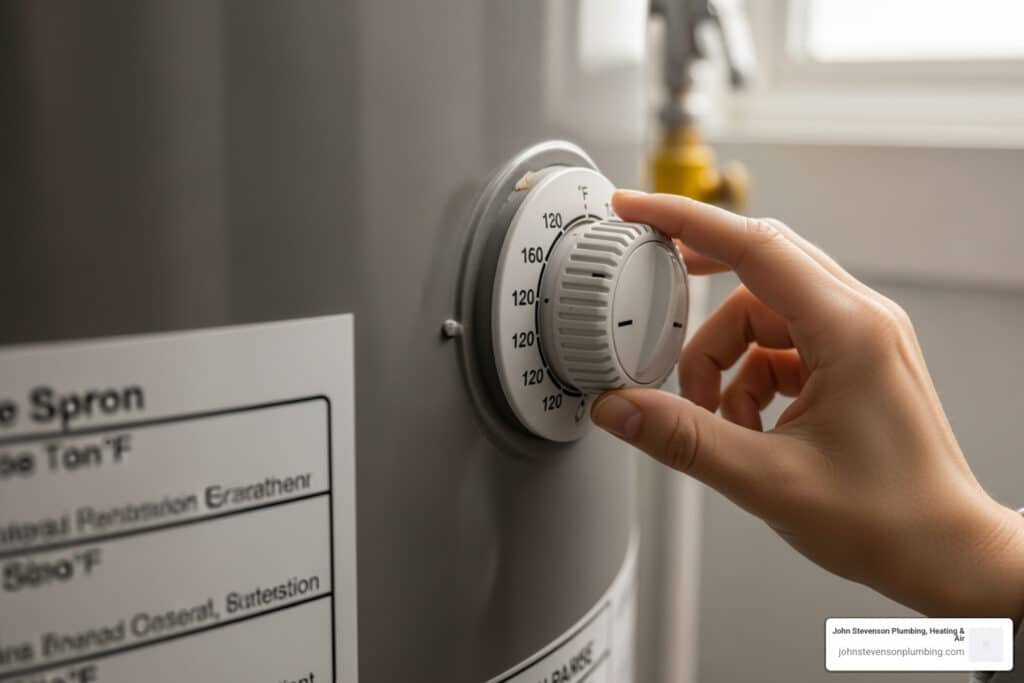
What Temperature Should I Set My Water Heater? (Quick Answer for Carlsbad Homeowners)
Knowing what temperature should I set my water heater at is one of the simplest ways to improve safety, cut energy waste, and protect your family — and most Carlsbad homeowners are surprised to learn their unit may be factory-set higher than it needs to be.
Here’s the quick answer most households need:
| Setting | Temperature | Best For |
|---|---|---|
| Recommended default | 120°F | Most homes — safe, efficient, comfortable |
| Middle ground | 130°F | Longer pipe runs, medium-demand households |
| Higher setting | 140°F | Immunocompromised residents, older dishwashers without a booster heater, large families |
| Too low (avoid) | Below 120°F | Risk of bacterial growth including Legionella |
For the vast majority of homes, 120°F is the right starting point. The U.S. Department of Energy and the Consumer Product Safety Commission both recommend it as the standard — hot enough to be useful and safe enough to protect kids, older adults, and anyone with sensitive skin.
That said, the “right” answer depends on who lives in your home, what appliances you have, and how your plumbing is set up. Water heaters account for roughly 18% of a home’s total energy use, so even a small adjustment can make a real difference on your utility bill. And with tap water scald burns sending over 1,500 people to the hospital every year in the U.S., getting this setting wrong in either direction carries real consequences.
In this guide, we’ll walk through every factor that should shape your decision — from bacteria risks and burn times to how to safely adjust your specific type of water heater.
What Temperature Should I Set My Water Heater for the Best Balance?
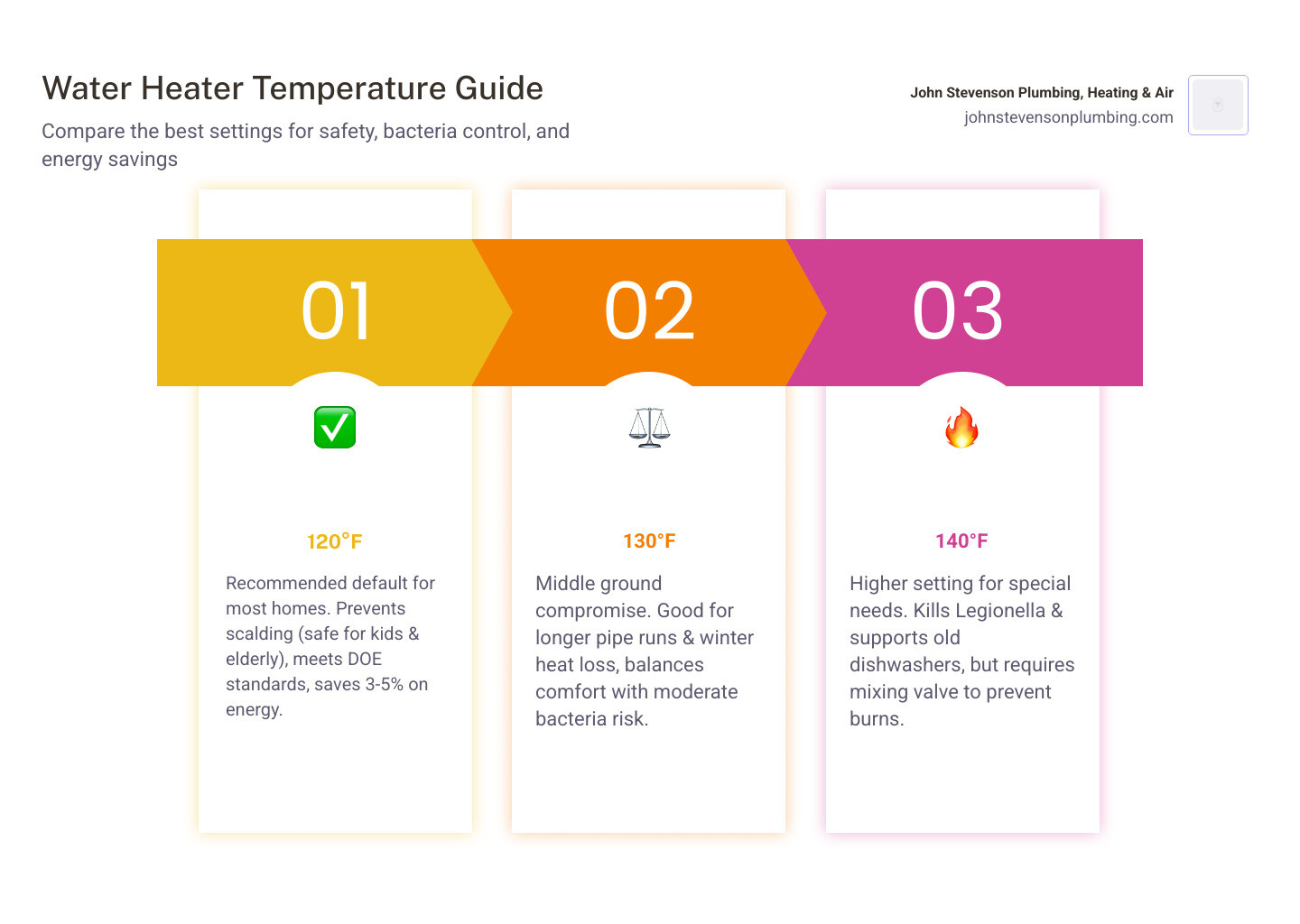
Finding that “Goldilocks” zone for your water heater is a balancing act between three major pillars: safety (preventing burns), health (killing bacteria), and energy efficiency (saving money). While the Department of Energy (DOE) suggests 120°F as the standard, many manufacturers still ship units with a factory preset of 140°F. This creates a disconnect that homeowners must navigate.
Why 120°F Is Right for Most Homes
For the average household in San Diego or Orange County, 120°F is considered the “sweet spot.” At this temperature, the water is hot enough for a comfortable shower and effective handwashing, yet it significantly reduces the risk of accidental scalding. This is particularly vital in homes with small children or elderly residents whose skin may be more sensitive to heat. Furthermore, keeping the temperature at 120°F slows down mineral buildup and pipe corrosion, which can extend the life of your tank.
When 130°F Can Be a Reasonable Middle Ground
Sometimes 120°F just doesn’t feel like enough. If you live in a larger home where the water heater is located in the garage and the master bathroom is on the opposite side of the house, you might lose several degrees of heat as the water travels through the pipes. Setting the unit to 130°F acts as a “compromise” setting. It provides a little extra heat to compensate for those long pipe runs or colder winter groundwater, ensuring the water is still steaming when it reaches your showerhead.
When 140°F May Be the Better Choice
There are specific scenarios where we might recommend bumping the dial up to 140°F. This is often the case for:
- Large Families: If you have five or six people trying to shower back-to-back, a higher tank temperature allows you to mix in more cold water at the tap, essentially “stretching” your hot water supply.
- Health Concerns: For residents with suppressed immune systems or chronic respiratory issues, 140°F is the gold standard for killing pathogens like Legionella or NTM (Mycobacterium avium).
- Older Appliances: Some older dishwashers lack internal “booster heaters” and require the incoming water to be at least 140°F to properly sanitize dishes.
If you do choose 140°F, we strongly recommend installing a thermostatic mixing valve. This device keeps the water in the tank at a high, bacteria-killing temperature but mixes it with cold water before it reaches your faucets, so the output is a safe 120°F.
| Factor | 120°F Setting | 140°F Setting |
|---|---|---|
| Scald Risk | Low (5+ mins to burn) | High (5 seconds to burn) |
| Bacteria Control | Adequate for most | Maximum |
| Energy Cost | Lower (Save 6-10%) | Higher |
| Mineral Buildup | Slower | Faster |
Safety Risks of Setting a Water Heater Too High or Too Low
When we think about what temperature should i set my water heater, safety should always be the primary driver. The risks aren’t just about a lukewarm shower; they involve serious physical injury or the growth of invisible pathogens.
what temperature should i set my water heater to avoid scalding?
Scalding is a major concern, especially for vulnerable populations. At 140°F, it takes only five seconds of exposure to cause a third-degree burn. For a child or an older adult with thinner skin, that window is even smaller. By contrast, at 120°F, it takes more than five minutes of constant exposure to produce a serious burn. Setting your heater to 120°F provides a massive safety buffer that prevents life-altering accidents in the bathroom or kitchen.
What Happens If the Temperature Is Too Low?
While saving energy is great, you shouldn’t set your heater below 120°F. When water sits between 90°F and 115°F, it becomes a literal breeding ground for bacteria. Legionella (the cause of Legionnaires’ disease) and NTM (non-tuberculous mycobacteria) thrive in lukewarm water and biofilms inside your tank. OSHA actually recommends a minimum of 122°F specifically to prevent this growth. Setting the temperature too low can turn your water heater into a health hazard.
Why Higher Temperatures Can Create Other Problems
Beyond the burn risk, high temperatures stress your entire plumbing system. Higher heat creates more internal pressure, which can lead to premature leaks or even tank failure. It also accelerates the “scaling” process, where calcium and magnesium in our Southern California hard water solidify and settle at the bottom of the tank. This sediment acts as an insulator, making the heater work harder and eventually causing those “popping” sounds you might hear from the garage.
How Water Heater Temperature Affects Energy Efficiency and Performance
Water heating is typically the second-largest energy expense in a home, accounting for about 18% of total energy use. By optimizing your settings, you can see a noticeable drop in your monthly utility bills.
How Much Energy You Save by Lowering the Setting
The Department of Energy notes that for every 10°F you reduce the temperature, you can save between 3% and 5% on your water heating costs. If you drop from 140°F to 120°F, you could see savings of up to 10% on that portion of your bill. This happens because of reduced “standby loss”—the heat that naturally escapes through the walls of the tank into the surrounding air. Lowering the temperature means the unit doesn’t have to cycle on as often to maintain the set heat.
Why a Higher Setting Can Make Hot Water Last Longer
This seems counterintuitive, but if you have a 40-gallon tank and a high demand for water, a higher setting (like 130°F or 140°F) actually makes that 40 gallons go further. Because the water is hotter, you use less of it at the showerhead, mixing in more cold water to reach a comfortable 105°F. This can prevent the “cold shower surprise” when the third person in the house hops in the tub.
Other Ways to Improve Water Heater Efficiency and Safety
Adjusting the dial isn’t the only way to optimize your system. Here are a few pro tips we recommend for our neighbors in Carlsbad and San Diego:
- Flush the Tank: Do this annually to remove sediment that kills efficiency.
- Insulate Pipes: Wrap the first six feet of hot water pipe leaving the heater to reduce heat loss.
- Check the Anode Rod: This “sacrificial” rod prevents the tank from rusting. Replacing it every 3-5 years can double the life of your heater.
- Use Low-Flow Fixtures: Reducing the amount of water you use is the best way to save energy.
For more information on keeping your system in top shape, check out our comprehensive guide to water heaters.
How to Adjust and Test Your Water Heater Safely
Ready to make a change? Whether you have a gas or electric unit, the process is straightforward, but you must follow safety protocols to avoid shocks or gas issues.
How to Safely Adjust a Gas Water Heater
Gas heaters are usually the easiest to adjust. You’ll find a dial near the bottom of the tank on the gas control valve.
- Locate the Dial: It might have numbers, or it might just say “Low,” “Hot,” “A,” “B,” “C,” and “Very Hot.”
- Understand the Labels: Typically, “Hot” represents 120°F. The letters A, B, and C usually represent 130°F, 140°F, and 150°F respectively.
- Turn the Dial: Move it in small increments toward your desired setting.
- Wait: It will take a few hours for the entire tank to reach the new temperature.
If you run into issues or the pilot light goes out, don’t hesitate to contact a professional for water heater repair.
How to Safely Adjust an Electric Water Heater
Electric heaters are a bit more complex because the thermostats are hidden behind panels, and there is a risk of electric shock.
- Turn Off the Power: This is critical. Flip the breaker at your main electrical panel.
- Remove the Panels: Unscrew the two access panels (top and bottom).
- Move the Insulation: Pull back the fiberglass insulation to see the thermostat.
- Adjust Both Dials: Most electric heaters have two elements. Use a flathead screwdriver to set both the upper and lower thermostats to the same temperature.
- Replace Everything: Put the insulation and panels back before turning the power back on.
How to Test the Actual Output Temperature
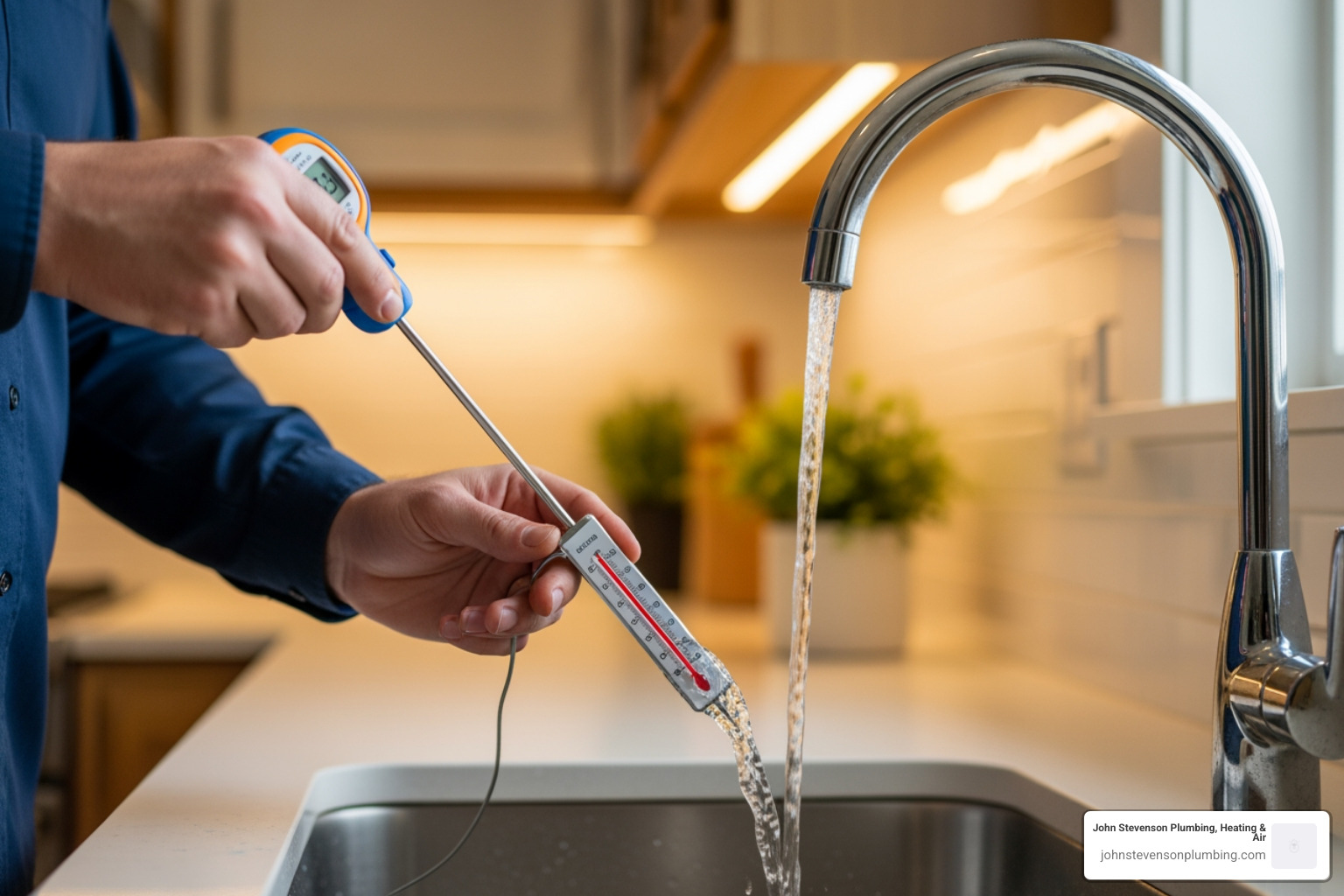
Don’t trust the dial on the tank blindly—they are often inaccurate. To get a real reading:
- Go to the faucet furthest from the water heater.
- Run the hot water for at least 60 seconds.
- Fill a glass and immediately stick a kitchen thermometer inside.
- If the temperature isn’t where you want it, go back and adjust the heater in 5-degree increments.
Tankless vs. Traditional Tank Water Heater Settings
Tankless systems are much easier to manage. Most have a digital LED display where you can set the exact degree you want. Because tankless units don’t store water, the risk of Legionella growth is significantly lower, and there is no standby heat loss to worry about. If you’re tired of the “tank struggle,” you might want to look into tankless water heaters as a more precise alternative.
Choosing the Right Setting for Your Household
Every home in the Carlsbad area is different. Your choice should reflect your specific lifestyle and health needs.
Households With Kids, Seniors, or Sensitive Skin
If you have a toddler who loves to turn the knobs in the bath, 120°F is non-negotiable. Children have thinner skin and slower reaction times, making them much more susceptible to burns. The same applies to seniors who may have reduced sensitivity to heat.
Homes With Immune-Compromised Residents or Respiratory Concerns
As mentioned earlier, health is a major factor. If someone in your home has a chronic lung condition or a weakened immune system, we often recommend a storage temperature of 140°F. This ensures that the water sitting in the tank is sterile. To keep it safe at the tap, we can help you install anti-scald mixing valves throughout the home.
Appliances and Home Factors That Change the Answer
- The Dishwasher Factor: Modern dishwashers usually have their own heating elements. If yours doesn’t, you may need a higher setting.
- The Winter Effect: In May 2026, as we look at seasonal changes, incoming groundwater can be colder in the winter months. You might need to bump the heater up 5 degrees in December to get the same shower experience you had in July.
- The Home Layout: If your house is sprawling, you lose heat in the pipes. Pipe insulation is your best friend here.
Signs your setting is wrong:
- You constantly run out of hot water (Setting might be too low).
- The water is “steaming” or boiling at the tap (Setting is dangerously high).
- Your energy bills are unusually high (Setting might be too high).
- The water smells musty or “off” (Setting might be too low, allowing bacteria).
When to Call a Professional Instead of Adjusting It Yourself
Plumbing isn’t always a DIY job. You should call us immediately if:
- You smell gas near the unit.
- You see water pooling at the base of the tank.
- The water temperature fluctuates wildly regardless of settings.
- You hear loud banging or popping sounds.
- You are installing a new unit and need to navigate the strict California water heater replacement codes.
If it’s time for a new unit, we can guide you through the water heater installation process to ensure everything is up to code and perfectly calibrated.
Frequently Asked Questions about what temperature should i set my water heater
Is 120°F hot enough for my dishwasher?
For most modern dishwashers, yes! Most units manufactured in the last decade include a “sanitizing” cycle that boosts the internal water temperature to 150°F-160°F regardless of your water heater’s setting. Check your manual; if it has a booster heater, 120°F is perfectly fine.
Should I change my water heater setting in winter?
You might need to. While the tank stays the same temperature, the pipes in your walls and attic get colder. This causes the water to lose more heat on its way to you. A 5-degree increase can compensate for this “transit loss.”
Do I need a mixing valve if I store water at 140°F?
In our professional opinion, yes. Storing water at 140°F without a mixing valve (also called a tempering valve) is a major safety hazard. A mixing valve allows you to kill the bacteria in the tank while delivering a safe 120°F to your skin. To learn more about safety regulations, read our guide on California Plumbing Code rules.
Conclusion
Finding the answer to what temperature should i set my water heater doesn’t have to be a guessing game. For most Carlsbad families, 120°F is the gold standard for safety and savings. If you have specific health needs or a very large household, 130°F or 140°F might be necessary, provided you take the proper safety precautions like installing mixing valves.
At John Stevenson Plumbing, Heating & Air Conditioning, we’ve spent decades helping Southern California homeowners optimize their comfort. Whether you need a quick adjustment, a tank flush to remove sediment, or a full system replacement, our 5-Star Service Guarantee ensures the job is done right the first time.
Don’t stay in lukewarm water—or risk a scald. If you’re unsure about your settings or your heater is acting up, reach out to us for expert water heater services. We’re here to keep your home safe, efficient, and comfortable all year long!