
How Many Mini Split Heads Do I Need? Here’s Your Quick Answer
Figuring out how many mini split heads do I need is one of the first — and most important — questions Carlsbad homeowners ask before going ductless. And the honest answer isn’t just about square footage. It comes down to your home’s layout, how many rooms have doors that close, and how you want to control comfort in each space.
Here’s a quick starting point based on home size and layout:
| Home Size | Typical Head Count |
|---|---|
| Under 600 sq ft (open plan) | 1 head |
| 600–1,200 sq ft | 2–3 heads |
| 1,200–2,000 sq ft | 3–4 heads |
| 2,000–3,000 sq ft | 4–5 heads |
| 3,000+ sq ft | 5–8 heads |
The simplest rule: plan for one indoor air handler for every room separated by a door that stays closed — except bathrooms, laundry rooms, and closets. Open-concept spaces like a combined kitchen, dining, and living area can often share a single, higher-capacity head.
One common mistake homeowners make is assuming one large unit placed in a hallway can cool three bedrooms. It can’t — closed doors block airflow completely, leaving bedrooms stuffy while the hallway freezes.
Most residential multi-zone outdoor condensers support between 2 and 5 indoor heads, with high-capacity systems handling up to 8 zones from a single outdoor unit. That means one condenser can often cover an entire home, provided it’s sized correctly for the total load.
The five steps in this guide will walk you through mapping your zones, measuring each room, estimating BTU needs, adjusting for Southern California conditions, and choosing the right equipment configuration — so you end up with a system that’s comfortable, efficient, and right-sized from day one.
How many mini split heads do i need terms explained:
- is a mini split good for whole house cooling
- mini split vs central air which is better
- what is a ductless mini split system
How Many Mini Split Heads Do I Need? Start With the Door Rule
The best place to start is not with a calculator. It is with your floor plan.
A mini split head, also called an indoor air handler, conditions the zone where it is installed. It blows heated or cooled air into that space. What it cannot do is push air through closed doors, around multiple corners, or evenly into rooms that are cut off from the main area.
That is why we use the door rule:
If a room has a door that is usually closed and you want that room comfortable, it usually needs its own mini split head or its own ducted supply from a slim-ducted mini split.
This is especially important for:
- Bedrooms
- Home offices
- Nurseries
- Guest rooms
- Bonus rooms
- Detached or converted spaces
- Upstairs rooms that heat up faster
Bathrooms, closets, and laundry rooms usually do not need dedicated heads. They are smaller, used for shorter periods, and often receive enough comfort from nearby areas.
For a deeper look at ductless options, visit our ductless mini split services.
How Many Mini Split Heads Do I Need for Enclosed Rooms?
For enclosed rooms, the answer is usually simple: one head per room or zone.
If your primary bedroom door is closed at night, it needs its own comfort source. If your home office door stays closed during video calls, it likely needs its own head too. If a nursery needs steady temperatures, it should not depend on air drifting in from the hallway.
The hallway idea sounds convenient, but it rarely works well. A hallway head may make the hallway very cold or warm while the bedrooms barely change. Air takes the easy path, and unfortunately, it has not learned how to politely open doors.
A dedicated head gives each enclosed room:
- Its own temperature control
- Better airflow
- More consistent comfort
- Less dependence on neighboring rooms
- Better zoning for different schedules
Do I Need a Mini Split Head in Every Room?
Not always. You need a head in every room or area where you want reliable, independent comfort.
You may not need a mini split head in:
- Bathrooms
- Closets
- Laundry rooms
- Pantries
- Small hallways
- Rarely used storage rooms
- Guest rooms that are almost never occupied
You may need a head in:
- Bedrooms used every night
- Living rooms
- Family rooms
- Home offices
- Converted garages
- Finished attics or lofts
- Sunrooms
- Rooms with large windows or strong afternoon sun
The better question is not, “Does every room need a head?” It is, “Which rooms need to feel comfortable even when doors are closed?”
That answer gives you your real zone count.
When One Head Can Serve More Than One Space
One head can often serve multiple spaces when the layout is open. This is common in many Carlsbad, San Diego County, and Orange County homes with connected kitchen, dining, and living areas.
One head may work for more than one area when:
- There are no doors between the spaces
- Openings between rooms are wide
- The head has a clear throw path across the room
- The space has good air circulation
- Ceiling fans can help move air gently
- The total BTU load is within the head’s capacity

Open-concept areas still need careful placement. A head tucked into a corner may not distribute air evenly. A head placed on a long wall with a clear path across the space often performs better.
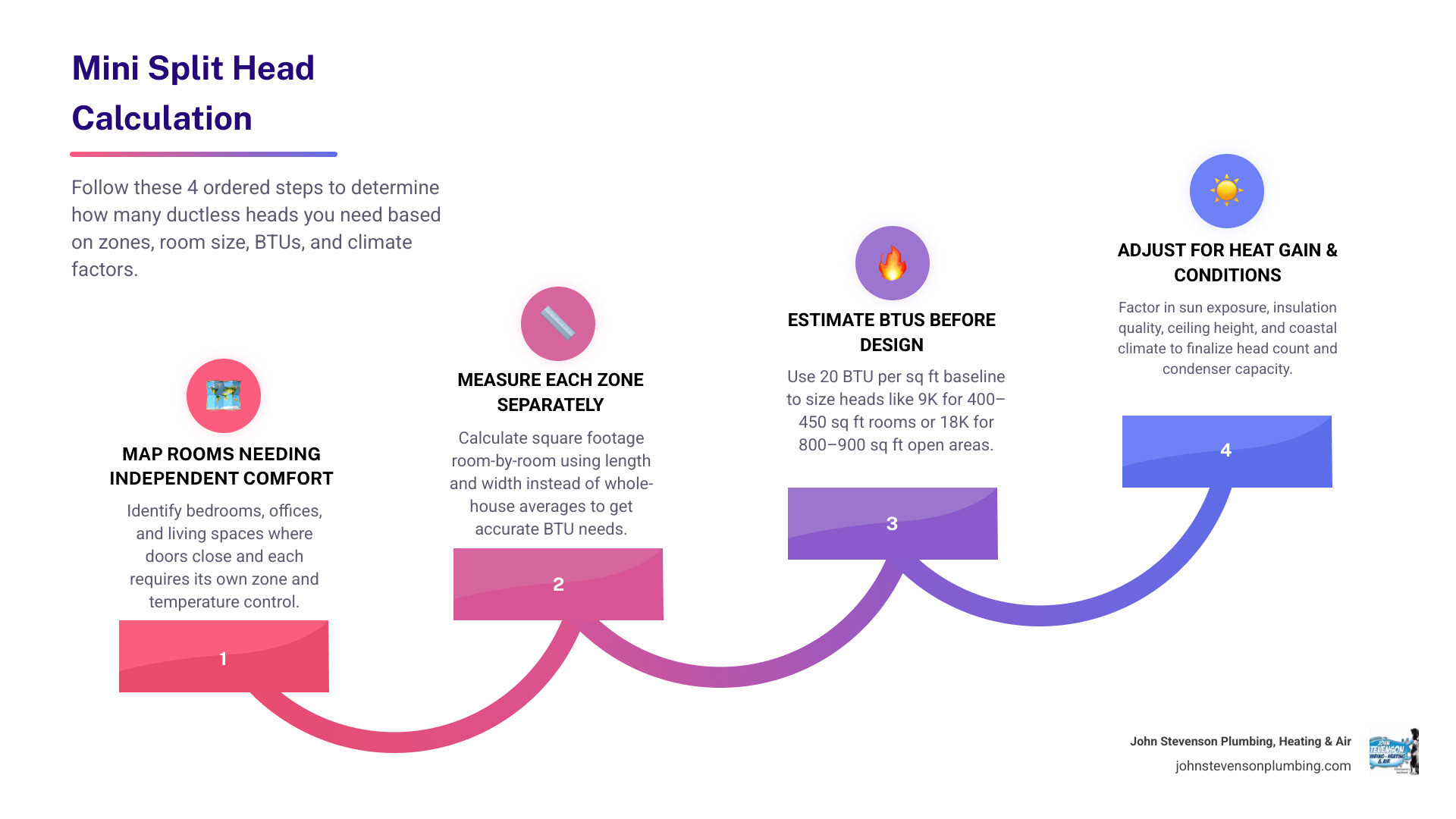
Step-by-Step: Calculate Your Mini Split Heads and Zones
Use this five-step process to estimate your mini split head count before a professional design:
- Map the rooms that need independent comfort.
- Measure each zone separately.
- Estimate BTUs for each zone.
- Adjust for heat gain and home conditions.
- Match the zone plan to the right equipment configuration.
This gives you a practical starting point. Final sizing should be confirmed with a professional load calculation, especially for whole-home ductless systems. You can also read more about whole-house mini split suitability.
Step 1: Map Rooms That Need Independent Comfort
Walk through your home and make a simple zone map. No fancy software required. A notepad works. A napkin works too, though we recommend using one without salsa on it.
Mark:
- Bedrooms
- Living areas
- Dining areas
- Kitchens
- Home offices
- Upstairs spaces
- Converted garages
- Rooms with doors that stay closed
- Rooms that get hotter than the rest of the house
Then think about how your household actually lives. A guest bedroom used twice a year may not need the same level of control as a primary bedroom. A home office used daily likely deserves its own zone. A teenager’s room may need its own head unless everyone enjoys thermostat negotiations.
Lifestyle matters because mini splits are all about zoning.
Step 2: Measure Each Zone Separately
Do not size the system by only using total home square footage. Ductless systems work best when each zone is sized on its own.
For each room or open area:
- Measure the length.
- Measure the width.
- Multiply length by width.
Example:
- 15 feet x 20 feet = 300 square feet
- 20 feet x 25 feet = 500 square feet
- 25 feet x 40 feet = 1,000 square feet
This matters because a 1,500-square-foot home could need very different head counts depending on layout. A mostly open 1,500-square-foot home may need fewer heads than a 1,500-square-foot home with many small enclosed rooms.
Step 3: Estimate BTUs Before Final Design
BTU stands for British Thermal Unit. In simple terms, it measures heating and cooling capacity.
A common starting point for mini split sizing is about 20 BTUs per square foot for cooling under typical conditions. This is only a rough baseline, not a final design.
Quick examples:
| Zone Size | Rough Starting BTU Range |
|---|---|
| 200-300 sq ft | 6,000-9,000 BTU |
| 300-450 sq ft | 9,000 BTU |
| 500-600 sq ft | 12,000 BTU |
| 650-800 sq ft | 18,000 BTU |
| 850-1,100 sq ft | 24,000 BTU |
A 12,000 BTU mini split head often covers around 500 to 600 square feet in average conditions. Smaller bedrooms may use 6K or 9K heads, while larger living areas may need 18K or 24K heads.
But do not stop here. Square footage is only the first draft.
Step 4: Adjust for Heat Gain and Home Conditions
Southern California homes have their own comfort challenges. Coastal homes may have mild temperatures but humidity and marine air. Inland areas such as Escondido, Poway, Rancho Bernardo, and Ramona can see more intense afternoon heat. Orange County homes with west-facing glass can also gain heat quickly late in the day.
Adjust your plan for:
- Sun exposure: West- and south-facing rooms often need more capacity.
- Large windows: Glass adds heat gain, especially with older or single-pane windows.
- Insulation: Poor attic or wall insulation increases load.
- Ceiling height: Vaulted ceilings add more air volume to condition.
- Kitchens: Appliances add heat, especially in open kitchen zones.
- Occupancy: A busy room with several people generates more heat.
- Room location: Upstairs rooms often run warmer because heat rises.
- Air leakage: Drafty windows and doors make comfort harder to maintain.
A professional Manual J load calculation accounts for these details. That is the best way to avoid guessing.
How Many Mini Split Heads Do I Need for Open-Concept Areas?
For open-concept areas, start with the total square footage of the connected space, then look at airflow.
A combined kitchen, dining, and living room may only need one head if the space is truly open. But if the room is long, L-shaped, divided by partial walls, or has a kitchen with heavy heat gain, one head may not distribute comfort evenly.
Good open-concept head placement usually includes:
- A central position on a long wall
- Clear airflow across the largest part of the room
- Avoiding placement directly over seating when possible
- Keeping airflow away from obstructions
- Accounting for kitchen appliance heat
- Using ceiling fans to improve circulation
Bigger is not always better. An oversized head can cool the area too quickly, shut off, and leave the room humid or uneven. The goal is not maximum blast. The goal is steady comfort.
Choosing the Right Configuration: Wall-Mounted Heads, Slim-Ducted Options, and Multi-Zone Systems
Once you know your zones, the next step is deciding how to serve them. Most homeowners choose one of three approaches:
- Wall-mounted ductless heads
- Slim-ducted mini split units
- A mixed system using both
Wall-mounted heads are the most recognizable ductless option. Slim-ducted systems use a concealed indoor unit, often placed in an attic or ceiling space, with short duct runs to nearby rooms.
For more homeowner-friendly benefits, see our guide to ductless mini split benefits.
| Option | Best For | Advantages | Things to Consider |
|---|---|---|---|
| Wall-mounted heads | Individual rooms and open spaces | Direct room control, efficient zoning, simple airflow path | Visible indoor units, one head often needed per enclosed room |
| Slim-ducted mini split | Nearby bedrooms or grouped rooms | Fewer visible heads, can serve multiple adjacent spaces | Requires duct routing, attic or ceiling access, careful balancing |
| Mixed configuration | Whole-home comfort | Combines visible and concealed options | Requires thoughtful design and equipment matching |
Single-Zone vs. Multi-Zone Mini Split Systems
A single-zone mini split has one outdoor condenser connected to one indoor head. It is commonly used for:
- Room additions
- Garages
- Home offices
- Primary bedrooms
- Bonus rooms
- Areas not served well by the existing HVAC system
A multi-zone system connects one outdoor condenser to multiple indoor heads. Each head serves a different zone and usually has its own control.
Multi-zone systems are useful for:
- Multiple bedrooms
- Whole-home ductless comfort
- Homes without ductwork
- Homes where different rooms need different temperatures
- Open areas plus enclosed rooms
If you are deciding between ductless and traditional options, our guide on mini split vs central air can help.
Can One Outdoor Condenser Support Multiple Indoor Heads?
Yes. One outdoor condenser can often support multiple indoor heads. Many residential multi-zone systems support 2 to 5 indoor units, while some high-capacity systems can support more.
The limits depend on:
- Number of available ports
- Outdoor unit BTU capacity
- Total indoor head capacity
- Manufacturer-approved combinations
- Refrigerant line length
- Height difference between indoor and outdoor units
- How often zones will run at the same time
- Future expansion plans
This is where professional design matters. In multi-zone systems, the total connected indoor capacity may not always match the outdoor capacity exactly because not every zone peaks at the same time. This is called load diversity. However, the system must stay within approved equipment limits.
If you want to add more heads later, the outdoor unit must have both an open port and enough capacity. If all ports are used from day one, expansion may require a different configuration.
Slim-Ducted Mini Splits vs. Multiple Wall-Mounted Heads
A slim-ducted mini split can reduce the number of visible wall heads. Instead of placing a wall-mounted unit in every nearby bedroom, a concealed indoor unit can send conditioned air through short ducts to two or more adjacent rooms.
This can be a good fit when:
- Bedrooms are clustered together
- You want fewer visible indoor units
- There is attic or ceiling access
- Short duct runs are possible
- Rooms have similar comfort needs
Wall-mounted heads may be better when:
- Each room needs independent control
- Rooms are far apart
- Attic access is limited
- You want direct zone-by-zone comfort
- The room has unusual heat gain
Slim-ducted systems still require proper duct design. Poor duct layout can reduce performance, create uneven room temperatures, or make maintenance harder. The right choice depends on your home’s structure and your comfort goals.
Check Your Plan: Outdoor Unit Limits, Efficiency, and Sizing Red Flags
Before installation, check the whole plan, not just the head count. A good mini split configuration balances:
- Number of heads
- BTU size per zone
- Outdoor unit capacity
- Line set routing
- Condensate drainage
- Wall placement
- Service access
- Controls
- Future expansion
Our team looks at the full cooling and heating picture during system planning. You can learn more about our cooling services.
How the Number of Heads Affects Energy Efficiency
More heads are not automatically better. Fewer heads are not automatically more efficient either.
Efficiency comes from matching the right head to the right zone.
A well-designed mini split system can save energy by conditioning only the rooms you are using. For example, you can keep bedrooms comfortable at night without over-conditioning the whole house. Inverter-driven systems can also adjust output instead of simply turning fully on and off.
However, efficiency can suffer when:
- Heads are oversized
- Rooms are undersized for the load
- Airflow paths are blocked
- One head is expected to serve too many enclosed spaces
- The outdoor unit is not matched correctly
- Line runs are excessive or poorly planned
The best configuration is the one that provides steady, balanced comfort with the least wasted operation.
Signs Your Mini Split System Is Undersized
An undersized mini split cannot keep up with the room’s load. It may run constantly and still leave you uncomfortable.
Watch for these signs:
- The room never reaches the set temperature
- The system runs for very long periods without catching up
- Bedrooms stay warm even when the living area feels fine
- Upstairs rooms are consistently uncomfortable
- Cooling feels weak during afternoon heat
- Heating feels weak during cooler nights
- Humidity feels high indoors
- The system struggles after doors have been opened
- You need fans constantly to feel comfortable
If this happens, the issue may be head size, placement, airflow, insulation, or outdoor unit capacity.
Signs Your Mini Split System Is Oversized
Oversizing causes a different set of problems. A head that is too large may satisfy the thermostat too quickly, shut off, and fail to run long enough to remove humidity or mix air properly.
Signs of oversizing include:
- Short cycling
- Quick bursts of cold or warm air
- Temperature swings
- Clammy rooms
- Poor dehumidification
- Frequent starts and stops
- Uneven comfort across the room
- Noisy operation because the unit ramps up and down often
Bigger equipment may sound comforting, but comfort is not a hot dog eating contest. More is not always better. Right-sized is better.
Questions to Confirm Before Installation
Before moving forward with a mini split installation, ask these questions:
- How many zones does my floor plan actually need?
- Which rooms need independent temperature control?
- Are any rooms better served by a slim-ducted unit?
- What BTU size is recommended for each zone?
- Was sun exposure included in the sizing?
- Were ceiling height and insulation considered?
- Is the kitchen part of an open-zone load?
- How many ports does the outdoor condenser have?
- Is there room for future expansion?
- Where will refrigerant lines run?
- How will condensate drain?
- Where will each indoor head be mounted?
- Will the outdoor unit location allow proper airflow and service access?
- Has a Manual J load calculation been considered for final sizing?
At John Stevenson Plumbing, Heating & Air Conditioning, we focus on thorough diagnostics, clear recommendations, upfront communication, certified technicians, and 24-hour satisfaction check-ins. Our goal is to help you understand the plan before work begins.
Conclusion: Get the Right Mini Split Configuration for Your Home
So, how many mini split heads do I need? For most homes, the answer starts with one head per closed-off comfort zone, then adjusts based on open layouts, room size, sun exposure, ceiling height, insulation, and how your household actually uses each space.
A good rule of thumb is:
- Closed bedroom or office: usually its own head
- Open kitchen, dining, and living area: often one shared head
- Bathrooms, closets, and laundry rooms: usually no dedicated head
- Multiple nearby rooms: possibly a slim-ducted solution
- Whole-home comfort: often a multi-zone system
For homeowners in Carlsbad, San Diego County, Orange County, and nearby Southern California communities, the right mini split design can deliver efficient, room-by-room comfort without traditional ductwork.
If you are planning a ductless system, we can help you map zones, size each room, review equipment options, and design a configuration that fits your home. Schedule your ductless mini split service with John Stevenson Plumbing, Heating & Air Conditioning today.