
Is a Mini Split Good for Whole House Cooling? Here’s What Carlsbad Homeowners Should Know
Is a mini split good for whole house cooling? Yes — and for many homes in Carlsbad and throughout Southern California, it’s one of the smartest comfort upgrades available. Whether you’re replacing an aging central AC or looking to cool a home without existing ductwork, a properly designed mini-split system can handle the job efficiently and quietly.
Here’s a quick answer breakdown:
| Your Situation | Is a Mini Split a Good Fit? |
|---|---|
| Home without existing ductwork | Yes — ideal choice |
| Home with 3+ separate rooms or floors | Yes — with a multi-zone system (3–5 zones for most homes) |
| Home with well-sealed existing ducts | Maybe — compare with central AC first |
| Small home or open floor plan (under 1,200 sq ft) | Yes — often 2–3 zones are enough |
| Older home with window units or baseboard heat | Yes — significant upgrade in comfort and efficiency |
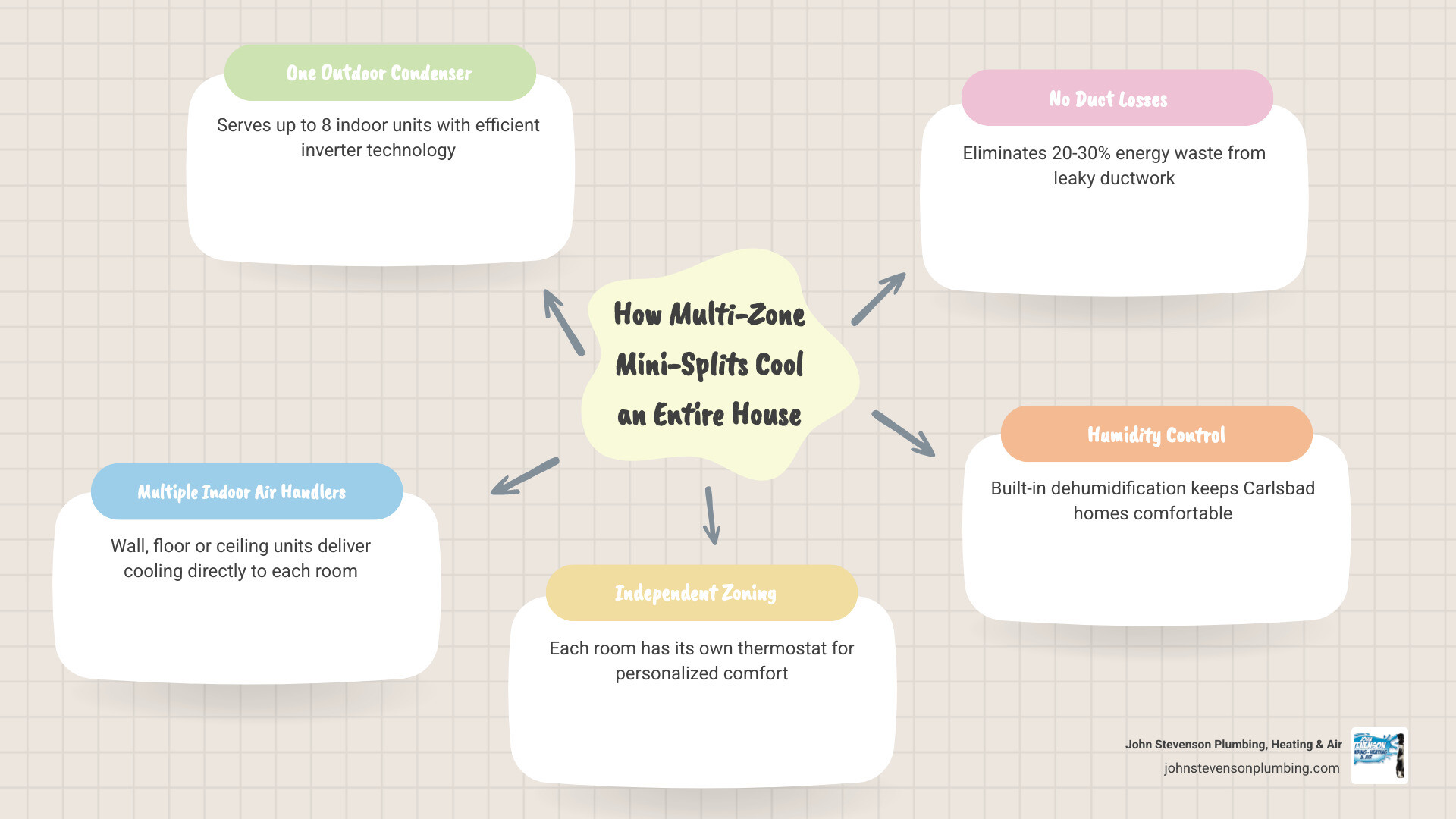
The key is proper system design. A single mini-split unit won’t cool an entire house on its own, but a multi-zone system — where multiple indoor air handlers connect to one outdoor condenser — absolutely can. Systems can support up to eight indoor units, making whole-home coverage realistic for most residential layouts.
What makes this especially relevant for Carlsbad homeowners is the local climate. Coastal Southern California brings warm summers, mild winters, and enough humidity to make indoor comfort a real concern year-round. Mini-splits handle all of it — cooling, heating, and even dehumidification — in one efficient package.
Space heating and cooling account for roughly half of a home’s total energy use. Ducted central systems lose 20–30% of that conditioned air to duct leaks before it ever reaches your rooms. Mini-splits deliver air directly, cutting that waste entirely.
Basic is a mini split good for whole house cooling vocab:
Is a Mini Split Good for Whole House Cooling?

To truly understand if a mini-split system is the right fit for your entire house, it helps to look at how ductless technology has evolved. In the past, people viewed mini-splits as “spot coolers” — perfect for a converted garage, a sunroom, or a home addition, but not quite ready to take on the whole house.
Today, that is no longer the case. Modern ductless systems are robust, highly sophisticated, and more than capable of managing the climate for an entire household. They achieve this through advanced inverter technology. Instead of the traditional “all-on” or “all-off” cycling of older central air conditioning units, an inverter compressor modulates its speed continuously. It functions much like the cruise control on your car, slowing down or speeding up slightly to maintain a perfectly consistent indoor temperature.
By delivering conditioned air directly into your living spaces, you bypass the thermal losses associated with ductwork. When you eliminate the ducts, you eliminate the leaks, meaning every bit of cool air you pay for actually stays inside your home. To explore these advantages in detail, take a look at The Homeowner Guide to Ductless Mini Split Benefits.
Multi-Zone Systems and Whole-Home Coverage
If you want to cool your entire house, a single-zone mini-split won’t cut it unless you live in a single-room studio. For multi-room homes, the magic lies in a multi-zone mini-split configuration.
A multi-zone system pairs a single, powerful outdoor condenser unit with multiple indoor air handlers. These indoor units can be mounted on walls, recessed into ceilings, or even installed near the floor. Because each indoor unit is wired and piped directly to the outdoor condenser, they operate independently.
This layout gives you true zoning capabilities. Each room or zone has its own thermostat. If you like your bedroom chilly at night but prefer the kitchen a bit warmer, you can set those exact temperatures without affecting the rest of the house. This room-by-room control is incredibly efficient because you can choose to only cool the rooms you are currently using, rather than paying to condition empty guest bedrooms or formal dining areas. To see how these systems are integrated into local homes, check out our dedicated Cooling Services: Ductless Mini Splits page.
Why a Mini Split Is Good for Whole House Cooling in Carlsbad
Southern California living comes with unique climate patterns. In Carlsbad, Oceanside, and Encinitas, we enjoy gorgeous ocean views, but we also deal with heavy marine layers, coastal humidity, and seasonal heat waves.
Many historic or older homes in our coastal communities were built without central air conditioning or ductwork. Retrofitting these properties with traditional ducted HVAC systems can be a nightmare. It often requires tearing open plaster walls, lowering ceilings to hide bulky ducts, and sacrificing precious closet space. A mini-split system bypasses all of this construction hassle. The connection between the outdoor condenser and the indoor air handlers requires only a small three-inch hole through the exterior wall for the refrigerant lines and electrical wiring.
Additionally, our moderate coastal climate means we don’t experience the extreme sub-zero temperatures of the Midwest, but we do get cool, damp winter nights. Because mini-splits are heat pumps, they don’t just cool your home — they reverse the refrigeration process to provide highly efficient heating during our cooler months. This makes them a true year-round climate solution for Southern California. You can learn more about our complete home comfort solutions on our Cooling Services page.
Key Factors for Whole-House Ductless Performance
While mini-splits are incredibly capable, they are not a one-size-fits-all, “plug-and-play” appliance. To ensure a mini-split system successfully cools your entire home, several critical design factors must be carefully evaluated by an experienced professional.
Home Layout and Airflow Barriers
Air is lazy — it takes the path of least resistance. Because ductless air handlers deliver air directly into the room where they are installed, your home’s layout plays a massive role in how well that cool air circulates.
- Open Floor Plans: If your home features an open-concept living room, dining area, and kitchen, a single, properly sized indoor air handler can easily keep the entire space comfortable.
- Wall Barriers and Closed Doors: In homes with traditional layouts — where hallways, closed doors, and walls separate bedrooms and offices — air cannot flow freely from room to room. If you install a single air handler in the living room and expect it to cool bedrooms down the hall, you will end up with a freezing living room and sweltering bedrooms.
- Multi-Story Homes: Heat naturally rises. Multi-story homes in communities like Lake Forest, Mission Viejo, or Carlsbad require dedicated indoor units on each level to combat this natural temperature imbalance.
For older homes with complex layouts, planning the placement of each air handler is essential. For a deeper dive into this topic, read A Practical Guide to Central Air vs Mini Split for Older Homes.
Insulation and Sizing Considerations
To get the most out of your mini-split system, proper sizing is everything. Sizing an HVAC system isn’t just about matching square footage to a generic chart. It requires a comprehensive Manual J load calculation, which takes into account:
- The quality of your home’s insulation and air sealing.
- The number, age, and orientation of your windows (especially those facing the intense afternoon sun).
- Ceiling heights and total room volume.
- Local climate data.
If a mini-split system is undersized, it will run constantly, struggling to keep up on hot summer days and driving up your utility bills. Conversely, if a system is oversized, it will fall victim to short cycling. This is when a powerful unit quickly cools the room air and shuts off before it has a chance to run a full cycle. Short cycling leads to uneven temperatures, high indoor humidity (since the system doesn’t run long enough to pull moisture from the air), and premature wear and tear on the compressor.
To ensure your system is perfectly tailored to your home’s unique footprint, professional design is key. Residents in Lake Forest and surrounding areas can find out more about our localized installation approach by visiting Heating Air Conditioning Lake Forest CA: Ductless Mini Split Installation.
Comparing Multi-Zone Mini-Splits and Central HVAC
When deciding how to cool your entire home, it helps to see how multi-zone mini-splits stack up against traditional ducted central air conditioning.
| Feature | Multi-Zone Mini-Split System | Traditional Central HVAC |
|---|---|---|
| Ductwork Required | None (uses small refrigerant lines) | Yes (requires extensive duct network) |
| Energy Efficiency | Extremely High (Up to 28.5 SEER2) | Moderate (Typically 14 to 21 SEER2) |
| Duct Energy Loss | 0% (Air delivered directly to rooms) | 20% to 30% (Due to leaks and uninsulated ducts) |
| Zoning Control | Independent control for every indoor unit | Single thermostat (or complex motorized dampers) |
| Operating Noise | Whisper quiet (Indoor units run at 19-32 dB) | Moderate (Noisy indoor fan and duct expansion) |
| Average Lifespan | 15 to 20 years (with proper maintenance) | 12 to 15 years |
| Maintenance Needs | Clean filters monthly; annual deep clean | Regular filter changes; duct cleaning/sealing |
When Is a Mini Split Good for Whole House Cooling vs. Central Air?
The choice between a mini-split and central air often comes down to the current state of your home.
If your home already has a healthy, well-designed, and properly sealed duct network, replacing an old AC with a modern central air system is often a straightforward, practical choice. However, if your home has no ductwork, or if your existing ducts are buried in tight, inaccessible attic spaces and are severely deteriorated, a mini-split system is almost always the superior option.
Additionally, if you have built a home addition, converted a garage, or have specific rooms that are always hotter or colder than the rest of the house, a mini-split offers the targeted comfort that central systems struggle to deliver. For a comprehensive head-to-head comparison, check out Mini Split vs Central Air: Which is Better?.
Efficiency and Energy Savings
Ductless mini-splits are among the most efficient heating and cooling systems on the market. Under the current SEER2 (Seasonal Energy Efficiency Ratio 2) testing standards, premium mini-split systems can achieve ratings up to 28.5. For comparison, many standard central air conditioners peak around 16 to 18 SEER2.
This massive efficiency gap is due to two main things:
- No Duct Losses: As mentioned, the U.S. Department of Energy estimates that typical ducted systems waste up to 30% of their energy through leaks, cracks, and poor duct insulation. Ductless systems bypass this entire issue.
- True Variable-Speed Operation: Traditional central AC compressors turn on at 100% capacity, run until the thermostat is satisfied, and then shut off. This constant cycling consumes a massive amount of electricity. Mini-split inverter compressors run continuously at ultra-low power levels, adjusting their output in tiny increments to match the exact cooling load of the home.
Indoor Air Quality and Humidity Control
Indoor air quality (IAQ) is a growing concern for many Southern California families. Traditional ductwork can act as a collection site for dust, pollen, pet dander, and mold spores. Every time your central fan kicks on, these allergens are blown throughout your living spaces.
Because mini-splits are ductless, they eliminate this hidden source of dust. Furthermore, each indoor air handler contains its own multi-stage filtration system. These filters are incredibly easy to access — you simply pop open the front panel, slide the filters out, rinse them in the sink, and slide them back in.
When it comes to humidity control, mini-splits excel. High humidity makes indoor air feel warmer and stickier than it actually is. Because inverter-driven mini-splits run for longer, gentler cycles, they spend more time pulling moisture out of the air. Most modern systems also feature a dedicated “Dry Mode”. In this mode, the system runs the fan at a very low speed to maximize moisture removal without over-cooling your home, keeping your indoor environment crisp, comfortable, and safe from mold growth.
Frequently Asked Questions About Whole-House Mini-Splits
Can a mini-split system heat and cool an entire house?
Yes, absolutely. Modern mini-splits are air-source heat pumps. In the summer, they absorb heat from inside your home and dump it outside. In the winter, they reverse this process, extracting heat from the outdoor air and bringing it indoors. Because they move heat rather than burning fuel to create it, they are incredibly efficient heaters.
While older heat pumps used to struggle when outdoor temperatures dropped below freezing, modern cold-climate mini-splits can operate effectively in extreme sub-zero temperatures. In our mild Southern California climate, a mini-split heat pump will easily handle all of your winter heating needs without ever requiring a backup furnace.
How many zones do I need for a whole house?
The number of zones you need depends entirely on your home’s layout, square footage, and how you use your living spaces.
- Small Homes (800 – 1,200 sq ft): Typically require 2 to 3 zones. For example, one unit for the main living area and one for each bedroom.
- Medium Homes (1,200 – 1,800 sq ft): Often need 3 to 4 zones to ensure even temperature distribution.
- Large Homes (1,800 – 2,500+ sq ft): Usually require 4 to 8 zones.
When planning your zones, you don’t necessarily need an air handler in every single room. Open-concept spaces can share a single, larger indoor unit, while infrequently used rooms can be grouped into a single zone or kept closed when not in use.
Do mini-splits provide good humidity control?
Yes, they provide exceptional humidity control. Standard single-stage air conditioners quickly cool a room and shut off, which often leaves the air feeling cold but clammy because the system didn’t run long enough to remove moisture. Because mini-splits modulate their output and run for longer, continuous cycles, they consistently pull humidity out of your home. This process lowers the indoor relative humidity to the ideal 30% to 60% range, making your home feel cooler at higher temperatures and preventing mold and mildew growth.
Conclusion
If you are asking yourself, “is a mini split good for whole house cooling?” the answer is a resounding yes. When properly sized, designed, and installed, a multi-zone mini-split system offers unparalleled efficiency, whisper-quiet operation, and precise room-by-room temperature control that traditional central systems simply cannot match.
At John Stevenson Plumbing, Heating & Air Conditioning, Inc., we have spent years helping homeowners throughout Carlsbad, San Diego County, and Orange County find the perfect comfort solutions for their homes. We back all of our work with our signature 5-Star Service Guarantee, which includes:
- Thorough Diagnostics: We perform complete load calculations to ensure your system is sized perfectly.
- Upfront Pricing: You will know exactly what to expect before any work begins.
- Certified Technicians: Our team is fully licensed, highly trained, and certified in the latest ductless technologies.
- 24-Hour Satisfaction Check-Ins: We follow up to make sure your new system is performing exactly as promised.
Ready to experience the ultimate in zoned comfort and energy savings? Contact us today to schedule your home assessment, and let our local Carlsbad HVAC experts design the perfect whole-house cooling system for you. Visit our Cooling Services: Ductless Mini Splits page to get started!