
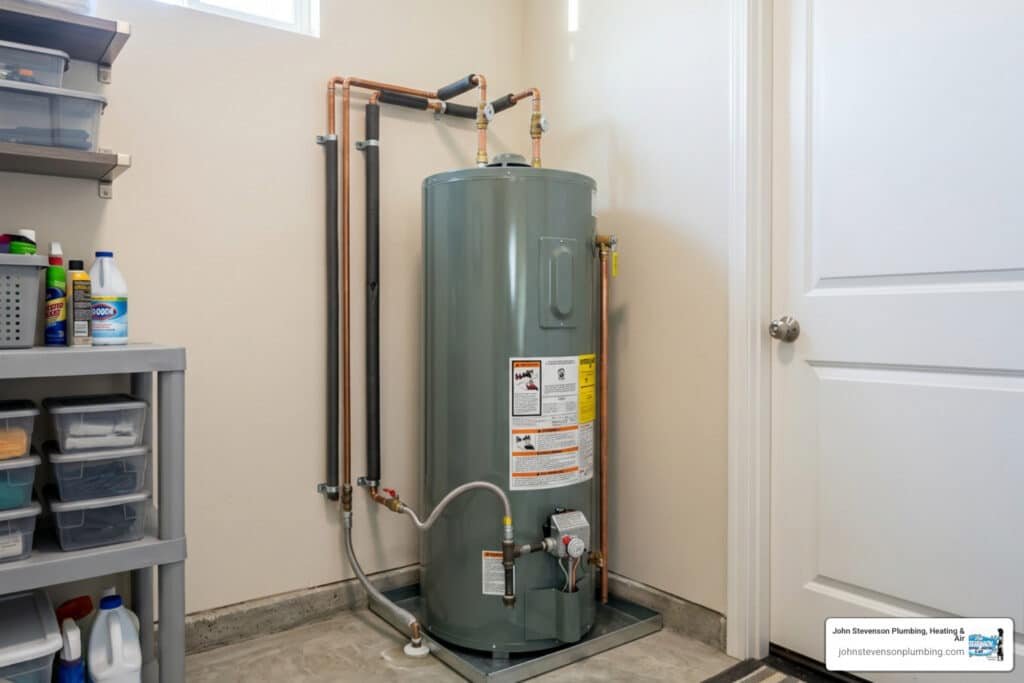
Is It Time? How to Know When Should You Replace Your Water Heater
Knowing when should you replace your water heater can save you from a flooded utility room, a string of cold showers, and a costly emergency call — here is a quick answer:
Replace your water heater if any of the following are true:
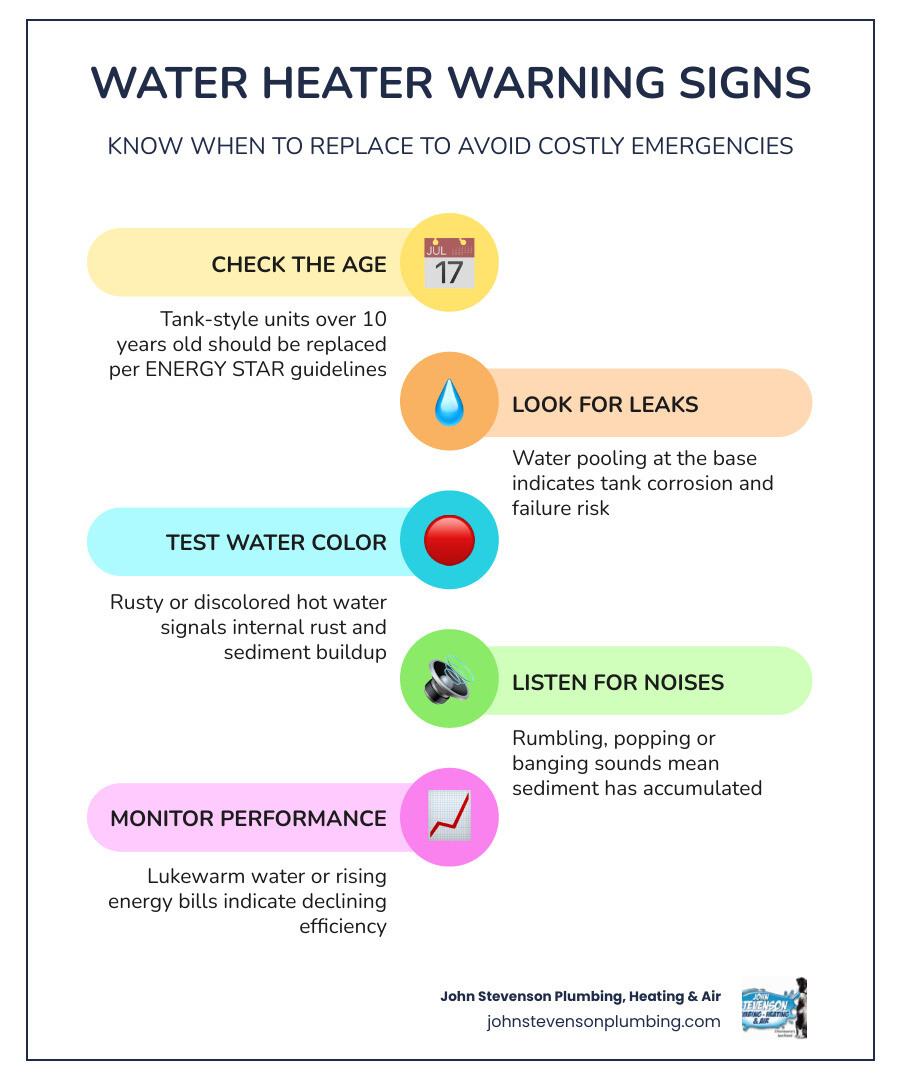
- Age: Your tank-style water heater is 10 or more years old (ENERGY STAR’s recommended threshold)
- Leaks: There is water pooling around the base of the unit
- Rust: Hot water coming from your taps looks rusty or discolored
- Noises: You hear rumbling, popping, or banging from the tank
- Lukewarm water: The unit struggles to heat water consistently
- Rising energy bills: Your utility costs have crept up without a clear reason
- Frequent repairs: You have needed repairs more than twice in the past year
If none of those apply and your unit is under 8 years old, a repair may still make sense — but keep reading to be sure.
Hot water is one of those things you only notice when it is gone. For homeowners in Carlsbad, CA and across San Diego County, an unexpected water heater failure does not just mean a cold shower — it can mean a flooded room, damage to flooring and walls, and a scramble to find a plumber on short notice. According to home maintenance research, water heater failures account for roughly 25% of all water damage insurance claims, and emergency replacements can cost significantly more than planned ones.
The good news is that most water heaters give clear warning signs before they fail completely. Understanding those signs — and knowing the typical lifespan of your system — puts you in control of the decision rather than letting a sudden breakdown make it for you.
This guide walks you through everything you need to know: how long different types of water heaters last, the warning signs that matter most, how to weigh repair against replacement, and the factors specific to your home and lifestyle that should shape your decision.
When should you replace your water heater terms to know:
- how long does a water heater last
- how to extend the life of your water heater
- signs your water heater is going out
Understanding Water Heater Lifespan: Tank vs. Tankless
To determine when should you replace your water heater, you first need to look at the baseline performance and life expectancy of the specific type of system installed in your home. Not all water heaters are built the same way, and their internal components degrade at very different rates.
In Southern California, particularly in areas like Carlsbad, Oceanside, and Irvine, our local water supply often carries high mineral content. Hard water contains elevated levels of calcium and magnesium, which can accelerate the wear and tear on your plumbing systems. These minerals settle inside your water heater, forming a thick layer of sediment that acts as an insulating barrier, forcing the system to work much harder and shortening its overall operational life.
To help you understand what to expect, let us look at the fundamental differences in longevity and design between traditional storage tank units and modern tankless systems.
| Feature | Traditional Tank Water Heater | Tankless Water Heater |
|---|---|---|
| Typical Lifespan | 8 to 12 years (Average: 10 years) | 15 to 20 years (Up to 20+ years) |
| Heating Method | Continuously heats stored water | Heats water on-demand |
| Vulnerability | Internal rust, sediment, tank leaks | Scale buildup in heat exchanger |
| Maintenance Need | Annual flushing, anode rod replacement | Annual descaling, filter cleaning |
| Efficiency | Moderate (suffers from standby heat loss) | High (no standby heat loss) |
How long does a traditional tank water heater last?
A standard storage tank water heater keeps a large volume of water — usually between 40 and 50 gallons — hot and ready for use at all times. Because these units are constantly holding water under pressure and subjected to continuous heating cycles, they face relentless corrosive forces.
Most tank-based water heaters have a lifespan of approximately 8 to 12 years, with the average life of a water heater hovering right around 10 years.
To combat natural corrosion, manufacturers equip these tanks with a “sacrificial” anode rod. This rod, typically made of magnesium or aluminum, is designed to attract the corrosive elements in the water so that they attack the rod instead of the steel tank. However, once the anode rod completely depletes — which usually happens within 5 to 8 years depending on water quality — the steel tank itself begins to rust.
Additionally, sediment buildup at the bottom of the tank creates an insulating layer over the burner or heating elements. This causes the metal tank bottom to overheat, weakening the steel over time. Combined with the stress of thermal expansion — where the metal expands and contracts as water temperatures fluctuate — the tank eventually develops micro-cracks, leading to an irreversible leak.
How long does a tankless water heater last?
If you are looking for a system with a longer runway, tankless models are a highly popular alternative. Tankless water heaters have a slightly longer life expectancy of 15 to 20 years, and with meticulous maintenance, some can even last up to 25 years.
Instead of storing water, a tankless system uses a powerful heat exchanger to heat water on-demand as it flows through the unit. Because they do not hold a large volume of standing water, they are not prone to the same catastrophic tank rust-throughs that plague traditional systems.
However, they are not entirely immune to the effects of hard Southern California water. Over time, calcium scale can build up inside the narrow passages of the heat exchanger. If this scale is not cleared out through regular descaling, the heat exchanger will overheat and fail prematurely.
While the upfront transition to tankless requires a more detailed installation process, the system’s longevity and high energy efficiency make it a highly desirable upgrade for homeowners planning to stay in their homes for the long haul.
When Should You Replace Your Water Heater? Key Warning Signs
Waiting for your water heater to burst before taking action is a high-risk strategy. A sudden failure can lead to extensive property damage, mold growth, and a frantic emergency replacement where you have very little time to research your options.
By learning how to diagnose a failing water heater, you can spot the subtle red flags before they turn into major plumbing disasters. Here are the primary warning signs that indicate your system is nearing the end of its reliable service life.
Inconsistent temperatures and lukewarm water
One of the most common early warning signs is a noticeable decline in hot water delivery. If your morning showers are turning lukewarm halfway through, or if you have to wait significantly longer for hot water to reach your faucets, your system is struggling.
In electric water heaters, this issue is often caused by a failed upper or lower heating element, or a malfunctioning thermostat. In gas units, it could point to a failing gas valve, a degraded burner assembly, or a thick layer of sediment blocking heat transfer.
While individual components like thermostats or heating elements can sometimes be replaced on newer units, a persistent loss of heating capacity in a system approaching its tenth year usually indicates that the unit is reaching the end of its useful life. If you find yourself constantly adjusting the temperature dial just to get a comfortable shower, it is time to evaluate whether your water heater is still a reliable keeper.
Visible leaks, corrosion, and moisture
Water pooling around the base of your water heater is an immediate cause for concern. If you notice moisture, dampness, or active puddles, you must act quickly to determine the source of the leak.
Sometimes, a leak is simply coming from a loose plumbing connection or a dripping Temperature and Pressure (T&P) relief valve. These are relatively straightforward repairs. However, if the leak is originating from the bottom of the tank shell itself, the internal steel liner has corroded through.
Because storage tanks are sealed, pressurized vessels, a leaking tank body cannot be patched or welded. A tank leak is a critical safety hazard and a sign of imminent failure, requiring immediate system replacement.
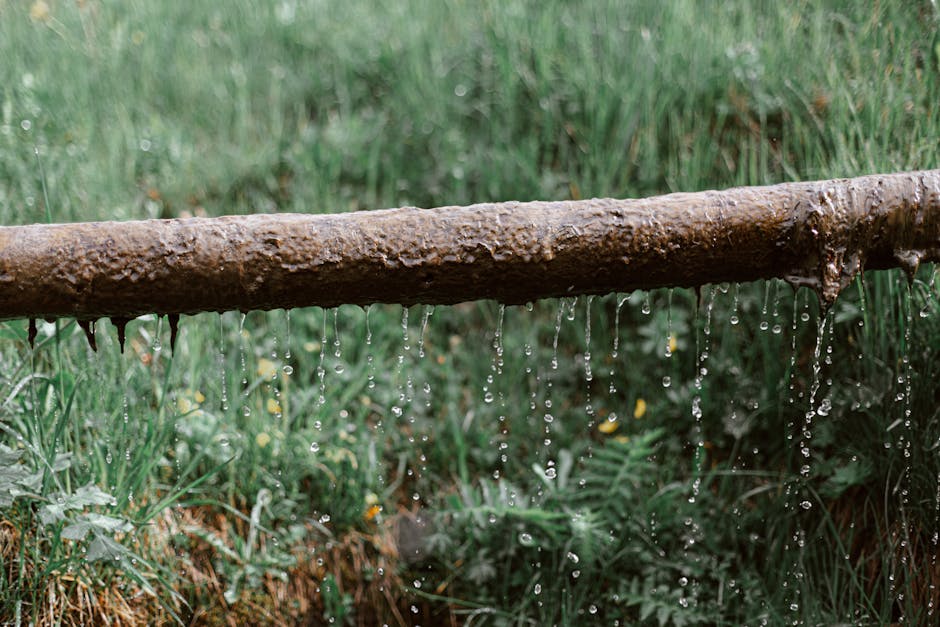
Keep an eye out for visible corrosion or heavy rust crusting around the inlet and outlet pipes, as well as the seams of the tank. This structural deterioration indicates that moisture has breached the outer casing, and a major leak is only a matter of time.
How age determines when should you replace your water heater
Even if your water heater seems to be performing quietly in the background, its age is one of the most reliable predictors of future failure. ENERGY STAR recommends replacing your storage water heater if it is more than 10 years old.
By the time a water heater reaches the decade mark, its internal components have endured years of high-pressure cycles, thermal stress, and mineral exposure. Even if it is not actively leaking, an older unit operates at a fraction of its original energy efficiency, quietly driving up your monthly utility bills.
Furthermore, older units carry a much higher risk of sudden, catastrophic failure. In fact, statistics show that water heaters exceeding their recommended lifespan by three or more years experience a 67% higher rate of sudden failure.
If your water heater was installed over a decade ago, planning a proactive replacement allows you to choose the perfect replacement model under non-emergency conditions, ensuring you get the best efficiency and fit for your household.
Repair vs. Replacement: Making the Cost-Effective Choice
When your water heater acts up, you face a classic homeowner dilemma: do you pay for a repair, or do you invest in a brand-new system?
To make the most cost-effective decision, we recommend using a balanced decision framework. A great rule of thumb is the “One-Third Rule” or the “50% Rule.” If the cost of repairing your water heater exceeds one-third of the cost of a brand-new installation, and the unit is over 8 years old, replacement is almost always the smarter financial move.
Making the wrong choice can lead to “stacked repairs,” where you spend money fixing one component only to have another part fail a few months later. Let us break down how to evaluate your options so you can stop getting into hot water over your choice of water heater.
When repairs are still a viable option
Repairs are generally the best path forward if your water heater is relatively young — typically under 8 years old — and has been well-maintained. If the issue is isolated to a single, easily replaceable component, a professional repair can successfully extend the unit’s lifespan for several more years.
Common repairs that are highly cost-effective on younger units include:
- Replacing the thermostat: A faulty thermostat can cause water to be too hot, too cold, or inconsistent, but it is easily swapped out.
- Replacing electric heating elements: If an electric unit stops heating, replacing a burned-out element is a routine fix.
- Installing a new anode rod: If your water heater is between 5 and 8 years old and the tank is still in great shape, installing a fresh anode rod can double the remaining life of the tank.
- Replacing the T&P safety valve: If the safety relief valve is dripping, replacing it is a simple and necessary safety measure.
If your system is clean, free of rust, and has been flushed regularly, investing in a minor repair is a highly practical way to maximize your original investment.
When replacement becomes the smarter investment
On the other hand, pouring money into an aging, inefficient system is often a case of throwing good money after bad. If your water heater is over 10 years old, even minor repairs are rarely a permanent fix. The internal tank corrosion and sediment buildup will continue to worsen, leading to inevitable failure.
Replacement is the clear winner when:
- The tank itself is leaking: As mentioned, there is no repair for a corroded, leaking tank.
- You experience frequent breakdowns: If you have needed professional service more than twice in the past year, your system is signaling systemic wear.
- Severe sediment buildup causes heavy rumbling: If years of hard water have baked a thick crust of sediment onto the bottom of the tank, the metal has likely been structurally weakened by overheating.
- Your energy bills are climbing: Modern water heaters are vastly more efficient than those built a decade ago. Upgrading allows you to immediately lower your operating costs.
Choosing to replace a failing unit proactively also gives you the opportunity to upgrade your home’s technology. Many homeowners find that going tankless is an excellent way to save money in the long run, thanks to lower energy consumption and an extended equipment lifespan.
Crucial Factors: Location, Safety, and Local Regulations
The decision of when should you replace your water heater is not just about age and performance; it is also heavily influenced by where the unit is located in your home, safety considerations, and local building codes.
In Southern California, plumbing installations must adhere to strict guidelines to protect homes from water damage, gas leaks, and seismic activity. Let us look at how these external factors should shape your replacement timeline.
How installation location influences your decision
Where your water heater is installed plays a massive role in your risk tolerance. A water heater located in a garage or an outdoor utility closet presents a much lower risk of property damage if it develops a sudden leak. In these scenarios, you might feel comfortable pushing the unit a bit closer to the end of its lifespan.
However, if your water heater is installed in an attic, a second-floor closet, or inside a finished living area, a sudden tank failure can be catastrophic. A burst tank can quickly dump dozens of gallons of water through your ceiling, destroying drywall, flooring, electrical systems, and personal belongings.
If your unit is in a high-risk location, we strongly recommend proactive replacement as soon as the unit reaches the 10-year mark. Additionally, modern installations in these areas should always feature:
- A sturdy drain pan: Positioned under the unit and piped to a safe disposal location to catch minor leaks.
- An automatic water shutoff valve: This smart device detects moisture at the base of the unit and instantly shuts off the incoming water supply, preventing a continuous flood if the tank fails while you are away.
Safety hazards that require immediate replacement
Some water heater issues go beyond simple performance inconveniences and become active safety hazards for your household. If you encounter any of the following issues, you should shut off the system immediately and contact a professional for replacement:
- Scorched or melted wiring/gas valves: This indicates severe electrical faults or combustion issues that pose a fire hazard.
- Exhaust venting issues: If a gas water heater is backdrafting carbon monoxide into your home rather than venting it safely outdoors, it is a life-threatening safety issue.
- Severe water contamination: If your hot water consistently smells like sulfur, looks black, or carries heavy debris even after a system flush, internal tank degradation may have reached a point where the water is no longer safe.
Furthermore, when replacing a water heater in California, the installation must comply with the California Plumbing Code. This includes securing proper permits, installing seismic bracing straps to protect against earthquakes, and ensuring correct combustion air venting. To keep your home safe and compliant, make sure you understand the California Plumbing Code water heater rules and the importance of obtaining a permit for your water heater replacement.
Lifestyle Changes and Upgrading for the Future
Your home is a dynamic environment, and the water heater that met your needs a few years ago might not be the right fit for your household today. When deciding how to choose the right water heater for your home, it is essential to look forward and consider how your household’s demands and technology are evolving.
How household changes affect when should you replace your water heater
Sometimes, a perfectly functional water heater needs to be replaced simply because your lifestyle has outgrown it.
- A growing family: If you have welcomed new children, or if extended family has moved in, your hot water demand will naturally spike. If your current 40-gallon tank leaves the third person in line with a freezing shower, upgrading to a larger tank or a tankless system is a great way to restore daily comfort.
- Home renovations: If you are remodeling a bathroom, adding a high-flow soaking tub, or installing a multi-head luxury shower, your existing water heater likely won’t have the capacity to keep up. Planning your water heater upgrade alongside your renovation ensures your new fixtures perform beautifully.
- Selling your home: If you plan to put your home on the market in Carlsbad or Orange County, an ancient, rusting water heater will immediately be flagged by home inspectors. Replacing it proactively shows buyers that the home has been meticulously maintained, preventing last-minute negotiation hurdles or price reductions.
Financial and environmental benefits of modern upgrades
Upgrading your water heater is also an excellent opportunity to reduce your home’s carbon footprint and cut down on monthly operating costs.
Modern water heating technology has advanced significantly. For example, ENERGY STAR certified electric heat pump water heaters (also known as hybrid water heaters) are incredibly efficient. They pull heat from the surrounding air and transfer it to the water, using up to 70% less electricity than standard electric models. For a typical family, this efficiency can translate into hundreds of dollars in annual utility savings.
Furthermore, as of June 2026, there are substantial financial incentives available to help offset the cost of upgrading to high-efficiency systems. Under the Inflation Reduction Act, homeowners can claim federal tax credits of up to $2,000 for qualifying heat pump water heaters. When you combine these federal incentives with local utility rebates available throughout San Diego and Orange Counties, upgrading to an eco-friendly system is more accessible than ever.
Frequently Asked Questions about Water Heater Replacement
Can a leaking water heater be repaired?
If the leak is coming from a loose pipe fitting, a flexible connector, or the temperature and pressure relief valve, it can absolutely be repaired by a professional plumber. However, if the leak is originating from the bottom or sides of the steel tank shell itself, it cannot be repaired. This type of leak indicates that internal corrosion has eaten through the metal liner, and the entire water heater must be replaced immediately to prevent major water damage.
How do I find the exact age of my water heater?
You can easily find the age of your water heater by looking at the manufacturer’s data plate on the side of the tank. Look for the serial number, which contains a coded manufacture date. For most major brands, the first two digits of the serial number represent the year, or the serial number starts with a letter representing the month (A for January, B for February, etc.) followed by two digits for the year. You can copy down the serial number and brand name, then check the manufacturer’s website or an online serial number decoder to find the exact month and year your unit was built.
What maintenance can extend my water heater’s lifespan?
To get the absolute most out of your water heater, you should perform three key maintenance tasks:
- Flush the tank annually: Drain a few gallons of water from the drain valve at the bottom of the tank once a year to flush out mineral sediment.
- Inspect the anode rod: Have a professional check your sacrificial anode rod every 2 to 3 years, and replace it once it is heavily degraded to protect your tank from rust.
- Test the T&P valve: Gently lift the lever on the temperature and pressure relief valve annually to ensure it opens and closes freely, which prevents dangerous pressure buildup.
Conclusion
Determining when should you replace your water heater is all about balancing age, performance, and risk. While it can be tempting to ignore your water heater as long as the water runs warm, taking a proactive approach protects your home from catastrophic water damage, lowers your energy bills, and ensures your family never has to face an icy morning surprise.
If your water heater is approaching the ten-year mark, showing signs of rust, or struggling to keep up with your household’s daily demands, do not wait for a major leak to make the decision for you. Planning a replacement on your own terms allows you to explore modern, high-efficiency options — like hybrid heat pumps or tankless systems — and take full advantage of available tax credits and utility rebates.
At John Stevenson Plumbing, Heating & Air Conditioning, we are proud to serve Carlsbad, CA, and communities throughout San Diego and Orange Counties. Our team of certified technicians is dedicated to helping you find the perfect water heating solution for your home. We stand behind our work with our 5-Star Service Guarantee, which means you can count on thorough diagnostics, clear upfront pricing, highly trained technicians, and a 24-hour satisfaction check-in to make sure you are completely happy with your service.
Ready to explore your options or schedule a professional inspection? Contact us today to learn more about our comprehensive Orange County Water Heater Services and find the perfect fit for your home’s comfort.