
Do Tankless Water Heaters Save Money Over Time? Here’s What Carlsbad Homeowners Need to Know
Do tankless water heaters save money over time? Yes — but the full answer depends on your household size, energy source, and how long you plan to stay in your home. Here’s a quick breakdown:
Quick Answer:
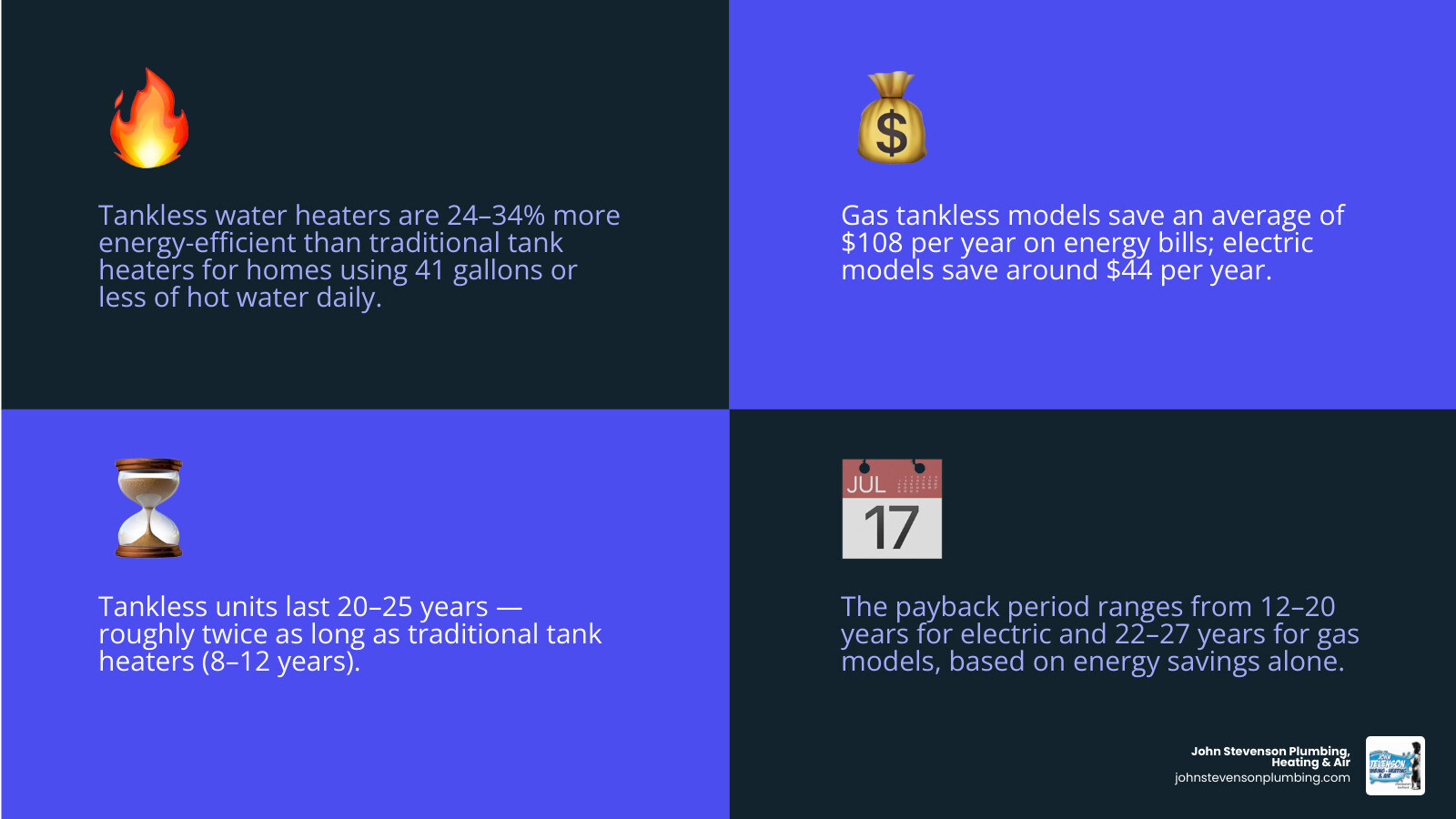
- Tankless water heaters are 24–34% more energy-efficient than traditional tank heaters for homes using 41 gallons or less of hot water daily
- Gas tankless models save an average of $108 per year on energy bills; electric models save around $44 per year
- Tankless units last 20–25 years — roughly twice as long as traditional tank heaters (8–12 years)
- The payback period ranges from 12–20 years for electric and 22–27 years for gas models, based on energy savings alone
- Rebates and tax credits (including the federal Section 25C credit) can shorten that payback window significantly
- For many homeowners, the long-term combination of lower energy bills, a longer lifespan, and avoided replacement costs adds up to real savings
Your water heater quietly runs in the background every day — heating water for showers, dishes, and laundry whether you’re using it or not. Traditional tank heaters keep 30 to 80 gallons of water hot around the clock, even at 2 a.m. when no one’s home. That constant reheating, known as standby heat loss, accounts for roughly 13% of the average American household’s annual energy bill. Tankless water heaters eliminate that waste by heating water only when you need it. But with a higher upfront cost and potential infrastructure upgrades required, many homeowners in Carlsbad, CA wonder whether making the switch is actually worth it in the long run. This guide breaks down the real numbers so you can decide with confidence.
Do Tankless Water Heaters Save Money Over Time?
To understand how a tankless system impacts your finances, we have to look past the monthly utility bill and evaluate the total cost of ownership over a 20-year horizon. When you ask, “do tankless water heaters save money over time“, the answer lies in the fundamental difference in how these systems operate.
Traditional storage tank water heaters are essentially giant, insulated kettles. They use energy constantly to maintain a pre-set temperature for dozens of gallons of water. This continuous cycle leads to standby energy loss, which is essentially money evaporating from your wallet while you sleep or work.
In contrast, a tankless water heater remains idle until you turn on a hot water tap. Instantly, high-powered burners or electric elements ignite, heating the cold water as it flows through a compact heat exchanger.

Over a 10-year period, a traditional tank can sometimes appear cheaper on paper because of its lower upfront installation cost. However, when you extend that timeline to 20 years, the financial math shifts dramatically. Because a tankless system avoids constant cycling and standby loss, it uses significantly less fuel. When you partner this daily efficiency with a much longer operational life, the long-term savings become clear.
For a deeper dive into the lifestyle and financial motivations behind this transition, check out our guide on Why Homeowners Are Going Tankless to Save Money.
How Daily Water Usage Affects Whether Tankless Water Heaters Save Money Over Time
Your household’s daily hot water consumption is one of the most critical factors determining your actual savings. The U.S. Department of Energy has found that the efficiency gains of tankless systems are closely tied to how much water you use:
- Low-Demand Homes (Under 41 Gallons/Day): In smaller households, tankless systems are 24% to 34% more energy-efficient than conventional storage tanks. This is because standby heat loss makes up a much larger percentage of a small household’s total energy footprint.
- High-Demand Homes (Around 86 Gallons/Day): For larger families, tankless units are 8% to 14% more energy-efficient.
While a smaller household enjoys a higher percentage of energy savings, a larger household will often see greater absolute dollar savings on their monthly bills because their total volume of hot water usage is much higher.
However, high demand also introduces flow rate limitations. Tankless water heaters are rated by how many gallons of water they can heat per minute (GPM). If your family frequently runs the dishwasher, the washing machine, and multiple showers simultaneously, a single tankless unit may struggle to keep up, leading to a temporary drop in temperature.
To avoid this, proper sizing is essential. You can learn more about finding the perfect fit for your household in our article Everything You Need to Know About What Size Water Heater Do I Need.
How Lifespan and Durability Help Tankless Water Heaters Save Money Over Time
The real secret to tankless water heater savings isn’t just the lower monthly gas or electric bill—it’s the equipment’s longevity.
Traditional tank water heaters have a relatively short lifespan of 8 to 12 years. They fail primarily because they store water constantly. Over time, the internal steel tank is subjected to relentless thermal expansion, sediment settling, and corrosive mineral attacks. Once the sacrificial anode rod inside the tank depletes, the steel begins to rust, eventually leading to a catastrophic leak or tank rupture.
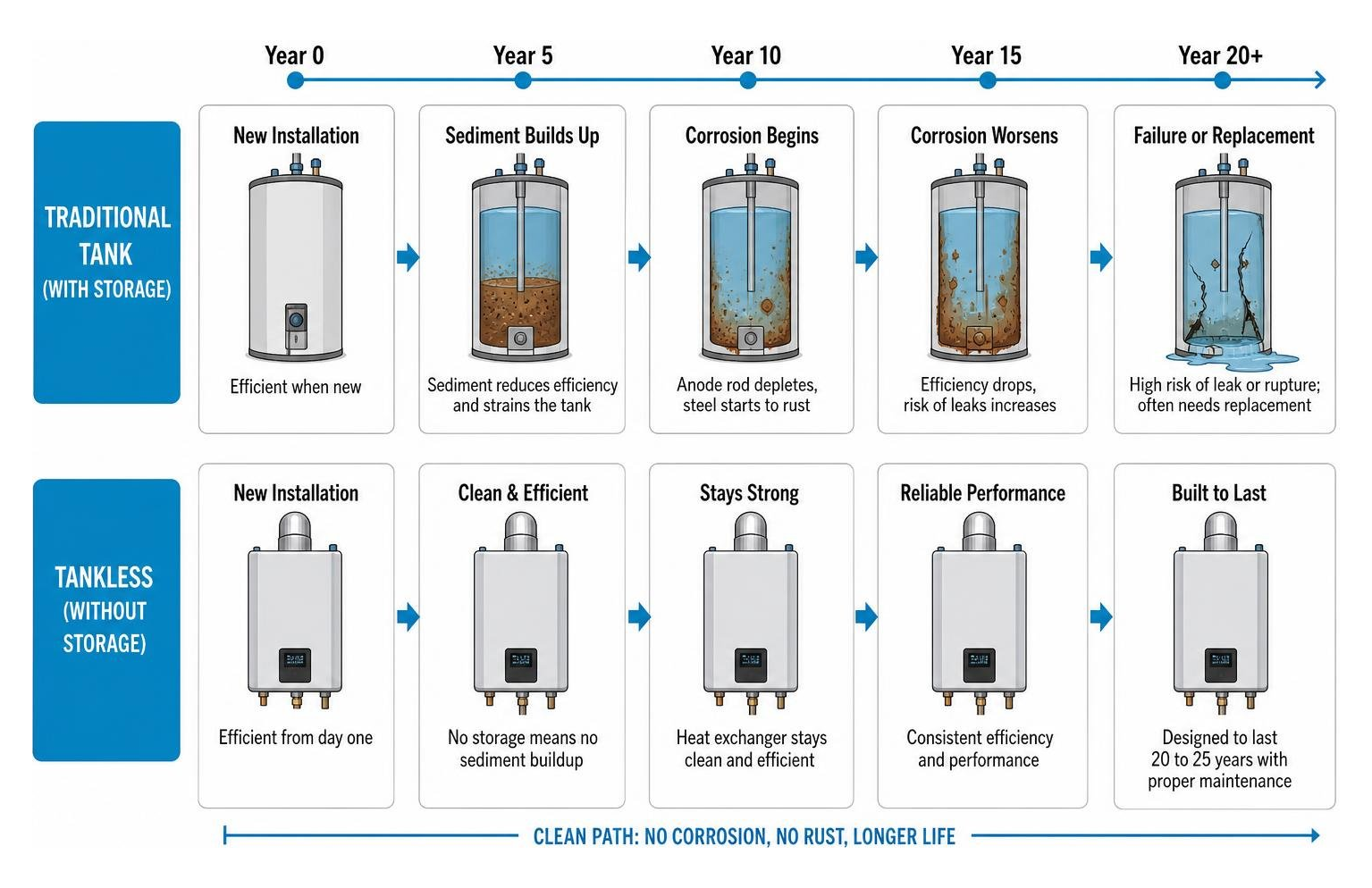
Tankless water heaters, on the other hand, do not store water. They feature durable copper or stainless steel heat exchangers that only encounter water flow on demand. Because they lack a massive steel tank that can rust out, a well-maintained tankless water heater typically lasts 20 to 25 years.
By choosing a tankless system, you are effectively avoiding the need to purchase and install a second traditional tank heater halfway through that same 20-year period. This avoided replacement cost is a massive factor in the overall return on investment.
To learn more about how long-term durability affects your home’s plumbing budget, read our detailed breakdown: Don’t Get Into Hot Water Over Your Heater’s Lifespan.
Comparing the Financial Trade-Offs of Tank vs. Tankless Systems
Choosing the right water heater requires balancing upfront installation requirements against long-term operational performance. To help visualize these differences, let’s look at how these systems compare side-by-side:
| Feature | Traditional Storage Tank | Tankless Water Heater |
|---|---|---|
| Average Lifespan | 8 to 12 Years | 20 to 25 Years |
| Energy Efficiency (UEF) | 0.60 to 0.70 | 0.81 to 0.96 |
| Standby Energy Loss | Yes (Continuous) | No (On-Demand Only) |
| Physical Space Required | Large footprint (30–80 gallons) | Compact (Suitcase-sized, wall-mounted) |
| Risk of Flooding | High (Up to 80 gallons of stored water) | Very Low (No stored water) |
| Upfront Installation | Standard / Plug-and-Play | Higher complexity / Potential retrofits |
While a tankless system requires a larger initial investment, it offers superior efficiency, space savings, and a dramatically reduced risk of water damage. For a comprehensive look at making this decision, see our guide on Choosing the Right Water Heater for Your Home.
Upfront Installation and Infrastructure Upgrades
One of the most common reasons homeowners hesitate to go tankless is the complexity of the initial installation. Only about one in five tankless replacements is a simple “plug-and-play” swap. Because these units require significant power to heat water instantly, your home may need some infrastructure upgrades:
- Gas Line Upgrades: Standard gas tank heaters typically require around 30,000 to 40,000 BTUs of gas. A gas-fired tankless heater, however, requires between 150,000 and 200,000 BTUs to heat water on demand. This often means we must upsize your gas line from a standard 1/2-inch line to a 3/4-inch line to deliver sufficient fuel.
- Venting Modifications: Non-condensing gas tankless units exhaust extremely hot air, requiring Category III stainless steel venting. Condensing gas models recover extra heat from exhaust gases, allowing us to use less expensive venting materials like Schedule 40 PVC, but they do require a dedicated drain line for the acidic condensate.
- Electrical Panel Capacity: Whole-house electric tankless heaters draw massive amounts of instantaneous power—often between 27 and 36 kW. This requires 120 to 150 amps of dedicated capacity, which frequently necessitates upgrading an older home’s electrical service panel.
We always recommend having a licensed professional evaluate your home’s existing infrastructure first. You can explore these structural requirements further in our In-Depth Guide to Energy-Efficient Water Heater Options.
Monthly Utility Bill Savings
Once a tankless system is installed, the monthly savings begin. By eliminating standby energy loss, a tankless unit dramatically reduces your daily energy consumption.
A water heater’s efficiency is measured by its Uniform Energy Factor (UEF). Traditional gas tanks typically have a UEF between 0.60 and 0.70. Condensing gas tankless water heaters can achieve a UEF of up to 0.96, meaning 96% of the energy consumed goes directly into heating your water, with only 4% lost in the process.
This translates directly to lower utility bills. An ENERGY STAR® certified condensing gas tankless water heater saves a typical four-person household about $95 per year on gas bills compared to a standard tank. Over its lifetime, that adds up to $1,800 or more in direct energy savings.
If you are trying to decide which energy source is best for your Southern California home, check out our resource: In-Depth Guide to Gas vs Electric Water Heater Which Is Better.
Maximizing Your Investment with Maintenance and Rebates in Carlsbad, CA
Living in coastal Southern California brings beautiful weather, but it also presents unique challenges for your home’s plumbing. To ensure your tankless water heater achieves its full 20-plus year lifespan and continues to save you money, proactive maintenance and local financial incentives are key.
The Impact of Hard Water and Maintenance on Savings
The municipal water supply in Carlsbad, San Diego County, and Orange County is notoriously hard, often containing high levels of dissolved calcium and magnesium.
When hard water is heated inside a tankless unit, these minerals solidify and cling to the copper heat exchanger. Over time, this scale buildup acts as an insulating barrier. The burner has to work harder and run longer to heat the water through the layer of scale, which slowly erodes your monthly energy savings. If ignored, severe mineral scale can cause the heat exchanger to overheat and crack, leading to premature system failure.
To protect your investment, we recommend:
- Annual Descaling Flushes: Flushing the system with a food-grade vinegar solution once a year clears away scale and restores peak heating efficiency.
- Water Softener Integration: Installing a whole-house water softener is the ultimate way to protect your plumbing. Running softened water through a tankless system virtually eliminates scale buildup, ensuring it runs efficiently for its full 20-year potential.
Regular care is the best way to avoid unexpected breakdowns. For tips on keeping your system running smoothly, read our guide on How to Extend the Life of Your Water Heater. If you aren’t sure where your current system stands, you can learn the warning signs in How to Know When to Replace Your Water Heater.
Leveraging California Rebates and Tax Credits
The state of California and the federal government offer excellent financial incentives to help homeowners transition to energy-efficient appliances. These programs can significantly offset your upfront installation expenses:
- Federal Section 25C Tax Credit: Under the Inflation Reduction Act (IRA), homeowners can claim a federal tax credit equal to 30% of the cost of installing a qualifying energy-efficient tankless gas water heater (with a UEF of 0.95 or higher), up to a maximum of $600.
- Local Utility Rebates: Regional utility providers frequently offer rebates for upgrading to high-efficiency gas tankless water heaters.
By stacking federal tax credits with local utility incentives, you can drastically shorten your system’s payback period.
To explore available local savings, see our guide on Don’t Sweat the Cost With These California HVAC and Water Heater Rebates and discover how federal programs can help in How the IRA Makes Your California Home Efficiency Upgrade Much Cheaper.
Frequently Asked Questions About Tankless Water Heater Savings
What is the typical payback period for a tankless water heater?
On energy savings alone, the payback period is typically 12 to 20 years for electric models and 22 to 27 years for gas models. However, this timeline is shortened significantly when you factor in local rebates, federal tax credits, and the avoided cost of buying a second traditional tank water heater ten years down the road.
Do tankless water heaters work during a power outage?
No. Even gas-powered tankless water heaters require electricity to operate their digital control boards, safety sensors, and electronic ignition systems. If you live in an area prone to seasonal power outages, we can help you set up a small battery backup or an uninterruptible power supply (UPS) to keep your hot water flowing during a blackout.
Is a heat pump water heater a better financial choice than tankless?
For homes that are entirely electric, a hybrid heat pump water heater is often the most cost-effective option available. Heat pump water heaters operate like a refrigerator in reverse, pulling heat from the surrounding air to warm your water. They are incredibly efficient and qualify for federal tax credits of up to $2,000 under Section 25C. However, they still require a large footprint and do not offer the space-saving benefits or endless hot water of a tankless system.
Conclusion
So, do tankless water heaters save money over time? When you look at the big picture—combining lower monthly energy bills, a 20-plus year lifespan, and the prevention of costly water damage—a tankless water heater is a highly rewarding long-term investment for many Southern California homeowners.
At John Stevenson Plumbing, Heating & Air Conditioning, we are committed to helping you make the right choice for your home. Our USP is our 5-Star Service Guarantee, which includes thorough diagnostics, upfront pricing, certified technicians, and a 24-hour satisfaction check-in to ensure your new system is operating perfectly. Whether you are in Carlsbad, Oceanside, Vista, or anywhere in San Diego or Orange County, we are here to provide dependable, professional service.
Ready to stop paying to heat water you aren’t using? Schedule Professional Water Heater Services in Carlsbad with us today, and let our friendly team help you maximize your home’s comfort and energy efficiency.