
Is a Gas or Electric Water Heater Better for Your Carlsbad Home?
When it comes to gas vs electric water heater which is better for your home, the honest answer is: it depends. Neither type wins outright. The right choice comes down to your home’s existing setup, your household’s hot water demand, and your local utility rates in Carlsbad and the greater San Diego area.
Here’s a quick breakdown to help you decide fast:
| Factor | Gas Water Heater | Electric Water Heater |
|---|---|---|
| Best for | High-demand households, existing gas lines | Smaller households, all-electric homes |
| Recovery rate | 30-45 gallons per hour | 14-20 gallons per hour |
| Energy efficiency | 60-70% (up to 80% high-efficiency) | 90-95% |
| Lifespan | 8-12 years | 10-15 years |
| Works in power outage? | Often yes (standing pilot models) | No |
| Environmental edge | Lower direct cost in most markets | Better when grid uses renewables |
| Installation complexity | Requires gas line + venting | Requires 240V circuit |
Water heating accounts for roughly 18% of a home’s total energy use — so this decision will affect your utility bills for the next decade or more. Whether your current unit is aging out or you’re building new, understanding the real differences between these two systems is the smartest first step. Read our guide on How to Know When to Replace Your Water Heater if you’re not sure whether a replacement is even needed yet.
Gas vs electric water heater which is better basics:
Core Operational Differences: Gas vs Electric Water Heater Which Is Better?
To determine gas vs electric water heater which is better for your household, it helps to understand how each system generates and maintains hot water. While both types store water in an insulated tank, their heating mechanisms, venting demands, and overall infrastructure requirements are completely different.
When choosing a new system, we always recommend looking closely at Choosing the Right Water Heater for Your Home to ensure the physical footprint and power requirements match what your home can support.
| Specification | Standard Gas Tank | Standard Electric Tank |
|---|---|---|
| Primary Heat Source | Natural gas or propane burner | Electric resistance elements |
| Venting Requirements | Metal or PVC exhaust venting required | None |
| Electrical Needs | None (unless power-vented) | Dedicated 240V, 30-amp circuit |
| Standby Loss Rate | Moderate (loses heat through exhaust flue) | Low (insulated tank, no flue required) |
| Heat Output Transfer | Indirect (burns fuel below tank) | Direct (elements submerged in water) |
How Gas Water Heaters Work
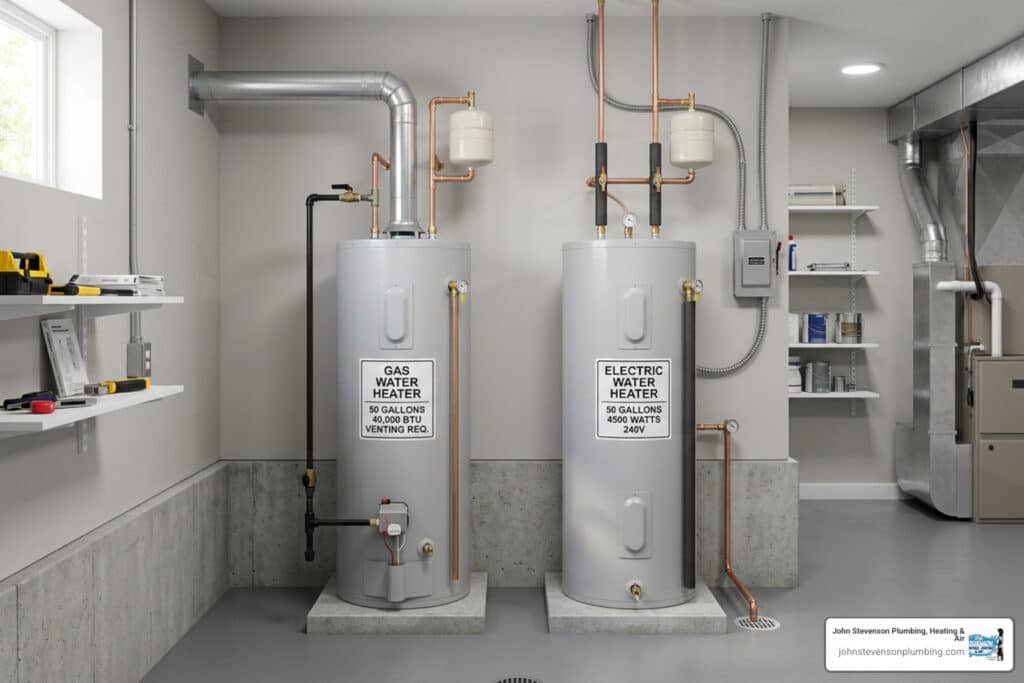
Gas water heaters rely on combustion. A burner located at the bottom of the tank ignites natural gas or propane to heat the water from below. The hot exhaust gases travel up through a central flue inside the tank, transferring additional heat to the surrounding water before exiting through a dedicated venting system.
Older gas models utilize a standing pilot light that burns continuously to ignite the main burner when needed. Modern, high-efficiency gas units often use electronic ignition systems to save fuel, though these require a nearby electrical outlet to operate. Because gas units burn fossil fuels, they require proper ventilation to safely carry combustion byproducts outside your home. To prevent unexpected cold showers, check out our guide to Stop Getting Into Hot Water Over Your Choice of Water Heater.
How Electric Water Heaters Work
Electric water heaters use electric resistance heating elements. These elements are positioned inside the tank, directly submerging themselves in the water to heat it. When the thermostat detects a temperature drop, it sends electricity to the elements, which heat up rapidly.
Because there are no combustion gases to vent, electric models do not require a chimney or flue. This lack of venting means electric tanks lose less heat to the environment during standby periods than gas units, which constantly lose a small amount of heat through their venting systems. For a deeper dive into these mechanisms, read our In-Depth Guide to Energy Efficient Water Heater Options.
Sizing, Performance, and Efficiency Options
Choosing the right water heater requires balancing your household’s peak hot water demand with long-term energy efficiency. Two key metrics to look for on any water heater’s yellow EnergyGuide label are the First Hour Rating (FHR) and the Uniform Energy Factor (UEF).
FHR tells you how many gallons of hot water the unit can deliver in its first hour of operation starting with a fully heated tank. UEF is the Department of Energy’s standard measurement for water heater efficiency—the higher the number, the more efficiently the unit converts energy into hot water. If your current unit is struggling to keep up with your household’s demands, learn How to Diagnose a Failing Water Heater.
Sizing a Gas vs Electric Water Heater Which Is Better for Large Families?
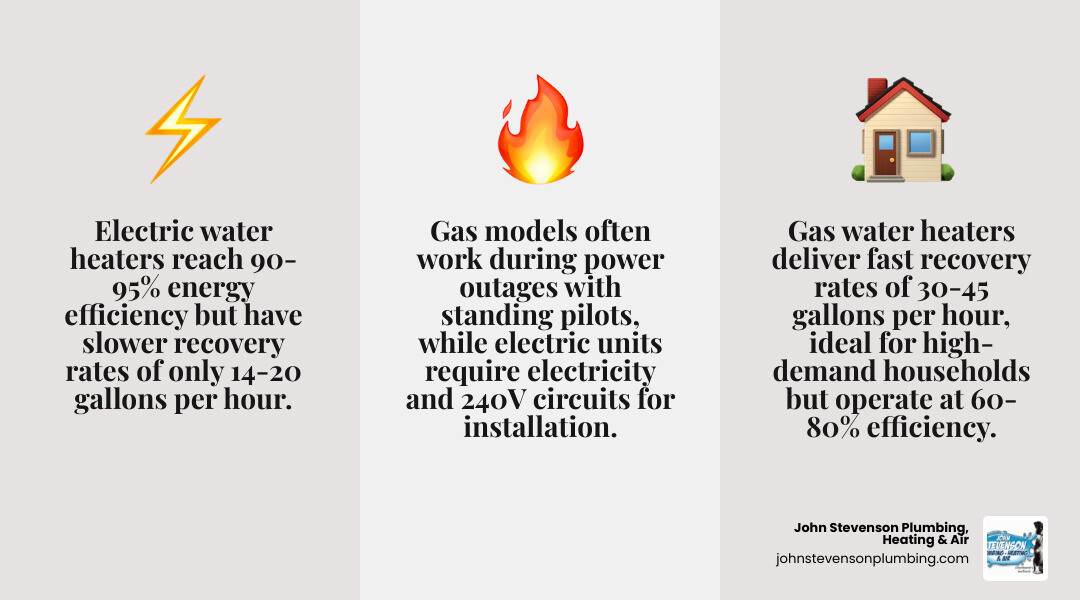
For high-demand homes with large families, gas water heaters often hold a distinct performance advantage. Gas units typically recover between 30 and 45 gallons of hot water per hour, which is nearly double the recovery rate of standard electric models (14 to 20 gallons per hour).
If your household has multiple people taking back-to-back morning showers while the dishwasher or washing machine is running, a gas water heater can replenish its hot water supply fast enough to prevent utility bottlenecks. A smaller 40-gallon gas unit can often match or outperform a larger 50-gallon electric unit in terms of real-world recovery speed.
Sizing a Gas vs Electric Water Heater Which Is Better for Smaller Households?
For retired couples, small apartments, or smaller households with lower peak hot water demands, electric water heaters are often the superior choice. Because electric models do not require complex venting systems or gas lines, they can be safely installed in compact spaces, tight utility closets, or under-stair areas where a gas unit cannot go.
While their recovery rate is slower, smaller households rarely exceed the capacity of a standard electric tank. Additionally, electric models convert 90% to 95% of their energy directly into heat, making them highly efficient at maintaining water temperature when hot water demand is low.
Heat Pump (Hybrid) Water Heaters vs Standard Options
If you are looking for the absolute highest energy efficiency in 2026, heat pump (hybrid) water heaters are the gold standard. Instead of generating heat directly through resistance elements, a heat pump water heater pulls heat from the surrounding air and transfers it into the water tank.
This process makes heat pump models two to four times more energy-efficient than conventional electric water heaters, achieving impressive UEF ratings of 3.5 to 4.0 (compared to 0.67 to 0.82 for gas storage tanks).
While they require a larger upfront investment and specific space requirements (usually requiring 700 to 1,000 cubic feet of surrounding air space to function efficiently), the long-term utility savings are unmatched. Even better, local programs make these upgrades highly affordable. Carlsbad and San Diego homeowners can learn more by reading how San Diego Homeowners Can Save Big on Heat Pumps With SDG&E Incentives and exploring How the IRA Makes Your California Home Efficiency Upgrade Much Cheaper.
Tankless Water Heater Alternatives
Tankless (or on-demand) water heaters are another excellent alternative to standard storage tanks. These systems eliminate the tank entirely, heating water instantaneously via a powerful heat exchanger as it flows to your tap.
Gas-fired tankless heaters are particularly popular because they can achieve flow rates of 2 to 5 gallons per minute, providing an endless supply of hot water. For homes using 41 gallons or less of hot water daily, gas tankless models can be 24% to 34% more energy-efficient than conventional storage tanks by completely eliminating standby energy losses. Discover more about this technology in our guide on Why Homeowners Are Going Tankless to Save Money.
Installation, Safety, and California Compliance Rules
Installing a water heater in Southern California involves strict building codes, safety standards, and regional environmental regulations. Whether you choose gas or electric, your installation must comply with local rules to protect your home and maintain your property’s resale value.
Before committing to a system, make sure you understand the regional permitting process by reading Permit or Perish: Your Guide to California Water Heater Replacements and reviewing Don’t Get Burned by California Plumbing Code Water Heater Rules.
California Earthquake Bracing and Safety Codes
Because our service area spans active seismic zones from San Diego to Orange County, the California Plumbing Code mandates strict earthquake safety measures for all water heaters. Storage tank water heaters must be securely anchored, strapped, or braced to prevent them from tipping over during an earthquake.
This requirement typically involves installing heavy-duty metal straps at the top and bottom thirds of the tank, anchored directly into the wall studs. This safety measure prevents gas line ruptures, water damage, and electrical fires. For a complete breakdown of these requirements, see The Ultimate Guide to California Earthquake Bracing for Water Heaters.
Challenges of Switching Fuel Types
Converting your home from gas to electric—or electric to gas—is entirely possible, but it is rarely a simple swap.
- Gas-to-Electric Conversions: Switching to a standard electric tank or a hybrid heat pump requires running a dedicated 240V, 30-amp circuit from your main electrical panel to the water heater closet. If your current electrical panel is fully loaded, you may also need a panel upgrade to support the new electrical load. You will also need a professional to safely cap and seal the old gas line.
- Electric-to-Gas Conversions: Switching to gas requires installing a brand-new gas line from your home’s gas meter to the installation site. You must also install a dedicated venting system through your roof or exterior wall to safely exhaust combustion gases, which can be highly complex depending on the location of the utility closet.
Maintenance, Lifespan, and Frequently Asked Questions
Like any major home appliance, a water heater requires routine care to reach its full life expectancy. Over time, naturally occurring minerals in our Southern California water supply settle to the bottom of the tank, forming a thick layer of sediment. This sediment acts as a barrier between the heating source and the water, forcing the unit to run longer, work harder, and wear out prematurely.
To keep your system running smoothly, check out our practical tips on How to Extend the Life of Your Water Heater and learn what to expect regarding longevity in Don’t Get Into Hot Water Over Your Heater’s Lifespan.
Can I switch from a gas water heater to an electric model?
Yes, you can switch from gas to electric. However, it requires modifying your home’s infrastructure. You will need a licensed electrician to run a new 240-volt circuit and install a dedicated breaker. You will also need a professional plumber to safely disconnect, cap, and seal the existing gas line, and seal off the old exhaust venting. A professional assessment of your electrical panel’s capacity is highly recommended before making this decision.
Do gas water heaters work during a power outage?
It depends on the specific model:
- Standing Pilot Models: Older gas water heaters with a continuously burning pilot light and a mechanical gas valve do not require electricity to operate. They will continue to provide hot water during a power outage.
- Modern Electronic Ignition Models: Many modern, high-efficiency gas units use electronic igniters instead of a standing pilot light. These units, along with power-vented gas models that use an electric fan to push exhaust gases outside, require electricity and will not work during a blackout unless connected to a backup generator or battery power supply.
Which type of water heater is safer for my home?
Both gas and electric water heaters are incredibly safe when installed by licensed professionals according to local building codes.
Electric water heaters eliminate the risks associated with fossil fuel combustion, such as gas leaks and carbon monoxide exposure. Gas water heaters require proper venting and annual inspections to ensure the exhaust system remains clear and intact. To mitigate gas-related risks, homeowners should install carbon monoxide detectors within ten feet of any gas-burning appliance.
Conclusion
When deciding gas vs electric water heater which is better, there is no single “correct” option. If you have an active gas line, a large family, and high peak hot water demands, a modern gas or gas tankless system is often the most practical choice. If you live in an all-electric home, have a smaller household, or want to maximize your home’s efficiency with a hybrid heat pump, going electric is an excellent path forward.
No matter which path you choose, proper installation is the key to safety, efficiency, and system longevity. At John Stevenson Plumbing, Heating & Air Conditioning, we back every installation with our 5-Star Service Guarantee—which includes thorough diagnostics, upfront pricing, certified technicians, and a 24-hour satisfaction check-in to ensure your system is working flawlessly.
If you are ready to upgrade your home’s comfort, let our expert team help you make the right choice. Explore our local guides and services below:
- Hot Solutions: Finding Professional Water Heater Services in Carlsbad
- Who to Call: The Best Water Heater Technicians in Oceanside Without the Burn
- The Ultimate Escondido Water Heater Services Handbook
- Navigating Water Heater Repair and Services in Oceanside
- Don’t Get Into Hot Water Alone With Our Guide to Irvine Water Heater Technicians
Ready to get started? Schedule professional water heater services with John Stevenson Plumbing, Heating & Air Conditioning today!