
Is Your Water Heater Temperature Setting Costing You Money?
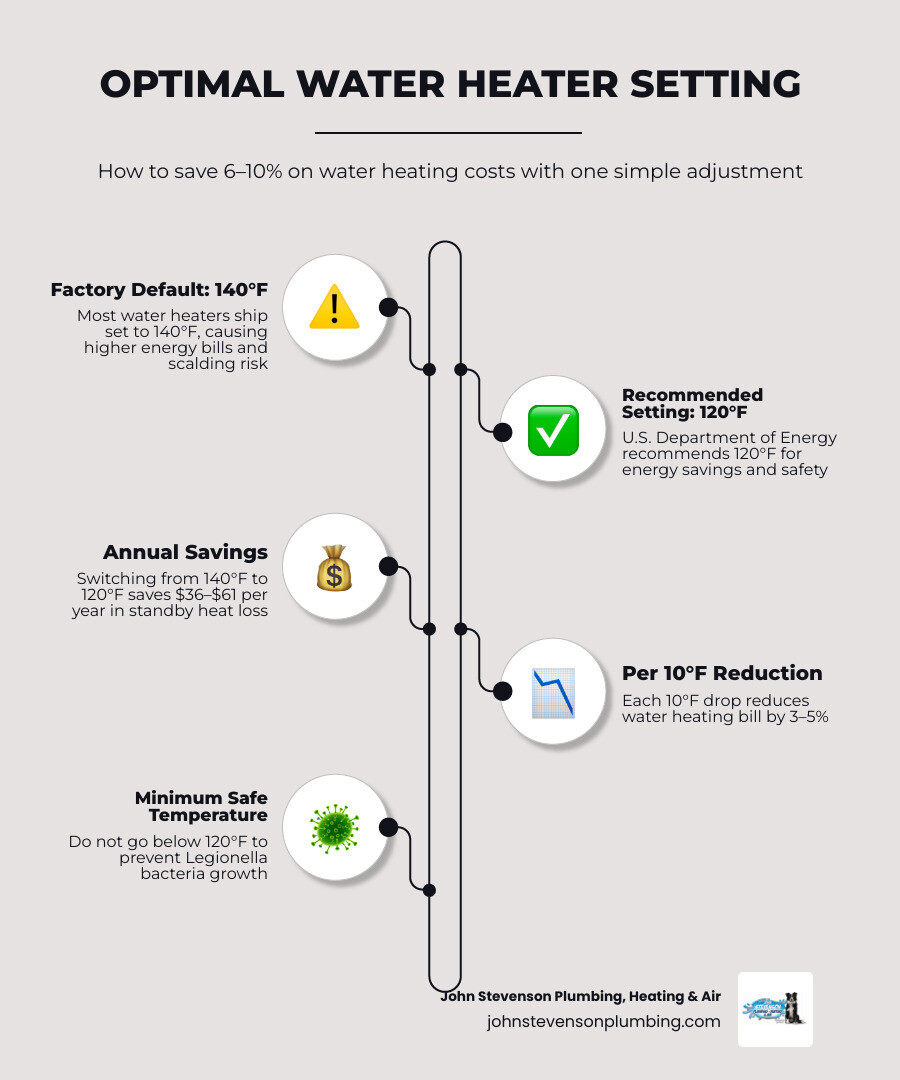
The right water heater temperature setting for energy savings is 120°F (49°C) — the setting recommended by the U.S. Department of Energy for most households. Here is a quick summary before we dive deeper:
- Recommended setting: 120°F for most homes
- Factory default: 140°F (costs more to run and poses a scalding risk)
- Savings from switching: 6–10% on water heating costs, or roughly $36–$61 per year in standby heat losses alone
- Savings per 10°F reduction: 3–5% on your water heating bill
- Bottom line: Do not go below 120°F — cooler water encourages harmful bacterial growth like Legionella
Water heating accounts for roughly 18% of a typical home’s total energy use, making it the second-largest energy expense behind heating and cooling. Yet most water heaters sit quietly in a closet or garage, set to 140°F straight from the factory — hotter than most households ever need, and quietly adding to your utility bill every single month through what is called standby heat loss (heat that escapes through the tank walls even when no hot water is being used).
For homeowners in Carlsbad, CA, where mild year-round temperatures mean your water heater may already be working less hard than units in colder climates, even a small thermostat adjustment can translate into real, lasting savings on your monthly bill — without any sacrifice in comfort.
My name is John Stevenson, and in this guide I will walk you through everything you need to know to find the ideal water heater temperature for your home, from understanding the tradeoffs to safely making the adjustment yourself.
Why Your Water Heater Temperature Setting for Energy Savings Matters
When we think about home energy conservation, our minds usually jump to turning off lights, adjusting the AC, or upgrading to energy-efficient appliances. But your water heater is a silent, constant power consumer. Because it operates 24/7 to keep dozens of gallons of water hot and ready, its energy consumption is incredibly high. In fact, water heating quietly eats up a larger chunk of your home’s energy bill than your lights, TV, and refrigerator combined!
The primary culprit behind this high energy draw is standby heat loss. Standby heat loss occurs when heat continuously transfers through the water heater tank walls and into the surrounding air. If your tank is sitting in an unconditioned space—like a garage or a utility closet in Carlsbad—it has to work much harder to keep that water hot, especially during cooler Southern California nights.
By optimizing your water heater’s operating parameters, you directly reduce the rate of this thermal transfer. Just as optimizing your home’s space heating can yield massive utility reductions—which you can learn more about in our guide on How To Skyrocket Your Energy Savings With Best Thermostat Settings—adjusting your water heater temperature is one of the easiest, zero-capital moves you can make to lower your carbon footprint and slash your monthly utility bills.
Finding the Sweet Spot: 120°F vs. 140°F
Most residential water heaters are shipped from the manufacturer with a factory setting of 140°F (60°C). While this high temperature ensures you will never have a lukewarm shower, it is generally overkill for the average household.
For the vast majority of homes, 120°F (49°C) is the absolute “sweet spot.” It strikes the perfect balance between safety, energy efficiency, and everyday comfort. Let’s look at why this setting is so highly recommended:
- Scalding Prevention: Water heated to 140°F can cause a severe third-degree burn in as little as five seconds. This poses a major safety risk, especially in households with young children, elderly family members, or pets. At 120°F, it takes several minutes of continuous contact to cause a similar burn, giving you plenty of time to react.
- Reduced Mineral Buildup: Southern California is known for having relatively hard municipal water. High temperatures accelerate the precipitation of minerals like calcium and magnesium inside your tank. Lowering the temperature to 120°F slows down this mineral scale buildup and corrosion, which protects your heating elements and extends your plumbing system’s lifespan. To understand how different heating systems handle these efficiency challenges, check out our In Depth Guide To Energy Efficient Water Heater Options.
- Standby Loss Reduction: Keeping water at 120°F requires significantly less energy than maintaining it at 140°F. For every 10-degree reduction in hot water temperature, you can save 3% to 5% on your water heating bill.
120°F vs. 140°F Comparison Table
To help you visualize the differences, here is a quick breakdown of how these two settings compare across key categories:
| Feature | 120°F (49°C) | 140°F (60°C) |
|---|---|---|
| Energy Efficiency | High (Saves 6–10% on energy bills) | Low (Higher standby heat loss) |
| Scald Risk | Safe (Takes minutes to burn) | Dangerous (Third-degree burns in 5 seconds) |
| Mineral Scale Buildup | Slower (Extends tank life) | Accelerated (Demands more frequent flushing) |
| Bacterial Control | Safe for healthy households | Maximum protection (Kills all pathogens) |
| Dishwasher Performance | Perfect for modern units with boosters | Required for older units without boosters |
Balancing Health Risks and a Water Heater Temperature Setting for Energy Savings
While a lower setting is fantastic for your wallet and safety, we must address the potential health risks. The primary concern with lowering water heater temperatures is the growth of Legionella bacteria, which can cause Legionnaires’ disease (a severe form of pneumonia).
Legionella thrives in warm water, particularly between 68°F and 122°F. At 120°F, the bacteria can still survive, though they do not actively multiply. Above 122°F, the bacteria begin to die off, and at 140°F, they are completely eradicated within minutes.
For the vast majority of healthy households, a setting of 120°F is completely safe. However, there are a few critical exceptions where you should keep your water heater at 140°F:
- Immunocompromised Residents: If anyone in your home has a suppressed immune system, a chronic respiratory disease, or is elderly, keeping the tank at 140°F is highly recommended to eliminate any bacterial risk.
- Older Dishwashers: Modern dishwashers built in the last 15 years include internal booster heaters that automatically heat incoming water to the 130°F–140°F required to sanitize dishes and activate detergent. However, if you have an older dishwasher that lacks a built-in booster, you may need to keep your primary water heater set to 140°F to ensure clean, sanitary dishes.
If you must keep your tank at 140°F for these reasons, you can still protect your family from scalding by installing thermostatic mixing valves. These valves are installed at your taps or showerheads to blend cold water with the hot water leaving the tank, delivering a safe 120°F stream at the faucet while keeping the water inside the tank hot enough to kill bacteria.
Ignoring these variables can lead to premature system failure or safety hazards. Learn more about protecting your investment in our article, Dont Get Into Hot Water Over Your Heaters Lifespan.
How to Adjust Your Water Heater Temperature Safely
Ready to make the adjustment? Before you begin, it is important to remember that safety comes first. If you ever feel uncomfortable working with electrical panels or gas lines, do not hesitate to contact a professional. If you are experiencing inconsistent temperatures or suspect your system is struggling, you may want to read up on How To Diagnose A Failing Water Heater before making adjustments.
Here is a step-by-step guide to adjusting the temperature on the three most common types of residential water heaters.
Step-by-Step Guide for Gas, Electric, and Tankless Systems
Different water heaters require different calibration methods. Follow the specific instructions below for your home’s system:
1. Electric Water Heaters (Storage Tank)
Electric water heaters typically have two heating elements, each controlled by its own thermostat. To adjust them, you must access the physical controls behind protective metal panels.
- Step 1: Turn off the power. Go to your home’s main electrical panel and switch off the circuit breaker dedicated to your water heater. Never attempt to adjust an electric water heater with the power on, as high-voltage components are exposed.
- Step 2: Remove the access panels. Use a screwdriver to remove the upper and lower access covers on the side of the tank. Pull back the insulation to expose the thermostats.
- Step 3: Adjust the thermostats. Using a flathead screwdriver, turn the dial on both the upper and lower thermostats to 120°F. They must be set to the exact same temperature to ensure even heating and prevent premature element burnout.
- Step 4: Replace insulation and panels. Put the insulation back in place, screw the metal access covers back on, and restore power at the circuit breaker.
2. Gas Water Heaters (Storage Tank)
Gas water heaters are much simpler to adjust because their thermostats are located on an external gas control valve near the bottom of the tank.
- Step 1: Locate the dial. Look for the dial on the front of the gas valve. Some gas heaters have precise degree markings, but many only have markings like “Very Hot,” “Hot,” “Warm,” or “Vacation.”
- Step 2: Turn the dial. If your dial does not have degree markings, “Warm” or the midway point between “Warm” and “Hot” usually represents approximately 120°F.
- Step 3: Test the tap temperature. Because gas dials can be imprecise, wait a few hours after making the adjustment. Go to the faucet furthest from your water heater, turn on the hot water, let it run for a couple of minutes, and measure the temperature with a cooking thermometer. Adjust the dial slightly if needed until the thermometer reads 120°F.
3. Tankless Water Heaters
Tankless water heaters are the easiest and safest systems to adjust.
- Step 1: Locate the digital control pad. Most tankless units have a digital control panel mounted on the front of the unit or on a nearby wall.
- Step 2: Adjust the digital setting. Simply use the up and down arrows to set the digital display directly to 120°F. There is no need to turn off breakers or open panels.
Taking the time to calibrate these settings correctly is a great way to prevent unnecessary wear and tear. For more tips on keeping your system running smoothly, read our guide on How To Extend The Life Of Your Water Heater. If you are still exploring your options, you might also find our guide on Stop Getting Into Hot Water Over Your Choice Of Water Heater helpful, or check out our breakdown on sizing with Everything You Need To Know About What Size Water Heater Do I Need.
Additional Tips to Boost Your Hot Water Efficiency
Adjusting your thermostat is the single highest-ROI energy move you can make with zero capital investment, but you don’t have to stop there! You can easily stack your savings by combining your new temperature setting with simple water conservation habits and quick weekend DIY projects.
- Install Low-Flow Fixtures: Replacing old, inefficient showerheads with modern low-flow models (rated between 1.5 and 2.0 gallons per minute) can save a four-person household thousands of gallons of hot water annually. Faucet aerators are another cheap, highly effective upgrade.
- Wash Laundry in Cold Water: Roughly 90% of the energy consumed by a washing machine goes toward heating the water. By shifting your laundry cycles to warm or cold settings, you cut your appliance’s energy draw in half. Modern detergents are specially formulated to work beautifully in cold water!
- Run Full Loads Only: Only run your dishwasher and washing machine when they are completely full. Running full loads can save the average family hundreds of gallons of water and significant energy every year.
- Avoid Peak Utility Rates: If your local utility provider uses a Time-of-Use (TOU) rate plan, try to run your hot-water-heavy appliances (like the dishwasher and washing machine) during off-peak hours when electricity or gas is cheapest.
These simple, everyday adjustments work hand-in-hand with your other home energy strategies. For instance, just as managing your summer cooling can drastically lower your electric bill, optimizing your hot water use keeps your overall utility costs low year-round. Check out our advice on How To Save Energy With Best Thermostat Settings For Summer to see how these savings compound.
Maximizing Your Water Heater Temperature Setting for Energy Savings with Insulation
If your water heater is an older storage tank model located in an unconditioned space like a garage, you can dramatically improve its thermal efficiency by adding insulation.
- Water Heater Blankets: Wrapping your tank in an insulating blanket (with an R-value of at least 8) can reduce standby heat losses by 25% to 45%. This simple $20 to $50 upgrade can pay for itself in under two years by saving you 4% to 9% on your water heating bill. Note: If you have a newer tank that already has thick built-in foam insulation, a blanket is generally unnecessary.
- Pipe Insulation: Insulating the first 5 to 6 feet of hot and cold water pipes leaving your water heater prevents heat from escaping as water travels to your faucets. This simple step can raise the water temperature at your tap by 2°F to 4°F, allowing you to lower your thermostat setting even further without noticing any drop in comfort.
If you are currently dealing with an older, uninsulated tank that is costing you too much to run, it might be time to look into modern, highly efficient models. Read our complete walkthrough on Choosing The Right Water Heater For Your Home to explore your options.
Frequently Asked Questions about Water Heater Settings
Will setting my water heater to 120°F result in cold showers?
No, setting your water heater to 120°F will not give you cold showers. Most people perceive a shower temperature of 110°F to 115°F as comfortably hot. Because some heat is naturally lost as water travels through your pipes, a tank set to 120°F will deliver perfectly hot water directly to your showerhead, especially when combined with pipe insulation.
Is 120°F safe from Legionella bacteria?
Yes, for the vast majority of healthy households, 120°F is completely safe. While Legionella bacteria can survive at 120°F, they do not actively multiply at this temperature, and the risk of infection in a standard residential system is extremely low. However, if anyone in your home is elderly, very young, or has a compromised immune system, it is safest to keep the tank at 140°F and install mixing valves at the taps.
How do I know if my water heater needs to be replaced?
Standard storage tank water heaters typically last between 8 and 12 years, while tankless models can last 15 to 20 years. If your system is nearing the end of its lifespan, showing signs of severe sediment buildup, leaking, or struggling to provide consistent hot water despite thermostat adjustments, it may be time for an upgrade. For a detailed guide on making this decision, check out our resource on How To Know When To Replace Your Water Heater.
Conclusion
Finding the optimal water heater temperature setting for energy savings is one of the easiest, most practical ways to lower your monthly utility bills, protect your family from scalding, and extend the lifespan of your plumbing system. For most homes in Carlsbad, CA, and the surrounding Southern California communities, setting your thermostat to 120°F is the perfect solution.
At John Stevenson Plumbing, Heating & Air Conditioning, we are dedicated to helping you maximize your home’s comfort and energy efficiency. Backed by our 5-Star Service Guarantee, our certified technicians provide thorough diagnostics, upfront pricing, and a 24-hour satisfaction check-in to ensure your plumbing and HVAC systems are running perfectly.
Whether you need help safely calibrating your water heater, installing thermostatic mixing valves, flushing sediment from your tank, or upgrading to a modern, energy-efficient tankless system, we are here to help.
Ready to start saving? Contact the team at John Stevenson Plumbing, Heating & Air Conditioning today to schedule your professional water heater service!