
Why Smart Thermostat Benefits for Homeowners Are Worth Understanding in Carlsbad, CA
The smart thermostat benefits for homeowners are real, measurable, and increasingly relevant — especially in Southern California where heating and cooling can dominate your monthly energy bill. According to the U.S. Department of Energy, HVAC accounts for roughly 50% of a typical household’s energy costs. That’s a significant chunk of your budget that a smart thermostat can help shrink.
Here’s a quick look at the core benefits:
- Energy savings – ENERGY STAR certified smart thermostats save an average of 8% on heating and cooling costs, with some models delivering 15% or more
- Remote control – Adjust your home’s temperature from anywhere using a smartphone app
- Automatic scheduling – Learning algorithms and occupancy sensors optimize your HVAC without you lifting a finger
- Maintenance alerts – Get notified when it’s time to change filters or schedule a tune-up
- Lower carbon footprint – Less energy use means fewer emissions
- Improved comfort – Remote sensors help balance temperatures across different rooms
- Home resale appeal – Smart home upgrades are increasingly expected by today’s buyers
- Utility rebates – Many programs, including SDG&E incentives, reward homeowners who make the switch
For Carlsbad homeowners dealing with warm summers and mild winters, a smart thermostat is one of the simplest upgrades you can make to cut waste and stay comfortable year-round — without sacrificing control.
What Is a Smart Thermostat and How Does It Work?
To understand why smart thermostats are such a game-changer, it helps to look at what came before them.
For decades, we relied on manual dials. You felt hot, you turned it down; you felt cold, you turned it up. Then came programmable thermostats, which promised to save energy by letting you set schedules. However, there was a major catch: they were notoriously difficult to program. In fact, a study by the Lawrence Berkeley National Laboratory found that roughly 40% of programmable thermostat owners never set a schedule at all. A separate Consumer Reports survey revealed that 29% of programmable thermostat owners simply do not take advantage of their system’s scheduling features.
A smart thermostat bridges this gap by introducing Wi-Fi connectivity, automation, and intuitive smartphone apps. Instead of squinting at a tiny, non-backlit screen trying to program a Tuesday afternoon schedule, you can set everything up in seconds on your phone.
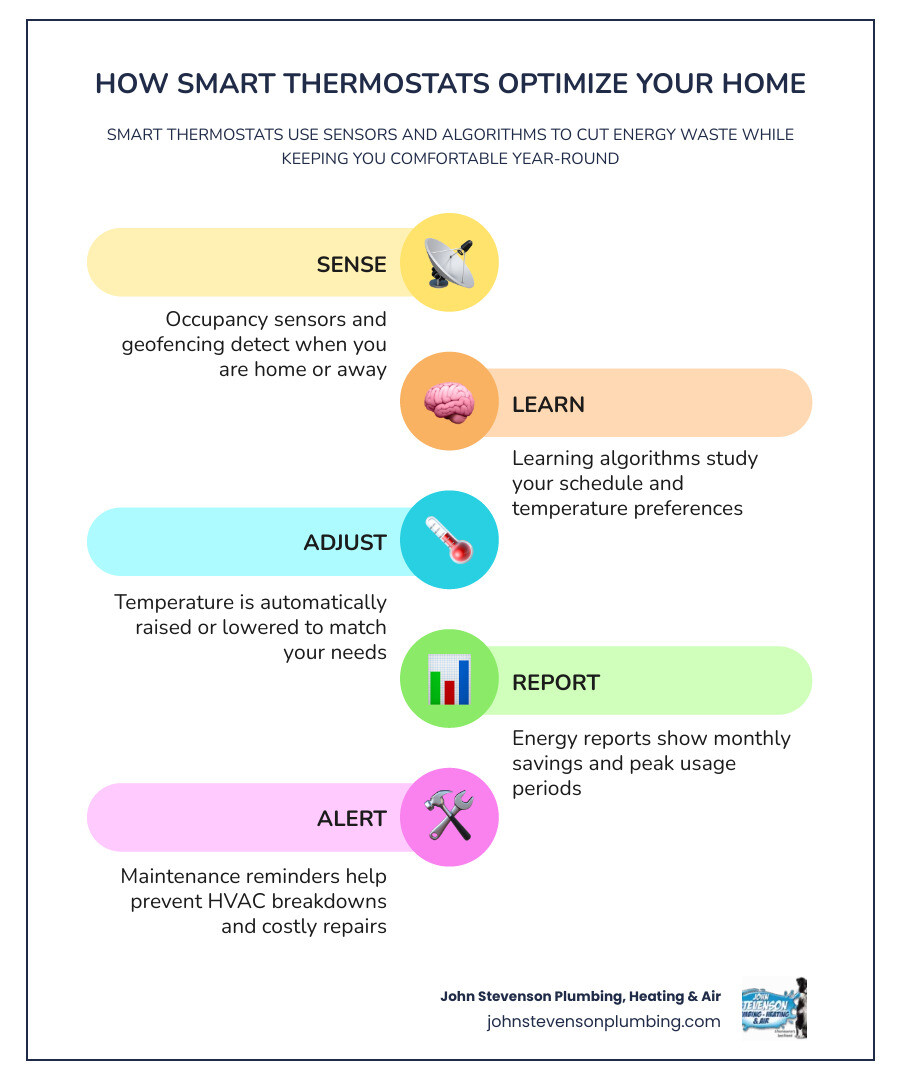
Even better, many smart thermostats feature machine learning algorithms. They observe your daily routines — when you wake up, when you leave for work at your office in San Diego, and what temperature you prefer when you go to bed. Within a week or two, the device builds a personalized schedule automatically.
Additionally, because these systems connect directly to your local Wi-Fi, they can monitor outdoor weather conditions in real-time. If a sudden June heatwave hits Carlsbad, your thermostat adjusts its cooling cycles to maintain maximum efficiency. When paired with high-efficiency systems, such as modern heat pumps, this level of control ensures your home remains perfectly conditioned. You can learn more about how these modern systems operate in The Simple Way a Heat Pump Heats and Cools Your Home.
Key Features That Drive Smart Thermostat Benefits for Homeowners
What makes a thermostat “smart” isn’t just the fact that it connects to the internet. It is the suite of advanced features designed to maximize your comfort while minimizing waste:
- Geofencing: By using your smartphone’s GPS, your thermostat knows when you leave Carlsbad and when you’re heading back. It automatically lowers the AC when you cross a certain boundary (saving energy while you’re away) and pre-cools the house so it’s comfortable the moment you walk through the door.
- Occupancy Sensors: Built-in motion and proximity sensors detect whether anyone is actually in a room. If the house is empty, the system shifts into an eco-friendly standby mode.
- Humidity Control: Many high-end smart thermostats monitor indoor humidity levels. High humidity makes air feel warmer than it actually is. By managing your AC or a dedicated dehumidifier, the thermostat can keep you comfortable at a slightly higher temperature setting, saving you money.
- HVAC Diagnostics & Alerts: Your thermostat acts as a digital watchman for your heating and cooling system. It tracks cumulative runtime and sends push notifications when it’s time to replace your air filter. It can even alert you if your system is failing to cool properly, helping you catch minor issues before they turn into major, expensive breakdowns. For more details on keeping your system running smoothly, check out Everything You Need to Know About Annual HVAC Maintenance.
Maximizing Efficiency and Comfort in Southern California
Southern California is famous for its microclimates. A home in coastal Carlsbad might experience mild, ocean-breeze-cooled afternoons, while a home just a few miles inland in Escondido, San Marcos, or Vista can experience scorching summer heat. This geographic variation is why smart thermostats are so valuable for our region.
According to Department of Energy data, the real-world performance of smart thermostats varies significantly by climate zone. In cold regions (like Climate Zone 5), homes see average savings of 14.7% because heating systems run so frequently. In warmer, cooling-dominated regions (like Climate Zone 3, which covers much of Southern California), homes average 8.2% savings on overall utility usage, though cooling-specific savings often climb much higher.
Because we live in a mild coastal climate, we can often rely on natural ventilation during shoulder seasons. A smart thermostat helps you capitalize on this by widening the “deadband” (the temperature range where neither heating nor cooling runs) when the weather is perfect, preventing your HVAC from cycling unnecessarily. To see how these savings pair with highly efficient HVAC systems, read All About How Heat Pumps Work Well in Mild Climates.
Realizing Energy Savings with Smart Thermostat Benefits for Homeowners
Let’s look at the actual numbers. ENERGY STAR certified smart thermostats are independently verified using real-world field data. This certification guarantees a baseline of energy efficiency, showing that users save an average of 8% on their annual utility bills.
In California, where electricity rates are among the highest in the country, these percentages translate to significant dollars. Real-world field studies show that:
- Heating costs are reduced by 10% to 12% on average.
- Cooling costs are cut by 15%.
- For an average California homeowner with typical HVAC spending, this translates to annual savings of $131 to $145.
- If you are upgrading directly from an old, manual dial thermostat, your savings jump even higher — often between 12% and 18% because manual systems are so frequently left running at inefficient temperatures.
Additionally, smart thermostats help you navigate California’s complex Time-of-Use (TOU) utility rates. By entering a low-power standby mode during peak demand hours (typically 4 PM to 9 PM) and pre-cooling your home when electricity is cheaper, you can avoid the highest tier of energy pricing. For practical strategies on navigating these hot summer months, read our guide on Peak Performance: How to Save on Electricity During Peak Summer.
Understanding Smart Thermostat Benefits for Homeowners
Beyond direct financial savings, installing a smart thermostat provides several long-term benefits that improve your lifestyle and your property’s value.
First, there is the environmental impact. By optimizing your heating and cooling cycles, you directly reduce your household’s energy consumption. This lower demand on the electrical grid translates to a smaller carbon footprint and fewer greenhouse gas emissions. When combined with clean electric heating and cooling technology, a smart thermostat becomes a cornerstone of an eco-friendly household. You can explore these environmental advantages further in The Definitive Guide to Heat Pump Benefits for Homeowners.
Second, smart thermostats add modern tech appeal and boost your home’s resale value. Today’s home buyers in Carlsbad, Encinitas, and Rancho Santa Fe expect smart home technology. A sleek, wall-mounted smart thermostat serves as a visual indicator that the home’s mechanical systems are modern, well-maintained, and energy-efficient. It’s a small upgrade that makes a strong first impression during open houses.
Comparing Top Smart Thermostat Technologies
When shopping for a smart thermostat, you will likely encounter three major brands: Ecobee, Google Nest, and Honeywell. While all three are excellent and perform within 2% of each other in terms of raw energy savings, they differ in their features and user experience.
| Feature / Capability | Ecobee Smart Thermostat Premium | Google Nest Learning Thermostat (4th Gen) | Honeywell Home T9 |
|---|---|---|---|
| Primary Strength | Best for multi-room temperature balancing | Best for automatic, set-and-forget learning | Best for traditional interface with smart features |
| Learning Algorithm | Optional / Schedule-based | Highly automated AI learning | Schedule-based |
| Geofencing | Yes | Yes | Yes |
| Remote Room Sensors | Included (detects occupancy & temperature) | Supported (sold separately) | Included (focuses on temperature) |
| Smart Home Ecosystems | Apple HomeKit, Alexa, Google Assistant | Google Home, Alexa | Alexa, Google Assistant |
| Standby Power Mode | ENERGY STAR Certified | ENERGY STAR Certified | ENERGY STAR Certified |
Choosing the right model depends on your home’s layout. If you live in a multi-story home in Carlsbad where the upstairs bedroom gets much hotter than the downstairs living room, a system like the Ecobee or Honeywell T9 with remote sensors allows you to prioritize comfort in the rooms you are actually using, rather than over-cooling the entire house.
Installation Requirements and Potential Challenges
While smart thermostats are incredibly user-friendly once up and running, installing them can sometimes present challenges, especially in older Southern California homes.
The primary technical hurdle is the C-wire (Common Wire). Traditional manual thermostats operate like simple switches, requiring very little electrical power. Smart thermostats, however, feature full-color touchscreens, Wi-Fi radios, and processors that must remain powered 24/7. The C-wire provides a continuous 24-volt stream of electricity from your HVAC system’s control board to the thermostat.
If your home was built before 2000, your thermostat wiring might only have two or four wires, lacking the crucial C-wire. Fortunately, there are solutions:
- Power Extender Kits (PEKs): Many top brands include a power adapter in the box that can be installed at your furnace or air handler to share power across existing wires.
- C-Wire Adapters: External plug-in transformers can supply power if you have an electrical outlet nearby.
- Professional Retrofitting: A professional technician can run a new, multi-conductor thermostat cable from your HVAC system to your wall.
System compatibility is another consideration. If your home uses a variable-speed air conditioner or a multi-stage heat pump, standard retail smart thermostats might not be able to communicate with the proprietary control boards of these high-end systems without special configuration. Ensuring your thermostat is correctly calibrated to your specific HVAC system is a standard part of professional service. You can learn more about what to expect during a professional visit in our A Comprehensive Guide to What Does an HVAC Maintenance Visit Include.
When a Smart Thermostat Might Not Be the Right Fit
While we highly recommend smart thermostats for the vast majority of Southern California homes, there are a few scenarios where the investment might not yield significant returns:
- High-Voltage Baseboard Heating: Most retail smart thermostats are designed for low-voltage (24V) systems. If your home uses high-voltage electric baseboard heaters, standard smart thermostats will not work without specialized line-voltage smart controllers.
- Constant Occupancy: If someone is always home (such as retirees or remote workers who rarely leave the house), the energy savings from occupancy sensors and geofencing will be minimal, though the convenience of remote control and voice commands remains.
- Temperate Microclimates: If you live directly on the coast in Carlsbad or Solana Beach and rarely turn on your heating or air conditioning, your baseline energy bills are already very low, meaning the payback period for a smart thermostat will be much longer.
California Incentives and Rebates for Smart Upgrades
One of the best parts of upgrading to a smart thermostat in San Diego County is that you rarely have to pay full price. Because smart thermostats reduce strain on the electrical grid during peak hours, local utility companies and government programs offer excellent financial incentives.
If you are a San Diego Gas & Electric (SDG&E) customer, you can take advantage of direct rebates on ENERGY STAR certified smart thermostats. These rebates often cover a significant portion of the device’s retail cost. Additionally, participating in SDG&E’s “demand response” programs allows the utility to make minor, temporary temperature adjustments during extreme heatwaves to prevent blackouts, in exchange for annual bill credits. You can find out more about these regional programs in San Diego Homeowners Can Save Big on Heat Pumps with SDG&E Incentives.
On a federal level, the Inflation Reduction Act (IRA) offers a 30% tax credit for qualifying energy efficiency home upgrades, which can include smart thermostats when installed as part of a qualifying HVAC system upgrade. To learn how to stack these savings, explore Don’t Sweat the Cost with These California HVAC and Water Heater Rebates and How the IRA Makes Your California Home Efficiency Upgrade Much Cheaper.
Frequently Asked Questions About Smart Thermostats
Do smart thermostats work with heat pumps in Southern California?
Yes, absolutely! However, they must be configured correctly. Heat pumps utilize an auxiliary heating element (often electric heat strips) for extremely cold days. If a smart thermostat is not programmed with an “auxiliary heat lockout” temperature, it might turn on the highly inefficient auxiliary heat when it isn’t necessary, spiking your electric bill. Professional installation ensures your thermostat and heat pump communicate perfectly. For a deeper dive into heat pump technology, check out All About Heat Pumps for Southern California.
Can I install a smart thermostat myself without a C-wire?
While many manufacturers include power adapter kits that allow for DIY installation without a C-wire, it can be a delicate process that involves opening your furnace or air handler cabinet and working with low-voltage electrical terminals. If you are uncomfortable handling electrical wiring, or if your existing wiring is old and fragile, it is always safest to have a licensed professional handle the installation to avoid damaging your HVAC system’s control board.
Do smart thermostats require a monthly subscription fee?
No. All major smart thermostat brands (including Nest, Ecobee, and Honeywell) provide free companion apps that allow you to control your system, set schedules, and view energy reports without any monthly fees. Some brands offer optional premium subscriptions for advanced home security integration or professional monitoring, but these are entirely optional.
Conclusion
Upgrading to a smart thermostat is one of the most practical, cost-effective steps you can take to improve your home’s comfort, lower your energy bills, and reduce your carbon footprint. Whether you want to take advantage of geofencing, balance the temperatures in your multi-story home, or cash in on local utility rebates, the benefits are clear.
At John Stevenson Plumbing, Heating & Air Conditioning, Inc., we have spent years helping homeowners throughout Carlsbad, Oceanside, Encinitas, Vista, and the greater San Diego area optimize their indoor comfort. Our team of certified HVAC technicians can help you select the perfect smart thermostat for your existing system, handle the low-voltage wiring safely, and walk you through the setup process so you can start saving immediately.
Ready to take control of your home’s climate and start saving on your energy bills? Schedule your energy-efficient thermostat installation with Carlsbad’s trusted comfort experts today!