
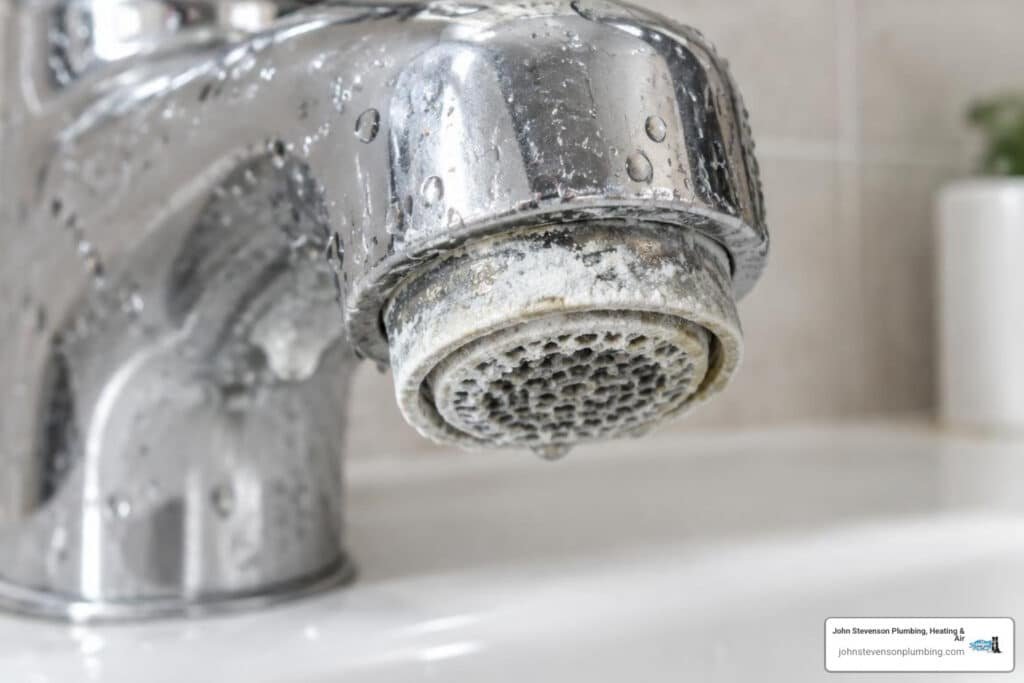
Understanding Hard Water and the True Impact of Mineral Scale
To protect your plumbing from hard water buildup, install a whole-house water softener or salt-free conditioner at the point of entry, flush tank-style water heaters every six to twelve months, descale tankless units annually, and clean faucet aerators and showerheads with vinegar on a regular schedule. These steps prevent calcium and magnesium scale from narrowing pipes, reducing water pressure, and shortening the life of water-using appliances.
Hard water is one of the most common plumbing challenges across the United States, affecting roughly 85% of American households. Here in Southern California, our regional water supplies travel through mineral-rich aquifers, rivers, and rock formations, picking up significant amounts of dissolved calcium and magnesium ions along the way. While these minerals are completely safe to drink, they behave aggressively inside closed plumbing systems.
Water hardness is typically measured in grains per gallon (GPG) or milligrams per liter (mg/L). Water containing more than 3.5 GPG is classified as moderately hard, while anything over 7.0 GPG is considered hard, and levels exceeding 10.5 GPG are categorized as very hard. When water with high mineral density enters your home, it triggers chemical reactions that cause solid limescale deposits to form on metallic and plastic surfaces. Exploring hard water effects on plumbing and appliances reveals just how pervasive this issue is throughout the entire house.
The Science of Mineral Scale and Flow Restriction
Scale accumulation is driven by thermal dynamics and pressure drops. Dissolved calcium bicarbonate remains stable in cold, moving water. However, when water is heated—such as inside a water heater or dishwasher—a chemical decomposition occurs. The heat drives off carbon dioxide, converting soluble calcium bicarbonate into insoluble calcium carbonate.
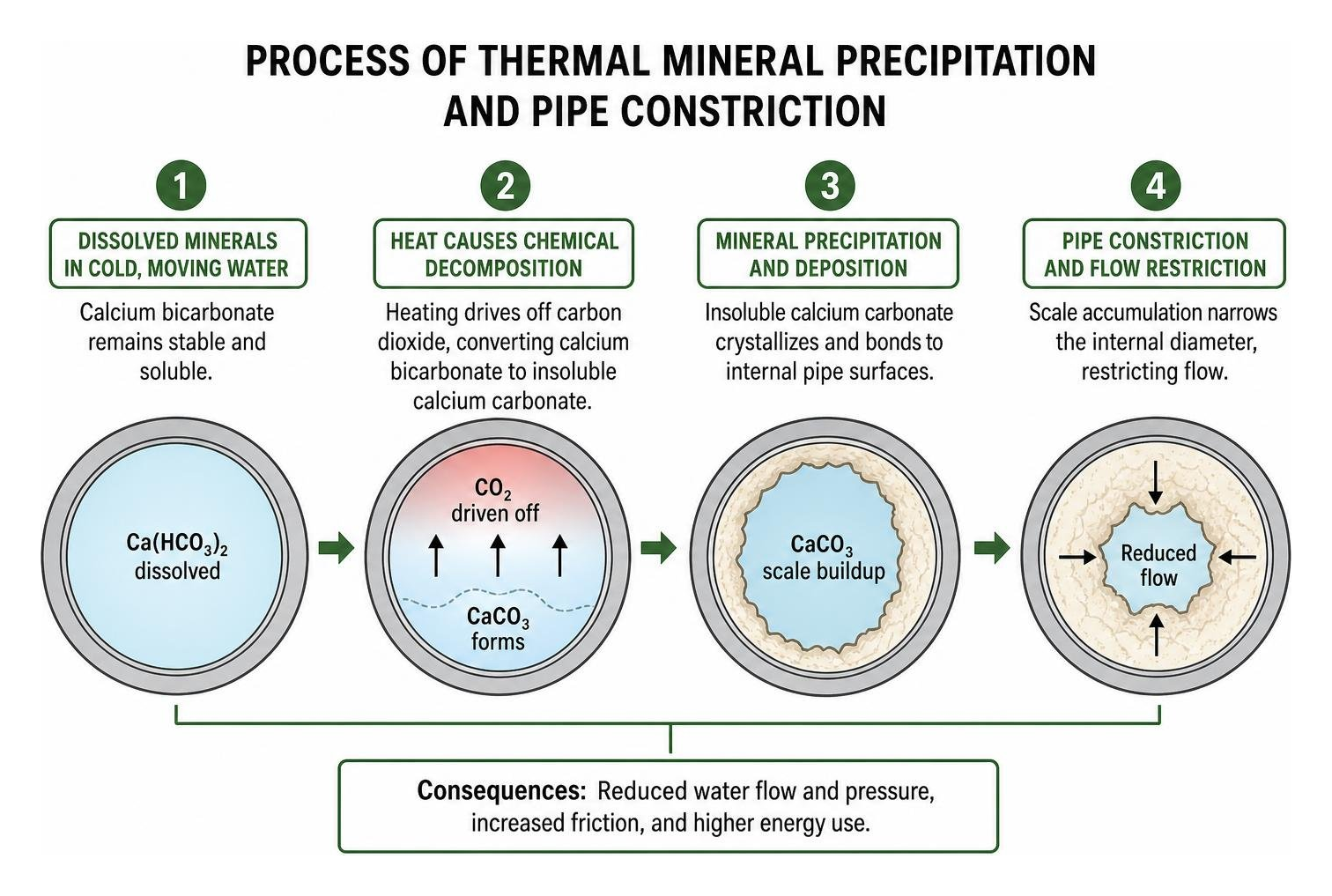
This insoluble mineral crystallizes and bonds directly to the internal walls of pipes, valves, and heating elements. As layers of calcium carbonate accumulate, the internal diameter of the pipe narrows. Fluid dynamics dictate that a reduction in pipe diameter significantly restricts fluid flow and increases velocity and friction. A mere 25% reduction in internal pipe diameter can lead to an estimated 50% drop in overall water pressure at the fixture, starving showers, faucets, and appliances of adequate volume.
The Damaging Toll on Home Appliances and Systems
Untreated mineral scale acts as an unwanted thermal insulator. Just 1.6mm of scale accumulation—about the thickness of a dime—on a water heater’s heating element forces the unit to work roughly 12% harder to transfer heat into the water. In severe cases, thick sediment layers cause up to a 25% loss in energy efficiency, placing unnecessary strain on home equipment.
Beyond energy waste, hard water shortens the operational lifespan of water-using appliances. Dishwashers and washing machines exposed to untreated hard water can experience up to a 30% to 40% reduction in their usable lifespan due to clogged internal solenoid valves, scaled pump impellers, and burned-out heating elements. Homeowners also find themselves using extra detergent and specialty cleaning agents just to counteract mineral interference and dissolve soap scum.
Early Warning Signs of Hard Water Damage
Mineral buildup rarely happens overnight. Instead, it leaves progressive clues throughout your plumbing fixtures:
- Low Water Pressure: A sudden or steady drop in volume from showerheads and sink faucets, often caused by scale choking internal aerator screens.
- Stiff Fixture Handles: Cartridges and mixing valves become gritty and difficult to turn as mineral crystals wedge inside moving mechanical seals.
- Cloudy Glassware and Dishes: White, etched spotting on drinking glasses and cutlery emerging from the dishwasher.
- Soap Scum Accumulation: A stubborn, chalky film coating shower doors, tubs, and sinks that resists standard household cleaners.
- Rattling or Popping Water Heaters: Rumbling sounds from the water heater tank, caused by steam bubbles trapped underneath a dense layer of mineral sediment at the bottom of the tank.
Reviewing our guide on identifying hard water signs can help you catch these symptoms before irreversible pipe damage occurs.
How to Protect Your Plumbing from Hard Water Buildup
Effectively defending your home against scale requires a strategic, layered approach tailored to your specific water chemistry. Step one is always comprehensive water testing to establish your exact GPG level, total dissolved solids (TDS), and pH balance. Municipal water reports provide a baseline, but on-site testing accounts for neighborhood-level distribution dynamics. Once your hardness level is established, selecting the right whole-house treatment system provides long-term defense.
How to Protect Your Plumbing from Hard Water Buildup with Whole-House Systems
To stop mineral scale at the point of entry, homeowners typically choose between ion-exchange water softeners, Template Assisted Crystallization (TAC) conditioners, and whole-house filtration setups. Each technology interacts with dissolved minerals differently:
| System Type | Mechanism | Scale Prevention Rate | Maintenance Required | Best Suited For |
|---|---|---|---|---|
| Salt-Based Ion Exchange Softener | Exchanges calcium and magnesium ions for sodium ions | >99% (True Softening) | Monthly salt refills; periodic resin cleanings | Homes with high GPG hardness (>7.0 GPG) |
| TAC Salt-Free Conditioner | Converts dissolved ions into microscopic, inert crystals | 85%–95% (Conditioning) | Media replacement every 3 to 5 years | Eco-conscious homes; moderate hardness |
| Whole-Home Water Filtration | Carbon media, sediment barriers, and KDF filtration | Variable (Filters contaminants, not hardness) | Filter cartridge replacements every 6–12 months | Chlorine, VOC, and sediment removal |
When evaluating your home, choosing between a water softener and filtration system often comes down to whether your primary goal is removing chemical contaminants, eliminating scale-forming minerals, or pairing both technologies for total protection.
Softening vs. Descaling: When to Prevent and When to Restore
Homeowners frequently confuse water softening with descaling, yet they serve two entirely different stages of plumbing care:
- Softening (Prevention): Softeners remove calcium and magnesium ions before water enters the home’s distribution pipes. This stops new scale from ever forming on pipe walls or heating elements.
- Descaling (Restoration): Descaling utilizes acidic flushes (such as food-grade citric acid or specialized chemical solutions) or mechanical cleaning to dissolve and flush away existing, hardened mineral scale that is already choking pipes and fixtures.
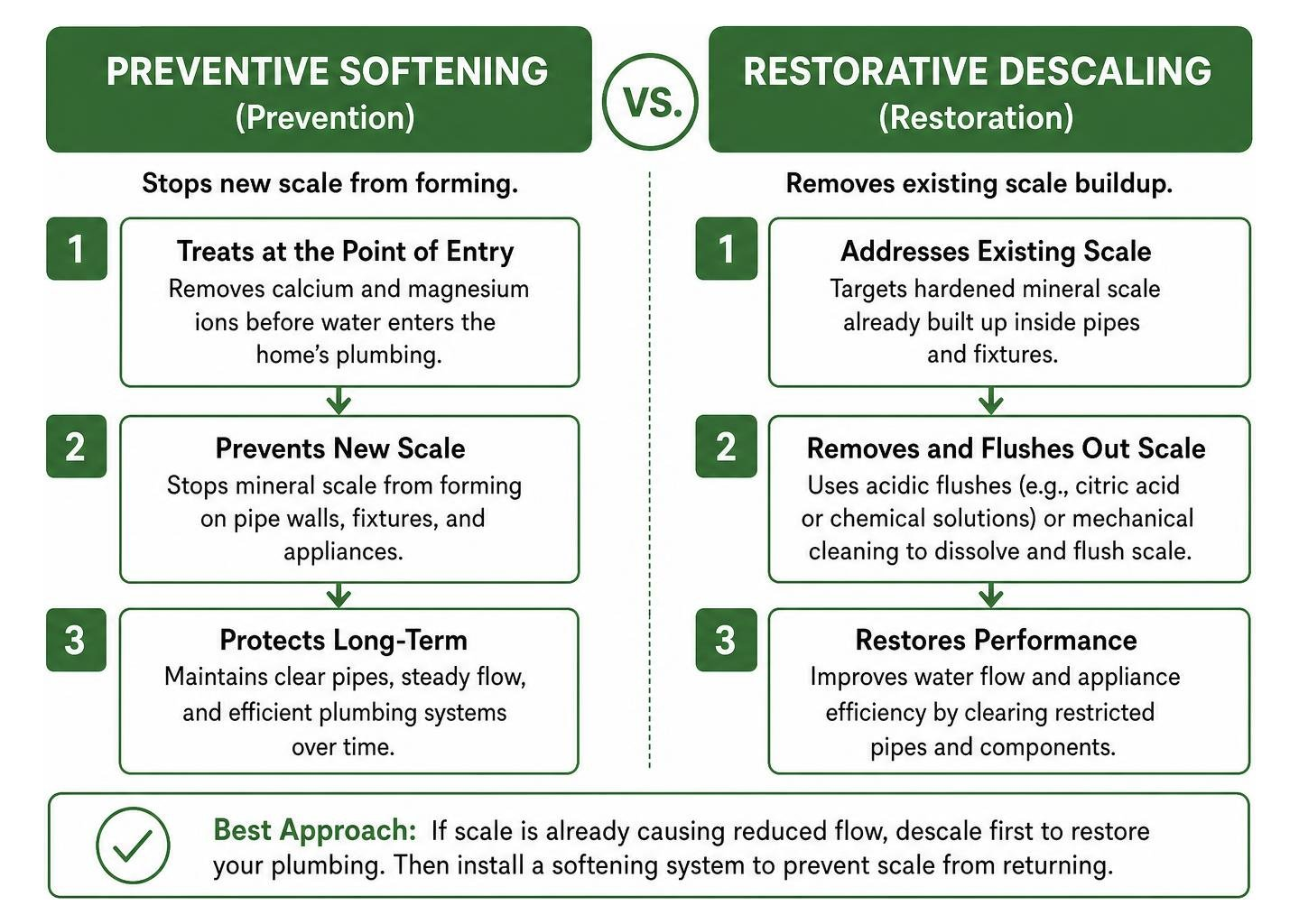
If your home already exhibits reduced flow from years of untreated hard water, installing a softener alone will not instantly restore your pipe diameter. You must perform a restorative descale first, followed by continuous softening to keep the lines clear. Reviewing our water softener vs descaler comparison helps clarify which stage your home currently needs.
The Langelier Saturation Index (LSI) and Balanced Water
In plumbing science, water chemistry is a delicate balancing act. The Langelier Saturation Index (LSI) calculates whether water is likely to precipitate calcium carbonate (scale-forming) or dissolve calcium carbonate (corrosive).
- Positive LSI (> 0.5): Water is supersaturated with minerals, leading to aggressive scale accumulation.
- Negative LSI (< -0.5): Water is undersaturated and “hungry,” meaning it actively seeks minerals and will corrode exposed metal pipe walls.
- Balanced LSI (0.0 to 0.5): Water maintains a microscopically thin, protective calcium carbonate film along pipe interiors without creating thick scale.
Over-softening water down to zero hardness can push water into an aggressive, negative LSI state, which strips away the protective barrier and accelerates pinhole leaks in copper piping. Maintaining a slight residual hardness (1 to 3 GPG) provides the ideal balance between scale prevention and pipe wall preservation.
How Pipe Materials React to Hard Water Accumulation
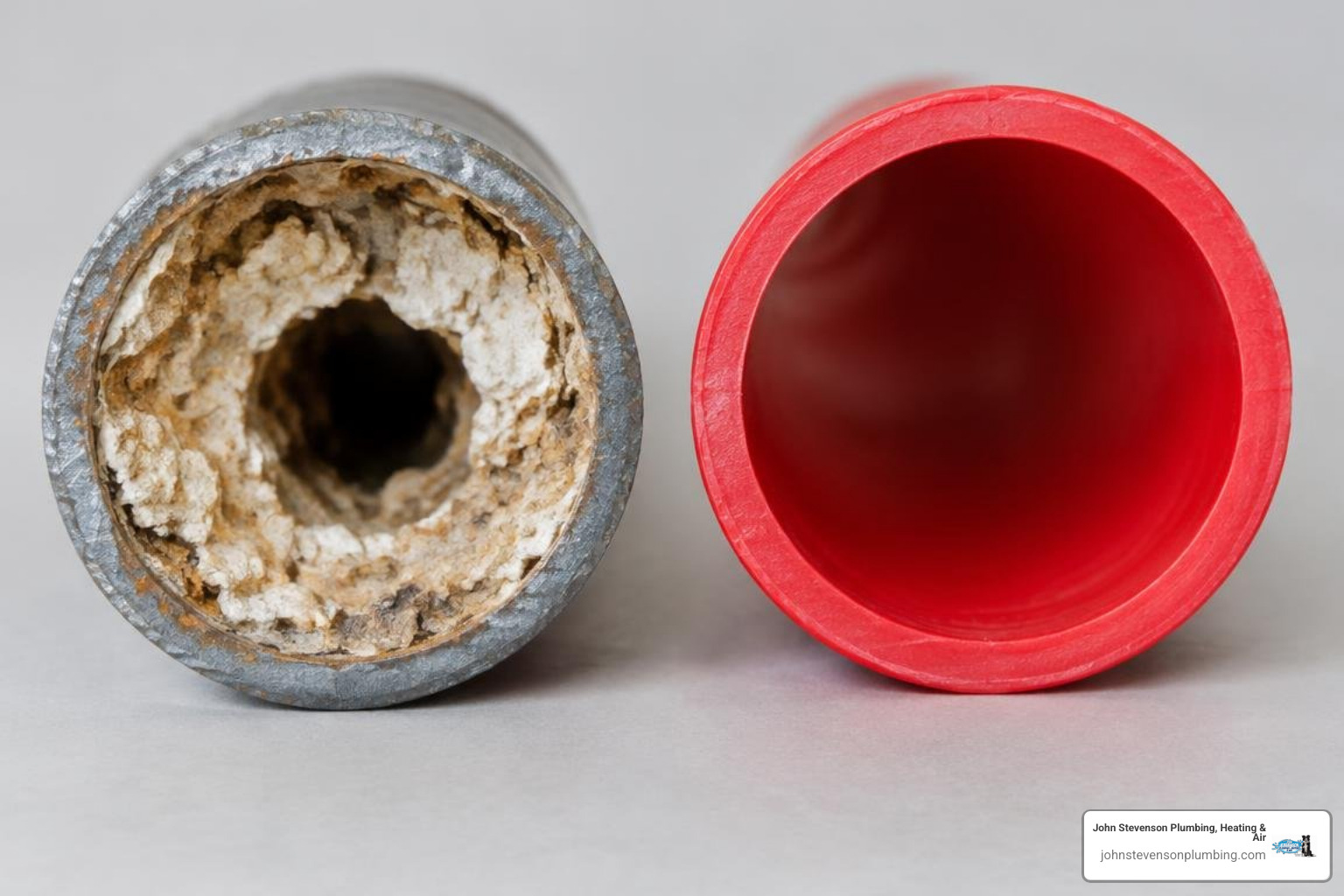
The material used in your home’s water supply lines significantly impacts how scale adheres to pipe walls and how quickly flow restriction occurs.
Metal Piping: Copper and Galvanized Steel Challenges
Older metal piping systems face distinct vulnerabilities when exposed to mineral-heavy water:
- Galvanized Steel: Pre-1970s homes often feature galvanized steel pipes coated with zinc. Hard water triggers an internal reaction known as tuberculation, where rust nodules and mineral scale fuse together into jagged, rock-hard obstructions. This can choke a 3/4-inch pipe down to the width of a pencil. Acid descaling on old galvanized pipes frequently causes leaks because the scale is often holding corroded joints together.
- Copper Piping: While smoother than steel, copper is subject to under-deposit corrosion. When mineral scale settles unevenly along copper walls, it creates microscopic galvanic cells beneath the deposits, leading to localized pitting and unexpected pinhole leaks.
When metal piping becomes severely compromised by internal tuberculation, whole-home repiping services provide the most reliable permanent remedy.
Modern Plastics: PEX and CPVC Scale Resistance
Modern plastic alternatives such as cross-linked polyethylene (PEX) and chlorinated polyvinyl chloride (CPVC) have transformed residential plumbing:
| Feature | Copper | Galvanized Steel | PEX | CPVC |
|---|---|---|---|---|
| Interior Smoothness | Moderate | Rough / Porous | Extremely High | Extremely High |
| Scale Adherence Risk | Moderate to High | Severe | Minimal | Low |
| Corrosion / Pitting Risk | High under scale | Extreme (Tuberculation) | Immune to corrosion | Immune to corrosion |
| Descaling Chemical Tolerance | Good | Poor (Acid causes leaks) | Excellent | High |
PEX and CPVC feature smooth interior surfaces that offer few microscopic anchor points for calcium crystals. While scale can still accumulate on mechanical brass fittings and inside appliances connected to plastic lines, the plastic pipe runs themselves resist narrowing and maintain steady water pressure over decades of use.
Practical Maintenance and Professional Solutions
Protecting your plumbing requires combining whole-home water conditioning with routine maintenance habits. Our team provides comprehensive water quality solutions to help homeowners keep every stage of their plumbing infrastructure running smoothly.
DIY Maintenance: How to Protect Your Plumbing from Hard Water Buildup
A consistent DIY routine prevents scale from hardening onto high-contact fixtures:
- Quarterly Aerator Cleaning: Unscrew faucet aerators and soak the mesh screens in a 1:1 mixture of warm water and distilled white vinegar for 4 to 8 hours to dissolve mineral deposits.
- Showerhead Vinegar Bags: Secure a plastic bag filled with warm white vinegar around showerheads using a rubber band, allowing it to soak overnight before running hot water to flush the jets.
- Washing Machine & Dishwasher Descaling: Run an empty hot cycle monthly using two cups of white vinegar or manufacturer-approved citric acid powder to clear scale from internal spray arms and pump housings.
- Quarterly Softener Salt Inspections: Check your brine tank for salt bridging (a hard crust forming above the water line) and ensure high-purity solar or evaporated salt pellets are used.
Protecting Water Heaters and Major Appliances
Water heaters are the primary target for mineral precipitation. Tank-style units should be drained and flushed every 6 to 12 months to clear sediment buildup from the bottom of the tank. Checking our guide on how to extend the life of your water heater outlines how inspecting and replacing the sacrificial anode rod prevents corrosive attacks inside the tank.
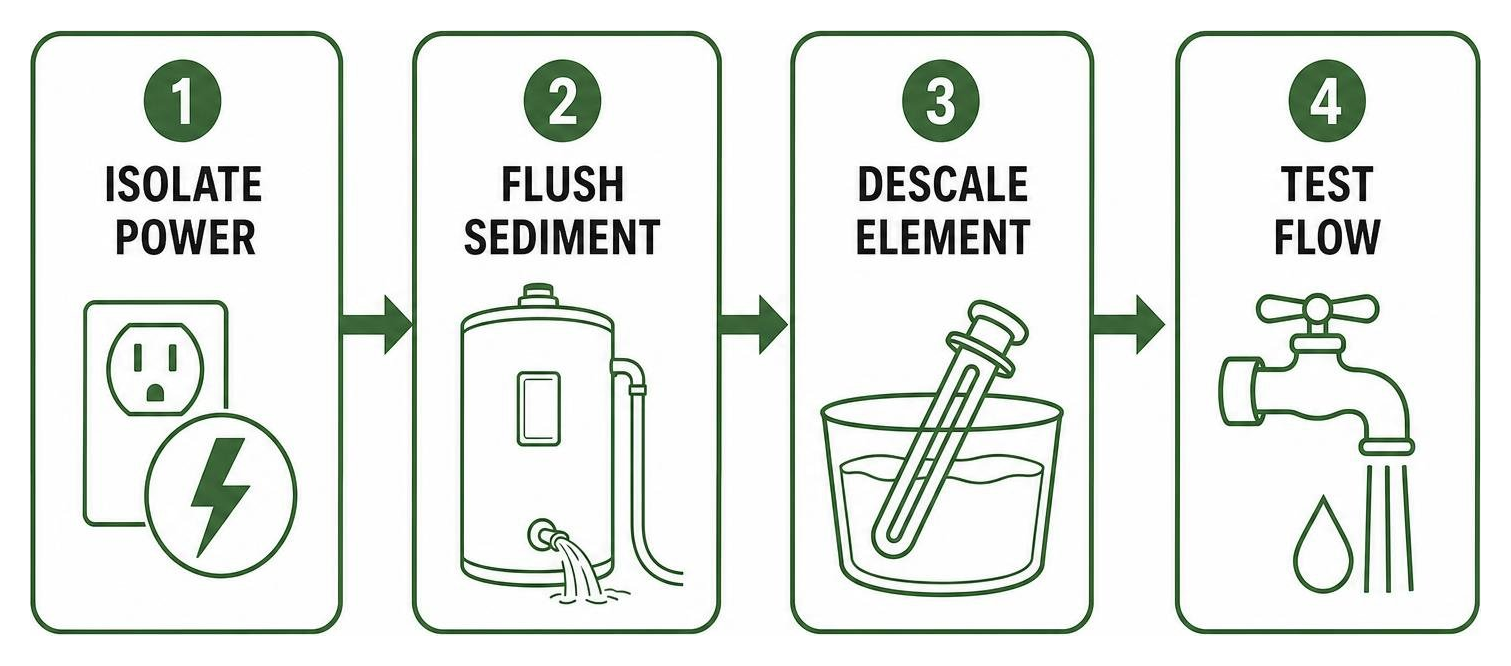
For on-demand systems, tankless water heater maintenance involves circulating an isolated citric acid or virgin white vinegar solution through the compact heat exchanger for 45 to 60 minutes. Because tankless units transfer intense heat across narrow copper or stainless steel passages, annual flushing is essential to prevent thermal error codes and element failure.
When to Call a Professional Plumber
While surface cleaning is straightforward, deep plumbing obstructions require professional tools. Contact a licensed technician if you experience:
- Persistent Low Flow: Pressure remains weak after cleaning aerators and showerheads, indicating scale accumulation deeper within branch lines.
- Heavy Water Heater Noise: Loud popping or knocking that continues after standard flushing, pointing to hardened mineral calcification.
- Corroded Valve Assemblies: Main shutoff valves or pressure-reducing valves (PRVs) become seized and immovable.
- Main Line Obstructions: Severe mineral choke points requiring professional water descaling or targeted hydro-jetting to safely clear without damaging pipe walls.
Frequently Asked Questions About Hard Water Protection
What is the most effective whole-house solution for hard water buildup?
For homes with water hardness above 7.0 GPG, an ion-exchange water softener is the gold standard because it physically removes calcium and magnesium ions, eliminating scale formation by over 99%. For homes with moderate hardness or municipal brine discharge restrictions, Template Assisted Crystallization (TAC) conditioners offer a reliable, salt-free alternative that prevents scale adhesion.
Can hard water scale buildup permanently ruin home plumbing pipes?
Yes. In older galvanized steel and aged copper plumbing systems, severe mineral buildup causes permanent internal constriction and accelerated under-deposit corrosion. Once heavy tuberculation or deep pitting takes hold, chemical or mechanical clearing often triggers leaks, making complete pipe replacement the only lasting solution.
How often should I descale or flush my water heater in hard water areas?
In regions with hard to very hard water, tank-style water heaters should be flushed every 6 months to prevent thick sediment beds. Tankless water heaters should undergo a professional pump-recirculated descaling flush at least once a year to keep the heat exchanger free of efficiency-robbing scale.
Conclusion
Guarding your home against hard water buildup requires an informed combination of water testing, appropriate whole-home treatment, and consistent fixture maintenance. Addressing scale before it calcifies protects your water pressure, lowers energy consumption, and extends the operational life of major appliances.
At John Stevenson Plumbing, Heating & Air Conditioning, our certified technicians provide comprehensive diagnostics and dependable service backed by our 5-Star Service Guarantee and 24-hour satisfaction check-ins. Whether you need system testing, water heater maintenance, or dedicated professional water quality solutions, our team is here to keep your home’s plumbing flowing smoothly for years to come.