
Is a Tankless Water Heater Worth It for Carlsbad Homeowners?
Is a tankless water heater worth it? For most Carlsbad homeowners, the answer is yes — but it depends on your household’s hot water habits, your home’s existing setup, and how long you plan to stay in the house.
Here’s a quick breakdown to help you decide:
| Factor | Tankless Wins If… | Tank Wins If… |
|---|---|---|
| Hot water usage | Your household uses 41 gallons or less per day | You have very high simultaneous demand |
| Long-term plans | You plan to stay 10+ years | You need a fast, lower-cost replacement |
| Space | You want a compact, wall-mounted unit | Space is not a concern |
| Energy savings | You want to cut standby heat loss | Upfront cost is your main priority |
| Lifespan | You want 20+ years of service | A 10–15 year lifespan is acceptable |
Most homeowners don’t think much about their water heater — until the shower goes cold halfway through, or they realize they’ve been paying to keep 50 gallons of water hot around the clock, every single day, whether they need it or not. That constant energy drain is called standby heat loss, and it’s one of the biggest reasons Carlsbad homeowners are taking a closer look at tankless systems.
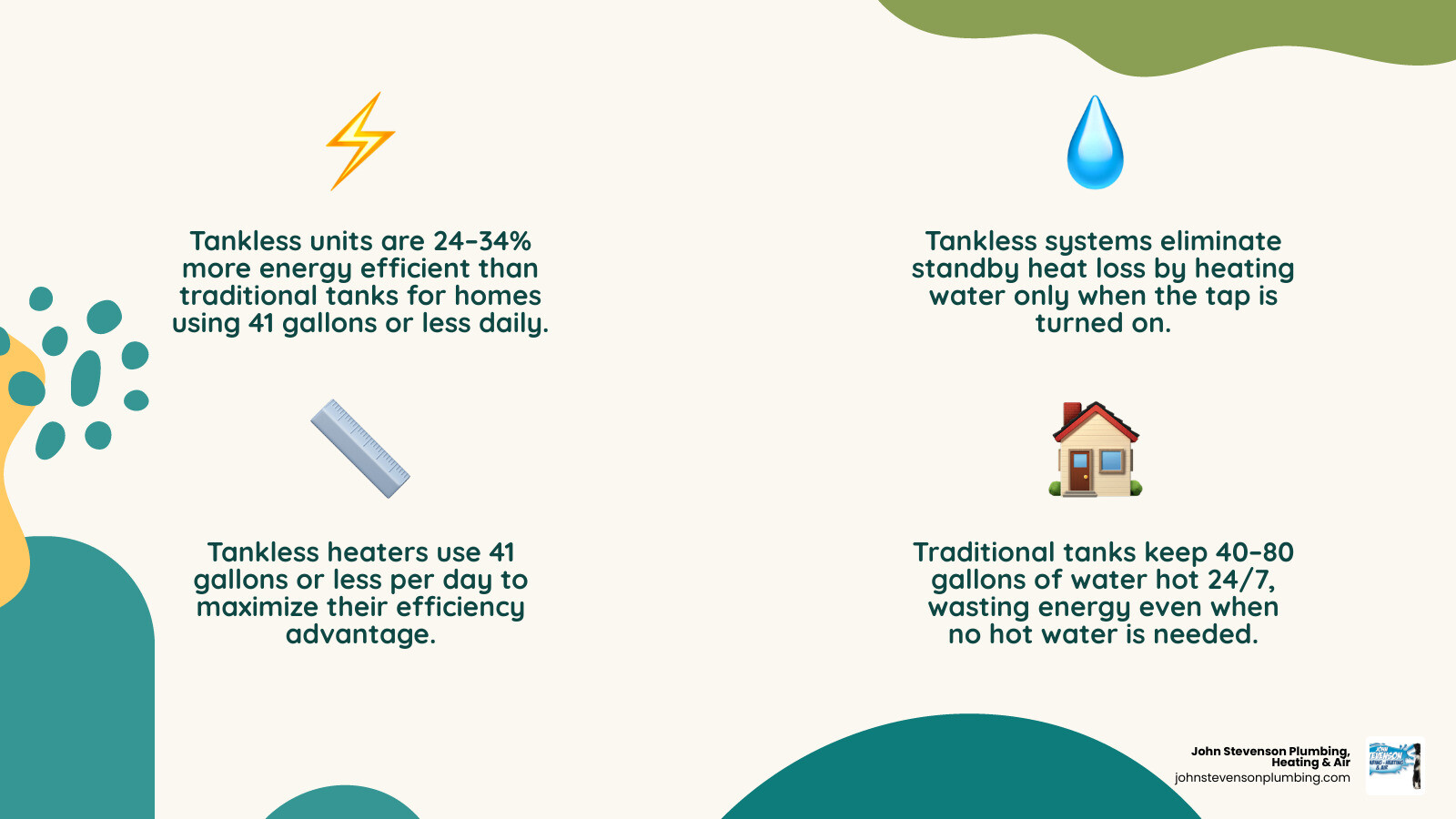
Unlike a traditional storage tank that keeps water hot 24/7, a tankless water heater only fires up when you actually turn on the tap. According to the U.S. Department of Energy, that on-demand approach can make tankless units 24–34% more energy efficient than conventional tank models for homes that use 41 gallons or less of hot water daily. Even households with higher demand can see efficiency gains of 8–14%.
That said, tankless systems aren’t a perfect fit for every home. There are real trade-offs to understand before you commit — from upfront installation requirements to how hard water in Southern California can affect long-term performance.
This guide walks you through everything you need to know to make a confident, informed decision.
Tankless vs. Traditional Storage Tank Water Heaters

To decide if making the switch is right for your home, it helps to look at how these two systems match up side-by-side. Traditional storage tanks have been the standard in Southern California homes for decades. They act like a large reservoir, keeping 40 to 80 gallons of water heated to a set temperature at all times.
While this design is reliable, it comes with a major downside: standby energy loss. The tank must constantly cycle on and off to keep that water hot, even when you are asleep or away at work.
A tankless system, by contrast, is a sleek, wall-mounted unit about the size of a small suitcase. It completely eliminates the storage reservoir. By heating water only when a tap is turned on, it saves energy and takes up a fraction of the space.
If you find yourself constantly debating whether your current setup is still doing its job, check out our guide on Stop Getting Into Hot Water Over Your Choice of Water Heater to see how the two styles compare in daily practice.
| Feature | Tankless Water Heater | Traditional Tank Water Heater |
|---|---|---|
| Operation | Heats water instantly on demand | Keeps a large volume of water hot 24/7 |
| Space Required | Compact, wall-mounted (saves floor space) | Large footprint, takes up utility closet space |
| Hot Water Supply | Continuous (never runs out of hot water) | Limited to the size of the tank |
| Standby Energy Loss | None | High (constantly reheats stored water) |
| Average Lifespan | 20+ years | 10–15 years |
How does a tankless system work?
When you turn on a hot water faucet, cold water enters the tankless unit. A flow sensor detects this movement and instantly activates either a gas burner or an electric heating element. The water circulates through a high-efficiency heat exchanger, which rapidly warms it to your desired temperature before sending it straight to your tap.
Because gas-fired models generally produce a higher flow rate than electric units, they are often the preferred choice for larger family homes. If you want to dive deeper into the technical mechanics of these systems, we explain the details on our Plumbing Services Tankless Water Heaters page.
Is a tankless water heater worth it for energy efficiency?
The short answer is yes, especially if you want to lower your monthly utility bills. Because tankless systems eliminate standby loss entirely, they are incredibly efficient.
For households using 41 gallons or less of hot water daily, tankless units can be 24–34% more energy efficient than conventional tanks. For busier homes that use around 86 gallons of hot water per day, they still offer an 8–14% efficiency boost.
In our local climate, gas tankless systems save families an average of $100 to $200 annually, while electric models save roughly $50 to $100 per year. Over a 20-year lifespan, those monthly utility savings add up to thousands of dollars back in your pocket. To see how these savings look over time, read more about Why Homeowners Are Going Tankless to Save Money.
The Pros and Cons of Going Tankless in Southern California
Switching to a tankless system offers several incredible benefits, but there are also practical limitations to consider.
The Pros:
- Endless Hot Water: You will never have to worry about taking a cold shower because someone else ran the dishwasher.
- Space Savings: These units mount directly to the wall, freeing up valuable closet or garage space.
- Longer Lifespan: A high-quality tankless system is built to last far longer than a standard tank.
- Lower Utility Bills: You only pay to heat the water you actually use.
The Cons:
- Upfront Investment: The initial equipment and professional installation require a larger upfront investment compared to standard tank replacements.
- Power Outages: Because tankless units rely on electronic control boards and gas solenoid valves, they will not produce hot water during a power outage unless connected to a backup battery or generator.
- Flow Rate Limits: If multiple high-demand appliances are running simultaneously, an single unit’s flow rate can be stretched to its limit.
If you are trying to decide whether to repair your current system or invest in an upgrade, our article on How to Decide If Your Water Heater Is a Keeper or a Goner can help you weigh your options.
Lifespan and long-term durability
One of the strongest arguments for going tankless is the sheer durability of the equipment. While traditional storage tank water heaters typically last between 10 and 15 years, a properly maintained tankless water heater has a life expectancy of more than 20 years.
Because they do not store water, they are far less prone to the rust, corrosion, and catastrophic tank ruptures that cut a traditional heater’s life short. For more details on what to expect as your system ages, take a look at our guide: Don’t Get Into Hot Water Over Your Heater’s Lifespan.
Is a tankless water heater worth it when dealing with hard water?
In Carlsbad, Oceanside, and surrounding North County communities, hard water is a reality we all deal with. The high concentration of calcium and magnesium in our local water supply can act as “poison” to a tankless system if left unaddressed.
As hard water is rapidly heated inside the heat exchanger, mineral scale can build up on the surfaces, reducing heat transfer efficiency and forcing the unit to work harder.
Fortunately, this is highly manageable. Installing a whole-home water softener or a scale-inhibitor system is an excellent way to protect your unit. Regular professional maintenance also ensures your system remains scale-free and runs at peak efficiency.
Installation Requirements and California Plumbing Codes
Installing a tankless water heater is a highly technical process. Gas-fired tankless units require specialized venting to safely exhaust combustion gases through a wall or roof, and they often require larger gas lines to handle the high burner capacity needed for instant heating.
Additionally, we must design installations to meet strict local regulations. For example, the California Energy Code (Title 24) sets high efficiency and installation standards for water-heating systems. To make sure your home is fully compliant, check out our breakdown of Don’t Get Burned by California Plumbing Code Water Heater Rules.
Permits and safety compliance in Carlsbad
Any water heater replacement in Carlsbad or San Diego County requires a local building permit to ensure safety and code compliance. Because we live in an active seismic region, California plumbing codes mandate specific seismic bracing to keep the unit secure during an earthquake.
Depending on your home’s plumbing design, you may also need a thermal expansion tank or specific pressure-relief venting.
To learn more about navigating these requirements safely, consult these helpful guides:
- Permit or Perish: Your Guide to California Water Heater Replacements
- The Ultimate Guide to California Earthquake Bracing for Water Heaters
- The Pressure Is On: Understanding California Expansion Tank Codes
Frequently Asked Questions About Tankless Water Heaters
Can a tankless water heater support a large household?
Yes, but proper sizing is critical. Tankless water heaters are rated by flow rate, measured in gallons per minute (GPM). While a traditional tank has a set capacity, a tankless unit’s limit is based on how many fixtures are running at the exact same time.
Gas-fired models typically deliver higher flow rates (5 to 10 GPM) than electric models (2 to 5 GPM). If you have a large household with heavy simultaneous hot water use, our team can help size a single high-capacity unit or design a system with multiple units to ensure you never run out.
What annual maintenance does a tankless system require?
To maintain your warranty and keep your system running for 20+ years, you should have your tankless water heater professionally flushed and descaled once a year. This process uses a food-grade descaling solution to clear out any mineral buildup inside the heat exchanger. The unit’s inlet water filter should also be checked and cleaned regularly.
Do tankless water heaters work during a power outage?
Standard tankless units do not work during a power outage because they require electricity to run the digital control boards, sensors, and gas ignition valves. However, because they have low electrical power demands, they can easily be plugged into a small battery backup system or a home generator to keep your hot water flowing when the power goes out.
Conclusion: Is a tankless water heater worth it for your home?
For homeowners in Carlsbad, Oceanside, and across Southern California, a tankless water heater is a highly rewarding long-term investment. If you appreciate lower utility bills, want to reclaim valuable storage space, and love the idea of never running out of hot water during a long shower, going tankless is absolutely worth it.
Because proper sizing and expert installation make all the difference, it is important to work with a licensed team that understands local plumbing codes and water conditions. If you live in Lake Forest, you can learn more about local options by visiting our page for a Plumber in Lake Forest Tankless Water Heaters.
When you are ready to explore your options or schedule an assessment, we are here to help. Contact us today or visit our John Stevenson Plumbing Orange County Water Heater Services page to schedule a professional consultation and find the perfect hot water solution for your home!