
Hot Water for the Whole Family: Tankless vs Tank Water Heater for Large Families in Carlsbad, CA
Choosing between a tankless vs tank water heater for large families comes down to three things: how much hot water your household needs at once, how long you plan to stay in your home, and what your home’s existing infrastructure can support. Here’s a quick breakdown to help you decide:
| Factor | Tank Water Heater | Tankless Water Heater |
|---|---|---|
| Hot water supply | Limited by tank capacity (50-80 gal) | Unlimited, on demand |
| Best for large families | Families with staggered usage | Families with simultaneous peak demand |
| Energy efficiency | Lower (standby heat loss) | Higher (8-34% more efficient) |
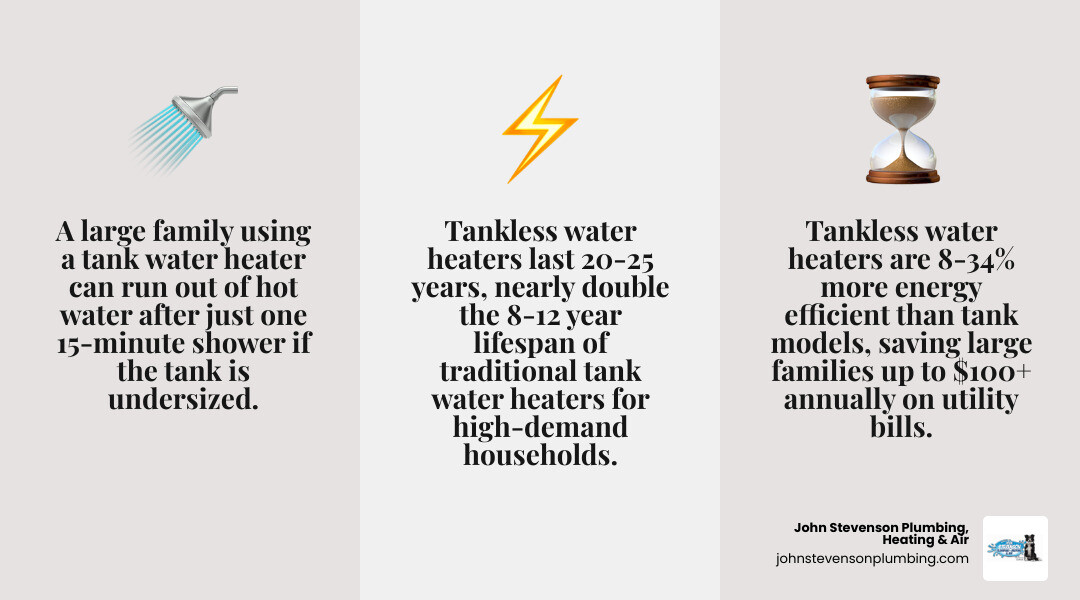
| Lifespan | 8-12 years | 20-25 years |
| Installation complexity | Simple, lower cost | Higher cost, may need upgrades |
| Maintenance | Annual flush, anode rod checks | Annual descaling required |
| Space required | Large floor footprint | Wall-mounted, compact |
The short answer: For most large families in Carlsbad who plan to stay in their home long-term, a properly sized gas tankless water heater or a hybrid heat pump water heater offers better long-term value. However, a high-capacity tank may still make sense if upfront cost is the priority or simultaneous hot water demand is very high.
Picture this: it’s 7:00 AM on a Tuesday. Your oldest just finished a shower, the dishwasher is running, and you step in — only to get hit with a cold blast. That’s the moment most Carlsbad families start seriously researching their options.
I’m John Stevenson, and after years of helping Southern California homeowners navigate exactly this decision, I want to give you the clearest, most honest comparison possible so you can choose with confidence.
Important tankless vs tank water heater for large families terms:
Sizing and Flow Rates: Tankless vs Tank Water Heater for Large Families
When sizing a water heater for a large household, you cannot rely on guesswork. If you undersize a tankless system, you will experience sudden drops in water temperature. If you undersize a tank system, the last person in line for the morning shower is guaranteed a freezing surprise.
To make the right choice, it helps to read our guide on Choosing the Right Water Heater for Your Home and learn more about calculations in Everything You Need to Know About What Size Water Heater Do I Need?
Sizing a Tankless vs Tank Water Heater for Large Families in Southern California
Sizing a tankless system requires calculating your peak Gallons Per Minute (GPM) demand alongside the required “temperature rise.” Temperature rise is the difference between the temperature of the incoming groundwater and your desired output temperature (usually around 120°F).
In Southern California, including Carlsbad, CA and San Diego County, our groundwater remains relatively mild year-round, typically hovering around 60°F to 65°F. This is a massive advantage compared to northern states where winter groundwater can drop to near-freezing.
Because our incoming water is already warm, a tankless unit in our service area only needs to raise the water temperature by about 55°F to 60°F. This allows tankless systems to operate much closer to their maximum rated GPM flow rates. A quality whole-home tankless unit can easily supply between 5 to 10 GPM under these local conditions, which is highly beneficial for busy households.
Managing Simultaneous Hot Water Demand for Five or More People
For a family of five or more, the morning rush is a high-stakes coordination challenge. To determine if a single tankless unit can keep up, you must add up the flow rates of all fixtures that might run at the same time during peak hours:
- Standard Shower: ~2.5 GPM
- Low-Flow Shower: ~1.5 to 2.0 GPM
- Dishwasher: ~1.0 to 1.5 GPM
- Washing Machine: ~2.0 GPM
If two family members are showering simultaneously while the dishwasher is running, your peak demand is roughly 6.0 to 6.5 GPM. A single high-capacity tankless unit rated for 8 to 10 GPM can handle this load comfortably. However, if your home has four bathrooms and a large family that regularly runs three showers, a washing machine, and a dishwasher all at once, a single tankless unit may struggle. In those extreme high-demand scenarios, we often recommend installing dual tankless units or opting for a high-capacity storage system.
Energy Efficiency, Lifespan, and Long-Term Utility Savings
Water heating accounts for roughly 20% of a typical home’s energy bill. For a large family using a significant volume of hot water daily, selecting an efficient system is one of the easiest ways to lower monthly utility costs. To understand the financial benefits of upgrading, explore Why Homeowners Are Going Tankless to Save Money and check out our In-Depth Guide to Energy-Efficient Water Heater Options.
Comparing Standby Heat Loss and On-Demand Heating
Traditional tank water heaters keep 50 to 80 gallons of water hot 24 hours a day, 7 days a week. This continuous heating process results in “standby heat loss” as heat constantly escapes through the walls of the tank. This represents a continuous draw on your gas or electric utility line even when the family is asleep or away at work and school.
Tankless systems eliminate standby heat loss entirely by heating water only on demand. When a hot water tap is opened, cold water flows through a high-powered copper or stainless steel heat exchanger, which instantly heats the water to your target temperature.
For households using over 80 gallons of hot water per day, tankless units are roughly 8% to 14% more energy-efficient than traditional tanks. While that efficiency percentage is slightly lower than in low-use homes (where tankless can be up to 34% more efficient), the actual dollar savings on your monthly bill are often higher because your total water volume is so large.
If your home is entirely electric, a hybrid heat pump water heater is an incredibly efficient alternative to both standard electric tanks and electric tankless units. Heat pump water heaters can be up to 5 times more efficient than standard electric tank heaters, boasting a Uniform Energy Factor (UEF) of 3.5 to 4.0 compared to electric tankless units which typically range from 0.91 to 0.99. Some advanced heat pump models can save up to 60% on energy bills compared to standard electric options, making them a fantastic choice for eco-conscious Southern California families. Learn more about these fuel options in our In-Depth Guide to Gas vs Electric Water Heater Which Is Better.
Maintenance Realities for Tankless vs Tank Water Heater for Large Families
A water heater is a major investment, and its total cost of ownership is heavily influenced by how long it lasts and the maintenance it requires.
Traditional tank water heaters typically last between 8 to 12 years. Over time, the sacrificial anode rod inside the tank depletes, allowing the steel tank to corrode from the inside out, which eventually leads to a catastrophic leak. Tankless systems, by contrast, can easily last 20 to 25 years because they do not store water and are built with highly durable components.
However, tankless systems are less tolerant of neglected maintenance. To keep your system running efficiently and protect its warranty, you must perform regular maintenance:
- Annual Descaling (Tankless): Flushing the heat exchanger with a mild descaling solution (like food-grade vinegar) to remove mineral scale buildup.
- Sediment Flushing (Tank): Draining and flushing a traditional tank annually to clear out sediment that settles at the bottom of the tank and reduces heating efficiency.
- Anode Rod Checks (Tank): Inspecting and replacing the sacrificial anode rod every 3 to 5 years.
To maximize the lifespan of whatever system you choose, read our professional tips on How to Extend the Life of Your Water Heater, Don’t Get Into Hot Water Over Your Heater’s Lifespan, and How to Know When to Replace Your Water Heater.
Installation Requirements and Home Infrastructure Upgrades
Switching from a traditional tank to a tankless system is rarely a simple swap. Because tankless systems heat water instantly, they require a massive, concentrated burst of energy. This means your home’s existing utility infrastructure may need to be upgraded to support the new unit. For a deeper dive into these requirements, see The Ultimate Guide to Is a Tankless Water Heater Worth It? and Stop Getting Into Hot Water Over Your Choice of Water Heater.
Gas Line and Venting Upgrades for High-BTU Systems
A standard gas tank water heater typically requires about 30,000 to 40,000 BTUs (British Thermal Units) of gas energy. A whole-home gas tankless unit, however, requires between 150,000 to 199,000 BTUs to heat water instantly on demand.
Because of this massive increase in fuel demand, your existing gas line may need to be upsized from a standard 1/2-inch pipe to a 3/4-inch pipe to maintain proper gas pressure. Additionally, gas tankless units require specialized Category III stainless steel or dedicated PVC venting to safely exhaust the high-temperature combustion gases through an exterior wall.
Electrical Panel Capacity for Whole-Home Electric Models
If you are considering a whole-home electric tankless water heater, you must evaluate your home’s electrical panel capacity. To heat water instantly using electricity alone, these units draw an immense amount of power—often requiring a dedicated 120-amp to 150-amp circuit.
Most older homes in Carlsbad and San Diego County only have a 100-amp or 200-amp total electrical service panel. Installing an electric tankless unit in these homes almost always requires a complete electrical panel upgrade to handle the load, which can add significant complexity to the installation process.
Frequently Asked Questions About Water Heaters for Large Families
Can a single tankless water heater support three simultaneous showers?
In Southern California, a single high-capacity tankless water heater (such as a 9.0 to 11.0 GPM unit) can support three simultaneous showers, provided you have modern low-flow showerheads installed. Because our local winter groundwater temperature rarely drops below 60°F, the required temperature rise is minimal, allowing the unit to operate at its peak flow capacity. However, if someone turns on a fourth hot-water appliance like a washing machine during those three showers, you may experience a temporary drop in water pressure or a brief “cold-water sandwich” effect.
How does hard water affect the performance of a tankless system?
Many communities in San Diego and Orange County have hard water containing elevated levels of calcium and magnesium. When hard water is heated inside a tankless unit, these minerals solidify and form scale deposits on the copper heat exchanger.
This scale acts as an insulator, forcing the unit to work harder to heat the water. Just a small layer of scale can reduce your system’s efficiency by up to 15% in a single year and significantly shorten the lifespan of the heat exchanger. If you have hard water, we highly recommend pairing your tankless unit with a whole-home water softener to protect your investment.
Are there energy efficiency rebates available in 2026?
Yes! In July 2026, there are several local utility incentives, state programs, and tax credits available for Southern California homeowners who upgrade to high-efficiency water heaters. Both qualifying gas tankless systems and hybrid heat pump water heaters may qualify for regional rebates through local utility programs, as well as state-level energy-efficiency incentives. When we perform your in-home consultation, our certified technicians will provide a complete list of active rebates and credits to help you maximize your savings.
Conclusion
Choosing the right tankless vs tank water heater for large families is a decision that impacts your household’s comfort, energy bills, and daily peace of mind for years to come. Whether you opt for the endless hot water of a modern tankless system, the ultra-high efficiency of a hybrid heat pump, or the dependable high-volume capacity of a traditional tank, professional sizing and installation are key to ensuring your system performs flawlessly.
At John Stevenson Plumbing, Heating & Air, we serve Carlsbad, CA, and surrounding Southern California communities with certified technicians, upfront pricing, and our signature 5-Star Service Guarantee. We are here to perform a thorough diagnostic of your home’s infrastructure, calculate your family’s exact peak hot water demand, and help you choose the perfect system for your needs.
Schedule your professional water heater consultation with John Stevenson Plumbing, Heating & Air today to take control of your family’s morning routine!