
Why the Recommended Water Heater Temperature for Families Matters More Than You Think
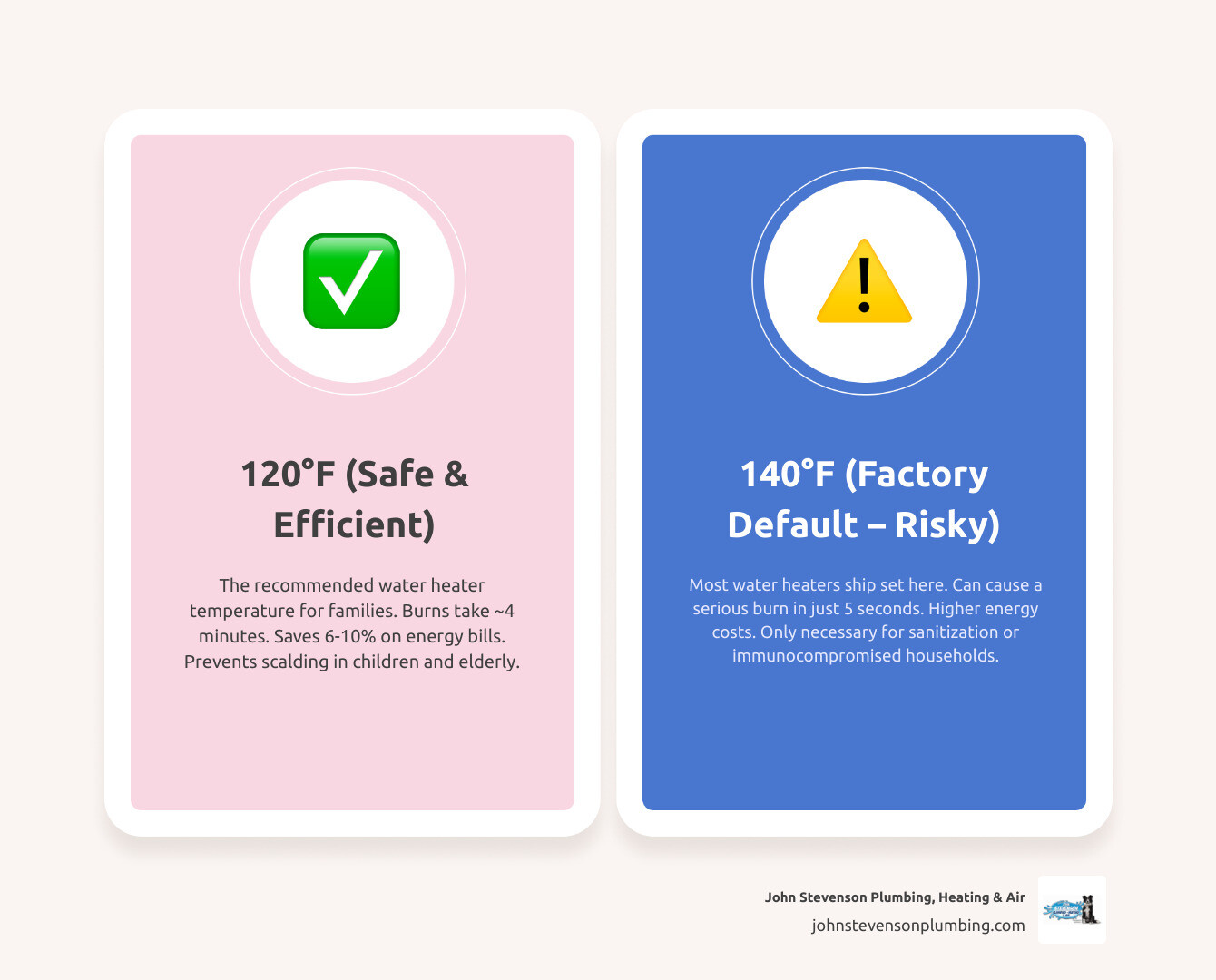
The recommended water heater temperature for families is 120°F (49°C) — a setting backed by both the U.S. Department of Energy and the Consumer Product Safety Commission (CPSC). Here is a quick summary before we dive deeper:
- 120°F is the standard safe setting for most households
- 140°F is the factory default on most water heaters — and higher than most families need
- Water at 140°F can cause a serious burn in as little as 5 seconds
- At 120°F, it takes roughly 4 minutes of continuous exposure to cause a burn
- Lowering from 140°F to 120°F can save 6 to 10 percent on your energy bill
Every day, 300 children are taken to emergency rooms due to hot-water burns, and burns are the second leading cause of death for children under age 5. At the same time, your water heater accounts for nearly 20% of your entire energy bill. That means the temperature dial on your water heater is not just a comfort setting — it is a safety and financial decision your household makes every single day.
Most homeowners never think twice about that dial. But whether you have young kids, elderly family members, or simply want to stop overpaying on utilities, getting that temperature right makes a real difference.
I’m John Stevenson, and in this guide we’ll walk you through everything you need to know to find the safest, most efficient setting for your home.
What is the Recommended Water Heater Temperature for Families?
When you buy a brand-new water heater or move into a new home in Southern California, you might assume the manufacturer set the temperature dial to the perfect, safest setting. In reality, most storage tank water heaters leave the factory set to 140°F (60°C).
While 140°F ensures that water is incredibly hot, it is often far too hot for normal household needs. For the vast majority of households, the recommended water heater temperature for families is 120°F (49°C).
At 120°F, you have plenty of thermal energy for comfortable hot showers, running the washing machine, and washing hands, without the extreme danger of instant physical burns. Additionally, keeping your water at this setting dramatically reduces standby heat loss—the energy wasted when your water tank continuously fires up to keep stored water hot when nobody is using it.
If you are currently trying to navigate these settings, it helps to understand the basics of your heating system. Take a look at our guide to Stop Getting Into Hot Water Over Your Choice of Water Heater to learn how different models manage and distribute heat throughout your home.
Why 120°F is the Recommended Water Heater Temperature for Families
Setting your water heater to 120°F strikes the perfect balance between comfort, cost, and safety.
First, let’s talk about scalding prevention. At 120°F, it takes about four minutes of continuous skin contact to cause a serious burn. This gives adults, children, and seniors plenty of time to react and pull away if they accidentally turn the hot water handle too far. At 140°F, that safety margin completely vanishes, and severe burns can happen in seconds.
Second, there is a massive opportunity for energy efficiency. Because heating water accounts for nearly 20% of your home’s total utility bills, keeping your water at an excessively high temperature wastes money. By lowering the temperature from 140°F to 120°F, you can save roughly 6% to 10% on your utility bills.
For more ways to keep your home’s utility bills in check, explore our In-Depth Guide to Energy Efficient Water Heater Options to see how modern, eco-friendly systems compare.
When a Higher Setting Like 140°F Might Be Necessary
While 120°F is the gold standard for most, there are unique situations where keeping your tank set to 140°F is actually recommended:
- Immunocompromised Residents: If someone in your home has a severely weakened immune system, raising the tank to 140°F is highly effective at killing off pathogens like Legionella bacteria.
- Older Dishwashers: Most modern dishwashers feature built-in booster heaters that automatically heat incoming water to the 130°F–140°F range required to activate modern detergents and sanitize dishes. However, if you have an older or budget-friendly dishwasher model without an internal booster, it will rely entirely on your water heater’s output, requiring a higher tank setting.
- High Demand and Large Families: If you have a large family taking back-to-back showers, a higher tank temperature means you will mix more cold water with the hot water at the tap, effectively stretching your hot water supply further.
If your household’s hot water needs are growing, check out Everything You Need to Know About What Size Water Heater Do I Need to make sure your system can keep up with daily demands.
The Risks of Setting Your Water Heater Temperature Too High or Too Low
Finding the perfect water temperature is a delicate balancing act. Setting the dial too high puts your family’s skin at risk, while setting it too low can turn your water tank into a breeding ground for harmful bacteria.
Understanding these risks is the first step in protecting your household. Regular system care also plays a massive role in maintaining safe, consistent temperatures. You can learn how to keep your system running safely by reviewing our tips on How to Extend the Life of Your Water Heater.
The Danger of Scalding and Pediatric Burn Statistics
The physical dangers of excessively hot water are staggering. According to a Johns Hopkins study, 41% of homes had hot water temperatures above the CPSC’s recommended 120°F, including 27% at or above 130°F.
This is incredibly dangerous for vulnerable family members. Children under the age of five have skin that is significantly thinner and more delicate than adult skin. Consequently, they burn much faster and at lower temperatures. Older adults are also highly vulnerable due to reduced skin sensitivity, slower physical reaction times, or limited mobility that makes it harder to quickly escape scalding water.
Consider how quickly hot water can cause a serious third-degree burn:
- At 150°F, scalding occurs in less than 1 second.
- At 140°F, water can cause a severe burn in as little as 2.5 to 5 seconds for a child.
- At 130°F, it takes about 30 seconds to cause a serious burn.
- At 120°F, it takes approximately 4 minutes of continuous exposure to burn.
Additionally, very hot water strips the skin of its natural oils, which can cause severe dryness, skin irritation, and worsen chronic conditions like eczema.
The Danger of Bacterial Growth and Legionella
On the flip side, you should never turn your water heater below 120°F. Stagnant, lukewarm water is the ultimate breeding ground for biological hazards, most notably Legionella bacteria, which causes Legionnaires’ disease (a severe form of pneumonia).
Legionella thrives and multiplies rapidly in water temperatures between 77°F and 113°F. Keeping your tank at a minimum of 120°F creates a hostile environment that prevents these pathogens from multiplying. If your system is struggling to reach or maintain these safe thresholds, it could point to a larger mechanical issue. To troubleshoot, take a look at our guide on How to Diagnose a Failing Water Heater.
How to Check and Adjust Your Water Heater Temperature
Because the dials on water heaters are often uncalibrated, vague, or worn down over time, you cannot always trust what the thermostat dial says. Sediment buildup inside the tank or electrical drift can cause a major discrepancy between the thermostat’s setting and the actual temperature of the water coming out of your faucets.
Before making any adjustments, it is helpful to know what type of system you have. If you are curious about the mechanical differences, read our In-Depth Guide to Gas vs Electric Water Heater Which Is Better.
Testing the Actual Tap Temperature with a Thermometer
To find out exactly what temperature your water heater is delivering to your home, perform a simple physical thermometer test:
- Choose a faucet located closest to your water heater.
- Let the water sit unused in your home for at least two hours to ensure the tank has fully heated.
- Turn on the hot water faucet completely and let it run for two full minutes to flush out any cooled water sitting in the pipes.
- Hold a reliable kitchen or candy thermometer directly under the running stream.
- Wait until the temperature reading stops rising, and write down the final number. This is your true baseline reading.
Step-by-Step: Adjusting a Gas Water Heater
Most gas water heaters are relatively straightforward to adjust because they feature an external dial located near the bottom of the tank on the gas control valve.
- Locate the dial on the front of the gas control valve.
- Note the markings. Many older or standard gas valves do not display exact numbers; instead, they use labels like “Low,” “Hot,” “A,” “B,” “C,” and “Very Hot.” Typically, “Hot” represents approximately 120°F, while the alphabetical letters represent increments up to 140°F or higher.
- Turn the dial down slightly toward the “Hot” or lower setting.
- Wait at least three hours for the water in the tank to adjust, then perform the faucet thermometer test again to verify the new temperature.
Step-by-Step: Adjusting an Electric Water Heater
Adjusting an electric water heater requires a bit more care because the thermostats are located behind metal access panels, which exposes live electrical wiring. Always prioritize safety.
- Turn off the power: Go to your home’s main electrical breaker panel and switch off the circuit breaker dedicated to your water heater.
- Remove the access panels: Use a screwdriver to remove the upper and lower access panels on the side of the water heater tank.
- Move the insulation: Gently push aside the protective insulation to reveal the thermostats.
- Adjust both thermostats: Electric water heaters typically have two heating elements, each controlled by its own thermostat. Use a flat-head screwdriver to turn both the upper and lower thermostats to the exact same temperature setting (e.g., 120°F). If they are set differently, you will experience uneven heating and premature element wear.
- Reassemble and restore power: Replace the insulation, screw the access panels back on, and turn the circuit breaker back on.
- Verify: Wait several hours, then test the tap water with your thermometer.
Advanced Safety Measures: Anti-Scald Devices and Mixing Valves
If you want the absolute best of both worlds—keeping your water heater tank at 140°F to completely eliminate bacterial growth while ensuring safe 120°F water at your faucets—there is an elegant plumbing solution available.
These upgrades are highly recommended by modern building codes and provide peace of mind, especially in multi-generational homes. When planning system upgrades, it is vital to match these safety accessories with the right hardware. Read our guide on Choosing the Right Water Heater for Your Home to see how different tank setups interact with modern safety valves.
Adjusting the Recommended Water Heater Temperature for Families with Mixing Valves
An anti-scald device, also known as a thermostatic mixing valve, is installed directly on the hot water outlet pipe of your water heater or at individual fixtures (like your shower or bathroom sink).
The mixing valve works by automatically blending a precise amount of incoming cold water with the hot water leaving the tank before it travels to your faucets. This ensures that even if your tank is set to a bacteria-killing 140°F, the water coming out of your showerheads and faucets will never exceed a safe, comfortable 120°F.
Troubleshooting Inconsistent Temperatures and System Sizing
If you find that your hot water is constantly fluctuating between boiling hot and freezing cold, or if you run out of hot water after just one shower, adjusting the thermostat might not solve the problem.
Common culprits for inconsistent temperatures include:
- Heavy Sediment Buildup: Over time, minerals in our Southern California water supply settle at the bottom of the tank, creating a barrier between the burner and the water. This forces the system to work harder, leading to fluctuating temperatures and hot water shortages. Flushing the tank annually resolves this.
- A Broken Dip Tube: The dip tube directs incoming cold water to the bottom of the tank to be heated. If this tube cracks, cold water mixes directly with the hot water at the top of the tank, resulting in lukewarm showers.
- Undersized System: Your water heater might simply be too small for your family’s peak usage times.
In these scenarios, upgrading to a modern system can make a world of difference. To see if a high-efficiency upgrade is right for you, check out The Ultimate Guide to Is a Tankless Water Heater Worth It. If you are on the fence about your current system, our guide on How to Decide If Your Water Heater Is a Keeper or a Goner can help you make the right choice.
Frequently Asked Questions About Water Heater Settings
| Water Temperature | Time to Cause 3rd-Degree Burn | Standby Heat Loss Cost | Primary Use Case |
|---|---|---|---|
| 150°F (66°C) | Less than 1 second | Very High | Commercial / Industrial |
| 140°F (60°C) | 2.5 to 5 seconds | High ($36–$61 wasted/year) | Immunocompromised / Old Dishwashers |
| 120°F (49°C) | Approximately 4 minutes | Low (6–10% utility savings) | Standard Residential / Families |
How much can I save on energy bills by lowering the water heater temperature?
Because water heating accounts for nearly 20% of your home’s energy consumption, turning down your hot water tank temperature from 140°F to 120°F can save you about 6% to 10% on your utility bills.
Additionally, keeping the tank at 120°F reduces standby heat loss, saving an estimated $36 to $61 per year in wasted energy alone.
What should I do if my water temperature is inconsistent or not hot enough?
If your water temperature is highly inconsistent, it is usually a sign of heavy sediment buildup, a failing thermostat, or a broken heating element (in electric models).
Over time, these issues will degrade your system’s efficiency and eventually cause complete system failure. If you are experiencing these issues, read our guide on How to Know When to Replace Your Water Heater to determine if a simple repair or a full replacement is the most cost-effective path forward.
Is 120°F hot enough to kill germs and bacteria?
Yes, for healthy individuals, 120°F is considered a safe and effective threshold for household sanitization and prevents the replication of Legionella bacteria.
While 140°F kills bacteria faster, a setting of 120°F keeps the water hot enough to prevent pathogens from multiplying while protecting your family from devastating scalding injuries. Most modern dishwashers and washing machines also feature internal heating elements to boost temperatures locally when needed.
Conclusion
Finding the perfect water heater temperature is one of the easiest ways to protect your family, lower your monthly utility bills, and keep your home running smoothly. While the recommended water heater temperature for families is 120°F, achieving that perfect balance of safety and comfort sometimes requires professional insight.
Whether you need a thermostatic mixing valve installed, your water tank flushed of performance-robbing sediment, or a comprehensive system diagnostic, our team at John Stevenson Plumbing, Heating & Air Conditioning is here to help. Serving Carlsbad, CA, and the surrounding Southern California communities, we back all of our work with our signature 5-Star Service Guarantee. This means you get:
- Thorough, expert diagnostics to get to the root of the problem
- Clear, upfront pricing with no hidden surprises
- Highly trained, certified technicians who treat your home with respect
- A 24-hour satisfaction check-in to ensure you are completely happy with our work
Keep your family comfortable and safe all year round. Schedule professional water heater services in Carlsbad with John Stevenson Plumbing, Heating & Air Conditioning today!