
Why the Best Rooms for a Mini Split System Matter in Every Carlsbad Home
The best rooms for a mini split system are bedrooms, home offices, sunrooms, converted garages, finished basements, and room additions — spaces where independent, targeted comfort makes the biggest everyday difference, especially in Southern California’s warm climate.
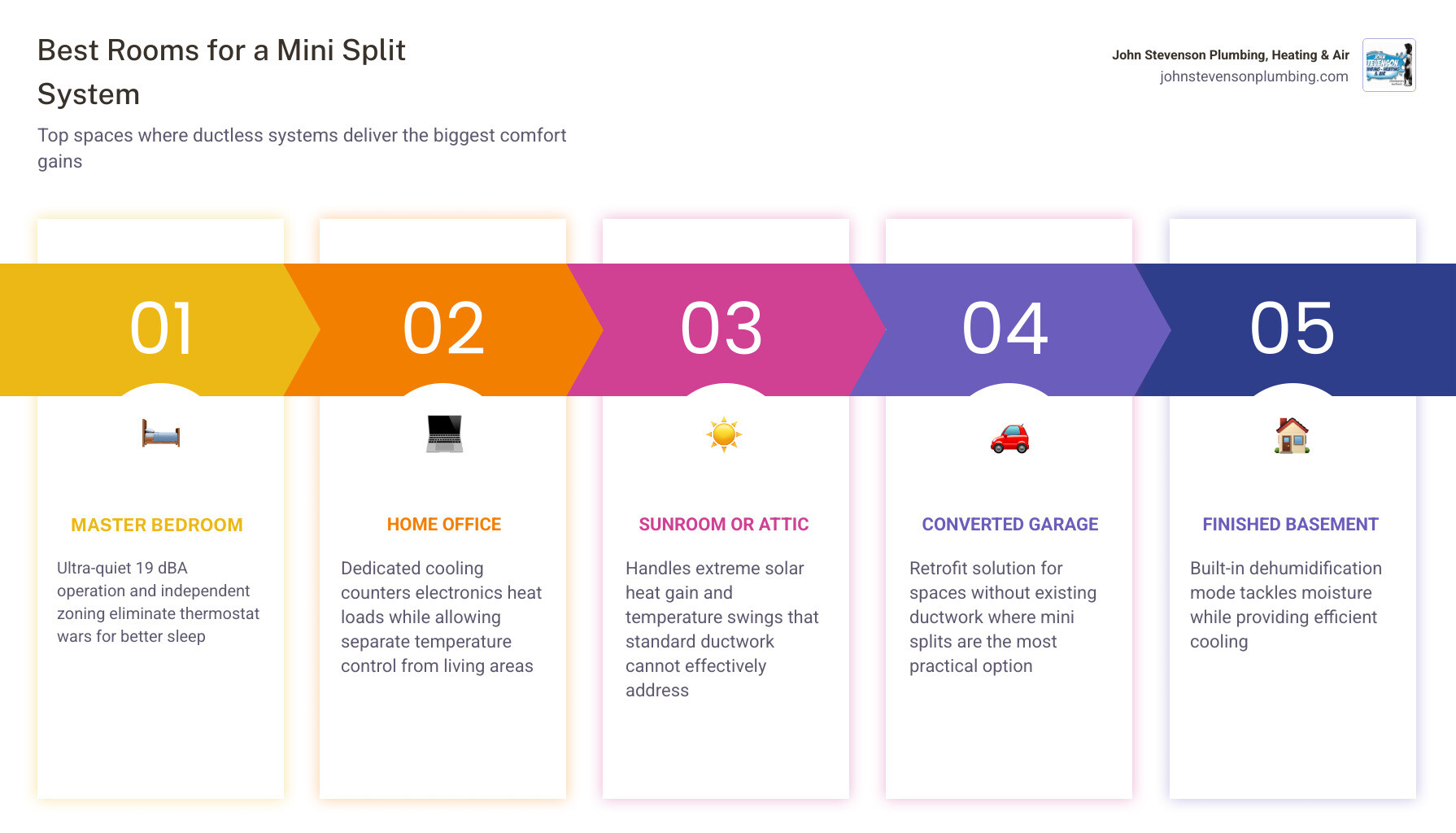
Quick Answer: Top Rooms for a Mini Split System
| Room | Why It Works Well |
|---|---|
| Master bedroom | Ultra-quiet operation; independent temperature control for better sleep |
| Home office | Dedicated cooling for electronics heat; zone separately from the rest of the home |
| Sunroom or attic | Handles extreme solar heat gain that standard ductwork can’t address |
| Converted garage or workshop | No existing ductwork; mini splits are the most practical retrofit option |
| Finished basement | Built-in dehumidification mode tackles moisture while cooling |
| Room additions | Added after original HVAC was designed; often unreachable by existing ducts |
If your home has a room that never quite feels right — always too hot, too stuffy, or too cold — you already know the frustration. In Carlsbad and across San Diego County, homes regularly deal with sun-drenched sunrooms, upstairs bedrooms that trap heat well into the evening, and converted spaces that the original HVAC system simply wasn’t designed to reach. A ductless mini split can solve all of these problems, but only when it’s installed in the right room and in the right spot within that room. Poor placement can cost you up to 20% in efficiency, even with a perfectly sized unit. This guide walks you through exactly where to put one — and where to absolutely avoid.
Relevant articles related to best rooms for a mini split system:
- how many mini split heads do i need
- is a mini split good for whole house cooling
- mini split vs central air which is better
What Are the Best Rooms for a Mini Split System?

Ductless mini split systems offer incredible flexibility because they do not rely on a central network of ducts. Instead, they use individual indoor air handlers connected to an outdoor condenser. This design allows for zoned cooling, meaning you only heat or cool the active spaces in your home.
By creating independent climate zones, you gain precise temperature control over different areas. To fully understand how these zoning capabilities can transform your home’s comfort, check out The Homeowner Guide to Ductless Mini Split Benefits.
While you can technically install a ductless system anywhere, certain spaces benefit far more than others. Let’s look at the primary rooms where these systems truly shine.
Master Bedrooms: Why They Are the Best Rooms for a Mini Split System
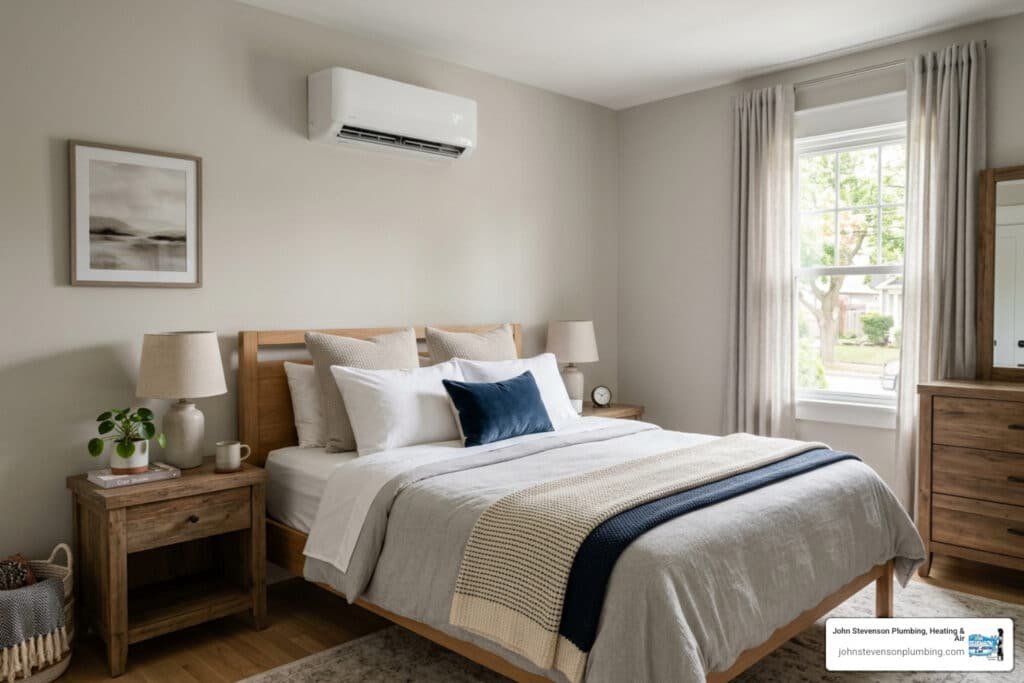
If you have ever fought over the thermostat at night, you know that bedroom comfort is non-negotiable. Master bedrooms and guest suites are among the best rooms for a mini split system for several reasons:
- Whisper-Quiet Operation: Many high-quality mini split indoor units operate at sound ratings as low as 19 dBA. To put that in perspective, a normal whisper is about 30 dBA, and rustling leaves are around 20 dBA. You will barely know the system is running.
- Personalized Sleep Settings: Your ideal sleeping temperature might be 66°F, while the rest of the family prefers 72°F. Independent zoning lets you cool your bedroom to your exact preference without freezing out the rest of the house.
- No More “Second-Floor Syndrome”: In two-story Southern California homes, heat naturally rises, leaving upstairs bedrooms sweltering even when the downstairs thermostat says it is cool. A dedicated mini split balances this temperature gap perfectly.
Sunrooms and Attics: Why They Are the Best Rooms for a Mini Split System
Sunrooms and converted attics are notorious for extreme temperature swings. Sunrooms experience intense solar heat gain (the greenhouse effect), while attics sit directly beneath hot roof shingles, often running 5 to 10 degrees warmer than the ground floor.
Extending central ductwork to these spaces is incredibly difficult and often overburdens your existing central AC. A mini split solves this issue by delivering targeted, powerful cooling directly where the heat load is highest. If you are considering ductless climate control for challenging architectural layouts or multiple rooms, read our guide on All About Mini Split Suitability for Whole House Cooling.
Home Offices and Converted Spaces
With more Carlsbad residents working from home in 2026, home offices have become prime locations for ductless systems. Electronics like computers, multiple monitors, and backup power supplies generate a surprising amount of heat. A mini split keeps your workspace comfortable and productive without requiring you to cool the entire house all day.
Converted spaces like garages and finished basements also benefit immensely:
- Converted Garages: Garages typically lack insulation and connection to the home’s main HVAC system. A mini split transforms a hot garage into a comfortable home gym, workshop, or playroom.
- Finished Basements: Basements are prone to dampness and musty odors. In addition to cooling, mini splits feature a dedicated “dry mode” that acts as a powerful dehumidifier, keeping the space crisp and comfortable.
How Mini Splits Compare to Central Air and Window Units
When deciding how to cool these specific rooms, homeowners usually choose between central air, window units, or mini splits.
According to the U.S. Department of Energy, typical ducted central air systems lose up to 30% of their cooling energy through leaks, gaps, and poorly insulated duct runs. Ductless systems bypass this issue entirely by delivering air directly into the room.
Furthermore, window units are heavy, noisy, and compromise your home’s security. Mini splits are permanently mounted, require only a small 3-inch hole in the wall for connection lines, and operate at a fraction of the noise level. For a deeper dive into this comparison, explore Mini Split vs Central Air Which is Better.
Sizing Your Mini Split: BTU Calculations Beyond Square Footage
Choosing the right size for your mini split is the most critical step in the purchasing process. Sizing is measured in British Thermal Units (BTUs). If your system is too small, it will run constantly, driving up your energy bills and wearing out the compressor. If it is too large, it will suffer from “short cycling”—turning on and off rapidly—which prevents the system from properly dehumidifying the air, leaving your room feeling clammy.
To help you get started, here is a general sizing reference based on standard room sizes:
| Room Size (Sq. Ft.) | Baseline BTU Capacity | Common Applications |
|---|---|---|
| 150 to 300 | 9,000 BTU | Small bedrooms, home offices |
| 300 to 500 | 12,000 BTU | Master bedrooms, standard garages |
| 500 to 750 | 18,000 BTU | Large living rooms, double garages |
| 750 to 1,000 | 24,000 BTU | Open-concept living areas, large basements |
The basic rule of thumb is to allocate 20 BTUs per square foot of living space. However, relying solely on square footage is a mistake. Modern inverter technology allows mini splits to modulate their speed to match the cooling load, but you still need an accurate baseline. For a step-by-step breakdown of how to plan your layout, read our guide on How to Calculate Needed Mini Split Heads in 5 Simple Steps.
Adjusting for Ceiling Height and Sun Exposure
Standard sizing formulas assume an 8-foot ceiling. If your Carlsbad home features beautiful vaulted ceilings, you must adjust your calculations:
- 9-Foot Ceilings: Add 12% to your baseline BTU requirement.
- 10-Foot Ceilings: Add 25% to your baseline.
- 12-Foot or Vaulted Ceilings: Add 50% to your baseline because there is significantly more air volume to cool.
Sun exposure is another critical factor. If you are installing a unit in a south- or west-facing room with large windows, the intense afternoon sun will act like a radiator. You should add 10% to 20% more BTU capacity to offset this solar heat load. Conversely, if the room is heavily shaded or north-facing, you can subtract 10%.
Insulation Quality and Room Occupancy Factors
Older homes in historic Southern California neighborhoods often have unique charm but lack modern insulation. If your home has plaster walls, single-pane windows, or minimal attic insulation, you should add 20% to 40% to your BTU calculation to compensate for heat transfer. To compare how mini splits perform versus central systems in these unique properties, read A Practical Guide to Central Air vs Mini Split for Older Homes.
Additionally, consider how the room is used:
- Occupancy: Every person in a room adds about 600 BTUs of heat per hour. If you are sizing a family room or home gym where multiple people gather, adjust your BTUs upward.
- Appliances: If the space contains heat-generating equipment (like computer servers, large TVs, or cooking appliances), add 1,000 to 2,000 BTUs to keep the space comfortable.
Critical Placement Rules for Indoor and Outdoor Units
Even the highest-quality mini split will underperform if it is installed in the wrong spot. Proper physical placement ensures optimal airflow, quick temperature adjustments, and easy maintenance access. To understand how ductless installation compares to traditional ducted systems, read The Definitive Guide to Central AC vs Ductless Mini Split Comparison.
Indoor Locations to Avoid: The “Don’t Put It There” List
When planning your indoor installation, avoid these common mistakes:
- Kitchens (The Grease Trap): We strongly advise against placing a standard wall unit directly in a kitchen. Cooking releases grease and steam into the air, which quickly coats the mini split’s air filters and internal coils, leading to foul odors, reduced efficiency, and frequent breakdowns.
- Bathrooms (The Humidity Hazard): High humidity from showers can overwhelm the unit’s condensate drain and lead to mold growth inside the chassis.
- Hallways (The “Ghost Trap”): Homeowners sometimes try to cool three bedrooms by mounting a single large mini split in a central hallway. This rarely works. Hallways are airflow dead zones; once the bedroom doors are closed, the cold air is trapped in the hallway, causing the unit to short cycle while the bedrooms remain hot.
- Directly Above Heat Sources: Mounting a unit above a fireplace, radiator, or major appliance will trick the unit’s internal thermostat into thinking the room is much hotter than it actually is, causing it to run constantly.
For standard installations, always follow the 6-inch rule: keep at least 6 inches of open space between the top of the indoor unit and the ceiling. The unit pulls warm air in through the top, so restricting this space limits its cooling capacity. We also prefer mounting units on perimeter (exterior) walls because it allows the condensate drain line to run directly outside via gravity, eliminating the need for a noisy internal condensate pump.
Best Practices for Placing the Outdoor Condenser
The outdoor unit (the condenser) needs just as much care as the indoor air handler:
- Adequate Clearance: Ensure there is at least 12 to 24 inches of clear space on all sides of the condenser. Do not hide it behind thick landscaping or crowd it against a fence, as restricted airflow can reduce efficiency by 15% or more.
- Shade Matters: Placing the outdoor unit on the north or east side of your home keeps it out of the direct afternoon sun. A condenser operating in constant, intense sunlight can consume up to 10% more energy.
- Level and Stable Surfaces: Mount the condenser on a level concrete pad or secure wall brackets. Use heavy-duty rubber vibration pads under the feet to prevent operational vibrations from transferring into your home’s structure.
- Keep Lines Short: Try to keep the distance between the indoor and outdoor units under 30 feet. Shorter line sets maintain higher refrigerant pressure, ensuring peak efficiency.
Frequently Asked Questions About Mini Split Placement
Can one mini split unit cool multiple rooms?
A single wall-mounted indoor unit is designed to condition the specific room it is installed in. Air does not travel easily around tight corners or through narrow doorways. If you want to cool multiple rooms, you should install a multi-zone system. This setup connects up to five indoor air handlers to a single outdoor condenser, allowing each room to have its own independent thermostat.
How high should a mini split indoor unit be mounted?
For standard 8-foot ceilings, the indoor air handler should be mounted between 7 and 7.5 feet from the floor. This height ensures even air distribution throughout the living space while keeping the unit accessible for regular filter cleanings. If you have high or vaulted ceilings, try to keep the unit mounted around 8 feet high to prevent cooled air from losing momentum before it reaches the living zone.
What maintenance considerations arise from different room placements?
Different rooms present unique environmental challenges:
- Bedrooms and Living Rooms: These spaces accumulate standard household dust and pet dander. Air filters should be slid out and rinsed under warm water every 1 to 2 months.
- Workshops and Garages: Sawdust, drywall dust, and outdoor debris will clog filters much faster. Inspect these units every 2 to 3 weeks.
- High-Traffic Areas: Units in busy family rooms may require more frequent coil cleanings. Regardless of placement, we recommend scheduling a professional maintenance check once a year to flush the condensate drain lines and check refrigerant levels.
Conclusion
Finding the best rooms for a mini split system and installing the units in the right spots is the key to unlocking maximum comfort and energy savings. Whether you want to tame a hot upstairs bedroom, reclaim your garage, or finally enjoy your sunroom, a ductless system is an incredibly efficient solution.
At John Stevenson Plumbing, Heating & Air Conditioning, Inc., we have spent years helping Carlsbad homeowners design perfect zoning systems. Our certified technicians back every installation with our 5-Star Service Guarantee, which includes thorough diagnostics, upfront pricing, and a 24-hour satisfaction check-in to ensure your system performs flawlessly.
Ready to upgrade your home’s comfort? Schedule your Carlsbad ductless mini split consultation today!