
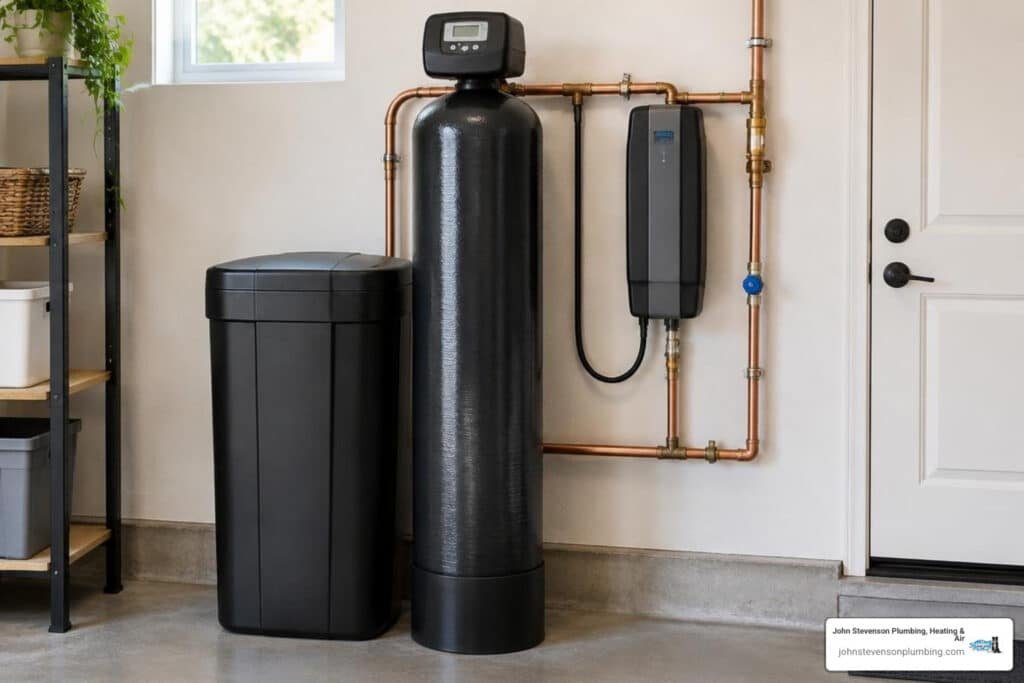
Understanding Hard Water and Its Impact on Southern California Plumbing
If you are asking, “do I need a water descaler or water softener,” the answer depends on your goals. Choose a water descaler when you want salt-free scale defense without changing how your water feels. Choose a water softener when you have severe hardness and want complete mineral elimination, softer skin, and better lathering. Both systems should be installed by licensed local plumbers who can size the equipment for your home.
Water hardness is determined by the concentration of dissolved minerals—primarily calcium and magnesium ions—collected as water percolates through natural limestone and mineral deposits. In municipal supplies across Carlsbad, San Diego County, and Orange County, mineral concentrations run high. While drinking these minerals is generally safe, their presence causes widespread complications throughout household plumbing.
Hardness is measured in parts per million (PPM) or grains per gallon (GPG). Water measuring over 60 PPM (around 3.5 GPG) is classified as hard, and levels exceeding 180 PPM (over 10.5 GPG) are considered very hard. If you notice crusty white deposits on showerheads or dull laundry, you can consult our practical guide to how to tell if you have hard water signs to confirm what is happening at your fixtures.
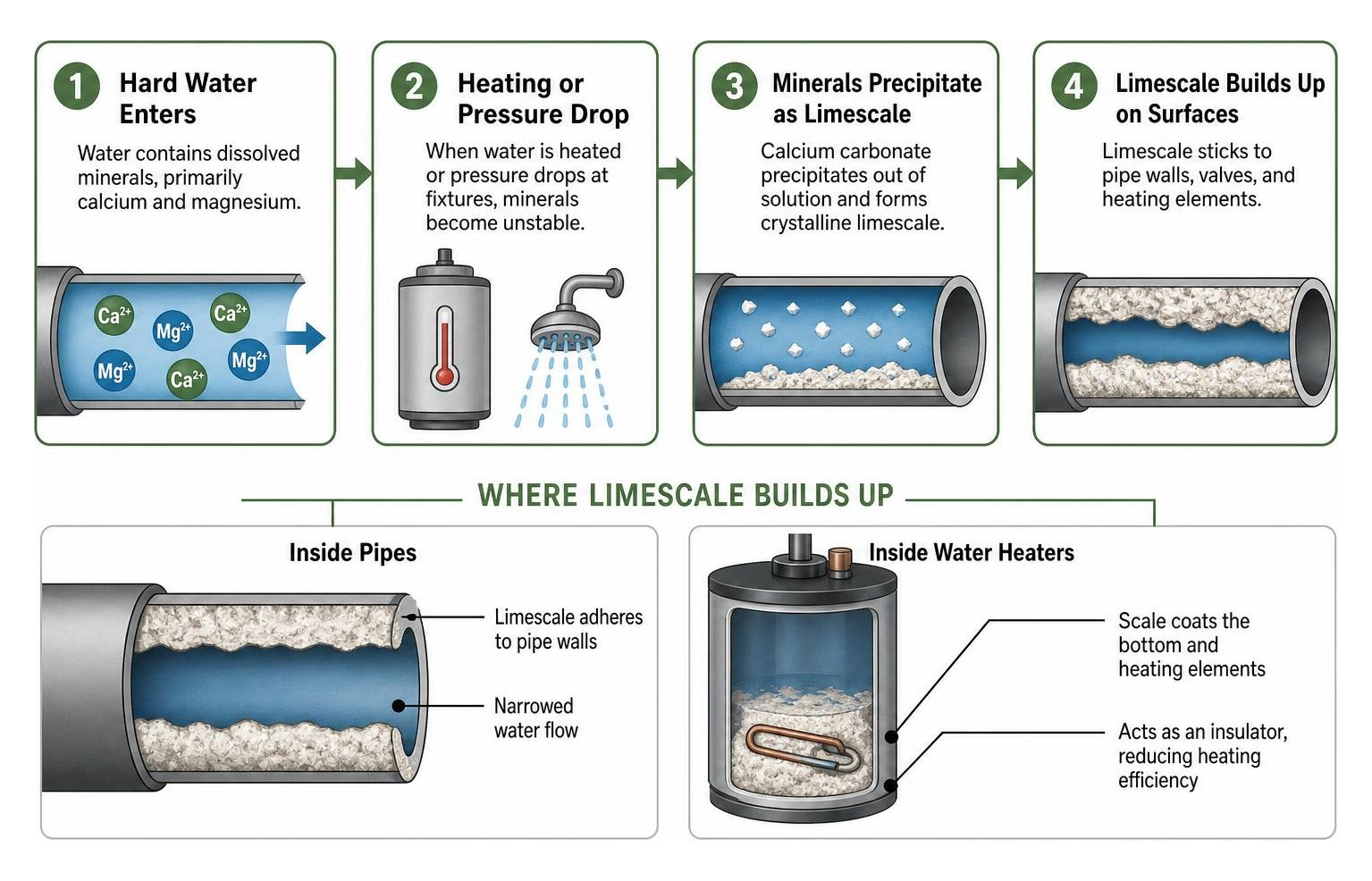
When hard water is heated or undergoes pressure drops at fixture outlets, dissolved calcium carbonate precipitates out of solution and forms crystalline limescale. Limescale sticks stubbornly to copper, PEX, valves, and heating elements. To learn how this degrades fixtures over time, review our complete guide to hard water effects on plumbing and appliances.
Water heaters suffer the greatest performance penalty. A layer of scale coating the bottom of a storage tank or the heat exchanger of a tankless unit acts as an unintended thermal insulator. This layer can decrease heating efficiency by 20% to 30%, driving up energy consumption and causing premature element burnout. Navigating Southern California’s complex water quality issues requires addressing this mineral load before it causes lasting damage to your pipes and water heating systems.
How Descalers and Softeners Work: Core Technology Differences
Homeowners weighing their options are often choosing between two fundamentally distinct methods: physically conditioning the minerals or removing them altogether. Reviewing the ins and outs of water softener vs descaler comparison helps clarify this difference. One system changes how minerals behave, while the other removes them from your water supply.
How Water Descalers Work
Water descalers, often categorized as salt-free water conditioners, do not extract calcium or magnesium from your supply. Instead, they alter the crystalline structure of these minerals so they struggle to bind to surfaces.
The most common descaling approaches include:
- Template-Assisted Crystallization (TAC): Water flows through a specialized catalytic media that encourages dissolved hardness ions to form microscopic, stable crystals. These microscopic seed crystals remain suspended in the water stream and flow freely out of your drains rather than adhering to pipe walls and heating elements.
- Electromagnetic and Electronic Conditioning: These units wrap around your main water line and apply oscillating electromagnetic fields. The field changes the charge and morphology of mineral ions, reducing their tendency to stick as stubborn scale.
Because descalers leave the minerals intact, testing your water with standard total dissolved solids (TDS) or hardness test strips will show the exact same mineral count before and after the system. Our team offers dedicated water descaling services for homeowners who want to prevent scale accumulation while keeping beneficial minerals in their tap water.
How Ion-Exchange Water Softeners Work
Traditional water softeners operate on the principle of ion exchange to physically strip calcium and magnesium ions out of your plumbing lines.
- Mineral Trapping: Hard water enters a pressurized tank filled with millions of microscopic, negatively charged polystyrene resin beads saturated with sodium (or potassium) ions.
- Ion Exchange: Because calcium and magnesium carry a stronger positive charge than sodium, they displace the sodium ions and cling securely to the resin beads as water passes through.
- Delivery of Soft Water: Mineral-free, truly soft water flows out into your home’s plumbing system.
- Brine Regeneration: Once the resin beads become saturated with hardness minerals, the system initiates an automated backwash cycle using concentrated saltwater from an adjacent brine tank. The high-concentration sodium solution knocks the calcium and magnesium off the beads, sending the mineral-laden brine out through a dedicated drain line and recharging the resin for the next cycle.
Do I Need a Water Descaler or Water Softener?
When determining, “do I need a water descaler or water softener,” you must weigh your water’s mineral concentration against your daily lifestyle expectations and maintenance preferences. If you are also weighing filtration options, see our guide on choosing between a water softener and filtration system.
| Feature / Goal | Water Descaler (Conditioner) | Water Softener (Ion Exchange) |
|---|---|---|
| Primary Mechanism | Crystal structure alteration | Complete mineral removal |
| Measurable Hardness Change | No (PPM/GPG remains unchanged) | Yes (drops to near 0 GPG) |
| Scale Prevention in Pipes | 60%–90% reduction | Near 100% elimination |
| Water Feel on Skin & Hair | Crisp, unchanged | Silky, smooth, reduced dryness |
| Soap Lathering & Detergent Use | Unchanged | Significantly improved (uses less soap) |
| Glassware Spotting | May still leave light, wipeable powder | Eliminates mineral spotting |
| Ongoing Supplies Required | None (or occasional media replacement) | Regular salt/potassium refills |
| Drain & Electrical Hookup | None required for TAC systems | Dedicated drain and power required |
| Wastewater Generation | Zero discharge | Generates rinse water per regeneration |
Water Chemistry and Hardness Levels: Do I Need a Water Descaler or Water Softener?
Your baseline water hardness is the most important factor in this decision. For homes with mild to moderate hardness (under 120 PPM or 7 GPG), a descaler often provides adequate scale defense for water heaters and pipe interiors without requiring salt management.
However, when hardness climbs above 180 PPM (over 10.5 GPG), a condition common across Southern California, untamed calcium ions continue to interfere with soaps, leave cloudy films on shower doors, and shorten the lifespan of high-demand appliances. For severe hardness, an ion-exchange softener provides complete, whole-home mineral control. You can explore the best water treatment for Southern California homes to match your regional supply to the right equipment.
Comparing Maintenance: Do I Need a Water Descaler or Water Softener?
Maintenance demands differ significantly between the two systems:
- Water Descalers: A template-assisted crystallization system operates passively without electricity or wastewater. The primary maintenance task involves replacing the catalytic media bed every few years, depending on your water consumption. Electronic descalers simply require continuous electrical connection to run their signal coils.
- Water Softeners: Softeners require ongoing oversight. You will need to monitor the brine tank and add 40-pound bags of salt or potassium chloride regularly. Softeners also consume water during their automatic regeneration cycles to flush out trapped minerals. The resin bed inside a well-maintained softener typically lasts 10 to 15 years, provided it is shielded from harsh municipal disinfectants like chlorine.
Space, Lifestyle, and Regulatory Factors
Your home’s layout and local municipal guidelines also shape which system works best:
- Square Footage & Utility Access: Salt-based softeners require dedicated floor space for both the mineral and brine tanks, along with nearby access to a 120V electrical outlet and a code-compliant drain line for discharge water. Descalers feature a much smaller footprint, making them well-suited for compact utility closets, garages with limited floor space, and rental properties where permanent drain modifications are not practical.
- Sensory Preferences: If your primary frustration is dry, itchy winter skin, brittle hair, stiff laundry, or scrubbing soap scum off shower tiles, a descaler will leave you disappointed. Only true soft water eliminates soap curd, allowing body washes and laundry detergents to lather freely and rinse clean.
- Environmental & Discharge Rules: In certain Southern California watersheds, local wastewater districts restrict or discourage high-salinity discharge from residential salt softeners because it complicates water recycling and agricultural irrigation. Descalers produce no brine discharge, making them fully compliant across all municipal districts.
Can Water Filtration and Reverse Osmosis Replace Softeners or Descalers?
A common misconception among homeowners is that a standard whole-house carbon filter will eliminate hard water issues. Filtration and softening target entirely different water quality challenges.
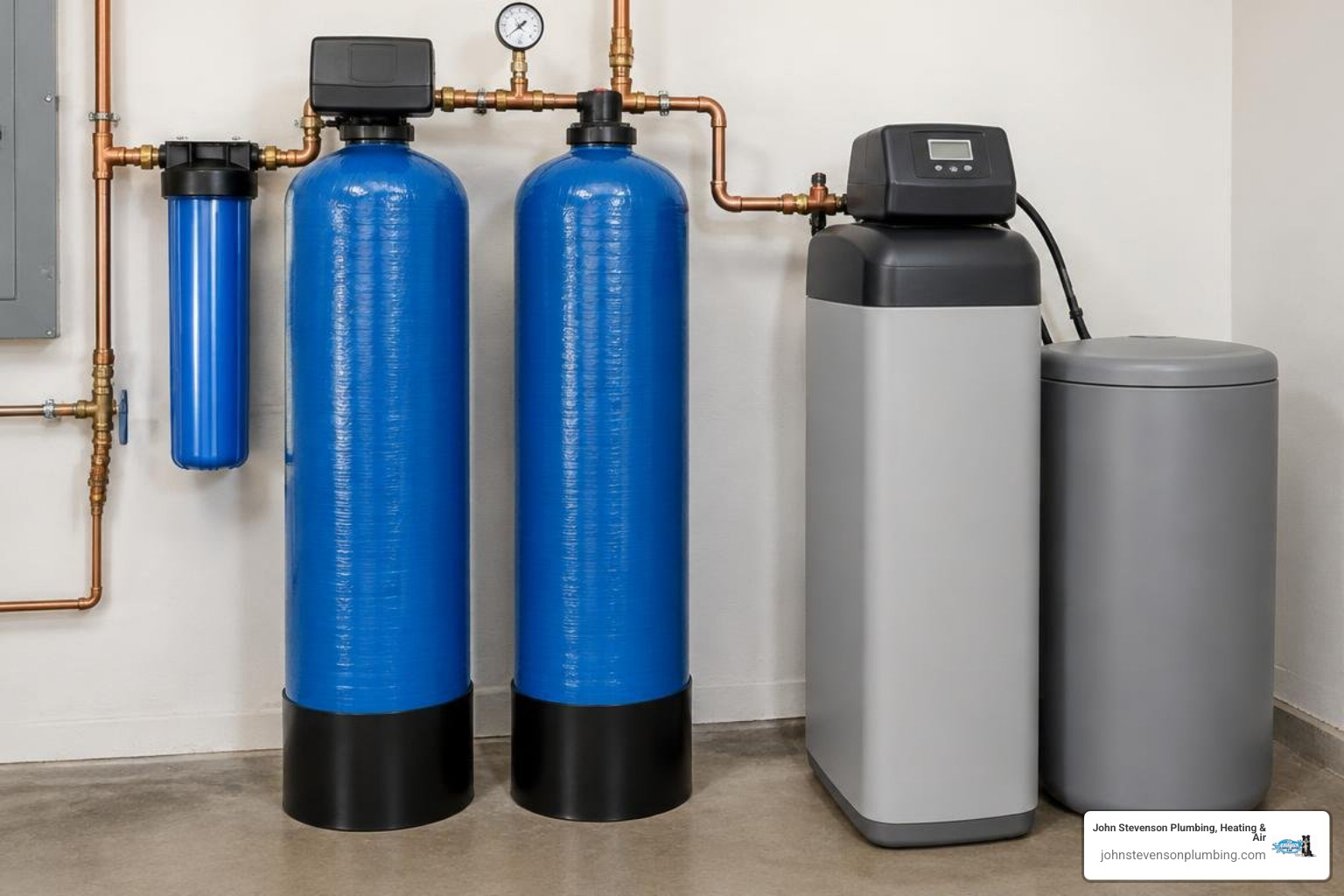
Whole-house carbon and sediment filters remove contaminants, including suspended dirt, volatile organic compounds (VOCs), pesticides, chloramines, and chlorine. However, dissolved calcium and magnesium ions pass straight through standard filter media. A whole-house filter will give you cleaner, better-tasting water, but it will not stop limescale from building up inside your tankless water heater.
Conversely, a water softener only removes hardness minerals; it does not filter out chemical disinfectants or sediment. In fact, chlorine degrades softening resin over time, causing the beads to fracture and lose their capacity. Installing dedicated water filtration services upstream of your softener shields the resin bed and improves overall water quality.
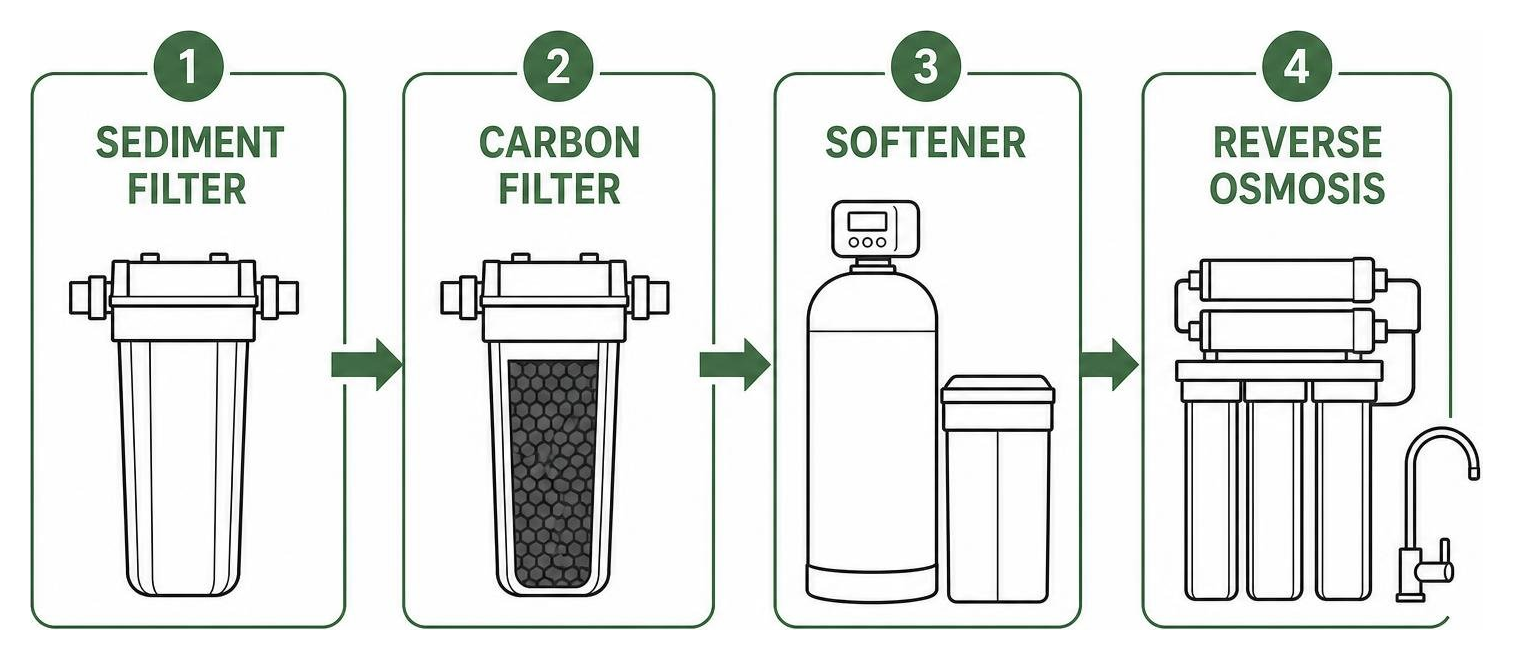
If your goal is pure drinking water, point-of-use reverse osmosis (RO) systems use semi-permeable membranes that successfully strip out both minerals and microscopic contaminants. Because RO systems operate at low flow rates and generate concentrated brine, they are installed under kitchen sinks for drinking and cooking rather than serving the entire house. For a detailed look at combining these technologies, read our water softener vs filter compatibility guide.
Professional Installation and System Sizing in Carlsbad
Installing a water treatment system requires more than simply connecting tanks to your plumbing lines. Undersized units cause noticeable water pressure drops during peak morning usage, while oversized softeners regenerate inefficiently and waste salt.
Our licensed plumbers evaluate several site-specific factors during an on-site consultation:
- Peak Flow Rate Calculation: Sizing equipment based on the number of bathrooms and high-flow fixtures in your home ensures steady, uninterrupted water pressure throughout the house.
- Main Line Integration: Splicing into your main water loop with dedicated bypass valves allows you to service the equipment or water outdoor landscaping with untreated water without interrupting flow to the rest of the home.
- Drainage and Electrical Sourcing: Installing compliant, air-gapped discharge piping prevents any risk of wastewater siphoning back into your potable water lines.
- Local Code Compliance: Ensuring all connections meet Carlsbad and regional California plumbing standards safeguards your manufacturer warranties and home value.
For professional diagnostics and tailored equipment sizing, schedule our water quality services in Carlsbad to find the ideal solution for your home.
Frequently Asked Questions About Water Softeners and Descalers
Will a water descaler make my water feel soft and improve soap lather?
No. A water descaler does not remove calcium or magnesium ions from your water supply. Because those minerals remain dissolved in the water, surface tension remains unchanged, and minerals will continue to interact with fatty acids in bar soaps. You will not get the slick, silky skin feel or the rich lather that comes with an ion-exchange water softener.
Are water softeners restricted in parts of Southern California?
Certain communities and regional water control boards throughout Southern California restrict or regulate the installation of self-regenerating salt-based water softeners. These rules are designed to prevent excess sodium chloride from entering municipal wastewater, which can complicate regional water recycling and agricultural reuse. In areas with strict discharge limits, eco-friendly salt-free descalers or potassium-regenerated systems provide a reliable, code-compliant alternative.
Can I install a descaler or softener myself, or do I need a licensed plumber?
While some electronic descalers simply clamp over existing copper or PEX pipes, physical inline descalers and whole-house water softeners require cutting into your main water line, installing pressure regulators, running drain lines with required air gaps, and building bypass loops. Poorly planned DIY installations can lead to hidden leaks, code violations, reduced water pressure, or voided manufacturer warranties. Hiring a licensed, certified plumbing technician ensures your equipment is sized correctly, plumbed cleanly, and supported by ongoing service guarantees.
Conclusion
Both water descalers and water softeners provide practical solutions for hard water, but they are built for different goals. If your main objective is protecting your plumbing lines and tankless water heater from scale buildup without managing salt or discharge lines, a descaler is a clean, low-maintenance option. If you want to eliminate scale entirely, enjoy softer skin and hair, use less soap, and keep your glassware crystal clear, an ion-exchange water softener is the better choice for your home.
At John Stevenson Plumbing, Heating & Air Conditioning, we bring decades of hands-on plumbing expertise to Carlsbad, San Diego County, and Orange County homes. Backed by our 5-Star Service Guarantee, our certified technicians provide thorough water testing, clear project details, and clean installations tailored to your household’s plumbing needs. Contact us today to explore our comprehensive water quality services and safeguard your home against hard water.